• Where in the world is Tom

    For those of you who like to keep track, July 24th – August 6th encompasses several milestones beginning with July 24th which is the 11th anniversary of my PD diagnoses. Yes, it has been 11 years and Mara and I think I am better now that I was then! Certainly I am in better physical shape due to the 5 – 7 days of exercise each week and my symptoms of bradykinesia and other motor symptoms are better because of taking Carbidopa/Levodopa. The fact that I have been able to reduce my Levodopa Equivalent Daily Dose (total LD per day from all sources) from 1688 mg to 932 mg over the past 5 years is certainly an indicator that something is working right.

    This week we celebrated our 34th wedding anniversary with a superb dinner out and a fine bottle of champagne! (I need to add the champagne tradition to the PD anniversary) I wouldn’t be in the shape I am without Mara’s support. She is not only the love of my life and my best friend, she is also my caretaker extraordinaire!

    Also this week I will celebrate my 78th birthday ( already have the champagne for this one!)

    And on August 6th this blog will be 11 years old, and this will be the first post of 2024! Yep it’s been 16 months since my last post and I have no valid excuse except to blame it on my Parkinson’s Disease non motor symptom of apathy. I have had various ideas or information that I could use to create a post but somehow they never get written. But I am going to make the breakthrough today!

    While I have successfully reduced my Levodopa Equivalent Daily Dose from 1688 mg to 932 mg per day, I haven’t stopped my PD progression particularly in non-motor symptoms. In addition to apathy, my handwriting is working it’s way to a completely illegible scrawl, my speech continues to get softer (I know, I should be using the Speak Out tools to improve this one) and constipation and drooling have become more prevalent. On the plus side, reducing my Levodopa has reduced my dyskinesia and something I am doing has improved my sleep, often getting 6 – 7 hours per night according to my FitBit:

    I wish I knew what I am doing to improve my sleep, I’m pretty sure I could patent it and make a fortune! I don’t follow any of the hints you see like reduce screen time ( I usually get in bed and read on my iPad!) or limit fluid intake before bed, or take melatonin or use CBD/Marijuana. The only thing I have doing different for the past 6 or 7 months is following a version of high dose thiamine therapy or vitamin B1 (HDTT) . I have noticed some improvements from following this therapy and I will discuss the details and process in my next blog post. There, I’ve set myself a task and I will plan to write the next post no later than next week.

    Speaking of tasks, I did update the Now What document with recommendations for persons who have been recently diagnosed with PD. You can click here or at the top right to read or print it.

    Until then, if you are a long time subscriber and wondered where I have been, I hope this finds you in good health and thank you for sticking with me despite my 16 month hiatus. Welcome to my new subscribers that have signed up in the last 16 months , now you know why you haven’t seen any posts.

    “It does not matter how slowly you go as long as you do not stop.” – Confucius
  • It’s Parkinson’s Awareness Month – 9th Edition

    Yep, in the 10 years since I was diagnosed with PD, I have written at least one post in April about Parkinson’s Awareness Day, or Week or Month. The only year missing is 2018 when we were moving into our Sarasota home. I thought it would be fun to take a trip down memory lane and see what I wrote about in the past 10 years.

    The first year was 2014 (click on the links to view) and most of the post was about Autism, my colonoscopy, my first dermatologist visit and how nice the weather was that week, Finally at the end of the post I mentioned the local Unity walk.

    The next year, 2015, I quoted paragraphs from another blogger – Corey King. His views about awareness resonated with me and I hope my readers too.

    In 2016 my post was long but all about PD awareness! So after 3 years I have caught on to the program and filled a post with my thoughts.

    2017 was a quick one, with a link to a video about Unite for Parkinson’s.

    In 2019 I had two posts (making up for missing 2018) the first one about our spinning class moving the bikes and holding our class in the lobby of the YMCA which was covered by a local TV station and resulted in my first TV gig! In the second post I covered the YMCA ride again and discussed how the class helps me fight PD. I also talked about experimenting with my medications doses and I am pleased to see that I am taking even less 4 years later!! EXERCISE WORKS!

    In the COVID year of 2020, my World PD Day post was a review of the new book Ending Parkinson’s Disease, A Prescription for Action by Ray Dorsey MD et. al. The book was the basis for the Ending Parkinson’s movement that continues to lobby and push for research funding and has pushed to ban various chemicals that appear to cause PD.

    In 2021 I discussed the book from the previous year and pushed for readers to join PD Avengers, a global alliance to end parkinson’s. If you haven’t joined, it’s not too late, click on the icon to the right and be a PD Avenger.

    And last year, I introduced Spark! the new symbol for Parkinson’s Awareness. I also pushed again for readers to join PD Avengers and shared some infographics from the European PD organization on the myths of PD.

    Now it is 2023 and we are getting closer to finding a marker that will improve the results of research trials looking for a cure or at least a disease modifying solution. We know that exercise is the best medicine to slow progression and we have many more options to deal with ‘off’ periods than there were in 2013. There have been significant improvements to DBS and Focused Ultrasound options to help deal with motor issues and tremor. Trials of stem cell implants are at stage 2 and 3 and we know a lot more about the genetics of PD. But I am sorry to report that the cure for Parkinson’s is still at least 5 years away, just like it was 10 years ago.

    Parkinson’s Awareness month will continue into the foreseeable future as the hunt goes on to solve PD. So, join PD Avengers, donate to your favorite PD organization, join a clinical trial and let your elected officials know that you support the Ending Parkinson’s initiatives.

  • We Survived Hurricane Ian!

    We have lived in Sarasota, Florida for 6+ years and have come to believe in the urban legend that Sarasota is protected from hurricanes because the Native Americans who first settled here blessed the lands to stay eternally safe from destructive storms and hurricanes. Fact is Sarasota Bay has not been a bull’s eye for a major hurricane in Florida since reliable records began in 1871.

    But two weeks ago hurricane Ian that was forecasted to hit in Tampa to our North, started slipping south and suddenly the forecast was for it to come ashore in Sarasota. The emergency management authorities started evacuating the barrier islands, and we joined with a few neighbors to install hurricane shutters in preparation for a direct hit. Since 2002, the Florida building codes require new construction be able to withstand winds up to 150MPH. Our home was built in 2013 so it meets the new codes and it looked liked we were going to test the construction!

    We opened our home to couple of friends who had to evacuate and one of them joined us as we hunkered down and got ready to ride out the storm. The Indian blessing seemed to be working as Ian continued to drop to the south and came ashore near Ft Myers’s about 50 miles (as the crow flies)south of us and then tracked northeast thru the city of Northport about 20 miles south of us on its way to the Atlantic, passing over Sarasota with windspeeds of 85 -100 mph. The wind and rain went on most of the night and you could feel the gusts when they hit the house.

    We got up the next morning to find the house was undamaged except for a couple of loose roof tiles. There were lots of trees and bushes down in the area but no physical damage that we could see. Even more amazing was we never lost power! According to Florida Power and Light, of their 287,000 customers in Sarasota 280,000 were without power, so we were one of the lucky 7,000. We did lose our internet and cable for a several days, making it hard to keep up with what was happening as cell reception was spotty due to power being out to cell towers or the towers being damaged by the hurricane.

    It’s been two weeks since the hurricane and most of the debris in our development has been cleaned up. Our tennis courts are back in operation after replacing the clay that blew off and putting the wind screens back up. There are still pockets of the area without power or internet particularly south of us in Northport where a large portion of the city was flooded by the Myakka river which is still above flood stage.

    So, thanks to an Ancient Indian Blessing, good neighbors, and the updated Florida building codes, we survived our first and hopefully only hurricane. We are able to get groceries and fuel again and play tennis and cycle for PD. Life is returning to normal.

Rallying to the Challenge – 2015

We recently attended our second Grand Challenges in Parkinson’s research conference hosted by the Van Andel Research Institute in Grand Rapids, MI.  Again this year The Cure Parkinson’s Trust (UK) and Parkinson’s Movement(UK) sponsored the Rallying to the Challenge meeting which is conducted in conjunction with the research conference and provides an opportunity for researchers, patients and caregivers to exchange information. The theme for this year’s Rally was “Outcomes and Measures, a new look at Measuring Parkinson’s” and, as you will see, we had a very full two day agenda.

Tom Isaacs, co-founder of the Cure Parkinson’s Trust, opened our portion of the meeting saying that together we are making a seismic shift for better research, research that includes the patient and the patient’s needs.  As a result of last years Rally a ‘Clinical Trials Charter’ (click here to view the charter) was developed as a cooperative effort by patients and researchers.  A UK multi-center clinical trial has adopted the charter for their research which will provide a real-world test and a stepping stone to wider adoption.  We were amazed to see how our efforts from just a year ago have paid off in the cooperative development of this charter by patients and researchers. (Read the post from last year here)

Tom then discussed this year’s Challenge – How do we improve outcomes and measures in clinical trials?  The emphasis again this year was on improving the patient experience and introducing patient centered change to the research process.  In addition we will discuss how data gathered from new technology, (wearable sensors, smartphone apps, etc) can provide new measures and improve some of the current measures.

Jon Palfreman, PwP and author of the recently released “Brain Storms – The Race to Unlock the Mysteries of Parkinson’s Disease” pointed out that the Unified Parkinson’s Disease Rating Scale (UPDRS) is primarily subjective and provides only a snapshot of the symptoms you are having when administered, usually 1 or 2 times a year during your Dr. visit.  Ideally, with the advent of wearable sensors and other technology, you should be able to provide a picture of your symptoms for the entire period between Dr. visits and get real time feedback yourself.

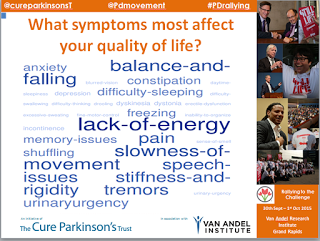
Dr. Soania Mathur and Dr. Jon Stamford reviewed the results of this year’s survey about the symptoms of PD which have the most important impact  quality of life. Interestingly, out of 492 responses to the survey not one respondent listed their top five symptoms in the same order. In fact, if you look at this slide from the final presentation, I count 28 symptoms that were brought up when answering the question “What symptoms most affect your quality of life?” This slide certainly points out that PD is truly different for each of us.

The top symptoms in both categories were put into smaller groupings and we broke out into focus groups to discuss how to improve measurement of our set of symptoms. Every focus group not only developed ideas for measuring symptoms, but also came up with tips and tricks for dealing with the issue, for example walking backwards to relax dystonia of the foot.

The next morning, we had an almost overwhelming number of presentations about new technological devices that will help measure PD symptoms when on or off medication.  Presenter’s included Ken Kubota from Michael J Fox Foundation (Fox Insight Wearable Trial), Anupam Pathak Ph.D. from Google (the Lyft spoon), Bruce Hellman (uMotif Smartphone app now available in the UK and coming soon to the US and Canada) and Caroline Tanner (mPower also a smartphone app developed from the SmartPhone PD clinical test I participated in)

We also had presentations from a Davis Phinney Foundation representative about a social networking program they are developing, one from Peter Schmidt of NPF about their Parkinson’s Outcome Project (another one I am participating in) and from Eli Pollard executive director of World Parkinson’s Coalition  about PowerThroughParkinson’s, a program they are bringing out with the Brian Grant Foundation that encourages PwP to commit to exercise and eat right.

Day Two also included a presentation from the renowned Parkinson’s Doctor and researcher Bas Bloem from the Netherlands about Parkinson’sNet, a program he helped develop in the Netherlands 10 years ago and which has been implemented in LA area and soon in Grand Rapids.  ParkinsonNet has one goal: to guarantee the best possible care
for people suffering from Parkinson’s Disease.The program has been extremely successful in providing expert care while also reducing costs.

We then reconvened with the researchers and Tom Isaacs and other members of Parkinson’s Movement made a presentation of the results of our meeting and the need for patient involvement in the development of measures that would be the:

  • Right Measure – developed with the end user as a partner
  • Right Person – measure what is important to the person
  • Right Situation – don’t forgot off periods and how PD changes

In addition to meeting old friends and making new ones, we also enjoyed the exhibition of photos by Norwegian Photographer Andres Leines entitled “This is Parkinson’s”.  Andres has early onset PD and has been taking pictures of other EOPD patients to point out that Parkinson’s is not just tremors and doesn’t just effect seniors. You can view some of the photos in this excellent YouTube video.

And finally, the Michael J Fox Foundation just announced that the Fox Clinical Trial Program has exceeded 50,000 registered volunteers!  In case you’re not one of us, click on the big shiny button at the top of this page and sign up!  Thanks.

“It does not matter how slowly you go as long as you do not stop.” – Confucius
 

Rallying to the Challenge – 2015

We recently attended our second Grand Challenges in Parkinson’s research conference hosted by the Van Andel Research Institute in Grand Rapids, MI.  Again this year The Cure Parkinson’s Trust (UK) and Parkinson’s Movement(UK) sponsored the Rallying to the Challenge meeting which is conducted in conjunction with the research conference and provides an opportunity for researchers, patients and caregivers to exchange information. The theme for this year’s Rally was “Outcomes and Measures, a new look at Measuring Parkinson’s” and, as you will see, we had a very full two day agenda.

Tom Isaacs, co-founder of the Cure Parkinson’s Trust, opened our portion of the meeting saying that together we are making a seismic shift for better research, research that includes the patient and the patient’s needs.  As a result of last years Rally a ‘Clinical Trials Charter’ (click here to view the charter) was developed as a cooperative effort by patients and researchers.  A UK multi-center clinical trial has adopted the charter for their research which will provide a real-world test and a stepping stone to wider adoption.  We were amazed to see how our efforts from just a year ago have paid off in the cooperative development of this charter by patients and researchers. (Read the post from last year here)

Tom then discussed this year’s Challenge – How do we improve outcomes and measures in clinical trials?  The emphasis again this year was on improving the patient experience and introducing patient centered change to the research process.  In addition we will discuss how data gathered from new technology, (wearable sensors, smartphone apps, etc) can provide new measures and improve some of the current measures.

Jon Palfreman, PwP and author of the recently released “Brain Storms – The Race to Unlock the Mysteries of Parkinson’s Disease” pointed out that the Unified Parkinson’s Disease Rating Scale (UPDRS) is primarily subjective and provides only a snapshot of the symptoms you are having when administered, usually 1 or 2 times a year during your Dr. visit.  Ideally, with the advent of wearable sensors and other technology, you should be able to provide a picture of your symptoms for the entire period between Dr. visits and get real time feedback yourself.

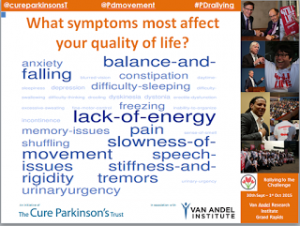
Dr. Soania Mathur and Dr. Jon Stamford reviewed the results of this year’s survey about the symptoms of PD which have the most important impact  quality of life. Interestingly, out of 492 responses to the survey not one respondent listed their top five symptoms in the same order. In fact, if you look at this slide from the final presentation, I count 28 symptoms that were brought up when answering the question “What symptoms most affect your quality of life?” This slide certainly points out that PD is truly different for each of us.

The top symptoms in both categories were put into smaller groupings and we broke out into focus groups to discuss how to improve measurement of our set of symptoms. Every focus group not only developed ideas for measuring symptoms, but also came up with tips and tricks for dealing with the issue, for example walking backwards to relax dystonia of the foot.

The next morning, we had an almost overwhelming number of presentations about new technological devices that will help measure PD symptoms when on or off medication.  Presenter’s included Ken Kubota from Michael J Fox Foundation (Fox Insight Wearable Trial), Anupam Pathak Ph.D. from Google (the Lyft spoon), Bruce Hellman (uMotif Smartphone app now available in the UK and coming soon to the US and Canada) and Caroline Tanner (mPower also a smartphone app developed from the SmartPhone PD clinical test I participated in)

We also had presentations from a Davis Phinney Foundation representative about a social networking program they are developing, one from Peter Schmidt of NPF about their Parkinson’s Outcome Project (another one I am participating in) and from Eli Pollard executive director of World Parkinson’s Coalition  about PowerThroughParkinson’s, a program they are bringing out with the Brian Grant Foundation that encourages PwP to commit to exercise and eat right.

Day Two also included a presentation from the renowned Parkinson’s Doctor and researcher Bas Bloem from the Netherlands about Parkinson’sNet, a program he helped develop in the Netherlands 10 years ago and which has been implemented in LA area and soon in Grand Rapids.  ParkinsonNet has one goal: to guarantee the best possible care
for people suffering from Parkinson’s Disease.The program has been extremely successful in providing expert care while also reducing costs.

We then reconvened with the researchers and Tom Isaacs and other members of Parkinson’s Movement made a presentation of the results of our meeting and the need for patient involvement in the development of measures that would be the:

  • Right Measure – developed with the end user as a partner
  • Right Person – measure what is important to the person
  • Right Situation – don’t forgot off periods and how PD changes

In addition to meeting old friends and making new ones, we also enjoyed the exhibition of photos by Norwegian Photographer Andres Leines entitled “This is Parkinson’s”.  Andres has early onset PD and has been taking pictures of other EOPD patients to point out that Parkinson’s is not just tremors and doesn’t just effect seniors. You can view some of the photos in this excellent YouTube video.

And finally, the Michael J Fox Foundation just announced that the Fox Clinical Trial Program has exceeded 50,000 registered volunteers!  In case you’re not one of us, click on the big shiny button at the top of this page and sign up!  Thanks.

“It does not matter how slowly you go as long as you do not stop.” – Confucius
 

Month: October 2015

  • Rallying to the Challenge – 2015

    Rallying to the Challenge – 2015

    We recently attended our second Grand Challenges in Parkinson’s research conference hosted by the Van Andel Research Institute in Grand Rapids, MI.  Again this year The Cure Parkinson’s Trust (UK) and Parkinson’s Movement(UK) sponsored the Rallying to the Challenge meeting which is conducted in conjunction with the research conference and provides an opportunity for researchers, patients and caregivers to exchange information. The theme for this year’s Rally was “Outcomes and Measures, a new look at Measuring Parkinson’s” and, as you will see, we had a very full two day agenda.

    Tom Isaacs, co-founder of the Cure Parkinson’s Trust, opened our portion of the meeting saying that together we are making a seismic shift for better research, research that includes the patient and the patient’s needs.  As a result of last years Rally a ‘Clinical Trials Charter’ (click here to view the charter) was developed as a cooperative effort by patients and researchers.  A UK multi-center clinical trial has adopted the charter for their research which will provide a real-world test and a stepping stone to wider adoption.  We were amazed to see how our efforts from just a year ago have paid off in the cooperative development of this charter by patients and researchers. (Read the post from last year here)

    Tom then discussed this year’s Challenge – How do we improve outcomes and measures in clinical trials?  The emphasis again this year was on improving the patient experience and introducing patient centered change to the research process.  In addition we will discuss how data gathered from new technology, (wearable sensors, smartphone apps, etc) can provide new measures and improve some of the current measures.

    Jon Palfreman, PwP and author of the recently released “Brain Storms – The Race to Unlock the Mysteries of Parkinson’s Disease” pointed out that the Unified Parkinson’s Disease Rating Scale (UPDRS) is primarily subjective and provides only a snapshot of the symptoms you are having when administered, usually 1 or 2 times a year during your Dr. visit.  Ideally, with the advent of wearable sensors and other technology, you should be able to provide a picture of your symptoms for the entire period between Dr. visits and get real time feedback yourself.

    Dr. Soania Mathur and Dr. Jon Stamford reviewed the results of this year’s survey about the symptoms of PD which have the most important impact  quality of life. Interestingly, out of 492 responses to the survey not one respondent listed their top five symptoms in the same order. In fact, if you look at this slide from the final presentation, I count 28 symptoms that were brought up when answering the question “What symptoms most affect your quality of life?” This slide certainly points out that PD is truly different for each of us.

    The top symptoms in both categories were put into smaller groupings and we broke out into focus groups to discuss how to improve measurement of our set of symptoms. Every focus group not only developed ideas for measuring symptoms, but also came up with tips and tricks for dealing with the issue, for example walking backwards to relax dystonia of the foot.

    The next morning, we had an almost overwhelming number of presentations about new technological devices that will help measure PD symptoms when on or off medication.  Presenter’s included Ken Kubota from Michael J Fox Foundation (Fox Insight Wearable Trial), Anupam Pathak Ph.D. from Google (the Lyft spoon), Bruce Hellman (uMotif Smartphone app now available in the UK and coming soon to the US and Canada) and Caroline Tanner (mPower also a smartphone app developed from the SmartPhone PD clinical test I participated in)

    We also had presentations from a Davis Phinney Foundation representative about a social networking program they are developing, one from Peter Schmidt of NPF about their Parkinson’s Outcome Project (another one I am participating in) and from Eli Pollard executive director of World Parkinson’s Coalition  about PowerThroughParkinson’s, a program they are bringing out with the Brian Grant Foundation that encourages PwP to commit to exercise and eat right.

    Day Two also included a presentation from the renowned Parkinson’s Doctor and researcher Bas Bloem from the Netherlands about Parkinson’sNet, a program he helped develop in the Netherlands 10 years ago and which has been implemented in LA area and soon in Grand Rapids.  ParkinsonNet has one goal: to guarantee the best possible care
    for people suffering from Parkinson’s Disease.The program has been extremely successful in providing expert care while also reducing costs.

    We then reconvened with the researchers and Tom Isaacs and other members of Parkinson’s Movement made a presentation of the results of our meeting and the need for patient involvement in the development of measures that would be the:

    • Right Measure – developed with the end user as a partner
    • Right Person – measure what is important to the person
    • Right Situation – don’t forgot off periods and how PD changes

    In addition to meeting old friends and making new ones, we also enjoyed the exhibition of photos by Norwegian Photographer Andres Leines entitled “This is Parkinson’s”.  Andres has early onset PD and has been taking pictures of other EOPD patients to point out that Parkinson’s is not just tremors and doesn’t just effect seniors. You can view some of the photos in this excellent YouTube video.

    And finally, the Michael J Fox Foundation just announced that the Fox Clinical Trial Program has exceeded 50,000 registered volunteers!  In case you’re not one of us, click on the big shiny button at the top of this page and sign up!  Thanks.

    “It does not matter how slowly you go as long as you do not stop.” – Confucius