• Thanksgiving

    Happy Thanksgiving Holiday! 

    It is a busy time of year but I wanted send along good wishes for the holiday, pass along a reminder or two and note some items of interest in the Parkinson’s community.

    Reminder number one:  November is National Caregivers  Month.  Yes the month is about over but I know that you, like me, are  thankful for your care partner(s) every day of the year.  Remember there are lots of resources available for care partners and one of the best, available from the Parkinson’s Foundation, is the Caring and Coping guide, written for caregivers at every stage of PD.  Download load a copy at this link.

    Reminder number two:  Tuesday the 28th is Giving Tuesday.  This is a great opportunity to make a donation to your favorite charity and, in many cases, have it matched.  For example the Michael J Fox Foundation is shooting to raise $1million in 1 day with every donation matched by anonymous donors.  Many other charities have similar opportunities on Tuesday, so scrape the bottom of your pocket book or wallet after Black Friday and Cyber Monday and help us find a cure for PD or the charity of your choice.

    Item of interest number one:  This article  Neurological disorders – including Parkinson’s – are leading source of disability globally  points out that PD is becoming pandemic and we must take action to find a cure.  This summary is worth the few minutes it will take you to read.

    Item of interest number two:  The Michael J. Fox Foundation for Parkinson’s Research has launched Fox Insight — an online clinical study that empowers people with PD to partner with researchers and accelerate the development of breakthrough treatments. I have talked about Fox Insight in previous posts but, if you haven’t joined yet, now is the time, your data is needed as we work to find a cure.  Click on the link above to get more information and join us.

    Item of interest number three:  The next World Parkinson’s Congress will be June, 2019 in Kyoto, Japan.  Soaring With Hope has started a project to make origami cranes for an art installation to display at the WPC.   Each crane represents a person withParkinson’s or a person impacted by Parkinson’s. They are asking each person to give their message of hope, which will be written on a crane.  They have a goal of 10,000 cranes to bring to the WPC, each of them with a message of hope written on it to help raise awareness and HOPE for PD globally.  Please take a minute to click on this link and add your WORDS OF HOPE, and please spread the word to get others to join in and participate.  Thanks to Sharon Krischer (blogging as Twitchy Woman) for providing this information on her blog.

    On this Thanksgiving day I am thankful for the support of my wonderful wife, my family, my friends and all of you who take the time to read my occasional posts. Thank you all and Happy Thanksgiving!
  • A Month of Change

    September has been a month of changes including:

    • We moved from Tennessee to Florida
    • Our house in Tennessee suffered a catastrophic flood due to a broken pipe
    • Hurricane Irma also moved to Florida
    • I moved this blog to a new host and a new platform and
    • Summer left and Fall arrived

    We arrived in Sarasota at the end of August after loading a POD and preparing the house in Tennessee for the next owners.  We arrived just in time for the Thursday Pedaling class and Saturday tennis matches and were already starting to get in the groove again.  Then we received a call from our realtor saying our home in Tennessee was flooded due to a broken pipe!

    So we quickly made plans to return to Tennessee to assess the damage, leaving a few days before Hurricane Irma was due, but not early enough to beat the traffic on I-75 North where we spent 9+ hours to go our usual 5-6 hour trip the first day and almost the same for the second day.  We found the house to be almost a complete remodel with water damage through out both floors.  We are now in between the dry out and removal of damaged walls, ceilings, etc. and getting the estimate for repair/rebuild approved by the insurance company.  I have to say that our insurance company (USAA) was quick to get someone out to the home to start the demolition and dry out process and to find a contractor for the rebuild, so hopefully, everything progresses as smoothly.

    While we were in Tennessee, Hurricane Irma swung by Sarasota preventing us from returning until the roads were open and gasoline was available.  Our rental here survived Irma with no problems and some friends that had to evacuate their home were able to ride out the storm in our unit while making sure our hurricane shutters were up and everything that might fly around was in the garage.

    Since our return we are back to trying to get in to the exercise routine, pedaling twice a week, tennis at least twice a week, yoga and dance once a week and try to squeeze in a walk most days too.  As I noted in the previous post, we saw a definite decline in my mobility and stiffness during the summer without enough exercise and I am glad to be able to up the level a bit.

    Also, since we returned, I moved this blog to a new hosting site and a new blogging platform (WordPress).   As a result I am slowly working through the site looking for broken links and missing photos in older posts, so don’t be surprised if a link doesn’t work or a post refers to a photo that doesn’t exist.  I will keep at it and all should be functional soon.

    In the meantime, if you subscribed to the posts by email or RSS, you may have gotten a repeat email of the previous posts which occurred when I updated the web address.  I think this was a one time event and future emails will only be sent when I have a new post.  If you aren’t subscribed but want to be, you can click on the subscribe by RSS link to the right and one of the options is to subscribe by email instead of RSS feed.  Also, if you have the old address of tomspdblog.blogspot.com bookmarked, please update your bookmark to tomspdblog.com.

    And the final change was Summer is now Fall, which in Florida means that the humidity will start dropping and the temperatures will be perfect for tennis and other outdoor events instead of falling leaves and snow.  Sounds OK to me!

    “It does not matter how slowly you go as long as you do not stop.” – Confucius


  • The Sarasota Experiment Results Are In!

    As I noted in the previous post, it had been over four months since I posted anything at all and a busy four months they were.  In April we decided the Sarasota experiment was a success and that we should sell our Tennessee home and move to Sarasota full time.  In Sarasota I am able to pedal for Parkinson’s twice a week, play tennis two to three times a week, attend a Dance for PD class once a week along with yoga, tai chi and general exercise classes.  And I don’t have to travel 45 minutes to attend any class, everything is within a 10 – 15 minute drive which makes it easy to ‘get up and go’ exercise. So I have updated the cover photo to a great beach sunset with two dolphins enjoying the view and made some modifications to my profile over there on the right.

    More and more studies are showing that exercise is one of the keys to living with PD (or just living in general).  While it seems like I am taking on more that I should, I find instead that the more I take on, the better I am able to deal with my PD symptoms.  This has certainly proved out during the 3 months we have been in Tennessee, my exercise routine dropped to almost nothing and I can tell my symptoms are worse.

    So we finished April in Sarasota with a visit from our friends Tom and Marilyn.  We enjoyed sunsets on the beach, nice walks in the complex where we live, touring the Ringling estate and Selby Gardens and kayaking through the mangrove tunnels near Lido Key.

    In early May we returned to Tennessee and started the process of getting the house and grounds ready to sell.  We also had a visit from my brother-in-law Mike and my sister Marcia and we took a trip to the Grand Ole Opry in Nashville, a bear sighting trip through Cades Cove in the Smokies (yep we saw some bears) and a lot of fishing!

    In June we worked on the home and squeezed in a trip to Bald Head Island with Dave and Shelley and Breanna and Garrett.  By the middle of June we were ready to put the house on the market and we listed it on a Friday and sold it on Monday, just before the first of the summer visitors arrived! At the end of the month, Dale Monica and Angelina and Ariana arrived to celebrate the fourth of July, a birthday or two and the sale of our house.  And on July 4th Ryan Sarah Julian and Trysten arrived to  celebrate the holiday and spend some time on the lake.
    After the first round of visitors left, Holly, Paul, Charlie and Kayla arrived for a visit at the end of July and we enjoyed the lake and took a trip up to Gatlinburg for lunch and mini golf.

    We had a great time with everyone and are glad everybody got a final visit to the Lake Cottage. At the end of the month Mara and I went to Townsend to celebrate our 27th wedding anniversary and my 71st birthday.  It was a great 3 days of R and R after a hectic couple of months getting ready for the house sale and visitors.

    Since the Townsend trip we have been packing and deciding what to sell and what to keep.  This weekend we will hold an estate sale and the house will be empty.  We will stay until the 22nd since we are on the direct path for the full eclipse on the 21st.  Then we will make a quick trip to West Virginia to visit granddaughter Breanna before returning to Sarasota by the 1st of September.

    July 24th marked the 4 years since being diagnosed with PD and I do believe that I was doing better while maintaining my Sarasota exercise routine and I am looking forward to gearing back up to see if I notice a difference.  I visited my PD doctor last week and he was pleased with my overall condition and he recommended no change in medication levels, just continue to exercise.

    August 6th also marked 4 years publishing this blog and, once again I could make my usual promise that I will do better and post more. But since all that does is set high expectations for you and feelings of impending doom for me, I’m going with no promise this year.  After all It Is What It Is!

    Speaking of exercise, last week the NPR show The Peoples Pharmacy aired a show about Pedaling for Parkinson’s and the advantages of exercise in general.  The show includes an interview with Kathy Helmuth, who is the instructor of our Pedaling class in Sarasota along with interviews with Dr. Jay Alberts who discovered the benefits of “forced exercise” for PD patients and Dr.Jordan Metzel who discusses the benefits of exercise for us all.  You can download or listen to the podcast here.

    So that is a condensed version of pretty much all that has been happening for the last four months.  Next time I will be posting from Sarasota and, hopefully, talking about changes we have seen since getting back into a regular exercise routine.  Until then, thanks for reading and for sticking around during my 4 month hiatus.

    “It does not matter how slowly you go as long as you do not stop.” – Confucius


World PD Day 2020

First and foremost, I hope this post finds you and your families well and hunkered down as we wait out the COVID-19 pandemic.  It is an unprecedented time in our lives and I have no idea how it will all end up but I have the cleanest hands in the neighborhood!

Today, April 11th, is World Parkinson’s Day, a part of Parkinson’s Awareness month.  In past years, we have celebrated with Parkinson’s Disease walks and last year we moved our Pedaling for PD class out into the lobby of the YMCA to bring attention to PD and the need for exercise.  But this year we can only act alone to raise awareness about PD as we stay in to prevent COVID-19.

This month I read a new book about Parkinson’s Disease – Ending Parkinson’s Disease, A Prescription for Action.  The books co-authors show that the increasing numbers of PwP has made PD the fastest growing brain disorder in the world.  The number of PwP’s has doubled from 3 million to over 6 million in 25 years and they predict it will double again to over 12 million by 2040.  As a result they feel  PD is a world wide pandemic.

The book is co-authored by four leading doctors and advocates for PD:

Ray Dorsey MD who directs the Center for Health + Technology at the University of Rochester. He has used telemedicine to improve care for individuals with Parkinson’s disease and I have participated in several clinical trials where he has pioneered the use of technolgy particularly cell phones and live video to improve diagnoses and treatment of PD.

Todd Sherer PHD is the Chief Executive Officer of The Michael J. Fox Foundation for Parkinson’s Research. Trained as a neuroscientist, he is responsible for the Foundation’s overall scientific and fundraising direction to speed treatment breakthroughs and a cure for Parkinson’s disease.

Michael S Okun MD is Chair of Neurology at the University of Florida. He established the Movement Disorder Clinic at the University of Florida bringing together Neurologists, Speech Therapists, Occupational Therapists and Physical Therapists for a complete evaluation of the patient.  You can read my blog post about our experience when we went to the University of Florida for a second opinion here.

Bastiaan R Bloem, MD, PHD is professor of neurology and the director of the Centre of Expertise for Parkinson & Movement Disorders at Radboud University Medical Centre in Nijmegen, the Netherlands. In 2004, with Dr. Marten Munneke, he created ParkinsonNet, the largest integrated-care program for Parkinson’s patients. 

The authors propose a PACT to Prevent the disease, Advocate for protective policies, Care for patients, and Treat the condition with innovative therapies.

Prevent – They point out that stopping the use of chemical pesticides and solvents and recognizing the impact of head traumas would help to prevent PD and lead to a large reduction in newly diagnosed PwP world wide.

Advocate – They point out the need to educate the public  about the worldwide Parkinson’s pandemic. The book discusses the campaigns to end or treat Polio, HIV, and Breast Cancer as examples.

Care – They discuss providing care for PwP’s  including in home care by healthcare workers trained in caring for PD patients.  They point out that care must be covered by health insurance including Medicare. In addition they discuss the need for each of us to take actions such as exercising to improve our own care. By the way, they have an excellent discussion about Pedaling for PD during the chapter about exercising to prevent and/or slow the progression of PD.

Treat – The final section deals with the need to take charge of the research process and make sure new treatments are fully funded.  This would include new medications, new surgeries and improved methods of care for Parkinson’s Disease.

The book ends with a prescription for action listing 25 steps each of us can and should take to reduce the worldwide toll of this disease. The list includes banning paraquat and other harmful pesticides, eating like the Greeks, exercising, advocating for resources and policy changes, and providing reasonable pricing for PD medications.

The book is well written and includes many case studies and research references to support their plan for ending or at least slowing down the increasing number of Parkinson’s Disease diagnoses.  It also lays out how to care for those of us that have already been diagnosed including supporting clinical trials that slow or reverse the progression of PD.

So, while you are home fighting off the COVID-19 pandemic, you might want to grab a copy of Ending Parkinson’s and read about the other pandemic we are fighting as PwP’s.  You can find more information about the book at www.endingPD.org.

I am still working my way through the PD School 2020 lessons and will provide an update in my next post. In the meantime, stay safe and stay healthy!

World PD Day 2020

First and foremost, I hope this post finds you and your families well and hunkered down as we wait out the COVID-19 pandemic.  It is an unprecedented time in our lives and I have no idea how it will all end up but I have the cleanest hands in the neighborhood!

Today, April 11th, is World Parkinson’s Day, a part of Parkinson’s Awareness month.  In past years, we have celebrated with Parkinson’s Disease walks and last year we moved our Pedaling for PD class out into the lobby of the YMCA to bring attention to PD and the need for exercise.  But this year we can only act alone to raise awareness about PD as we stay in to prevent COVID-19.

This month I read a new book about Parkinson’s Disease – Ending Parkinson’s Disease, A Prescription for Action.  The books co-authors show that the increasing numbers of PwP has made PD the fastest growing brain disorder in the world.  The number of PwP’s has doubled from 3 million to over 6 million in 25 years and they predict it will double again to over 12 million by 2040.  As a result they feel  PD is a world wide pandemic.

The book is co-authored by four leading doctors and advocates for PD:

Ray Dorsey MD who directs the Center for Health + Technology at the University of Rochester. He has used telemedicine to improve care for individuals with Parkinson’s disease and I have participated in several clinical trials where he has pioneered the use of technolgy particularly cell phones and live video to improve diagnoses and treatment of PD.

Todd Sherer PHD is the Chief Executive Officer of The Michael J. Fox Foundation for Parkinson’s Research. Trained as a neuroscientist, he is responsible for the Foundation’s overall scientific and fundraising direction to speed treatment breakthroughs and a cure for Parkinson’s disease.

Michael S Okun MD is Chair of Neurology at the University of Florida. He established the Movement Disorder Clinic at the University of Florida bringing together Neurologists, Speech Therapists, Occupational Therapists and Physical Therapists for a complete evaluation of the patient.  You can read my blog post about our experience when we went to the University of Florida for a second opinion here.

Bastiaan R Bloem, MD, PHD is professor of neurology and the director of the Centre of Expertise for Parkinson & Movement Disorders at Radboud University Medical Centre in Nijmegen, the Netherlands. In 2004, with Dr. Marten Munneke, he created ParkinsonNet, the largest integrated-care program for Parkinson’s patients. 

The authors propose a PACT to Prevent the disease, Advocate for protective policies, Care for patients, and Treat the condition with innovative therapies.

Prevent – They point out that stopping the use of chemical pesticides and solvents and recognizing the impact of head traumas would help to prevent PD and lead to a large reduction in newly diagnosed PwP world wide.

Advocate – They point out the need to educate the public  about the worldwide Parkinson’s pandemic. The book discusses the campaigns to end or treat Polio, HIV, and Breast Cancer as examples.

Care – They discuss providing care for PwP’s  including in home care by healthcare workers trained in caring for PD patients.  They point out that care must be covered by health insurance including Medicare. In addition they discuss the need for each of us to take actions such as exercising to improve our own care. By the way, they have an excellent discussion about Pedaling for PD during the chapter about exercising to prevent and/or slow the progression of PD.

Treat – The final section deals with the need to take charge of the research process and make sure new treatments are fully funded.  This would include new medications, new surgeries and improved methods of care for Parkinson’s Disease.

The book ends with a prescription for action listing 25 steps each of us can and should take to reduce the worldwide toll of this disease. The list includes banning paraquat and other harmful pesticides, eating like the Greeks, exercising, advocating for resources and policy changes, and providing reasonable pricing for PD medications.

The book is well written and includes many case studies and research references to support their plan for ending or at least slowing down the increasing number of Parkinson’s Disease diagnoses.  It also lays out how to care for those of us that have already been diagnosed including supporting clinical trials that slow or reverse the progression of PD.

So, while you are home fighting off the COVID-19 pandemic, you might want to grab a copy of Ending Parkinson’s and read about the other pandemic we are fighting as PwP’s.  You can find more information about the book at www.endingPD.org.

I am still working my way through the PD School 2020 lessons and will provide an update in my next post. In the meantime, stay safe and stay healthy!

Year: 2020

  • World PD Day 2020

    First and foremost, I hope this post finds you and your families well and hunkered down as we wait out the COVID-19 pandemic.  It is an unprecedented time in our lives and I have no idea how it will all end up but I have the cleanest hands in the neighborhood!

    Today, April 11th, is World Parkinson’s Day, a part of Parkinson’s Awareness month.  In past years, we have celebrated with Parkinson’s Disease walks and last year we moved our Pedaling for PD class out into the lobby of the YMCA to bring attention to PD and the need for exercise.  But this year we can only act alone to raise awareness about PD as we stay in to prevent COVID-19.

    This month I read a new book about Parkinson’s Disease – Ending Parkinson’s Disease, A Prescription for Action.  The books co-authors show that the increasing numbers of PwP has made PD the fastest growing brain disorder in the world.  The number of PwP’s has doubled from 3 million to over 6 million in 25 years and they predict it will double again to over 12 million by 2040.  As a result they feel  PD is a world wide pandemic.

    The book is co-authored by four leading doctors and advocates for PD:

    Ray Dorsey MD who directs the Center for Health + Technology at the University of Rochester. He has used telemedicine to improve care for individuals with Parkinson’s disease and I have participated in several clinical trials where he has pioneered the use of technolgy particularly cell phones and live video to improve diagnoses and treatment of PD.

    Todd Sherer PHD is the Chief Executive Officer of The Michael J. Fox Foundation for Parkinson’s Research. Trained as a neuroscientist, he is responsible for the Foundation’s overall scientific and fundraising direction to speed treatment breakthroughs and a cure for Parkinson’s disease.

    Michael S Okun MD is Chair of Neurology at the University of Florida. He established the Movement Disorder Clinic at the University of Florida bringing together Neurologists, Speech Therapists, Occupational Therapists and Physical Therapists for a complete evaluation of the patient.  You can read my blog post about our experience when we went to the University of Florida for a second opinion here.

    Bastiaan R Bloem, MD, PHD is professor of neurology and the director of the Centre of Expertise for Parkinson & Movement Disorders at Radboud University Medical Centre in Nijmegen, the Netherlands. In 2004, with Dr. Marten Munneke, he created ParkinsonNet, the largest integrated-care program for Parkinson’s patients. 

    The authors propose a PACT to Prevent the disease, Advocate for protective policies, Care for patients, and Treat the condition with innovative therapies.

    Prevent – They point out that stopping the use of chemical pesticides and solvents and recognizing the impact of head traumas would help to prevent PD and lead to a large reduction in newly diagnosed PwP world wide.

    Advocate – They point out the need to educate the public  about the worldwide Parkinson’s pandemic. The book discusses the campaigns to end or treat Polio, HIV, and Breast Cancer as examples.

    Care – They discuss providing care for PwP’s  including in home care by healthcare workers trained in caring for PD patients.  They point out that care must be covered by health insurance including Medicare. In addition they discuss the need for each of us to take actions such as exercising to improve our own care. By the way, they have an excellent discussion about Pedaling for PD during the chapter about exercising to prevent and/or slow the progression of PD.

    Treat – The final section deals with the need to take charge of the research process and make sure new treatments are fully funded.  This would include new medications, new surgeries and improved methods of care for Parkinson’s Disease.

    The book ends with a prescription for action listing 25 steps each of us can and should take to reduce the worldwide toll of this disease. The list includes banning paraquat and other harmful pesticides, eating like the Greeks, exercising, advocating for resources and policy changes, and providing reasonable pricing for PD medications.

    The book is well written and includes many case studies and research references to support their plan for ending or at least slowing down the increasing number of Parkinson’s Disease diagnoses.  It also lays out how to care for those of us that have already been diagnosed including supporting clinical trials that slow or reverse the progression of PD.

    So, while you are home fighting off the COVID-19 pandemic, you might want to grab a copy of Ending Parkinson’s and read about the other pandemic we are fighting as PwP’s.  You can find more information about the book at www.endingPD.org.

    I am still working my way through the PD School 2020 lessons and will provide an update in my next post. In the meantime, stay safe and stay healthy!

  • PD School 2020 – Update

    This will be a short blog post regarding the PD School being conducted by Dr Laurie Mischley which I wrote about in the last post. A few days ago I received the following message from Dr Mischely:

    Hi Tom,
    Yours was one of many requests I’ve received the past few days to make class #1 free. 
    Done. It is now free.  
    Thanks for helping spread the word!  
    Laurie
     
    If you have or have not watched the first class, you now have an opportunity to not only watch it but forward that class to family members, friends, care givers and any other person you think could benefit from a good discussion about what it means to be diagnosed with PD. 
     
    As I mentioned in the last post, this lesson should be offered to all newly diagnosed Parkinson’s patients- it answers so many of the questions we have at that point but didn’t know enough to ask during that first meeting with the neurologist.  The two links below take you to the overview lesson (was already free) and the orientation lesson which is now free.


    I have completed lesson two “Dopamine Repletion” and lesson three “How Do We Know What We Know”.  Both were excellent and I highly recommend them both.  Here are a few of the highlights:
     
    Lesson two – Dopamine Repletion – is an excellent overview on the drugs available, along with when is the best time to take them and avoid the protein from meals blocking the transfer of dopamine to the brain.
     
    She utilizes the results of the ongoing CAM Study and other published research to support taking your levadopa/carbidopa with water  mixed with vitamin C to provide additional stomach acid to speed up the breakdown of the pills.
     
    In addition, she discusses the use of  Fish Oil and Citicoline (both supplements) to reduce dyskinesia by improving the uptake of dopamine so you can reduce your overall dose.
     
    At the end there is a brief discussion of Mucuna, a plant form of levadopa followed  by a ‘guest lecturer’ who discusses the pluses and minuses of using Mucuna.
     
    Lesson three – How Do We Know What We Know – discusses PD research from all directions.  She was worried this would be the lesson no one watched,  but it is another must see as she tackles traditional research, the placebo effect and more.  Rather than try to recapitulate it all here I am going to just pull a few points from her summary at the end of the lesson:
    -Physicians, patients, and researchers all describe/ define PD differently.
    -Everyone says they want medicines that slow PD progression, but they don’t have a scale to measure progression.
    -By time a patient is diagnosed, ability to significantly impact course may be compromised.
    -We don’t know who is going to get PD (screening tests), we don’t know who is at greatest risk of progression, we don’t have a tool to measure progression, and we can’t agree on a definition.
    -A shocking amount of researcher time goes to keeping one’s job. If you’re not bringing in grant money, you don’t get paid, so instead of just doing science, we spend our time courting the system. Novel ideas and  innovation must swim against a significant current. Everyone wants so
    As she wrapped up this lesson, she said she favors a ‘friendly competition’ among PD practitioners.  If she is doing something right, doesn’t your neurologist need to know and if they are doing something right, she wants to know that too. 
     
    Sounds like a good idea to me.
     
    “It does not matter how slowly you go as long as you do not stop.” – Confucius
     
     
  • PD School – 2020

    PD School – 2020

    Some of you may be familiar with Dr. Laurie K Mischley from Bastyr University in Seattle. She has a medical degree in Naturopathic Medicine and specializes in the nutritional requirements for neuro degenerative disorders. She has spent over 10 years working with PD patients and has a clinical trial going on regarding Complementary and Alternative Medicine (CAM) in PD where participants (I have been one since 8/2014) complete a series of surveys every 6 months to report the status and progression of their PD and we also compete a 24 hour food diary. She has presented programs at the World Parkinson’s Congress and other research meetings and she is considered an expert in the nutritional needs of PD patients.

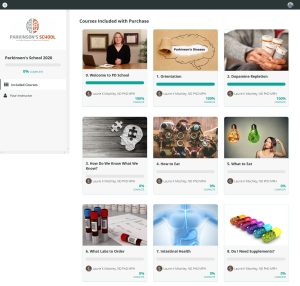
    In addition to seeing patients and conducting research, Laurie also hosts a week long Parkinson’s Summer School at Baystr and she is now offering PD School 2020, an on line course.   She describes the course as follows:

    Parkinson’s School was created to be a resource for patients and their family members. Clinic visits are too few and far between and patients have questions that are going unanswered. Over the past 10 years I’ve treated over 3000 patients with Parkinson’s and these courses represent the themes I find myself repeating.

    Throughout 2020, a new course will be released on the 14th and 28th of every month. Comments and course discussion will be open for the two weeks after each course to allow time for questions. After comments close, you will continue to have unlimited access to the videos and may watch them as often as you’d like.

    As far as I know, online education programs to teach patients to better navigate their disease do not exist. I’m hoping this program will stimulate conversation, collaboration, and a sense of empowerment throughout the community.

    You can register for the course here. The cost of the course is $10 per lesson or $150 for all 24 lessons.  Use coupon code NWPF-HOPE for a 20% discount bringing the price down to $120 for all 24 lessons. Below are the topics that will be covered during the year so you can pick and choose if you don’t want to sign up for the entire course. 

    You can watch the welcome for no charge where she discusses her background and credentials and the outline of the course so you have a better idea of what will be offered before you commit to taking the courses. I have signed up for the full course and I have included my thoughts about the first course below.

    Lesson One – Orientation

    I think this is the video we wish we could have viewed when we were first diagnosed.  It covers what PD is and how it is more than the motor symptoms that affect us and what we can do to delay or reverse it.  If you are on the fence about taking the course I highly recommend  you purchase the first lesson for $10 just for the knowledge you will gain about Parkinson’s, how it progresses and what she has been doing to reverse or slow progression. 

    She and her research team have created a PD scoring system that is easy to complete and correlates well with the UPDRS and other tests we often take at the Doctor’s office for both diagnosis and current status.  Her goal is to reduce your score by the end of the year.  The PRO PD test is available to anyone at propd.org.  There is no cost and it takes about 5 minutes to complete and get a score.  I took it and ended up with a score of 744.  I have asked for my previous scores from my participation in the CAM trial and will be interested to see if there is a change and which way, since my exercise level now is about double what  it was in 2014/15.

    All of her ideas are supported by slides that contain relevant research reports along with supporting data from the CAM study. This class is interesting and provides a wealth of information for PwP’s. I will keep you posted as I progress through the remaining classes.

    “It does not matter how slowly you go as long as you do not stop.” – Confucius

    PS: I just received an email from National Parkinson’s Foundation, Dr. Mischley is the featured expert on their next Expert Briefing webinar on March 17, 2020 from 1pm – 2pm ET. More information is available here If you are reading this post after 3/17/2020, all of the webinars are recorded and made available on their website.