• My Everyday Heroes

    After my last post, I started thinking about the support network we have built because of the people we have met while attending the Kripalu Wellness Retreat, the Partner’s in Parkinson’s event and the Grand Challenge meeting. The more I thought about them, the more I realized how every one of us has been impacted differently by the  many symptoms of PD and how we hunger for information from each other. As Bill Wilkins said in Atlanta, I can meet a person with PD and immediately strike up a conversation and that conversation often gravitates to questions like:

    •     When were you diagnosed?
    •     What symptoms do you have?
    •     What medications are you using?
    •      How are you dealing with….?
    •      Do you belong to a support group?
    •     What kind of exercise regimen do you follow?

    In the past year we have met many other PwP’s, care partners, researchers, representatives of organizations supporting Parkinson’s patients and others involved in Parkinson’s care or research. And I have realized how many everyday heroes we have met, for example the couple whose son was diagnosed with early onset PD and can no longer work, or the school teacher who had to retire because she lost her voice, or Soania who was diagnosed at 27 as she was just starting her medical career and now writes a blog for about.com health including one about another hero we met, Steve, who has come up with an innovative way to transport PwP to clinical trials, or Saul from Atlanta whose daughter / care partner was diagnosed with MS and Sandra who started our local support group because she saw a need and many, many more. All heroes in my book.

    Then there are the many people we have met that work or volunteer for the Michael J Fox Foundation (MJFF) or the Cure Parkinson’s Trust (CPT) or the National Parkinson’s Foundation (NPF) or Parkinson’s Disease Foundation (PDF) or Brian Grant Foundation (BGF) or Parkinson’s Action Network (PAN) and others. These individuals are dedicated to the cause of finding a cure for PD and they are passionate about it. Some have PD and some have relatives or friends with PD but they all want to be involved in research or fund raising or developing educational materials or advocating on behalf of PD patients at the state and national and world levels. They include Tom Isaacs whom I mentioned in the last post and Jon Stamford of CPT, Claire and Claudia from MJFF, Joyce from NPF, Steve and Linda from PDF, Bill of the Wilkins Foundation, Brian Grant from BGF (duh), and Israel from PAN.

    And while we didn’t meet Michael J Fox, I know I am not alone in viewing him as a hero, in fact, he was just selected as the first WebMD Health Hero Hall of Fame winner for his significant accomplishments, both personally and through his foundation, to raise awareness, expand funding, develop treatment options, and advocate for patients in his tireless quest to find a cure for Parkinson’s disease.

    And there is the online community which includes some of the same people I’ve already mentioned that I follow on Twitter along with Robert who writes the blog Tremors in the Universe and has just published a book of the same name with part of the proceeds going to MJFF and NPF, and Grove who represents PAN for the State of Idaho and Kaitlyn whom we first met at Kripalu and many, many more. Again even more heroes.

    These are just a few examples of the many dedicated PD advocates I have met in the past year. I could easily fill several more pages with examples of the people we have met and the actions they have taken to live with Parkinson’s or help someone else live with PD or the research they have done to find a cure, or the actions they have taken to raise funds for research and education and they are all everyday heros.

    Finding a cure or even a way to slow the progression won’t happen without this patient involvement and advocacy. As Tom Isaacs said in Grand Rapids, “We must make patient involvement the rule, not the exception.” He found that PwP’s who are involved in any constructive way benefit from an improved sense of wellbeing and fulfillment. Being able to go to Kripalu and Atlanta and Grand Rapids has resulted in having expanded my network of supporters and increased my understanding of PD. My online community helps me stay current on PD news, new medications and therapies, how others are dealing with the many symptoms of PD and provide me with another support network.

    We plan to keep on traveling to Parkinson’s events while I still can and we will continue to be advocates for PD. This includes advocating for increased patient involvement in all aspects of PD from clinical trials to pushing for increased funding for PT & OT visits and for changes that will allow PwP to take or get your medication on time while hospitalized.

    I am honored to report that my last blog post – Increasing Patient Involvement – was featured on the Parkinson’s Movement website!  Thanks for reading, and if you tuned in to find out about brewing beer at home, maybe I’ll get to that one next !
  • Increasing Patient Involvement

    What a busy couple of weeks! We traveled to Bellaire and Traverse City Michigan to visit relatives, spent two days at the Grand Challenges in Parkinson’s Disease Symposium held in Grand Rapids Michigan (more details below) and finished up with a trip to Bay City to visit with more relatives and friends.

    In the Bellaire area we celebrated Mara’s brother’s 70th birthday and in Traverse City we helped out her sister at her used book store, The Bookie Joint, in downtown Traverse City (shameless plug). In Grand Rapids we had dinner with Rob and Carol Jones whom we first met at the Kripalu Wellness Retreat last October. We had a great time and caught up on changes to medications, symptoms, etc. since Kripalu.

    In Bay City we visited with Mara’s cousins and met up with our friends Karen and Jerry whom we visited in Tucson, AZ in April. As I mentioned in the post about that visit, Jerry was diagnosed about the same time as I was last year. They were great hosts and a highlight was Friday night’s fried perch dinner.

    The Grand Challenges in Parkinson’s Disease Symposium was held at the Van Andel Institute and provided a forum for people with Parkinson’s Disease to interact with some of the top medical professionals and scientists involved in Parkinson’s Disease research. The event featured information sessions and presentations aimed at those in the research/medical field, caregivers and people living with the disease. The symposium also included Rallying to the Challenge, a one-of-a-kind patient-centered meeting designed to highlight the many ways people with Parkinson’s disease can impact the clinical trial process and accelerate access to new Parkinson’s disease treatments.

    The Rallying to the Challenge was kicked off by Tom Isaacs, PwP and co-founder of the Cure Parkinson’s Trust, a UK based Parkinson’s research organization. Tom was diagnosed with early onset PD 20 years ago at the age of 27 and has been an active advocate for Parkinson’s research since then. His presentation to the 250+ neuroscientists and medical professionals and the 100+ PwP and care partners titled “The Urgent Unmet Needs of People with Parkinson’s” was inspiring and he received a standing ovation from the entire audience.

    Tom noted that the one constant he has seen in PwP’s is if they are involved in any constructive way they benefit from an improved sense of well being and fulfillment. Saying “We must make patient involvement the rule, not the exception”, he went on to set out the different unmet needs at the different stages of the disease. You can watch a prerecorded video of the speech here it is about 16 minutes long but it will be worth your time.

    Patients and caregivers then joined Tom Isaacs and a panel consisting of PwP’s, representatives from major organizations including National Parkinson’s Foundation, Michael J Fox Foundation, Parkinson’s Disease Foundation, Parkinson’s Action Network, The Davis Phinney Foundation, The Brian Grant Foundation, Parkinson’s Movement, and The Cure Parkinson’s Trust along with patient advocates from around the world. We went over the results of a survey of PwP’s and researchers about what is needed for successful clinical trials. It was pretty exciting to be involved in this group all focused on one goal, increasing patient involvement.

    The issue we brainstormed was how to overcome the fact that only about 5 – 10% of PwP’s participate in trials and up to 30% of clinical trials fail to recruit any participants. The goal was to find ways around the barriers that prevent participation. One of our team members was Brian Grant, a former NBA star who was diagnosed at the age of 36. He made an excellent presentation to the group on the benefits of teamwork.

    The next day we rejoined the scientific presentation group and Tom Isaacs and the moderators from the breakout groups made a presentation on what is needed to increase patient engagement and clinical trial participation. Some of the points included getting PwP’s involved at the beginning of the trial so that our concerns are addressed up front, providing additional funding to pay for participants travel costs, and making use of current technology such as Skype so the participant doesn’t have to travel as often. The end goal is to make the process patient driven because with patient involvement more will participate in the trial, they will address patient needs, and they can be completed in a shorter time frame.

    The conference was very educational and we added new “family” as we met many more PwP’s and care partner’s from the US, UK, and Canada. We were happy to see Bill Wilkins our fellow panel member from Atlanta on the Rallying to the Challenge team. Meeting Tom Isaacs and many of his panel members was an added bonus as it included many authors of blogs I follow and it was nice to meet them or hear them speak.

    I have included a link to an easy to use glossary of the language of PD from National Parkinson’s Foundation under the PD Resources heading in the right hand column. If you do much research into PD you will come across a lot of new words and this link (or Google) will help you decode them.

    We are home for a while and one of our goals is to switch my Parkinson’s care to a Movement Disorder Specialist (MDS) at the Vanderbilt Parkinson’s Disease Center in Nashville. They are one of NPF’s Centers of Excellence and only about two hours away from home. Stay tuned for our progress in that endeavor and my foray into brewing my own

  • On The Road…Again!

    Mara and I attended the Partners in Parkinson’s event in Atlanta recently, along with an estimated 650+ other patients with Parkinson’s and their loved ones.  We were also honored to serve as panelists during one of the breakout sessions.
     
    Our day started with meeting a couple from Knoxville as we walked to the convention center. We introduced ourselves and agreed to stay in contact since they had not yet found a support group.  After getting registered, we enjoyed the complimentary breakfast with a couple from Atlanta and soon selected a table to sit at for the morning presentation, joining a father and daughter from the area.  We had already added six people to our support group and the day was young!
     
    Three main topics were covered in the morning moderated by longtime journalist Dave Iverson, a Parkinson’s patient himself, who serves as contributing editor for the The Michael J. Fox Foundation.  Each topic was followed by Q & A from the audience. The first topic was The Many Faces of Parkinson’s Disease.  Dave questioned three Parkinson’s patients about their diagnoses and the path their lives have taken since, reinforcing the fact that this disease impacts everyone differently. As Dave said “If you have seen one person with Parkinson’s, you have seen one person with Parkinson’s.”
     
    Next up was Seeing a Movement Disorder Specialist: What to Know, Ask and Expect.  A Movement Disorder Specialist MDS is a neurologist who has received additional training in PD and other disorders. One of the cool things you can find on the Partners in Parkinson’s website is a searchable database to help you find a movement disorder specialist near you.

    Dr. Stewart Factor, Director of the Emory University Movement Disorder Clinic, conducted an “appointment”  with a PD patient and his wife.  It was an interesting, informative session prompting many of us to realize that our initial consultation may not have been filled with as much information about PD that he was covering.

    The final topic was Parkinson’s Research: The Road Ahead where Dave questioned three experts involved in clinical trials and PD research.  This was an informative session that engendered many questions from the audience including when to start levodopa, diet, new drugs in the pipeline, clinical trials and others.
     
    After lunch, the breakout sessions were offered twice so you  could attend two different sessions.  The sessions were Living Well with Parkinson’s, presented by The Davis Phinney Foundation; I’m Still Wondering About…, an opportunity to ask additional questions; and Building Connections with Family, Friends and Community, the one we participated in.You could also browse the Resource Fair where over 20 local organizations and care providers offered information for PD patients.Since we were involved in both of our sessions, we couldn’t attend any of the others but I did hear a lot of positive response about The Davis Phinney presentation.
     
    Our panel included Bill Wilkins, diagnosed 8 years ago and very active in the Parkinson’s community through his organization, The Wilkins Parkinson’s Foundation,  and India Pender Martin, whose grandfather was diagnosed when she was three and who is also active in the Parkinson’s community.  Our panel was expertly moderated by Claire Meunier, vice president of  research engagement for the Fox Foundation.
     
    Mara and I discussed the path we have been following since my diagnosis, how we communicate with family and friends, our trip to Kripalu and why I started the blog.  Bill discussed his diagnosis and how he became active in the Atlanta community and across the US.  India talked about dealing with her grandfather’s Parkinson’s symptoms at an early age and her desire to find a cure.  Then we took questions from the audience.  We received positive comments from attendee’s after each session, and I handed out quite a few cards with the blog address — so might pick up a few more readers!
     
    We are glad we accepted the invitation to participate on this panel even though neither of us are fans of public speaking. It became easier for me when Bill said, “I can meet a person with PD and immediately strike up a conversation.” Which is true for us too. We added many new friends to our support group. Partners in Parkinson’s allowed us  the opportunity to “strike up a conversation” with fellow people living with Parkinson’s.
     
    At the closing session Dave interviewed Mahlon R. DeLong MD, who just received the Lasker Award for research that led to Deep Brain Stimulation (DBS).  They talked about what’s next and the possibility of using DBS to help with balance and gait issues that aren’t solved with the current procedure.  I am excited about that since those are my worst motor symptoms.
     
    So that’s what happens at a Partners in Parkinson’s event and if one is being held near you we both recommend attending, you can find the schedule for the remaining events here.
     
    Next…we are in Northern Michigan to celebrate Mara’s  brother’s 70th birthday.   Our timing is right and we will attend the Grand Challenges in Parkinson’s Disease conference held in Grand Rapids where we will meet up with a couple we met at Kripalu.
     
    Whew this was a long post, thanks for sticking it out to the end and stay tuned for the next post.

World PD Day 2020

First and foremost, I hope this post finds you and your families well and hunkered down as we wait out the COVID-19 pandemic.  It is an unprecedented time in our lives and I have no idea how it will all end up but I have the cleanest hands in the neighborhood!

Today, April 11th, is World Parkinson’s Day, a part of Parkinson’s Awareness month.  In past years, we have celebrated with Parkinson’s Disease walks and last year we moved our Pedaling for PD class out into the lobby of the YMCA to bring attention to PD and the need for exercise.  But this year we can only act alone to raise awareness about PD as we stay in to prevent COVID-19.

This month I read a new book about Parkinson’s Disease – Ending Parkinson’s Disease, A Prescription for Action.  The books co-authors show that the increasing numbers of PwP has made PD the fastest growing brain disorder in the world.  The number of PwP’s has doubled from 3 million to over 6 million in 25 years and they predict it will double again to over 12 million by 2040.  As a result they feel  PD is a world wide pandemic.

The book is co-authored by four leading doctors and advocates for PD:

Ray Dorsey MD who directs the Center for Health + Technology at the University of Rochester. He has used telemedicine to improve care for individuals with Parkinson’s disease and I have participated in several clinical trials where he has pioneered the use of technolgy particularly cell phones and live video to improve diagnoses and treatment of PD.

Todd Sherer PHD is the Chief Executive Officer of The Michael J. Fox Foundation for Parkinson’s Research. Trained as a neuroscientist, he is responsible for the Foundation’s overall scientific and fundraising direction to speed treatment breakthroughs and a cure for Parkinson’s disease.

Michael S Okun MD is Chair of Neurology at the University of Florida. He established the Movement Disorder Clinic at the University of Florida bringing together Neurologists, Speech Therapists, Occupational Therapists and Physical Therapists for a complete evaluation of the patient.  You can read my blog post about our experience when we went to the University of Florida for a second opinion here.

Bastiaan R Bloem, MD, PHD is professor of neurology and the director of the Centre of Expertise for Parkinson & Movement Disorders at Radboud University Medical Centre in Nijmegen, the Netherlands. In 2004, with Dr. Marten Munneke, he created ParkinsonNet, the largest integrated-care program for Parkinson’s patients. 

The authors propose a PACT to Prevent the disease, Advocate for protective policies, Care for patients, and Treat the condition with innovative therapies.

Prevent – They point out that stopping the use of chemical pesticides and solvents and recognizing the impact of head traumas would help to prevent PD and lead to a large reduction in newly diagnosed PwP world wide.

Advocate – They point out the need to educate the public  about the worldwide Parkinson’s pandemic. The book discusses the campaigns to end or treat Polio, HIV, and Breast Cancer as examples.

Care – They discuss providing care for PwP’s  including in home care by healthcare workers trained in caring for PD patients.  They point out that care must be covered by health insurance including Medicare. In addition they discuss the need for each of us to take actions such as exercising to improve our own care. By the way, they have an excellent discussion about Pedaling for PD during the chapter about exercising to prevent and/or slow the progression of PD.

Treat – The final section deals with the need to take charge of the research process and make sure new treatments are fully funded.  This would include new medications, new surgeries and improved methods of care for Parkinson’s Disease.

The book ends with a prescription for action listing 25 steps each of us can and should take to reduce the worldwide toll of this disease. The list includes banning paraquat and other harmful pesticides, eating like the Greeks, exercising, advocating for resources and policy changes, and providing reasonable pricing for PD medications.

The book is well written and includes many case studies and research references to support their plan for ending or at least slowing down the increasing number of Parkinson’s Disease diagnoses.  It also lays out how to care for those of us that have already been diagnosed including supporting clinical trials that slow or reverse the progression of PD.

So, while you are home fighting off the COVID-19 pandemic, you might want to grab a copy of Ending Parkinson’s and read about the other pandemic we are fighting as PwP’s.  You can find more information about the book at www.endingPD.org.

I am still working my way through the PD School 2020 lessons and will provide an update in my next post. In the meantime, stay safe and stay healthy!

World PD Day 2020

First and foremost, I hope this post finds you and your families well and hunkered down as we wait out the COVID-19 pandemic.  It is an unprecedented time in our lives and I have no idea how it will all end up but I have the cleanest hands in the neighborhood!

Today, April 11th, is World Parkinson’s Day, a part of Parkinson’s Awareness month.  In past years, we have celebrated with Parkinson’s Disease walks and last year we moved our Pedaling for PD class out into the lobby of the YMCA to bring attention to PD and the need for exercise.  But this year we can only act alone to raise awareness about PD as we stay in to prevent COVID-19.

This month I read a new book about Parkinson’s Disease – Ending Parkinson’s Disease, A Prescription for Action.  The books co-authors show that the increasing numbers of PwP has made PD the fastest growing brain disorder in the world.  The number of PwP’s has doubled from 3 million to over 6 million in 25 years and they predict it will double again to over 12 million by 2040.  As a result they feel  PD is a world wide pandemic.

The book is co-authored by four leading doctors and advocates for PD:

Ray Dorsey MD who directs the Center for Health + Technology at the University of Rochester. He has used telemedicine to improve care for individuals with Parkinson’s disease and I have participated in several clinical trials where he has pioneered the use of technolgy particularly cell phones and live video to improve diagnoses and treatment of PD.

Todd Sherer PHD is the Chief Executive Officer of The Michael J. Fox Foundation for Parkinson’s Research. Trained as a neuroscientist, he is responsible for the Foundation’s overall scientific and fundraising direction to speed treatment breakthroughs and a cure for Parkinson’s disease.

Michael S Okun MD is Chair of Neurology at the University of Florida. He established the Movement Disorder Clinic at the University of Florida bringing together Neurologists, Speech Therapists, Occupational Therapists and Physical Therapists for a complete evaluation of the patient.  You can read my blog post about our experience when we went to the University of Florida for a second opinion here.

Bastiaan R Bloem, MD, PHD is professor of neurology and the director of the Centre of Expertise for Parkinson & Movement Disorders at Radboud University Medical Centre in Nijmegen, the Netherlands. In 2004, with Dr. Marten Munneke, he created ParkinsonNet, the largest integrated-care program for Parkinson’s patients. 

The authors propose a PACT to Prevent the disease, Advocate for protective policies, Care for patients, and Treat the condition with innovative therapies.

Prevent – They point out that stopping the use of chemical pesticides and solvents and recognizing the impact of head traumas would help to prevent PD and lead to a large reduction in newly diagnosed PwP world wide.

Advocate – They point out the need to educate the public  about the worldwide Parkinson’s pandemic. The book discusses the campaigns to end or treat Polio, HIV, and Breast Cancer as examples.

Care – They discuss providing care for PwP’s  including in home care by healthcare workers trained in caring for PD patients.  They point out that care must be covered by health insurance including Medicare. In addition they discuss the need for each of us to take actions such as exercising to improve our own care. By the way, they have an excellent discussion about Pedaling for PD during the chapter about exercising to prevent and/or slow the progression of PD.

Treat – The final section deals with the need to take charge of the research process and make sure new treatments are fully funded.  This would include new medications, new surgeries and improved methods of care for Parkinson’s Disease.

The book ends with a prescription for action listing 25 steps each of us can and should take to reduce the worldwide toll of this disease. The list includes banning paraquat and other harmful pesticides, eating like the Greeks, exercising, advocating for resources and policy changes, and providing reasonable pricing for PD medications.

The book is well written and includes many case studies and research references to support their plan for ending or at least slowing down the increasing number of Parkinson’s Disease diagnoses.  It also lays out how to care for those of us that have already been diagnosed including supporting clinical trials that slow or reverse the progression of PD.

So, while you are home fighting off the COVID-19 pandemic, you might want to grab a copy of Ending Parkinson’s and read about the other pandemic we are fighting as PwP’s.  You can find more information about the book at www.endingPD.org.

I am still working my way through the PD School 2020 lessons and will provide an update in my next post. In the meantime, stay safe and stay healthy!

Year: 2020

  • World PD Day 2020

    First and foremost, I hope this post finds you and your families well and hunkered down as we wait out the COVID-19 pandemic.  It is an unprecedented time in our lives and I have no idea how it will all end up but I have the cleanest hands in the neighborhood!

    Today, April 11th, is World Parkinson’s Day, a part of Parkinson’s Awareness month.  In past years, we have celebrated with Parkinson’s Disease walks and last year we moved our Pedaling for PD class out into the lobby of the YMCA to bring attention to PD and the need for exercise.  But this year we can only act alone to raise awareness about PD as we stay in to prevent COVID-19.

    This month I read a new book about Parkinson’s Disease – Ending Parkinson’s Disease, A Prescription for Action.  The books co-authors show that the increasing numbers of PwP has made PD the fastest growing brain disorder in the world.  The number of PwP’s has doubled from 3 million to over 6 million in 25 years and they predict it will double again to over 12 million by 2040.  As a result they feel  PD is a world wide pandemic.

    The book is co-authored by four leading doctors and advocates for PD:

    Ray Dorsey MD who directs the Center for Health + Technology at the University of Rochester. He has used telemedicine to improve care for individuals with Parkinson’s disease and I have participated in several clinical trials where he has pioneered the use of technolgy particularly cell phones and live video to improve diagnoses and treatment of PD.

    Todd Sherer PHD is the Chief Executive Officer of The Michael J. Fox Foundation for Parkinson’s Research. Trained as a neuroscientist, he is responsible for the Foundation’s overall scientific and fundraising direction to speed treatment breakthroughs and a cure for Parkinson’s disease.

    Michael S Okun MD is Chair of Neurology at the University of Florida. He established the Movement Disorder Clinic at the University of Florida bringing together Neurologists, Speech Therapists, Occupational Therapists and Physical Therapists for a complete evaluation of the patient.  You can read my blog post about our experience when we went to the University of Florida for a second opinion here.

    Bastiaan R Bloem, MD, PHD is professor of neurology and the director of the Centre of Expertise for Parkinson & Movement Disorders at Radboud University Medical Centre in Nijmegen, the Netherlands. In 2004, with Dr. Marten Munneke, he created ParkinsonNet, the largest integrated-care program for Parkinson’s patients. 

    The authors propose a PACT to Prevent the disease, Advocate for protective policies, Care for patients, and Treat the condition with innovative therapies.

    Prevent – They point out that stopping the use of chemical pesticides and solvents and recognizing the impact of head traumas would help to prevent PD and lead to a large reduction in newly diagnosed PwP world wide.

    Advocate – They point out the need to educate the public  about the worldwide Parkinson’s pandemic. The book discusses the campaigns to end or treat Polio, HIV, and Breast Cancer as examples.

    Care – They discuss providing care for PwP’s  including in home care by healthcare workers trained in caring for PD patients.  They point out that care must be covered by health insurance including Medicare. In addition they discuss the need for each of us to take actions such as exercising to improve our own care. By the way, they have an excellent discussion about Pedaling for PD during the chapter about exercising to prevent and/or slow the progression of PD.

    Treat – The final section deals with the need to take charge of the research process and make sure new treatments are fully funded.  This would include new medications, new surgeries and improved methods of care for Parkinson’s Disease.

    The book ends with a prescription for action listing 25 steps each of us can and should take to reduce the worldwide toll of this disease. The list includes banning paraquat and other harmful pesticides, eating like the Greeks, exercising, advocating for resources and policy changes, and providing reasonable pricing for PD medications.

    The book is well written and includes many case studies and research references to support their plan for ending or at least slowing down the increasing number of Parkinson’s Disease diagnoses.  It also lays out how to care for those of us that have already been diagnosed including supporting clinical trials that slow or reverse the progression of PD.

    So, while you are home fighting off the COVID-19 pandemic, you might want to grab a copy of Ending Parkinson’s and read about the other pandemic we are fighting as PwP’s.  You can find more information about the book at www.endingPD.org.

    I am still working my way through the PD School 2020 lessons and will provide an update in my next post. In the meantime, stay safe and stay healthy!

  • PD School 2020 – Update

    This will be a short blog post regarding the PD School being conducted by Dr Laurie Mischley which I wrote about in the last post. A few days ago I received the following message from Dr Mischely:

    Hi Tom,
    Yours was one of many requests I’ve received the past few days to make class #1 free. 
    Done. It is now free.  
    Thanks for helping spread the word!  
    Laurie
     
    If you have or have not watched the first class, you now have an opportunity to not only watch it but forward that class to family members, friends, care givers and any other person you think could benefit from a good discussion about what it means to be diagnosed with PD. 
     
    As I mentioned in the last post, this lesson should be offered to all newly diagnosed Parkinson’s patients- it answers so many of the questions we have at that point but didn’t know enough to ask during that first meeting with the neurologist.  The two links below take you to the overview lesson (was already free) and the orientation lesson which is now free.


    I have completed lesson two “Dopamine Repletion” and lesson three “How Do We Know What We Know”.  Both were excellent and I highly recommend them both.  Here are a few of the highlights:
     
    Lesson two – Dopamine Repletion – is an excellent overview on the drugs available, along with when is the best time to take them and avoid the protein from meals blocking the transfer of dopamine to the brain.
     
    She utilizes the results of the ongoing CAM Study and other published research to support taking your levadopa/carbidopa with water  mixed with vitamin C to provide additional stomach acid to speed up the breakdown of the pills.
     
    In addition, she discusses the use of  Fish Oil and Citicoline (both supplements) to reduce dyskinesia by improving the uptake of dopamine so you can reduce your overall dose.
     
    At the end there is a brief discussion of Mucuna, a plant form of levadopa followed  by a ‘guest lecturer’ who discusses the pluses and minuses of using Mucuna.
     
    Lesson three – How Do We Know What We Know – discusses PD research from all directions.  She was worried this would be the lesson no one watched,  but it is another must see as she tackles traditional research, the placebo effect and more.  Rather than try to recapitulate it all here I am going to just pull a few points from her summary at the end of the lesson:
    -Physicians, patients, and researchers all describe/ define PD differently.
    -Everyone says they want medicines that slow PD progression, but they don’t have a scale to measure progression.
    -By time a patient is diagnosed, ability to significantly impact course may be compromised.
    -We don’t know who is going to get PD (screening tests), we don’t know who is at greatest risk of progression, we don’t have a tool to measure progression, and we can’t agree on a definition.
    -A shocking amount of researcher time goes to keeping one’s job. If you’re not bringing in grant money, you don’t get paid, so instead of just doing science, we spend our time courting the system. Novel ideas and  innovation must swim against a significant current. Everyone wants so
    As she wrapped up this lesson, she said she favors a ‘friendly competition’ among PD practitioners.  If she is doing something right, doesn’t your neurologist need to know and if they are doing something right, she wants to know that too. 
     
    Sounds like a good idea to me.
     
    “It does not matter how slowly you go as long as you do not stop.” – Confucius
     
     
  • PD School – 2020

    PD School – 2020

    Some of you may be familiar with Dr. Laurie K Mischley from Bastyr University in Seattle. She has a medical degree in Naturopathic Medicine and specializes in the nutritional requirements for neuro degenerative disorders. She has spent over 10 years working with PD patients and has a clinical trial going on regarding Complementary and Alternative Medicine (CAM) in PD where participants (I have been one since 8/2014) complete a series of surveys every 6 months to report the status and progression of their PD and we also compete a 24 hour food diary. She has presented programs at the World Parkinson’s Congress and other research meetings and she is considered an expert in the nutritional needs of PD patients.

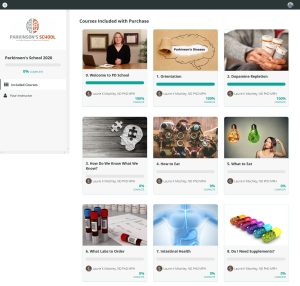
    In addition to seeing patients and conducting research, Laurie also hosts a week long Parkinson’s Summer School at Baystr and she is now offering PD School 2020, an on line course.   She describes the course as follows:

    Parkinson’s School was created to be a resource for patients and their family members. Clinic visits are too few and far between and patients have questions that are going unanswered. Over the past 10 years I’ve treated over 3000 patients with Parkinson’s and these courses represent the themes I find myself repeating.

    Throughout 2020, a new course will be released on the 14th and 28th of every month. Comments and course discussion will be open for the two weeks after each course to allow time for questions. After comments close, you will continue to have unlimited access to the videos and may watch them as often as you’d like.

    As far as I know, online education programs to teach patients to better navigate their disease do not exist. I’m hoping this program will stimulate conversation, collaboration, and a sense of empowerment throughout the community.

    You can register for the course here. The cost of the course is $10 per lesson or $150 for all 24 lessons.  Use coupon code NWPF-HOPE for a 20% discount bringing the price down to $120 for all 24 lessons. Below are the topics that will be covered during the year so you can pick and choose if you don’t want to sign up for the entire course. 

    You can watch the welcome for no charge where she discusses her background and credentials and the outline of the course so you have a better idea of what will be offered before you commit to taking the courses. I have signed up for the full course and I have included my thoughts about the first course below.

    Lesson One – Orientation

    I think this is the video we wish we could have viewed when we were first diagnosed.  It covers what PD is and how it is more than the motor symptoms that affect us and what we can do to delay or reverse it.  If you are on the fence about taking the course I highly recommend  you purchase the first lesson for $10 just for the knowledge you will gain about Parkinson’s, how it progresses and what she has been doing to reverse or slow progression. 

    She and her research team have created a PD scoring system that is easy to complete and correlates well with the UPDRS and other tests we often take at the Doctor’s office for both diagnosis and current status.  Her goal is to reduce your score by the end of the year.  The PRO PD test is available to anyone at propd.org.  There is no cost and it takes about 5 minutes to complete and get a score.  I took it and ended up with a score of 744.  I have asked for my previous scores from my participation in the CAM trial and will be interested to see if there is a change and which way, since my exercise level now is about double what  it was in 2014/15.

    All of her ideas are supported by slides that contain relevant research reports along with supporting data from the CAM study. This class is interesting and provides a wealth of information for PwP’s. I will keep you posted as I progress through the remaining classes.

    “It does not matter how slowly you go as long as you do not stop.” – Confucius

    PS: I just received an email from National Parkinson’s Foundation, Dr. Mischley is the featured expert on their next Expert Briefing webinar on March 17, 2020 from 1pm – 2pm ET. More information is available here If you are reading this post after 3/17/2020, all of the webinars are recorded and made available on their website.