• Cognitive Training and ….Cinnamon?

    I started ‘brain training’ with Lumosity last fall and usually play five games a day whenever possible.  If you aren’t familiar with Lumosity, they provide cognitive training exercises that teach neuroplasticity, that is training the brain to use new pathways to complete a task.  Cognitive training has blossomed in the past few years and since some of my neural pathways are deteriorating, I thought Lumosity would be an interesting test and might help me build those new paths.

    The Lumosity training works to improve five areas – memory, flexibility, problem solving, attention and speed – all improvements I can use!  After every five game session you get an overall score called  the Lumosity Performance Index or LPI which is an average of the five areas and hopefully goes up each day (I wish).  But enough of the background, if you want more info, check out their website.

    I have found that playing the brain games with PD can be a challenge, particularly the flexibility and speed games that usually require the use of the arrow keys on my laptop to select the right answer.  I have noticed that I can visualize the correct move but making my fingers press the right key is another thing altogether.  As I learned from the presentation by Kaitlyn Roland at the Kripalu session, one of the problems with a lack of dopamine is the brain sends the correct command but it gets scrambled and doesn’t follow the correct pathway which results in the wrong action being taken which can result in a fall, freezing in place or, it appears, pressing the wrong key.

    So I am hopeful that by doing the games every day I am creating those new neural pathways and my LPI score will  reflect the improvement.  But sometimes I seem to be stuck with the old paths and my LPI chart ends up looking like this one for the last four weeks, up and down.  Such is life with Parkinson’s 🙂

    The big Parkinson’s news of the last couple of weeks is the publication of a study that cinnamon might stop the progression of Parkinson’s Disease!  I figure this means I should be baking and consuming my famous (in some circles) Gram’s Pecan Rolls so named because the recipe is from my daughter in law Monica’s Gram and it is full of cinnamon.  Of course the study was conducted on mice so I don’t know how many rolls I need to eat daily but do know what the effect would be on my weight!  Guess I’ll wait for more information before getting the baking equipment out but I wonder if my LPI would go up? Sounds like a clinical study in the making!

    We had a great 4th of July visit with son Ryan and his wife Sarah and their son Julian and his half brother Trysten.  In addition, grandson Jake and granddaughter McKenna and her friend Katie also joined us for the  holiday weekend so we had a houseful.  The kids enjoyed tubing on the lake and swimming off the dock, and we all enjoyed taking the boat down to watch the fireworks go off over the lake.  We even managed to load the tube with all five kids for some fun on the lake.  Again some fishing and paddle boarding took place along with watching the World Cup games.

    Next week it will be one year since my PD diagnosis and a lot has happened in the space of the year, most of which I have managed to chronicle in this blog.   Once again I thank you all for sticking with me on this journey, your support means  a lot to me.

    BTW, if you are a tweeter, follow me on twitter by clicking on the link on the right below my profile.

  • At the Beach — Again!


    I am writing this from the deck of a beautiful home overlooking the Atlantic Ocean on Bald Head Island, NC.  Yep, at the beach again!!  More about how we got here later in this post.

    I have looked at several more clinical trials but again find that I don’t qualify because I am already on medication.  It seems to me that communication between Movement Disorder Specialists (MDS) or Neurologists and clinical trial operators could increase trial participants.  If the Doctors were aware of the trials being conducted nearby, they could then offer their newly diagnosed patients the opportunity to particpate in the trial before they prescribed a medications.  Of course another issue is travel, most of the trials that I have tried to join are at least 200 miles away and the travel costs are usually not covered.  In her latest blog post, Soania Mathur MD states “…close to 85% of all clinical trials are delayed due to recruitment difficulties and a shocking 30% fail to recruit a single subject.”  The post goes on to discuss both the logistical and the lack of knowledge issues I have discussed above.  The Michael J Fox Trial Finder website does a great job of listing all of the trials in my home radius of 300 miles and they notify me if a new one is added that meets the criteria but the newly diagnosed need to know where to look.  Perhaps one or more of the National organizations can develop a simple brochure that can be supplied to MDS and Neurologists for them to hand out or make available to patients.  It might be a start?

    I was asked this week to be a PatientsLikeMe Research Ambassador.  PatientsLikeMe is an online support group I belong to and I had applied to be a member of a research advisory committee they were forming.  While I wasn’t selected for the advisory group I was asked to be a Research Ambassador. Per the email ..”Like the Team of Advisors, our Research Ambassadors are being asked to commit to a program that’s designed to put you in the driver’s seat of making research better.”  As an Ambassador, I will get special communications each month for the rest of the year about new research initiatives, information about data being collected and how it will be used, and use my blog and other social avenues to share this information with the Parkinson’s community.  I have participated in a couple of their research projects already, including the one where I did the voice test over the phone to see if they can track the progress of my Parkinson’s. Sounds interesting and I am looking forward to participating.


    We had a great visit with my daughter Holly and grandchildren Charlie and Kayla.  The weather was great until the last evening so we got in a lot of boating, tubing, swimming, fishing and stand up paddle boarding along with side trips to the Ripley’s Believe It or Not museum and a couple of rounds of mini golf.

    Kayla turned out to be the fisherperson extraordinaire hooking a couple of nice catfish and a bunch of sunfish from the dock.  Charlie loved being on the water and riding the tube. Holly and Kayla both enjoyed stand up paddle boarding so much the first time, they went back for more before leaving for home.  It was a great visit and a good time was had by all.

    We are enjoying our time at the beach in Bald Head Island.  The island is reachable by ferry from Southport, NC and once you are here, you travel by foot, bike or golf cart.  We have been lucky to spend a week here for the past several summers with my stepson David and his wife Shelly and the two grand kids Breanna and Garrett.  This year Breanna is in MN so this is the first time we have been here without her.  Garrett always brings along a friend or two, this year he brought along 4 high school buddies and they are having a blast.  Dave and Shelly’s friends Mario and Missy have also joined us for the week.  It is a great place to just relax, read books, take long walks on the beach and watch the World Cup.  I am trying to catch up with all of the magazines I haven’t read since we returned from Florida in early March and produce this blog post.  Looks like the blog post will make it, we’ll see about the magazines.

    Our friends Mary Ann and Don live nearby in Wilmington, NC so they came over for a day and we had a great time, we hadn’t seen them for almost 2 years so we had a lot of catching up to do.  We enjoyed a nice lunch with them and a couple of ‘slow’ rides around the island as one of our golf carts is not super speedy. 🙂

    Next up is a visit from my son Ryan and his wife Sarah and grandson Julian and his half brother Trysten for the Fourth of July, look for more fun on the lake in the next post.

  • Time Flies

    May seems to be going  has gone by awfully quickly, here it is Memorial Day June 1 and it seems like we just got home from our West Coast tour last week, not 5 weeks ago.  It’s been a busy time since we returned including Doctor appointments (annual physicals), catching up our volunteer work for Project Linus and getting ready for Spring.

    Spring did finally arrive (more or less) and we took the pontoon out for the first time not long after we got home and it was great to be able to get back out on the water.
    We also started getting ready for our oldest grandson Garrett’s high school graduation including adding a few hanging plants to the yard and having Mara’s son Darrin help with painting, yard work, and launching the pedal boat before our visitors arrived.  Our youngest grandchildren, Angelina and Ariana, arrived from Seattle (oh they did travel with their parents Dale and Monica) a few days before the big event.

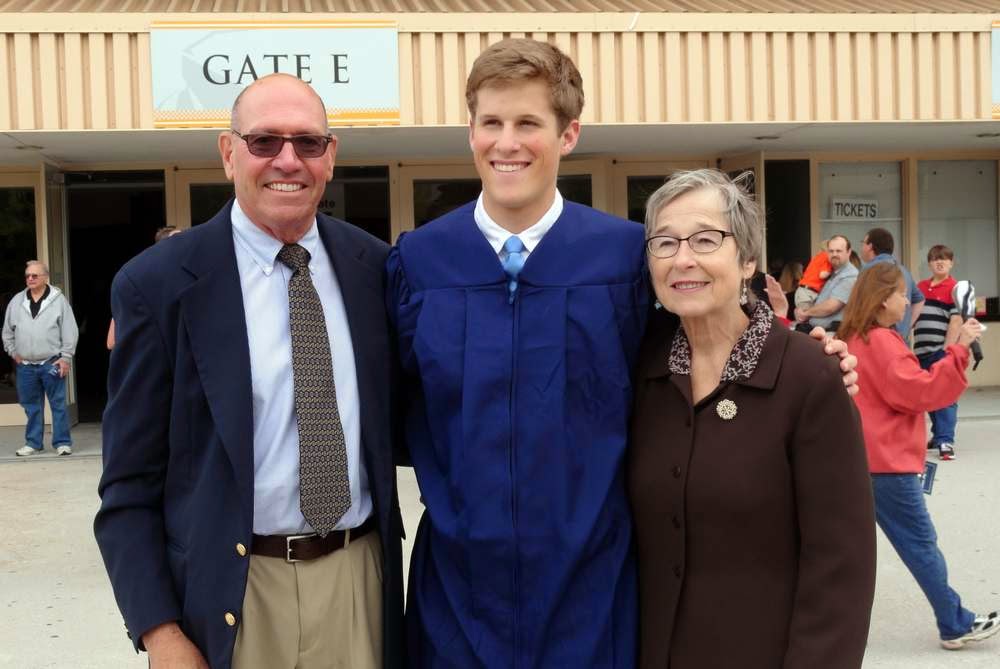
    We are very proud of Garrett – he was a varsity soccer player, a National Merit scholarship winner and a diploma candidate in the International Baccalaureate  program.   After visiting many college campuses over the last couple of years he has decided to join his sister Breanna and attend Rhodes College in Memphis where he will  also play soccer for the Lynx.

    We had a great time with our visitors.   In addition to attending the graduation and subsequent festivities, we all spent a day at Dollywood, Dolly Parton’s amusement park in Pigeon Forge, near Smoky Mountains National Park.  The weather wasn’t perfect but we didn’t let the rain dampen our spirits and a good time was had by all.

    We had a day of great weather for being on the lake and doing some tubing and some fishing.  They left before Memorial Day and we spent a quiet (and wet) holiday weekend getting in our walks and catching up on a few to-dos including finishing my Introduction to Genetics course.  I really enjoyed the course, my first online learning experience and I would recommend it if you have an interest in genetics.

    Next up, my daughter Holly and grandchildren Charlie and Kayla arrive from Colorado Springs on Tuesday and I expect more tubing, fishing and maybe another trip to Dollywood will occur during their visit.

    On the Parkinson’s front, I am still working thinking about adding a page with a list of the blogs I follow but in the meantime here is a list of Parkinson’s Disease blogs posted on The Bachmann-Strauss Dystonia and Parkinson Foundation website.  I am honored to be on their list which also includes many of the blogs that I follow and has pointed me to some new ones to add to my list.

World PD Day 2020

First and foremost, I hope this post finds you and your families well and hunkered down as we wait out the COVID-19 pandemic.  It is an unprecedented time in our lives and I have no idea how it will all end up but I have the cleanest hands in the neighborhood!

Today, April 11th, is World Parkinson’s Day, a part of Parkinson’s Awareness month.  In past years, we have celebrated with Parkinson’s Disease walks and last year we moved our Pedaling for PD class out into the lobby of the YMCA to bring attention to PD and the need for exercise.  But this year we can only act alone to raise awareness about PD as we stay in to prevent COVID-19.

This month I read a new book about Parkinson’s Disease – Ending Parkinson’s Disease, A Prescription for Action.  The books co-authors show that the increasing numbers of PwP has made PD the fastest growing brain disorder in the world.  The number of PwP’s has doubled from 3 million to over 6 million in 25 years and they predict it will double again to over 12 million by 2040.  As a result they feel  PD is a world wide pandemic.

The book is co-authored by four leading doctors and advocates for PD:

Ray Dorsey MD who directs the Center for Health + Technology at the University of Rochester. He has used telemedicine to improve care for individuals with Parkinson’s disease and I have participated in several clinical trials where he has pioneered the use of technolgy particularly cell phones and live video to improve diagnoses and treatment of PD.

Todd Sherer PHD is the Chief Executive Officer of The Michael J. Fox Foundation for Parkinson’s Research. Trained as a neuroscientist, he is responsible for the Foundation’s overall scientific and fundraising direction to speed treatment breakthroughs and a cure for Parkinson’s disease.

Michael S Okun MD is Chair of Neurology at the University of Florida. He established the Movement Disorder Clinic at the University of Florida bringing together Neurologists, Speech Therapists, Occupational Therapists and Physical Therapists for a complete evaluation of the patient.  You can read my blog post about our experience when we went to the University of Florida for a second opinion here.

Bastiaan R Bloem, MD, PHD is professor of neurology and the director of the Centre of Expertise for Parkinson & Movement Disorders at Radboud University Medical Centre in Nijmegen, the Netherlands. In 2004, with Dr. Marten Munneke, he created ParkinsonNet, the largest integrated-care program for Parkinson’s patients. 

The authors propose a PACT to Prevent the disease, Advocate for protective policies, Care for patients, and Treat the condition with innovative therapies.

Prevent – They point out that stopping the use of chemical pesticides and solvents and recognizing the impact of head traumas would help to prevent PD and lead to a large reduction in newly diagnosed PwP world wide.

Advocate – They point out the need to educate the public  about the worldwide Parkinson’s pandemic. The book discusses the campaigns to end or treat Polio, HIV, and Breast Cancer as examples.

Care – They discuss providing care for PwP’s  including in home care by healthcare workers trained in caring for PD patients.  They point out that care must be covered by health insurance including Medicare. In addition they discuss the need for each of us to take actions such as exercising to improve our own care. By the way, they have an excellent discussion about Pedaling for PD during the chapter about exercising to prevent and/or slow the progression of PD.

Treat – The final section deals with the need to take charge of the research process and make sure new treatments are fully funded.  This would include new medications, new surgeries and improved methods of care for Parkinson’s Disease.

The book ends with a prescription for action listing 25 steps each of us can and should take to reduce the worldwide toll of this disease. The list includes banning paraquat and other harmful pesticides, eating like the Greeks, exercising, advocating for resources and policy changes, and providing reasonable pricing for PD medications.

The book is well written and includes many case studies and research references to support their plan for ending or at least slowing down the increasing number of Parkinson’s Disease diagnoses.  It also lays out how to care for those of us that have already been diagnosed including supporting clinical trials that slow or reverse the progression of PD.

So, while you are home fighting off the COVID-19 pandemic, you might want to grab a copy of Ending Parkinson’s and read about the other pandemic we are fighting as PwP’s.  You can find more information about the book at www.endingPD.org.

I am still working my way through the PD School 2020 lessons and will provide an update in my next post. In the meantime, stay safe and stay healthy!

World PD Day 2020

First and foremost, I hope this post finds you and your families well and hunkered down as we wait out the COVID-19 pandemic.  It is an unprecedented time in our lives and I have no idea how it will all end up but I have the cleanest hands in the neighborhood!

Today, April 11th, is World Parkinson’s Day, a part of Parkinson’s Awareness month.  In past years, we have celebrated with Parkinson’s Disease walks and last year we moved our Pedaling for PD class out into the lobby of the YMCA to bring attention to PD and the need for exercise.  But this year we can only act alone to raise awareness about PD as we stay in to prevent COVID-19.

This month I read a new book about Parkinson’s Disease – Ending Parkinson’s Disease, A Prescription for Action.  The books co-authors show that the increasing numbers of PwP has made PD the fastest growing brain disorder in the world.  The number of PwP’s has doubled from 3 million to over 6 million in 25 years and they predict it will double again to over 12 million by 2040.  As a result they feel  PD is a world wide pandemic.

The book is co-authored by four leading doctors and advocates for PD:

Ray Dorsey MD who directs the Center for Health + Technology at the University of Rochester. He has used telemedicine to improve care for individuals with Parkinson’s disease and I have participated in several clinical trials where he has pioneered the use of technolgy particularly cell phones and live video to improve diagnoses and treatment of PD.

Todd Sherer PHD is the Chief Executive Officer of The Michael J. Fox Foundation for Parkinson’s Research. Trained as a neuroscientist, he is responsible for the Foundation’s overall scientific and fundraising direction to speed treatment breakthroughs and a cure for Parkinson’s disease.

Michael S Okun MD is Chair of Neurology at the University of Florida. He established the Movement Disorder Clinic at the University of Florida bringing together Neurologists, Speech Therapists, Occupational Therapists and Physical Therapists for a complete evaluation of the patient.  You can read my blog post about our experience when we went to the University of Florida for a second opinion here.

Bastiaan R Bloem, MD, PHD is professor of neurology and the director of the Centre of Expertise for Parkinson & Movement Disorders at Radboud University Medical Centre in Nijmegen, the Netherlands. In 2004, with Dr. Marten Munneke, he created ParkinsonNet, the largest integrated-care program for Parkinson’s patients. 

The authors propose a PACT to Prevent the disease, Advocate for protective policies, Care for patients, and Treat the condition with innovative therapies.

Prevent – They point out that stopping the use of chemical pesticides and solvents and recognizing the impact of head traumas would help to prevent PD and lead to a large reduction in newly diagnosed PwP world wide.

Advocate – They point out the need to educate the public  about the worldwide Parkinson’s pandemic. The book discusses the campaigns to end or treat Polio, HIV, and Breast Cancer as examples.

Care – They discuss providing care for PwP’s  including in home care by healthcare workers trained in caring for PD patients.  They point out that care must be covered by health insurance including Medicare. In addition they discuss the need for each of us to take actions such as exercising to improve our own care. By the way, they have an excellent discussion about Pedaling for PD during the chapter about exercising to prevent and/or slow the progression of PD.

Treat – The final section deals with the need to take charge of the research process and make sure new treatments are fully funded.  This would include new medications, new surgeries and improved methods of care for Parkinson’s Disease.

The book ends with a prescription for action listing 25 steps each of us can and should take to reduce the worldwide toll of this disease. The list includes banning paraquat and other harmful pesticides, eating like the Greeks, exercising, advocating for resources and policy changes, and providing reasonable pricing for PD medications.

The book is well written and includes many case studies and research references to support their plan for ending or at least slowing down the increasing number of Parkinson’s Disease diagnoses.  It also lays out how to care for those of us that have already been diagnosed including supporting clinical trials that slow or reverse the progression of PD.

So, while you are home fighting off the COVID-19 pandemic, you might want to grab a copy of Ending Parkinson’s and read about the other pandemic we are fighting as PwP’s.  You can find more information about the book at www.endingPD.org.

I am still working my way through the PD School 2020 lessons and will provide an update in my next post. In the meantime, stay safe and stay healthy!

Year: 2020

  • World PD Day 2020

    First and foremost, I hope this post finds you and your families well and hunkered down as we wait out the COVID-19 pandemic.  It is an unprecedented time in our lives and I have no idea how it will all end up but I have the cleanest hands in the neighborhood!

    Today, April 11th, is World Parkinson’s Day, a part of Parkinson’s Awareness month.  In past years, we have celebrated with Parkinson’s Disease walks and last year we moved our Pedaling for PD class out into the lobby of the YMCA to bring attention to PD and the need for exercise.  But this year we can only act alone to raise awareness about PD as we stay in to prevent COVID-19.

    This month I read a new book about Parkinson’s Disease – Ending Parkinson’s Disease, A Prescription for Action.  The books co-authors show that the increasing numbers of PwP has made PD the fastest growing brain disorder in the world.  The number of PwP’s has doubled from 3 million to over 6 million in 25 years and they predict it will double again to over 12 million by 2040.  As a result they feel  PD is a world wide pandemic.

    The book is co-authored by four leading doctors and advocates for PD:

    Ray Dorsey MD who directs the Center for Health + Technology at the University of Rochester. He has used telemedicine to improve care for individuals with Parkinson’s disease and I have participated in several clinical trials where he has pioneered the use of technolgy particularly cell phones and live video to improve diagnoses and treatment of PD.

    Todd Sherer PHD is the Chief Executive Officer of The Michael J. Fox Foundation for Parkinson’s Research. Trained as a neuroscientist, he is responsible for the Foundation’s overall scientific and fundraising direction to speed treatment breakthroughs and a cure for Parkinson’s disease.

    Michael S Okun MD is Chair of Neurology at the University of Florida. He established the Movement Disorder Clinic at the University of Florida bringing together Neurologists, Speech Therapists, Occupational Therapists and Physical Therapists for a complete evaluation of the patient.  You can read my blog post about our experience when we went to the University of Florida for a second opinion here.

    Bastiaan R Bloem, MD, PHD is professor of neurology and the director of the Centre of Expertise for Parkinson & Movement Disorders at Radboud University Medical Centre in Nijmegen, the Netherlands. In 2004, with Dr. Marten Munneke, he created ParkinsonNet, the largest integrated-care program for Parkinson’s patients. 

    The authors propose a PACT to Prevent the disease, Advocate for protective policies, Care for patients, and Treat the condition with innovative therapies.

    Prevent – They point out that stopping the use of chemical pesticides and solvents and recognizing the impact of head traumas would help to prevent PD and lead to a large reduction in newly diagnosed PwP world wide.

    Advocate – They point out the need to educate the public  about the worldwide Parkinson’s pandemic. The book discusses the campaigns to end or treat Polio, HIV, and Breast Cancer as examples.

    Care – They discuss providing care for PwP’s  including in home care by healthcare workers trained in caring for PD patients.  They point out that care must be covered by health insurance including Medicare. In addition they discuss the need for each of us to take actions such as exercising to improve our own care. By the way, they have an excellent discussion about Pedaling for PD during the chapter about exercising to prevent and/or slow the progression of PD.

    Treat – The final section deals with the need to take charge of the research process and make sure new treatments are fully funded.  This would include new medications, new surgeries and improved methods of care for Parkinson’s Disease.

    The book ends with a prescription for action listing 25 steps each of us can and should take to reduce the worldwide toll of this disease. The list includes banning paraquat and other harmful pesticides, eating like the Greeks, exercising, advocating for resources and policy changes, and providing reasonable pricing for PD medications.

    The book is well written and includes many case studies and research references to support their plan for ending or at least slowing down the increasing number of Parkinson’s Disease diagnoses.  It also lays out how to care for those of us that have already been diagnosed including supporting clinical trials that slow or reverse the progression of PD.

    So, while you are home fighting off the COVID-19 pandemic, you might want to grab a copy of Ending Parkinson’s and read about the other pandemic we are fighting as PwP’s.  You can find more information about the book at www.endingPD.org.

    I am still working my way through the PD School 2020 lessons and will provide an update in my next post. In the meantime, stay safe and stay healthy!

  • PD School 2020 – Update

    This will be a short blog post regarding the PD School being conducted by Dr Laurie Mischley which I wrote about in the last post. A few days ago I received the following message from Dr Mischely:

    Hi Tom,
    Yours was one of many requests I’ve received the past few days to make class #1 free. 
    Done. It is now free.  
    Thanks for helping spread the word!  
    Laurie
     
    If you have or have not watched the first class, you now have an opportunity to not only watch it but forward that class to family members, friends, care givers and any other person you think could benefit from a good discussion about what it means to be diagnosed with PD. 
     
    As I mentioned in the last post, this lesson should be offered to all newly diagnosed Parkinson’s patients- it answers so many of the questions we have at that point but didn’t know enough to ask during that first meeting with the neurologist.  The two links below take you to the overview lesson (was already free) and the orientation lesson which is now free.


    I have completed lesson two “Dopamine Repletion” and lesson three “How Do We Know What We Know”.  Both were excellent and I highly recommend them both.  Here are a few of the highlights:
     
    Lesson two – Dopamine Repletion – is an excellent overview on the drugs available, along with when is the best time to take them and avoid the protein from meals blocking the transfer of dopamine to the brain.
     
    She utilizes the results of the ongoing CAM Study and other published research to support taking your levadopa/carbidopa with water  mixed with vitamin C to provide additional stomach acid to speed up the breakdown of the pills.
     
    In addition, she discusses the use of  Fish Oil and Citicoline (both supplements) to reduce dyskinesia by improving the uptake of dopamine so you can reduce your overall dose.
     
    At the end there is a brief discussion of Mucuna, a plant form of levadopa followed  by a ‘guest lecturer’ who discusses the pluses and minuses of using Mucuna.
     
    Lesson three – How Do We Know What We Know – discusses PD research from all directions.  She was worried this would be the lesson no one watched,  but it is another must see as she tackles traditional research, the placebo effect and more.  Rather than try to recapitulate it all here I am going to just pull a few points from her summary at the end of the lesson:
    -Physicians, patients, and researchers all describe/ define PD differently.
    -Everyone says they want medicines that slow PD progression, but they don’t have a scale to measure progression.
    -By time a patient is diagnosed, ability to significantly impact course may be compromised.
    -We don’t know who is going to get PD (screening tests), we don’t know who is at greatest risk of progression, we don’t have a tool to measure progression, and we can’t agree on a definition.
    -A shocking amount of researcher time goes to keeping one’s job. If you’re not bringing in grant money, you don’t get paid, so instead of just doing science, we spend our time courting the system. Novel ideas and  innovation must swim against a significant current. Everyone wants so
    As she wrapped up this lesson, she said she favors a ‘friendly competition’ among PD practitioners.  If she is doing something right, doesn’t your neurologist need to know and if they are doing something right, she wants to know that too. 
     
    Sounds like a good idea to me.
     
    “It does not matter how slowly you go as long as you do not stop.” – Confucius
     
     
  • PD School – 2020

    PD School – 2020

    Some of you may be familiar with Dr. Laurie K Mischley from Bastyr University in Seattle. She has a medical degree in Naturopathic Medicine and specializes in the nutritional requirements for neuro degenerative disorders. She has spent over 10 years working with PD patients and has a clinical trial going on regarding Complementary and Alternative Medicine (CAM) in PD where participants (I have been one since 8/2014) complete a series of surveys every 6 months to report the status and progression of their PD and we also compete a 24 hour food diary. She has presented programs at the World Parkinson’s Congress and other research meetings and she is considered an expert in the nutritional needs of PD patients.

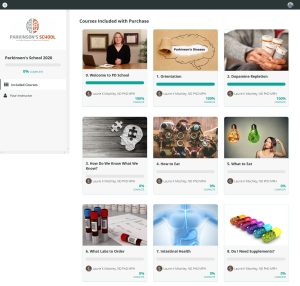
    In addition to seeing patients and conducting research, Laurie also hosts a week long Parkinson’s Summer School at Baystr and she is now offering PD School 2020, an on line course.   She describes the course as follows:

    Parkinson’s School was created to be a resource for patients and their family members. Clinic visits are too few and far between and patients have questions that are going unanswered. Over the past 10 years I’ve treated over 3000 patients with Parkinson’s and these courses represent the themes I find myself repeating.

    Throughout 2020, a new course will be released on the 14th and 28th of every month. Comments and course discussion will be open for the two weeks after each course to allow time for questions. After comments close, you will continue to have unlimited access to the videos and may watch them as often as you’d like.

    As far as I know, online education programs to teach patients to better navigate their disease do not exist. I’m hoping this program will stimulate conversation, collaboration, and a sense of empowerment throughout the community.

    You can register for the course here. The cost of the course is $10 per lesson or $150 for all 24 lessons.  Use coupon code NWPF-HOPE for a 20% discount bringing the price down to $120 for all 24 lessons. Below are the topics that will be covered during the year so you can pick and choose if you don’t want to sign up for the entire course. 

    You can watch the welcome for no charge where she discusses her background and credentials and the outline of the course so you have a better idea of what will be offered before you commit to taking the courses. I have signed up for the full course and I have included my thoughts about the first course below.

    Lesson One – Orientation

    I think this is the video we wish we could have viewed when we were first diagnosed.  It covers what PD is and how it is more than the motor symptoms that affect us and what we can do to delay or reverse it.  If you are on the fence about taking the course I highly recommend  you purchase the first lesson for $10 just for the knowledge you will gain about Parkinson’s, how it progresses and what she has been doing to reverse or slow progression. 

    She and her research team have created a PD scoring system that is easy to complete and correlates well with the UPDRS and other tests we often take at the Doctor’s office for both diagnosis and current status.  Her goal is to reduce your score by the end of the year.  The PRO PD test is available to anyone at propd.org.  There is no cost and it takes about 5 minutes to complete and get a score.  I took it and ended up with a score of 744.  I have asked for my previous scores from my participation in the CAM trial and will be interested to see if there is a change and which way, since my exercise level now is about double what  it was in 2014/15.

    All of her ideas are supported by slides that contain relevant research reports along with supporting data from the CAM study. This class is interesting and provides a wealth of information for PwP’s. I will keep you posted as I progress through the remaining classes.

    “It does not matter how slowly you go as long as you do not stop.” – Confucius

    PS: I just received an email from National Parkinson’s Foundation, Dr. Mischley is the featured expert on their next Expert Briefing webinar on March 17, 2020 from 1pm – 2pm ET. More information is available here If you are reading this post after 3/17/2020, all of the webinars are recorded and made available on their website.