• Welcome 2021!!

    Happy New Year!!  I don’t know about you but I have never been so happy to leave a year behind.  It has been a year of trials and tribulations and wrinkled hands from so much washing.  We have averaged  5 – 7 books per week since March, lived through almost 3 months with no tennis and discovered Zoom can be used for just about everything from exercise classes to family gatherings.  

    We have survived not eating out unless we can eat outside, wearing a mask everywhere you go, and not hugging.  We go nowhere except to the grocery store and the tennis court which has reduced gasoline use and carbon in the air.  

    I could go on and on about what we will not miss about 2020 but we did learn some lesson from 2020. I received this list from a good friend and reader of this blog  and I thought I would pass it along to you all.  

    It has been about 5 months since  my last post but with the COVID-19 restrictions there is very little news to report.   As noted above, we have been playing tennis with a small group (our pod) and the ever resourceful Pedaling for PD instructor Kathy has been teaching classes 3 days a week via Zoom.  I purchased a spin bike for home in order to keep up with the exercise as much a possible.

    I finally had a face to face visit with my neurologist in October which went well with no changes to medications or routines.  I also met with a speech pathologist and we decided the Speak Out! program would be beneficial as my voice has been getting softer and softer requiring me to repeat myself often.

    Speak Out! is a program where you meet one on one  with the speech pathologists three times  a week for four weeks  and learn to speak with intent!  The sessions were very focused on improving the volume of my voice using breathing exercises, visualising projecting my voice and practicing going from low to high and back while saying ahhhh.  In addition to the voice exercises, they also have cognitive drills for each lesson and a reading aloud exercise.  I found the program to be very beneficial and I have continued to work at speaking with intent everyday. 

    We spent the holidays at home with no family visitors for the first time that we can remember.  Hopefully next year we can return to normal as the vaccine is rolled out.

    Speaking of the vaccine, through a combination of serendipitous events, Mara and I received the first Moderna shot last week and are scheduled for the second shot in early February.  Sarasota county opened appointments for persons 65 and over using an online reservation system.  Because I had signed up for text messages from the county back in March, I received a text message that they were taking appointments and was able to schedule both of us before they were filled up.  The process worked very smoothly when we arrived at the County Health Department.  While there was a long line, it turned out they were people without an appointment hoping to get the vaccine  by waiting. 

    Since we had an appointment, we went to the head of the line and were in and out in approximately an hour including a 15 – 20 minute observation period after the shot.  So far we have had no major complications beyond some pain at the injection site.  I will update you when we get the second shot as I have heard that is when they expect more minor complications will occur since your body has been making antibodies to fight the virus.

    A reminder – if you haven’t already joined PD Avengers, please click here and add your name to the list of supporters.  We are hoping for 1 million supporters by 2022 and together we are fighting to END PARKINSON’S!

    I hope this post finds you healthy and not totally bored out of your mind.  Please mask up, practice social distancing and stay safe! 

    “It does not matter how slowly you go as long as you do not stop.” – Confucius


  • Join PD Avengers & Let’s End PD!

    Last  month  marked the 7th anniversary of my official “you have Parkinson’s Disease” diagnosis from my first neurologist.   During the past 7 years  I’ve become very knowledgeable about PD, discovered tennis, turned into an exercise junkie to help slow the progression of my PD,  and moved to Florida.

    Meanwhile, after 200 + years Levadopa/Carbidopa, discovered 50 years ago, continues to be the main treatment for the symptoms of PD.  A lot of research has been done trying to identify the cause of PD and a number of new medications have been developed to deal with the symptoms of PD but the cure remains elusive.  The recent book “Ending Parkinson’s Disease” pointed out that PD is fast becoming  pandemic and action needs to be taken to end PD. You can read my blog post about the book here.

    Inspired by the book and it’s proposed PACT (Prevent,Advocate, Care, Treat)  a worldwide group of PD advocates have formed PD Avengers to advocate for ending Parkinson’s.  They want to unite 50 million voices world wide to prove PD matters and to build a sense of urgency to end Parkinson’s.  I have added my voice and have become a PD Avenger and I hope you will too!  You can find out more information and add your voice at PDAdvengers.com.  Together we can END PARKINSON’S!!

  • Sample Posts #4

    Gravida dictum fusce

    Lorem ipsum dolor sit amet, consectetur adipiscing elit, sed do eiusmod tempor incididunt ut labore et dolore magna aliqua. Gravida dictum fusce ut placerat. Convallis aenean et tortor at. Mauris sit amet massa vitae. A condimentum vitae sapien pellentesque habitant morbi tristique senectus et. Malesuada nunc vel risus commodo viverra maecenas accumsan lacus. Magnis dis parturient montes nascetur ridiculus. Volutpat sed cras ornare arcu dui vivamus arcu felis. Neque sodales ut etiam sit amet nisl purus in. Elit ut aliquam purus sit amet luctus venenatis lectus. At volutpat diam ut venenatis tellus in metus vulputate.

    Fermentum et sollicitudin ac orci phasellus egestas tellus. Amet dictum sit amet justo donec enim. Iaculis nunc sed augue lacus viverra vitae. Pharetra pharetra massa massa ultricies mi quis hendrerit dolor magna. Vel fringilla est ullamcorper eget nulla facilisi etiam dignissim diam. Nisi porta lorem mollis aliquam ut porttitor. Vel turpis nunc eget lorem dolor. Lacinia quis vel eros donec ac odio tempor orci dapibus. Mi sit amet mauris commodo quis imperdiet. Porta nibh venenatis cras sed felis. Phasellus faucibus scelerisque eleifend donec pretium vulputate sapien nec sagittis. Volutpat ac tincidunt vitae semper quis lectus nulla.

    At tellus at urna condimentum mattis pellentesque. Arcu non sodales neque sodales. Tincidunt ornare massa eget egestas. Ut tortor pretium viverra suspendisse potenti nullam ac tortor vitae. Vestibulum rhoncus est pellentesque elit ullamcorper dignissim. Donec adipiscing tristique risus nec feugiat in. Ut ornare lectus sit amet. Hendrerit dolor magna eget est lorem. Ipsum suspendisse ultrices gravida dictum fusce. Ultricies leo integer malesuada nunc vel risus commodo viverra. Mauris in aliquam sem fringilla. Fermentum odio eu feugiat pretium.

    Tellus in metus vulputate eu scelerisque felis imperdiet proin. Eu ultrices vitae auctor eu augue ut lectus. Enim sed faucibus turpis in eu. Hac habitasse platea dictumst quisque sagittis purus. Justo laoreet sit amet cursus. Lobortis mattis aliquam faucibus purus in massa tempor nec feugiat. Mauris pharetra et ultrices neque ornare aenean euismod elementum nisi. Lectus sit amet est placerat. Vulputate enim nulla aliquet porttitor lacus luctus accumsan. Odio pellentesque diam volutpat commodo sed egestas. Sapien eget mi proin sed libero. Ut placerat orci nulla pellentesque. Mi quis hendrerit dolor magna eget est. Nunc scelerisque viverra mauris in aliquam. Sapien faucibus et molestie ac feugiat sed lectus vestibulum mattis. Odio ut enim blandit volutpat maecenas volutpat blandit. Cras sed felis eget velit aliquet sagittis id consectetur purus. Porta nibh venenatis cras sed felis eget velit. Imperdiet proin fermentum leo vel. Tempus egestas sed sed risus pretium quam vulputate dignissim suspendisse.

    Lorem ipsum dolor sit amet consectetur adipiscing elit duis tristique. Nunc consequat interdum varius sit amet mattis vulputate enim. Faucibus et molestie ac feugiat sed lectus vestibulum mattis. Massa sed elementum tempus egestas sed sed. Nunc consequat interdum varius sit amet. Neque vitae tempus quam pellentesque nec. Cursus metus aliquam eleifend mi. Eu scelerisque felis imperdiet proin fermentum leo vel orci. Quam elementum pulvinar etiam non quam lacus suspendisse faucibus interdum. Non enim praesent elementum facilisis leo vel fringilla. Nisi vitae suscipit tellus mauris a diam maecenas sed. Lorem sed risus ultricies tristique nulla. Elementum facilisis leo vel fringilla. Ut tortor pretium viverra suspendisse potenti. Diam in arcu cursus euismod quis viverra. Mattis vulputate enim nulla aliquet porttitor. Lorem ipsum dolor sit amet consectetur adipiscing. Libero id faucibus nisl tincidunt eget nullam non. Libero nunc consequat interdum varius.

World PD Day 2020

First and foremost, I hope this post finds you and your families well and hunkered down as we wait out the COVID-19 pandemic.  It is an unprecedented time in our lives and I have no idea how it will all end up but I have the cleanest hands in the neighborhood!

Today, April 11th, is World Parkinson’s Day, a part of Parkinson’s Awareness month.  In past years, we have celebrated with Parkinson’s Disease walks and last year we moved our Pedaling for PD class out into the lobby of the YMCA to bring attention to PD and the need for exercise.  But this year we can only act alone to raise awareness about PD as we stay in to prevent COVID-19.

This month I read a new book about Parkinson’s Disease – Ending Parkinson’s Disease, A Prescription for Action.  The books co-authors show that the increasing numbers of PwP has made PD the fastest growing brain disorder in the world.  The number of PwP’s has doubled from 3 million to over 6 million in 25 years and they predict it will double again to over 12 million by 2040.  As a result they feel  PD is a world wide pandemic.

The book is co-authored by four leading doctors and advocates for PD:

Ray Dorsey MD who directs the Center for Health + Technology at the University of Rochester. He has used telemedicine to improve care for individuals with Parkinson’s disease and I have participated in several clinical trials where he has pioneered the use of technolgy particularly cell phones and live video to improve diagnoses and treatment of PD.

Todd Sherer PHD is the Chief Executive Officer of The Michael J. Fox Foundation for Parkinson’s Research. Trained as a neuroscientist, he is responsible for the Foundation’s overall scientific and fundraising direction to speed treatment breakthroughs and a cure for Parkinson’s disease.

Michael S Okun MD is Chair of Neurology at the University of Florida. He established the Movement Disorder Clinic at the University of Florida bringing together Neurologists, Speech Therapists, Occupational Therapists and Physical Therapists for a complete evaluation of the patient.  You can read my blog post about our experience when we went to the University of Florida for a second opinion here.

Bastiaan R Bloem, MD, PHD is professor of neurology and the director of the Centre of Expertise for Parkinson & Movement Disorders at Radboud University Medical Centre in Nijmegen, the Netherlands. In 2004, with Dr. Marten Munneke, he created ParkinsonNet, the largest integrated-care program for Parkinson’s patients. 

The authors propose a PACT to Prevent the disease, Advocate for protective policies, Care for patients, and Treat the condition with innovative therapies.

Prevent – They point out that stopping the use of chemical pesticides and solvents and recognizing the impact of head traumas would help to prevent PD and lead to a large reduction in newly diagnosed PwP world wide.

Advocate – They point out the need to educate the public  about the worldwide Parkinson’s pandemic. The book discusses the campaigns to end or treat Polio, HIV, and Breast Cancer as examples.

Care – They discuss providing care for PwP’s  including in home care by healthcare workers trained in caring for PD patients.  They point out that care must be covered by health insurance including Medicare. In addition they discuss the need for each of us to take actions such as exercising to improve our own care. By the way, they have an excellent discussion about Pedaling for PD during the chapter about exercising to prevent and/or slow the progression of PD.

Treat – The final section deals with the need to take charge of the research process and make sure new treatments are fully funded.  This would include new medications, new surgeries and improved methods of care for Parkinson’s Disease.

The book ends with a prescription for action listing 25 steps each of us can and should take to reduce the worldwide toll of this disease. The list includes banning paraquat and other harmful pesticides, eating like the Greeks, exercising, advocating for resources and policy changes, and providing reasonable pricing for PD medications.

The book is well written and includes many case studies and research references to support their plan for ending or at least slowing down the increasing number of Parkinson’s Disease diagnoses.  It also lays out how to care for those of us that have already been diagnosed including supporting clinical trials that slow or reverse the progression of PD.

So, while you are home fighting off the COVID-19 pandemic, you might want to grab a copy of Ending Parkinson’s and read about the other pandemic we are fighting as PwP’s.  You can find more information about the book at www.endingPD.org.

I am still working my way through the PD School 2020 lessons and will provide an update in my next post. In the meantime, stay safe and stay healthy!

World PD Day 2020

First and foremost, I hope this post finds you and your families well and hunkered down as we wait out the COVID-19 pandemic.  It is an unprecedented time in our lives and I have no idea how it will all end up but I have the cleanest hands in the neighborhood!

Today, April 11th, is World Parkinson’s Day, a part of Parkinson’s Awareness month.  In past years, we have celebrated with Parkinson’s Disease walks and last year we moved our Pedaling for PD class out into the lobby of the YMCA to bring attention to PD and the need for exercise.  But this year we can only act alone to raise awareness about PD as we stay in to prevent COVID-19.

This month I read a new book about Parkinson’s Disease – Ending Parkinson’s Disease, A Prescription for Action.  The books co-authors show that the increasing numbers of PwP has made PD the fastest growing brain disorder in the world.  The number of PwP’s has doubled from 3 million to over 6 million in 25 years and they predict it will double again to over 12 million by 2040.  As a result they feel  PD is a world wide pandemic.

The book is co-authored by four leading doctors and advocates for PD:

Ray Dorsey MD who directs the Center for Health + Technology at the University of Rochester. He has used telemedicine to improve care for individuals with Parkinson’s disease and I have participated in several clinical trials where he has pioneered the use of technolgy particularly cell phones and live video to improve diagnoses and treatment of PD.

Todd Sherer PHD is the Chief Executive Officer of The Michael J. Fox Foundation for Parkinson’s Research. Trained as a neuroscientist, he is responsible for the Foundation’s overall scientific and fundraising direction to speed treatment breakthroughs and a cure for Parkinson’s disease.

Michael S Okun MD is Chair of Neurology at the University of Florida. He established the Movement Disorder Clinic at the University of Florida bringing together Neurologists, Speech Therapists, Occupational Therapists and Physical Therapists for a complete evaluation of the patient.  You can read my blog post about our experience when we went to the University of Florida for a second opinion here.

Bastiaan R Bloem, MD, PHD is professor of neurology and the director of the Centre of Expertise for Parkinson & Movement Disorders at Radboud University Medical Centre in Nijmegen, the Netherlands. In 2004, with Dr. Marten Munneke, he created ParkinsonNet, the largest integrated-care program for Parkinson’s patients. 

The authors propose a PACT to Prevent the disease, Advocate for protective policies, Care for patients, and Treat the condition with innovative therapies.

Prevent – They point out that stopping the use of chemical pesticides and solvents and recognizing the impact of head traumas would help to prevent PD and lead to a large reduction in newly diagnosed PwP world wide.

Advocate – They point out the need to educate the public  about the worldwide Parkinson’s pandemic. The book discusses the campaigns to end or treat Polio, HIV, and Breast Cancer as examples.

Care – They discuss providing care for PwP’s  including in home care by healthcare workers trained in caring for PD patients.  They point out that care must be covered by health insurance including Medicare. In addition they discuss the need for each of us to take actions such as exercising to improve our own care. By the way, they have an excellent discussion about Pedaling for PD during the chapter about exercising to prevent and/or slow the progression of PD.

Treat – The final section deals with the need to take charge of the research process and make sure new treatments are fully funded.  This would include new medications, new surgeries and improved methods of care for Parkinson’s Disease.

The book ends with a prescription for action listing 25 steps each of us can and should take to reduce the worldwide toll of this disease. The list includes banning paraquat and other harmful pesticides, eating like the Greeks, exercising, advocating for resources and policy changes, and providing reasonable pricing for PD medications.

The book is well written and includes many case studies and research references to support their plan for ending or at least slowing down the increasing number of Parkinson’s Disease diagnoses.  It also lays out how to care for those of us that have already been diagnosed including supporting clinical trials that slow or reverse the progression of PD.

So, while you are home fighting off the COVID-19 pandemic, you might want to grab a copy of Ending Parkinson’s and read about the other pandemic we are fighting as PwP’s.  You can find more information about the book at www.endingPD.org.

I am still working my way through the PD School 2020 lessons and will provide an update in my next post. In the meantime, stay safe and stay healthy!

Year: 2020

  • World PD Day 2020

    First and foremost, I hope this post finds you and your families well and hunkered down as we wait out the COVID-19 pandemic.  It is an unprecedented time in our lives and I have no idea how it will all end up but I have the cleanest hands in the neighborhood!

    Today, April 11th, is World Parkinson’s Day, a part of Parkinson’s Awareness month.  In past years, we have celebrated with Parkinson’s Disease walks and last year we moved our Pedaling for PD class out into the lobby of the YMCA to bring attention to PD and the need for exercise.  But this year we can only act alone to raise awareness about PD as we stay in to prevent COVID-19.

    This month I read a new book about Parkinson’s Disease – Ending Parkinson’s Disease, A Prescription for Action.  The books co-authors show that the increasing numbers of PwP has made PD the fastest growing brain disorder in the world.  The number of PwP’s has doubled from 3 million to over 6 million in 25 years and they predict it will double again to over 12 million by 2040.  As a result they feel  PD is a world wide pandemic.

    The book is co-authored by four leading doctors and advocates for PD:

    Ray Dorsey MD who directs the Center for Health + Technology at the University of Rochester. He has used telemedicine to improve care for individuals with Parkinson’s disease and I have participated in several clinical trials where he has pioneered the use of technolgy particularly cell phones and live video to improve diagnoses and treatment of PD.

    Todd Sherer PHD is the Chief Executive Officer of The Michael J. Fox Foundation for Parkinson’s Research. Trained as a neuroscientist, he is responsible for the Foundation’s overall scientific and fundraising direction to speed treatment breakthroughs and a cure for Parkinson’s disease.

    Michael S Okun MD is Chair of Neurology at the University of Florida. He established the Movement Disorder Clinic at the University of Florida bringing together Neurologists, Speech Therapists, Occupational Therapists and Physical Therapists for a complete evaluation of the patient.  You can read my blog post about our experience when we went to the University of Florida for a second opinion here.

    Bastiaan R Bloem, MD, PHD is professor of neurology and the director of the Centre of Expertise for Parkinson & Movement Disorders at Radboud University Medical Centre in Nijmegen, the Netherlands. In 2004, with Dr. Marten Munneke, he created ParkinsonNet, the largest integrated-care program for Parkinson’s patients. 

    The authors propose a PACT to Prevent the disease, Advocate for protective policies, Care for patients, and Treat the condition with innovative therapies.

    Prevent – They point out that stopping the use of chemical pesticides and solvents and recognizing the impact of head traumas would help to prevent PD and lead to a large reduction in newly diagnosed PwP world wide.

    Advocate – They point out the need to educate the public  about the worldwide Parkinson’s pandemic. The book discusses the campaigns to end or treat Polio, HIV, and Breast Cancer as examples.

    Care – They discuss providing care for PwP’s  including in home care by healthcare workers trained in caring for PD patients.  They point out that care must be covered by health insurance including Medicare. In addition they discuss the need for each of us to take actions such as exercising to improve our own care. By the way, they have an excellent discussion about Pedaling for PD during the chapter about exercising to prevent and/or slow the progression of PD.

    Treat – The final section deals with the need to take charge of the research process and make sure new treatments are fully funded.  This would include new medications, new surgeries and improved methods of care for Parkinson’s Disease.

    The book ends with a prescription for action listing 25 steps each of us can and should take to reduce the worldwide toll of this disease. The list includes banning paraquat and other harmful pesticides, eating like the Greeks, exercising, advocating for resources and policy changes, and providing reasonable pricing for PD medications.

    The book is well written and includes many case studies and research references to support their plan for ending or at least slowing down the increasing number of Parkinson’s Disease diagnoses.  It also lays out how to care for those of us that have already been diagnosed including supporting clinical trials that slow or reverse the progression of PD.

    So, while you are home fighting off the COVID-19 pandemic, you might want to grab a copy of Ending Parkinson’s and read about the other pandemic we are fighting as PwP’s.  You can find more information about the book at www.endingPD.org.

    I am still working my way through the PD School 2020 lessons and will provide an update in my next post. In the meantime, stay safe and stay healthy!

  • PD School 2020 – Update

    This will be a short blog post regarding the PD School being conducted by Dr Laurie Mischley which I wrote about in the last post. A few days ago I received the following message from Dr Mischely:

    Hi Tom,
    Yours was one of many requests I’ve received the past few days to make class #1 free. 
    Done. It is now free.  
    Thanks for helping spread the word!  
    Laurie
     
    If you have or have not watched the first class, you now have an opportunity to not only watch it but forward that class to family members, friends, care givers and any other person you think could benefit from a good discussion about what it means to be diagnosed with PD. 
     
    As I mentioned in the last post, this lesson should be offered to all newly diagnosed Parkinson’s patients- it answers so many of the questions we have at that point but didn’t know enough to ask during that first meeting with the neurologist.  The two links below take you to the overview lesson (was already free) and the orientation lesson which is now free.


    I have completed lesson two “Dopamine Repletion” and lesson three “How Do We Know What We Know”.  Both were excellent and I highly recommend them both.  Here are a few of the highlights:
     
    Lesson two – Dopamine Repletion – is an excellent overview on the drugs available, along with when is the best time to take them and avoid the protein from meals blocking the transfer of dopamine to the brain.
     
    She utilizes the results of the ongoing CAM Study and other published research to support taking your levadopa/carbidopa with water  mixed with vitamin C to provide additional stomach acid to speed up the breakdown of the pills.
     
    In addition, she discusses the use of  Fish Oil and Citicoline (both supplements) to reduce dyskinesia by improving the uptake of dopamine so you can reduce your overall dose.
     
    At the end there is a brief discussion of Mucuna, a plant form of levadopa followed  by a ‘guest lecturer’ who discusses the pluses and minuses of using Mucuna.
     
    Lesson three – How Do We Know What We Know – discusses PD research from all directions.  She was worried this would be the lesson no one watched,  but it is another must see as she tackles traditional research, the placebo effect and more.  Rather than try to recapitulate it all here I am going to just pull a few points from her summary at the end of the lesson:
    -Physicians, patients, and researchers all describe/ define PD differently.
    -Everyone says they want medicines that slow PD progression, but they don’t have a scale to measure progression.
    -By time a patient is diagnosed, ability to significantly impact course may be compromised.
    -We don’t know who is going to get PD (screening tests), we don’t know who is at greatest risk of progression, we don’t have a tool to measure progression, and we can’t agree on a definition.
    -A shocking amount of researcher time goes to keeping one’s job. If you’re not bringing in grant money, you don’t get paid, so instead of just doing science, we spend our time courting the system. Novel ideas and  innovation must swim against a significant current. Everyone wants so
    As she wrapped up this lesson, she said she favors a ‘friendly competition’ among PD practitioners.  If she is doing something right, doesn’t your neurologist need to know and if they are doing something right, she wants to know that too. 
     
    Sounds like a good idea to me.
     
    “It does not matter how slowly you go as long as you do not stop.” – Confucius
     
     
  • PD School – 2020

    PD School – 2020

    Some of you may be familiar with Dr. Laurie K Mischley from Bastyr University in Seattle. She has a medical degree in Naturopathic Medicine and specializes in the nutritional requirements for neuro degenerative disorders. She has spent over 10 years working with PD patients and has a clinical trial going on regarding Complementary and Alternative Medicine (CAM) in PD where participants (I have been one since 8/2014) complete a series of surveys every 6 months to report the status and progression of their PD and we also compete a 24 hour food diary. She has presented programs at the World Parkinson’s Congress and other research meetings and she is considered an expert in the nutritional needs of PD patients.

    In addition to seeing patients and conducting research, Laurie also hosts a week long Parkinson’s Summer School at Baystr and she is now offering PD School 2020, an on line course.   She describes the course as follows:

    Parkinson’s School was created to be a resource for patients and their family members. Clinic visits are too few and far between and patients have questions that are going unanswered. Over the past 10 years I’ve treated over 3000 patients with Parkinson’s and these courses represent the themes I find myself repeating.

    Throughout 2020, a new course will be released on the 14th and 28th of every month. Comments and course discussion will be open for the two weeks after each course to allow time for questions. After comments close, you will continue to have unlimited access to the videos and may watch them as often as you’d like.

    As far as I know, online education programs to teach patients to better navigate their disease do not exist. I’m hoping this program will stimulate conversation, collaboration, and a sense of empowerment throughout the community.

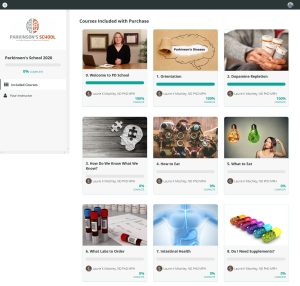
    You can register for the course here. The cost of the course is $10 per lesson or $150 for all 24 lessons.  Use coupon code NWPF-HOPE for a 20% discount bringing the price down to $120 for all 24 lessons. Below are the topics that will be covered during the year so you can pick and choose if you don’t want to sign up for the entire course. 

    You can watch the welcome for no charge where she discusses her background and credentials and the outline of the course so you have a better idea of what will be offered before you commit to taking the courses. I have signed up for the full course and I have included my thoughts about the first course below.

    Lesson One – Orientation

    I think this is the video we wish we could have viewed when we were first diagnosed.  It covers what PD is and how it is more than the motor symptoms that affect us and what we can do to delay or reverse it.  If you are on the fence about taking the course I highly recommend  you purchase the first lesson for $10 just for the knowledge you will gain about Parkinson’s, how it progresses and what she has been doing to reverse or slow progression. 

    She and her research team have created a PD scoring system that is easy to complete and correlates well with the UPDRS and other tests we often take at the Doctor’s office for both diagnosis and current status.  Her goal is to reduce your score by the end of the year.  The PRO PD test is available to anyone at propd.org.  There is no cost and it takes about 5 minutes to complete and get a score.  I took it and ended up with a score of 744.  I have asked for my previous scores from my participation in the CAM trial and will be interested to see if there is a change and which way, since my exercise level now is about double what  it was in 2014/15.

    All of her ideas are supported by slides that contain relevant research reports along with supporting data from the CAM study. This class is interesting and provides a wealth of information for PwP’s. I will keep you posted as I progress through the remaining classes.

    “It does not matter how slowly you go as long as you do not stop.” – Confucius
    PS: I just received an email from National Parkinson’s Foundation, Dr. Mischley is the featured expert on their next Expert Briefing webinar on March 17, 2020 from 1pm – 2pm ET. More information is available here If you are reading this post after 3/17/2020, all of the webinars are recorded and made available on their website.