• Is Patient Centered Care a Myth?

    I have written previously about Patient Centered care, health care that establishes a partnership among practitioners and patients, where the patient is respected and has input into his or her care.  Seems like a fairly simple concept but, as you will see in this post from my friend and fellow PwP Alan Zimmerman, patient involvement was not wanted during his recent hospital stay and any attempts to get involved were discouraged by doctors at the hospital and the VA.

    Alan is a member of the Parkinson’s Foundation Patient Advisory Council, advocates with the Public Policy group at the Michael J Fox Foundation, maintains a couple of Facebook group pages on PD, and somehow finds time to serve as president of the local East Tennessee support group, PK Hope is Alive.  His recent four day stay in a local Knoxville hospital prompted this post on the support group website:

    ———————————-

    “I spent four lonely days in a brown L.A. haze” from “Come Monday” by Jimmy Buffett

    In other words, I was in the hospital for four days and three nights.

    There is good news and bad news.  The good news (from some perspectives including mine) is that i am still alive.  The bad news is that PwP seem to be thrown into the “One size fits all” bag.  Oh! Almost forgot.  There is even more good news:  The nurses were fantastic (with one exception).

    As many of you know, I’m fairly knowledgeable about most things Parkinson’s.  That piece of trivia probably worked in my disfavor. 

    Intellectual curiosity?  None noticed from Dr. Wong.  Did he do any extra reading or look at a few PD studies?  Not that I could tell.  I even asked for a neurological consult but was ignored.  Evidently this doctor already knows everything.

    What gives a mere patient the right to come in here and challenge what we do?  

    Learn anything from the patient – no way. The patient could not possibly know anything because they do not have a MD or DO behind their name.  Only those that do are considered worthy.  At least that is the attitude that came across from one doc.

    Don’t ask me about delivery of medications.  Unless of course you are interested in an illustration why PwP dread hospital and time spent in the ER.  Had my particular form of the disease been different, I could easily have found my way to the “crazy ward.”  Why?  Because I would not have received my meds on time and could have suffered a severe reaction.

    Why?   Because medication delivery was so very hap-hazard.  You will get it when you get it.  You are on our schedule now.  We have you captured.  

    “You can check out any time you like, but you can never leave!”  from “Hotel California” by the Eagles.

    And speaking of meds, Dr. Wong gave me three days worth to last me until I could see my primary care physician.  I got lucky (kind of) in that I was able to make an appointment to see Dr. Mistry at the VA.  Whew!  Or so I thought.  Of course, by the time I get the meds through the VA mail order system, I should be well.

    I even copied research on Blood Pressure and Parkinson’s Disease for Dr. Mistry.  I figured it would help her treat me.  Since some PwP have BP that fluctuates significantly (as does mine), one cannot treat it as high or low except when carefully and frequently monitored.  Dr. Mistry refused to even look at the research I provided.  Intellectual curiosity seemed non-existent.

    I also discussed the “Outcomes Project” sponsored by the Parkinson’s Foundation.  With over 10,000 participants, there is a whole lot of data.  I only told her about a portion which includes developing a treatment plan by three physicians discussing the patient.  The primary care physician, a general neurologist and a Movement Disorder Specialist should all talk to each other in ordser to provide for the best patient outcome.  She was quick say that idea is worthless.

    I’m at a loss.  I have no idea where to start nor how to convince.
    ———————————-
     
    I’m at a loss too,  but it doesn’t seem right that you have to fight with hospital staff or your VA doctor for the right to explain your symptoms and why you need to take your medication on time. 
     
    While it seems that being surrounded by medical professionals would mean no worries about getting your medication timely, a recent study found that three out of four people with Parkinson’s do not receive medications on time when staying in the hospital.  As a result of this study, the free Aware in Care kit was developed with a primary goal of be able to inform the hospital staff that some drugs don’t play well with your PD medication and you need your medication on time, every time.
     
    Alan is well versed in PD and he was proactive in trying to get his medications timely and and explaining his symptoms.  He even had a printout about the effect PD medications have on his blood pressure, yet no one was interested.   I don’t know what the answer is but I think we have to be proactive, make sure your medical care team knows that you expect patient centered care in the office and in the hospital.  As for the timely medication problem, lets spread the word- On Time/Every Time!
     
    “It does not matter how slowly you go as long as you do not stop.” – Confucius


  • Welcome 2018 – Another Year of Exercise

    YMCA Pedaling Class Parakinsonscyclingcoach.com

    It’s a new year and time to renew my resolution to continue exercising at least 4 -5 times per week.  As 2017 came to a close a new research study was published that shows high intensity interval training (HIIT) delays Parkinson’s progression.  As Daniel Corcos, one of the lead authors of the study states “If you have Parkinson’s disease and you want to delay the progression of your symptoms, you should exercise three times a week with your heart rate between 80 and 85 percent maximum.  It is that simple.”  If you query Google for High Intensity Exercise and Parkinson’s you will find an abundance of articles about this study, here is the link to one of them from Science Daily

    While the need to exercise for PD patients has been shown in many studies, this was one of the first to be conducted for 6 months instead of 12 weeks.  The participants were divided into three groups, HIIT exercise, moderate exercise and no exercise.  All scored about 20 on a PD scale of 0 – 108 before the study.  When scored after the 6 months The HIIT group showed no change while the moderate group got worse by 1.5 points and the no exercise group worsened by 3 points or about a 15% change.

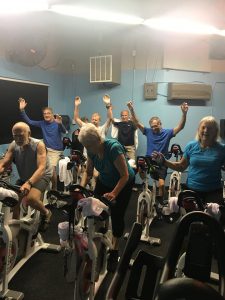
    Although  the primary exercise used during this study was the treadmill, Kathy, our Parkinson’s cycling instructor immediately figured that we can step up our cycling program to include high intensity intervals and start raising our aerobic fitness level.  So, even though many of us thought we were doing high intensity training already (well at least I did), she started pushing us to reach the 80 – 85% heart rate after Thanksgiving.  Almost every workout has incorporated HIIT and I am already starting to see a change in just 6 weeks.  The first few sessions I found I had to lower the gear to finish the workout.  But each time I felt I was getting stronger and this week I was able to increase instead of decrease the gear and still maintain the required 80 – 90 RPM.  I am happy with that progress and I am noticing a reduction in my symptoms after exercise including not feeling ‘off’ a half hour or so before it’s time to take my medicines on the day of exercise.

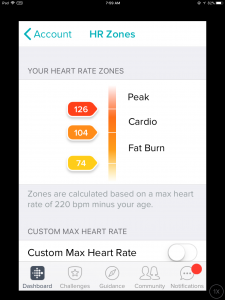
    But I wondered what is happening to my aerobic fitness?  Then I discovered that my Fitbit app is keeping track of my cardio fitness! The app determined my heart rate zones and then uses those zones and my resting heart rate to compute a cardio fitness score.  As you can see in this screen shot on the left, Fitbit has determined that, for me,  a heart rate greater than 126 is my peak zone and my cardio zone is 104 – 125.  The peak range is approximately 80% of my maximum heart rate so anything above that would be considered high intensity exercise.

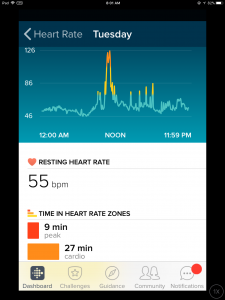
    The app also graphs my heart rate for the entire day so I can tell from that graph how long I was in the peak zone.  The screen shot on the left is for 1/2/18 which includes a cycling class. 

    November 16, 2017
    January 2, 2018

    So I was in the ‘zone’ for 9 minutes during the class which corresponds to intervals where we pushed up to 85 or 90 RPM for short periods.

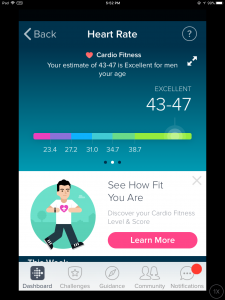
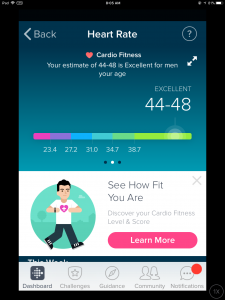
    And here are screen shots showing my cardio fitness as computed by Fitbit on November 16, 2017 and January 2, 2018. So, in theory, I’ve already improved my Cardio Fitness by a point since we started the HIIT.  But just as important is that fact that either score is considered excellent by Fitbit where the average score for men over 60 is 27.2 – 31.0. 


    Between cycling twice a week, playing tennis 2 -3 times a week and the Dance for PD class I am staying fit, slowing the progression of my Parkinson’s and having fun.  We will revisit my cardiac score in a month or so to see if the trend continues or maybe I’m maxed out!

    So my New Year’s resolution this year is the same as last year, keep exercising and keep fighting PD. By the way, if you are interested in Pedaling for Parkinson’s, check out this video from the Sarasota YMCA website of one of Kathy’s classes and watch us having fun doing intervals!

    “It does not matter how slowly you go as long as you do not stop.” – Confucius
     
  • Sarasota Happenings

    We have been busy with exercise, visitors and events since returning from Knoxville after Thanksgiving. 

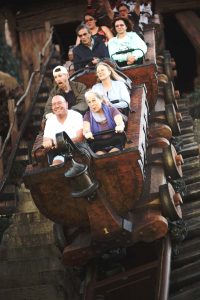
    Right after we returned, our friends Pat and Steve from Colorado arrived for a visit which included a trip to Walt Disney World where we met up with our mutual friends Ted, who also has Parkinson’s, and his wife Jan.  We spent two nice days at Epcot and the Magic Kingdom with light crowds so we actually got to ride the 7 Dwarfs Mine Train with only a 25 minute wait!  (That’s all six of us zipping down the hill) And we got a lot of exercise walking around the parks.

    We finished the visit up with our first trip to the Dali museum in St. Petersburg.   It contains the largest collection of his works outside of Spain, all donated by a couple who started collecting his work in 1940’s.  It was interesting to see his painting style change to surrealism as his career progressed.


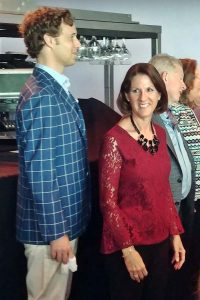
    This week we also attended Cause 4 Fashion, a lunch and fashion show to benefit the Neuro Challenge Foundation for Parkinson’s.  All of the models were either Parkinson’s patients or care persons and our friend Carolina was ‘on the runway’ again this year.  It was a well attended event and for a great cause.  Neuro Challenge sponsors over 30 monthly education and support programs in four Florida counties including our PD in Motion class and all at no charge.

    As always, we try to exercise at least 5 days a week. We attend  the PD in Motion dance class every week and play tennis at least 3 times a week.  I attend Pedaling for Parkinson’s at the YMCA and Mara does her weight training routine twice a week.   Kathy, our pedaling instructor, continues to push our class with new routines which keeps it interesting.  I am amazed at the improvement in my aerobic base since we returned in September.   I continue to see a reduction in symptoms for up to 24 hours after each class.  If you have a class near you I highly recommend adding it to your exercise routine.

    As you have probably noticed, I continue to play around with the format of the new site along with trying to find all of the broken links and missing photos.  This week I also updated the Resources page to reflect the merger of Parkinson’s Disease Foundation (PDF) and the National Parkinson’s Foundation (NPF) in to Parkinson’s Foundation. I  added a new resource website about hallucinations and delusions caused by PD.  The site is called more to parkinson’s  and is sponsored by Acadia Pharmaceuticals.   

    In case I don’t produce another post this year, I will take this opportunity to wish everyone a Happy Holidays!!  We hope 2018 will be a year of Peace, Joy, Good Health and Good will for us all. 

    “It does not matter how slowly you go as long as you do not stop.” – Confucius


Tom Isaacs Tribute

It has been over 4 months since my last post and it will take a couple of posts just to catch you up on what’s been happening this summer.  But first I wish to pay tribute to Tom Isaacs, co-founder of the Cure Parkinson’s Trust in the UK, who passed away suddenly May 31st at the age of 49.

We first met Tom at the Rally to the Challenge held at the Van Andel Institute in Grand Rapids in 2014 and again in 2015.  In 2016 we were present at the World Parkinson’s Congress in Portland where Tom received the award for Distinguished Contributions to the Parkinson’s Community.

Each time we came away inspired by his vision, by his energy and his sense of humor.  Tom always had a smile, always had a new idea, and was always leading the way to a cure for PD. ​​His optimism and enthusiasm were contagious and his boundless energy put the Energizer Bunny to shame. ​​It is hard to picture a world without Tom Isaacs and his determination to find a cure for PD.

The obituary printed below is from the Journal of Parkinson’s Disease, vol. 7, no. 3, pp. 409-410, 2017  and was published August 8, 2017.


Tom Isaacs was diagnosed with Parkinson’s at the young age of 26 and worked tirelessly to challenge the view that Parkinson’s was incurable, raising funds for research to trial new treatments and becoming one of the most well-known and popular international patient advocates.

Having completed a successful 1,250 mile sponsored walk in 1999, Tom was determined to use his Parkinson’s to achieve more in life than he could have done without it, leaving his job as Director of a London property company to undertake his Coastin’ challenge to raise funds for Parkinson’s research. He walked 4,500 miles around the British coastline, climbed the highest mountains in England, Scotland and Wales and ran the Flora London Marathon, raising over £350,000 for Parkinson’s research. He wrote a book, Shake Well Before Use about his walk and his experiences living with Parkinson’s which he conveys with passion, optimism and humour.

In 2004 he was awarded UK Charity Personality of the Year and a year later he helped to co-found The Cure Parkinson’s Trust (CPT), a patient-led charitable organisation of which he was President. The name alone challenged the view that Parkinson’s was incurable. “I still maintain that one day I will be able to insert the word ‘used to’ when I say I have Parkinson’s.” Tom said. Over ten years on and under Tom’s guidance, CPT is recognised as a key player in the world of research and has funded over $7.4 million of Parkinson’s research projects.

In the early days of CPT, Tom and the charity’s Director of Research and Development Dr Richard Wyse, forged ahead with international collaborations. The first was with Patrik Brundin (of the Van Andel Institute in Grand Rapids, Michigan) who they approached about developing a research programme to re-purpose existing drugs and investigate their potential to slow, stop or reverse Parkinson’s. Dr Brundin described Tom as “a beacon of light who guided us all doing Parkinson’s research, keeping us on track.” This project became the Linked Clinical Trials (LCT) initiative, now driven by a 14-strong international Committee of neurologists and Parkinson’s researchers. LCT is in its fifth year and to date there are eight drugs within the trial programme.

Once described as “the most expert patient” Tom was able to take part in scientific discussions at the highest level and his passion, charm and single-mindedness helped him earn the respect and support of such leading Parkinson’s researchers as Dr Patrik Brundin and Professors Andrew Lees, Anders Bjorkland, Roger Barker and Steven Gill.

Tom worked closely and successfully with many international organisations including the Van Andel Research Institute and the Michael J Fox Foundation. He was also a Board Member of the European Parkinson’s Disease Association from 2005 until 2010.

Tom was the first person with Parkinson’s to speak at the World Parkinson Congress in 2006. He has attended and presented at every WPC since and was also the patient representative on the Steering Committee and chaired the Patient Advocacy Committee for the World Parkinson Congress in 2010 and 2013. “He was a leader from the day of his diagnosis and he dreamed about helping others with PD to also become leaders to march alongside him in his journey to end Parkinson’s disease.” says Eli Pollard, Executive Director of the World Parkinson Coalition. At the 2016 World Parkinson Congress, Tom was awarded the inaugural prize for Distinguished Contribution to the Parkinson’s Community.

He was also a leading contributor to the SENSE-PARK project in 2011, a European funded initiative which established more personalised, objective measuring devices for people with Parkinson’s and those who treat them. He co-founded Parkinson’s Movement, which provided a voice for people with Parkinson’s and has made progress in addressing some of the problems experienced in clinical trials – in particular, recruitment and outcome measures.

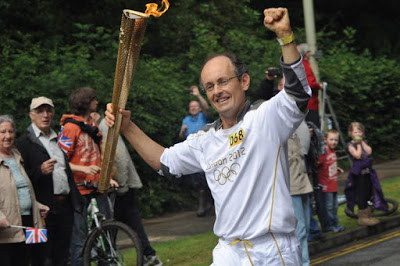
In 2012 Tom was awarded the prestigious, Dr Rana International Parkinson’s Community Service Award and was also one of the torchbearers in the run up to the 2012 Olympic Games.

Tom has written articles and been published in the Lancet Neurology, the Journal of Clinical Investigations and the Journal of Parkinson’s Disease for which he was on the editorial board.

He was married to Lyndsey, an acupuncturist and former nurse who fully embraced Tom’s vision and was an advocate for Parkinson’s in her own right. Her phenomenal support for Tom enabled them to travel extensively to attend conferences and meetings at which Tom gave speeches and presentations about the urgent need for a cure, the power of advocacy in research and the impact of living with Parkinson’s. Tom and Lyndsey not only shared a vision but also a wonderful sense of humour, friendship and fun.

Perhaps most important of all, Tom inspired people with Parkinson’s, giving hope that a cure will be found and a belief that the patient voice was being heard. He spoke openly about his condition and helped fellow patients understand they were not alone, describing hope as ‘the best medicine of all.’ As one CPT supporter said, “The PD world has lost a hero and a trailblazer.”

Tom Isaacs, co-founder and President of The Cure Parkinson’s Trust was born on April 2 1968 and died on May 31st, 2017, aged 49.

As you can see from his obituary, Tom was a visionary with a unique ability to pull together the people needed to make a vision become a reality. He was one of my Everyday Hero’s and, while he will be missed, his vision to find a cure will continue on through the work of the Cure Parkinson’s Trust.

Stay tuned for my next post and we will start to catch up on what else has been happening for the last four months!

“It does not matter how slowly you go as long as you do not stop.” – Confucius

Tom Isaacs Tribute

It has been over 4 months since my last post and it will take a couple of posts just to catch you up on what’s been happening this summer.  But first I wish to pay tribute to Tom Isaacs, co-founder of the Cure Parkinson’s Trust in the UK, who passed away suddenly May 31st at the age of 49.

We first met Tom at the Rally to the Challenge held at the Van Andel Institute in Grand Rapids in 2014 and again in 2015.  In 2016 we were present at the World Parkinson’s Congress in Portland where Tom received the award for Distinguished Contributions to the Parkinson’s Community.

Each time we came away inspired by his vision, by his energy and his sense of humor.  Tom always had a smile, always had a new idea, and was always leading the way to a cure for PD. ​​His optimism and enthusiasm were contagious and his boundless energy put the Energizer Bunny to shame. ​​It is hard to picture a world without Tom Isaacs and his determination to find a cure for PD.

The obituary printed below is from the Journal of Parkinson’s Disease, vol. 7, no. 3, pp. 409-410, 2017  and was published August 8, 2017.


Tom Isaacs was diagnosed with Parkinson’s at the young age of 26 and worked tirelessly to challenge the view that Parkinson’s was incurable, raising funds for research to trial new treatments and becoming one of the most well-known and popular international patient advocates.

Having completed a successful 1,250 mile sponsored walk in 1999, Tom was determined to use his Parkinson’s to achieve more in life than he could have done without it, leaving his job as Director of a London property company to undertake his Coastin’ challenge to raise funds for Parkinson’s research. He walked 4,500 miles around the British coastline, climbed the highest mountains in England, Scotland and Wales and ran the Flora London Marathon, raising over £350,000 for Parkinson’s research. He wrote a book, Shake Well Before Use about his walk and his experiences living with Parkinson’s which he conveys with passion, optimism and humour.

In 2004 he was awarded UK Charity Personality of the Year and a year later he helped to co-found The Cure Parkinson’s Trust (CPT), a patient-led charitable organisation of which he was President. The name alone challenged the view that Parkinson’s was incurable. “I still maintain that one day I will be able to insert the word ‘used to’ when I say I have Parkinson’s.” Tom said. Over ten years on and under Tom’s guidance, CPT is recognised as a key player in the world of research and has funded over $7.4 million of Parkinson’s research projects.

In the early days of CPT, Tom and the charity’s Director of Research and Development Dr Richard Wyse, forged ahead with international collaborations. The first was with Patrik Brundin (of the Van Andel Institute in Grand Rapids, Michigan) who they approached about developing a research programme to re-purpose existing drugs and investigate their potential to slow, stop or reverse Parkinson’s. Dr Brundin described Tom as “a beacon of light who guided us all doing Parkinson’s research, keeping us on track.” This project became the Linked Clinical Trials (LCT) initiative, now driven by a 14-strong international Committee of neurologists and Parkinson’s researchers. LCT is in its fifth year and to date there are eight drugs within the trial programme.

Once described as “the most expert patient” Tom was able to take part in scientific discussions at the highest level and his passion, charm and single-mindedness helped him earn the respect and support of such leading Parkinson’s researchers as Dr Patrik Brundin and Professors Andrew Lees, Anders Bjorkland, Roger Barker and Steven Gill.

Tom worked closely and successfully with many international organisations including the Van Andel Research Institute and the Michael J Fox Foundation. He was also a Board Member of the European Parkinson’s Disease Association from 2005 until 2010.

Tom was the first person with Parkinson’s to speak at the World Parkinson Congress in 2006. He has attended and presented at every WPC since and was also the patient representative on the Steering Committee and chaired the Patient Advocacy Committee for the World Parkinson Congress in 2010 and 2013. “He was a leader from the day of his diagnosis and he dreamed about helping others with PD to also become leaders to march alongside him in his journey to end Parkinson’s disease.” says Eli Pollard, Executive Director of the World Parkinson Coalition. At the 2016 World Parkinson Congress, Tom was awarded the inaugural prize for Distinguished Contribution to the Parkinson’s Community.

He was also a leading contributor to the SENSE-PARK project in 2011, a European funded initiative which established more personalised, objective measuring devices for people with Parkinson’s and those who treat them. He co-founded Parkinson’s Movement, which provided a voice for people with Parkinson’s and has made progress in addressing some of the problems experienced in clinical trials – in particular, recruitment and outcome measures.

In 2012 Tom was awarded the prestigious, Dr Rana International Parkinson’s Community Service Award and was also one of the torchbearers in the run up to the 2012 Olympic Games.

Tom has written articles and been published in the Lancet Neurology, the Journal of Clinical Investigations and the Journal of Parkinson’s Disease for which he was on the editorial board.

He was married to Lyndsey, an acupuncturist and former nurse who fully embraced Tom’s vision and was an advocate for Parkinson’s in her own right. Her phenomenal support for Tom enabled them to travel extensively to attend conferences and meetings at which Tom gave speeches and presentations about the urgent need for a cure, the power of advocacy in research and the impact of living with Parkinson’s. Tom and Lyndsey not only shared a vision but also a wonderful sense of humour, friendship and fun.

Perhaps most important of all, Tom inspired people with Parkinson’s, giving hope that a cure will be found and a belief that the patient voice was being heard. He spoke openly about his condition and helped fellow patients understand they were not alone, describing hope as ‘the best medicine of all.’ As one CPT supporter said, “The PD world has lost a hero and a trailblazer.”

Tom Isaacs, co-founder and President of The Cure Parkinson’s Trust was born on April 2 1968 and died on May 31st, 2017, aged 49.

As you can see from his obituary, Tom was a visionary with a unique ability to pull together the people needed to make a vision become a reality. He was one of my Everyday Hero’s and, while he will be missed, his vision to find a cure will continue on through the work of the Cure Parkinson’s Trust.

Stay tuned for my next post and we will start to catch up on what else has been happening for the last four months!

“It does not matter how slowly you go as long as you do not stop.” – Confucius

Tom Isaacs Tribute

It has been over 4 months since my last post and it will take a couple of posts just to catch you up on what’s been happening this summer.  But first I wish to pay tribute to Tom Isaacs, co-founder of the Cure Parkinson’s Trust in the UK, who passed away suddenly May 31st at the age of 49.

We first met Tom at the Rally to the Challenge held at the Van Andel Institute in Grand Rapids in 2014 and again in 2015.  In 2016 we were present at the World Parkinson’s Congress in Portland where Tom received the award for Distinguished Contributions to the Parkinson’s Community.

Each time we came away inspired by his vision, by his energy and his sense of humor.  Tom always had a smile, always had a new idea, and was always leading the way to a cure for PD. ​​His optimism and enthusiasm were contagious and his boundless energy put the Energizer Bunny to shame. ​​It is hard to picture a world without Tom Isaacs and his determination to find a cure for PD.

The obituary printed below is from the Journal of Parkinson’s Disease, vol. 7, no. 3, pp. 409-410, 2017  and was published August 8, 2017.


Tom Isaacs was diagnosed with Parkinson’s at the young age of 26 and worked tirelessly to challenge the view that Parkinson’s was incurable, raising funds for research to trial new treatments and becoming one of the most well-known and popular international patient advocates.

Having completed a successful 1,250 mile sponsored walk in 1999, Tom was determined to use his Parkinson’s to achieve more in life than he could have done without it, leaving his job as Director of a London property company to undertake his Coastin’ challenge to raise funds for Parkinson’s research. He walked 4,500 miles around the British coastline, climbed the highest mountains in England, Scotland and Wales and ran the Flora London Marathon, raising over £350,000 for Parkinson’s research. He wrote a book, Shake Well Before Use about his walk and his experiences living with Parkinson’s which he conveys with passion, optimism and humour.

In 2004 he was awarded UK Charity Personality of the Year and a year later he helped to co-found The Cure Parkinson’s Trust (CPT), a patient-led charitable organisation of which he was President. The name alone challenged the view that Parkinson’s was incurable. “I still maintain that one day I will be able to insert the word ‘used to’ when I say I have Parkinson’s.” Tom said. Over ten years on and under Tom’s guidance, CPT is recognised as a key player in the world of research and has funded over $7.4 million of Parkinson’s research projects.

In the early days of CPT, Tom and the charity’s Director of Research and Development Dr Richard Wyse, forged ahead with international collaborations. The first was with Patrik Brundin (of the Van Andel Institute in Grand Rapids, Michigan) who they approached about developing a research programme to re-purpose existing drugs and investigate their potential to slow, stop or reverse Parkinson’s. Dr Brundin described Tom as “a beacon of light who guided us all doing Parkinson’s research, keeping us on track.” This project became the Linked Clinical Trials (LCT) initiative, now driven by a 14-strong international Committee of neurologists and Parkinson’s researchers. LCT is in its fifth year and to date there are eight drugs within the trial programme.

Once described as “the most expert patient” Tom was able to take part in scientific discussions at the highest level and his passion, charm and single-mindedness helped him earn the respect and support of such leading Parkinson’s researchers as Dr Patrik Brundin and Professors Andrew Lees, Anders Bjorkland, Roger Barker and Steven Gill.

Tom worked closely and successfully with many international organisations including the Van Andel Research Institute and the Michael J Fox Foundation. He was also a Board Member of the European Parkinson’s Disease Association from 2005 until 2010.

Tom was the first person with Parkinson’s to speak at the World Parkinson Congress in 2006. He has attended and presented at every WPC since and was also the patient representative on the Steering Committee and chaired the Patient Advocacy Committee for the World Parkinson Congress in 2010 and 2013. “He was a leader from the day of his diagnosis and he dreamed about helping others with PD to also become leaders to march alongside him in his journey to end Parkinson’s disease.” says Eli Pollard, Executive Director of the World Parkinson Coalition. At the 2016 World Parkinson Congress, Tom was awarded the inaugural prize for Distinguished Contribution to the Parkinson’s Community.

He was also a leading contributor to the SENSE-PARK project in 2011, a European funded initiative which established more personalised, objective measuring devices for people with Parkinson’s and those who treat them. He co-founded Parkinson’s Movement, which provided a voice for people with Parkinson’s and has made progress in addressing some of the problems experienced in clinical trials – in particular, recruitment and outcome measures.

In 2012 Tom was awarded the prestigious, Dr Rana International Parkinson’s Community Service Award and was also one of the torchbearers in the run up to the 2012 Olympic Games.

Tom has written articles and been published in the Lancet Neurology, the Journal of Clinical Investigations and the Journal of Parkinson’s Disease for which he was on the editorial board.

He was married to Lyndsey, an acupuncturist and former nurse who fully embraced Tom’s vision and was an advocate for Parkinson’s in her own right. Her phenomenal support for Tom enabled them to travel extensively to attend conferences and meetings at which Tom gave speeches and presentations about the urgent need for a cure, the power of advocacy in research and the impact of living with Parkinson’s. Tom and Lyndsey not only shared a vision but also a wonderful sense of humour, friendship and fun.

Perhaps most important of all, Tom inspired people with Parkinson’s, giving hope that a cure will be found and a belief that the patient voice was being heard. He spoke openly about his condition and helped fellow patients understand they were not alone, describing hope as ‘the best medicine of all.’ As one CPT supporter said, “The PD world has lost a hero and a trailblazer.”

Tom Isaacs, co-founder and President of The Cure Parkinson’s Trust was born on April 2 1968 and died on May 31st, 2017, aged 49.

As you can see from his obituary, Tom was a visionary with a unique ability to pull together the people needed to make a vision become a reality. He was one of my Everyday Hero’s and, while he will be missed, his vision to find a cure will continue on through the work of the Cure Parkinson’s Trust.

Stay tuned for my next post and we will start to catch up on what else has been happening for the last four months!

“It does not matter how slowly you go as long as you do not stop.” – Confucius