Last week was another great week at the beach. Our son, daughter-in-law and two granddaughters arrived on Saturday and we had a couple of great beach days and some pool time, when the weather cooperated, along with good food, good conversations and lots of just hanging out time. We managed a couple of trips to Capt Curt’s for clam chowder and celebrated Mara’s birthday at one of our favorite restaurants, Ophelia’s on the Bay. We were sorry to see them off for home in Seattle after a fun week.
Monday we attended a Parkinson’s event at the Asolo Theatre in Sarasota. The event was organized by Lynn Schramek, founder of the Parkinson’s Cafe. After getting to know everyone over coffee and cookies, we were treated to a backstage tour by Alex Suczewski that was fascinating. After a short history of the Asolo, we saw both stages, the rehearsal space, the green room, a dressing room, learned about costume design and saw the nifty way they move the sets back and forth on rails controlled by a computer. After the tour, we enjoyed a box lunch and a great presentation by actress Carolyn Michel who has been preforming at the Asolo for 25 years. After talking about her career and fielding our many questions, she performed a couple of monologues and it was amazing to see her drop right into the character, changing her voice and facial mannerisms to match. It was a wonderful event and we are looking forward to next month’s visit to the Sarasota Ballet.
On the Parkinson’s front, we are very pleased with the new medication routine. Our walk times to the same turn around point on the beach have dropped enough that we have moved the point further out. My rigidity is almost non existent most of the time and Mara has remarked that sometimes my walking speed is almost back to normal, we have even done a little jogging on the beach. The walking poles help with arm movement and walking erect. Studies continue to show that exercise is the best medication for PD, in fact, a Google search for scholarly studies using ‘Parkinsons and exercise’ produced 16,400 results, 617 in 2015 alone. My Doctor’s idea to add levadopa to my medication to reduce the motor symptoms so I would be able to exercise more seems to be paying off.A few weeks ago I was asked to be a guest blogger for HealthiVibe, LLC and my article was posted today and can be seen here. HealthiVibe is a firm helping design clinical trials with the premise that patients should play a more instrumental and active role in the design process and also throughout the patient journey, a topic I have blogged about in the past. I was excited to be able to add my voice to the need for changes in the clinical trial process. Which reminds me, don’t forget to sign up for the Fox Trial Finder, it’s easy and YOU are needed! See you next time.
“It does not matter how slowly you go as long as you do not stop.” – Confucius
Our first week at the beach is already over. 🙁 Last Saturday we attended the Parkinson’s Symposium sponsored by The Neuro Challenge Foundation and Sarasota Memorial Hospital. This is an annual event with 500+ attendees and included talks by recognized PD experts followed by a Q & A session afterwards. In between the talks we did two mini exercise sessions which included some voice exercises from the Loud portion of the Big and Loud program. We were joined at the meeting by Joel and Melissa whom we first met at Kripalu and then again here at the beach last year.
At the meeting we met Brad and Lynn Schramek who founded the Parkinson’s Cafe for the purpose of providing social, cultural and intellectual interaction for people with Parkinson’s disease and their families. This years events include a visit to the Asolo Repertory Theatre and a visit to the Sarasota Ballet. Both agendas look interesting so we have signed up to attend them both.
This week NPR (among others) talked about the benefits of exercise for Parkinson’s and so did all of the speakers at the Symposium. Since we arrived we have upped our exercise routine to include at least an hour walking plus Qi Gong and Tai Chi. During my recent Doctor visit, we discussed my lack of arm swing while walking and he suggested using walking poles to improve my posture and arm swing while walking. So this week I took delivery of a pair of Green Zen Nordic walking poles from York Nordic and they definitely help with the arm swing, posture and pace. I also started the Sinemet (Cardidopa/levodopa) at the beginning of the week and
I have noticed reduced rigidity and shuffle along with the improved walk times over last
year’s beach visits.
Also this week we have signed on to be Fox Trial Finder Ambassadors, which I’m sure comes as a surprise to regular readers 🙂 We are looking forward to helping spread the word about the importance of participating in clinical trials at support groups, events, informal meetings, and any other opportunities we get, like this blog.
This weekend, our granddaughters (oh and their parents) arrive from Seattle for a week of beach fun so I’m thinking it will be another fun and busy week! Thanks for reading.
“It does not matter how slowly you go as long as you do not stop.” – Confucius
For the last few months, Mara and I have been discussing changing neurologists with the idea of being seen by a Movement Disorder Specialist (MDS). I was seen by a MDS when we went to U of FL last year we felt that it was too far of a drive for regular appointments. The Vanderbilt Movement Disorder Clinic in Nashville is also an National Parkinson Foundation (NPF) Center of Excellence, they conduct a lot of Parkinson’s research and it is a two hour drive instead of ten, so we decided that was where I would go. So this week I met with Dr. Thomas Davis, a MDS and clinical researcher and Director of the Vanderbilt Movement Disorder Clinic. It was a very positive experience and we were quite impressed with Dr Davis and the Vanderbilt Movement Disorder Clinic staff.
After a simple check in process that took all of 5 minutes and only required my electronic signature on the usual forms, that’s right, I did not have to fill out any health history forms, who to contact, etc.! I had barely sat down when a nurse called me into an interview room where she took my BP, weight, and medical history once again without me having to fill out a form! She then took me to the examination room where we met Dr. Davis.
During the meeting with Dr Davis we discussed my PD history, what medication I was on and how it was working, what other symptoms I was having plus he performed the usual PD tests, finger and toe tapping, walking, etc. He also tested my cognitive skills and once again I passed! We then discussed my medication routine and he recommended I start taking levadopa/cardidopa along with a reduced dose of Mirapex four times a day instead of three. We were happy with this recommendation as it seemed the Mirapex has not been as effective in reducing my rigidity and I am taking the maximum dose. He also noted that exercise is still the best prescription for PwP and reducing the rigidity and other symptoms will allow me to up the exercise routine. The appointment lasted about 50 minutes and we came away feeling that he and the staff cared about me as a person and a patient and we had made the right decision to transfer to Dr Davis.
We also met with Kelly Arney, research outreach coordinator, whom I had been in contact with last year about a clinical trial sponsored by NPF to track the effects of treatment. I did not qualify then because the trial required participants to be seen by the Clinic, but now that I am a patient, I should be able to participate beginning with my next visit at the end of April. We also discussed upcoming clinical trials with both Dr Davis and Kelly and they will contact me if I meet the qualifications.
When I checked out, they had me sign up for access to their electronic health record system which gives me access to all of my records and a way to email Dr Davis. Again the process was simple and an employee walked me though the sign up at a terminal in the waiting area, then gave me full access to the system.
The NIH defines patient-centered care as follows: “health care that establishes a partnership among practitioners, patients, and their families (when appropriate) to ensure that decisions respect patients’ wants, needs and preferences and solicit patients’ input on the education and support they need to make decisions and participate in their own care.” The care we received at the Vanderbilt Medical Center Movement Disorder Clinic certainly fit the NIH definition.
And the positive experiences continued because Friday we checked into our ‘home away from home’ a villa on Siesta Key! Yes that’s right, we are at the BEACH! We will be attending a Parkinson’s symposium on Saturday and I also plan to sign up for the Big and Loud program while we are here so I will have plenty to blog about next time. Until then don’t forget to sign up for the Fox Trial Finder, we all have a stake in finding a cure.
“It does not matter how slowly you go as long as you do not stop.” – Confucius
It has been over 4 months since my last post and it will take a couple of posts just to catch you up on what’s been happening this summer. But first I wish to pay tribute to Tom Isaacs, co-founder of the Cure Parkinson’s Trust in the UK, who passed away suddenly May 31st at the age of 49.
We first met Tom at the Rally to the Challenge held at the Van Andel Institute in Grand Rapids in 2014 and again in 2015. In 2016 we were present at the World Parkinson’s Congress in Portland where Tom received the award for Distinguished Contributions to the Parkinson’s Community.
Each time we came away inspired by his vision, by his energy and his sense of humor. Tom always had a smile, always had a new idea, and was always leading the way to a cure for PD. His optimism and enthusiasm were contagious and his boundless energy put the Energizer Bunny to shame. It is hard to picture a world without Tom Isaacs and his determination to find a cure for PD.
The obituary printed below is from the Journal of Parkinson’s Disease, vol. 7, no. 3, pp. 409-410, 2017 and was published August 8, 2017.
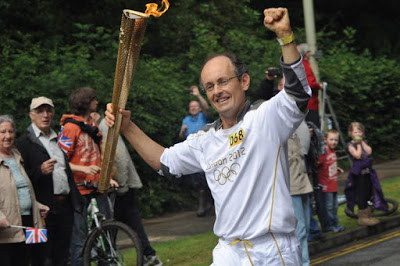
Tom Isaacs was diagnosed with Parkinson’s at the young age of 26 and worked tirelessly to challenge the view that Parkinson’s was incurable, raising funds for research to trial new treatments and becoming one of the most well-known and popular international patient advocates. Having completed a successful 1,250 mile sponsored walk in 1999, Tom was determined to use his Parkinson’s to achieve more in life than he could have done without it, leaving his job as Director of a London property company to undertake his Coastin’ challenge to raise funds for Parkinson’s research. He walked 4,500 miles around the British coastline, climbed the highest mountains in England, Scotland and Wales and ran the Flora London Marathon, raising over £350,000 for Parkinson’s research. He wrote a book, Shake Well Before Use about his walk and his experiences living with Parkinson’s which he conveys with passion, optimism and humour. In 2004 he was awarded UK Charity Personality of the Year and a year later he helped to co-found The Cure Parkinson’s Trust (CPT), a patient-led charitable organisation of which he was President. The name alone challenged the view that Parkinson’s was incurable. “I still maintain that one day I will be able to insert the word ‘used to’ when I say I have Parkinson’s.” Tom said. Over ten years on and under Tom’s guidance, CPT is recognised as a key player in the world of research and has funded over $7.4 million of Parkinson’s research projects. In the early days of CPT, Tom and the charity’s Director of Research and Development Dr Richard Wyse, forged ahead with international collaborations. The first was with Patrik Brundin (of the Van Andel Institute in Grand Rapids, Michigan) who they approached about developing a research programme to re-purpose existing drugs and investigate their potential to slow, stop or reverse Parkinson’s. Dr Brundin described Tom as “a beacon of light who guided us all doing Parkinson’s research, keeping us on track.” This project became the Linked Clinical Trials (LCT) initiative, now driven by a 14-strong international Committee of neurologists and Parkinson’s researchers. LCT is in its fifth year and to date there are eight drugs within the trial programme. Once described as “the most expert patient” Tom was able to take part in scientific discussions at the highest level and his passion, charm and single-mindedness helped him earn the respect and support of such leading Parkinson’s researchers as Dr Patrik Brundin and Professors Andrew Lees, Anders Bjorkland, Roger Barker and Steven Gill. Tom worked closely and successfully with many international organisations including the Van Andel Research Institute and the Michael J Fox Foundation. He was also a Board Member of the European Parkinson’s Disease Association from 2005 until 2010. Tom was the first person with Parkinson’s to speak at the World Parkinson Congress in 2006. He has attended and presented at every WPC since and was also the patient representative on the Steering Committee and chaired the Patient Advocacy Committee for the World Parkinson Congress in 2010 and 2013. “He was a leader from the day of his diagnosis and he dreamed about helping others with PD to also become leaders to march alongside him in his journey to end Parkinson’s disease.” says Eli Pollard, Executive Director of the World Parkinson Coalition. At the 2016 World Parkinson Congress, Tom was awarded the inaugural prize for Distinguished Contribution to the Parkinson’s Community. He was also a leading contributor to the SENSE-PARK project in 2011, a European funded initiative which established more personalised, objective measuring devices for people with Parkinson’s and those who treat them. He co-founded Parkinson’s Movement, which provided a voice for people with Parkinson’s and has made progress in addressing some of the problems experienced in clinical trials – in particular, recruitment and outcome measures. In 2012 Tom was awarded the prestigious, Dr Rana International Parkinson’s Community Service Award and was also one of the torchbearers in the run up to the 2012 Olympic Games. Tom has written articles and been published in the Lancet Neurology, the Journal of Clinical Investigations and the Journal of Parkinson’s Disease for which he was on the editorial board. He was married to Lyndsey, an acupuncturist and former nurse who fully embraced Tom’s vision and was an advocate for Parkinson’s in her own right. Her phenomenal support for Tom enabled them to travel extensively to attend conferences and meetings at which Tom gave speeches and presentations about the urgent need for a cure, the power of advocacy in research and the impact of living with Parkinson’s. Tom and Lyndsey not only shared a vision but also a wonderful sense of humour, friendship and fun. Perhaps most important of all, Tom inspired people with Parkinson’s, giving hope that a cure will be found and a belief that the patient voice was being heard. He spoke openly about his condition and helped fellow patients understand they were not alone, describing hope as ‘the best medicine of all.’ As one CPT supporter said, “The PD world has lost a hero and a trailblazer.” Tom Isaacs, co-founder and President of The Cure Parkinson’s Trust was born on April 2 1968 and died on May 31st, 2017, aged 49.
As you can see from his obituary, Tom was a visionary with a unique ability to pull together the people needed to make a vision become a reality. He was one of my Everyday Hero’s and, while he will be missed, his vision to find a cure will continue on through the work of the Cure Parkinson’s Trust.
Stay tuned for my next post and we will start to catch up on what else has been happening for the last four months!
“It does not matter how slowly you go as long as you do not stop.” – Confucius
It has been over 4 months since my last post and it will take a couple of posts just to catch you up on what’s been happening this summer. But first I wish to pay tribute to Tom Isaacs, co-founder of the Cure Parkinson’s Trust in the UK, who passed away suddenly May 31st at the age of 49.
We first met Tom at the Rally to the Challenge held at the Van Andel Institute in Grand Rapids in 2014 and again in 2015. In 2016 we were present at the World Parkinson’s Congress in Portland where Tom received the award for Distinguished Contributions to the Parkinson’s Community.
Each time we came away inspired by his vision, by his energy and his sense of humor. Tom always had a smile, always had a new idea, and was always leading the way to a cure for PD. His optimism and enthusiasm were contagious and his boundless energy put the Energizer Bunny to shame. It is hard to picture a world without Tom Isaacs and his determination to find a cure for PD.
The obituary printed below is from the Journal of Parkinson’s Disease, vol. 7, no. 3, pp. 409-410, 2017 and was published August 8, 2017.
Tom Isaacs was diagnosed with Parkinson’s at the young age of 26 and worked tirelessly to challenge the view that Parkinson’s was incurable, raising funds for research to trial new treatments and becoming one of the most well-known and popular international patient advocates. Having completed a successful 1,250 mile sponsored walk in 1999, Tom was determined to use his Parkinson’s to achieve more in life than he could have done without it, leaving his job as Director of a London property company to undertake his Coastin’ challenge to raise funds for Parkinson’s research. He walked 4,500 miles around the British coastline, climbed the highest mountains in England, Scotland and Wales and ran the Flora London Marathon, raising over £350,000 for Parkinson’s research. He wrote a book, Shake Well Before Use about his walk and his experiences living with Parkinson’s which he conveys with passion, optimism and humour. In 2004 he was awarded UK Charity Personality of the Year and a year later he helped to co-found The Cure Parkinson’s Trust (CPT), a patient-led charitable organisation of which he was President. The name alone challenged the view that Parkinson’s was incurable. “I still maintain that one day I will be able to insert the word ‘used to’ when I say I have Parkinson’s.” Tom said. Over ten years on and under Tom’s guidance, CPT is recognised as a key player in the world of research and has funded over $7.4 million of Parkinson’s research projects. In the early days of CPT, Tom and the charity’s Director of Research and Development Dr Richard Wyse, forged ahead with international collaborations. The first was with Patrik Brundin (of the Van Andel Institute in Grand Rapids, Michigan) who they approached about developing a research programme to re-purpose existing drugs and investigate their potential to slow, stop or reverse Parkinson’s. Dr Brundin described Tom as “a beacon of light who guided us all doing Parkinson’s research, keeping us on track.” This project became the Linked Clinical Trials (LCT) initiative, now driven by a 14-strong international Committee of neurologists and Parkinson’s researchers. LCT is in its fifth year and to date there are eight drugs within the trial programme. Once described as “the most expert patient” Tom was able to take part in scientific discussions at the highest level and his passion, charm and single-mindedness helped him earn the respect and support of such leading Parkinson’s researchers as Dr Patrik Brundin and Professors Andrew Lees, Anders Bjorkland, Roger Barker and Steven Gill. Tom worked closely and successfully with many international organisations including the Van Andel Research Institute and the Michael J Fox Foundation. He was also a Board Member of the European Parkinson’s Disease Association from 2005 until 2010. Tom was the first person with Parkinson’s to speak at the World Parkinson Congress in 2006. He has attended and presented at every WPC since and was also the patient representative on the Steering Committee and chaired the Patient Advocacy Committee for the World Parkinson Congress in 2010 and 2013. “He was a leader from the day of his diagnosis and he dreamed about helping others with PD to also become leaders to march alongside him in his journey to end Parkinson’s disease.” says Eli Pollard, Executive Director of the World Parkinson Coalition. At the 2016 World Parkinson Congress, Tom was awarded the inaugural prize for Distinguished Contribution to the Parkinson’s Community. He was also a leading contributor to the SENSE-PARK project in 2011, a European funded initiative which established more personalised, objective measuring devices for people with Parkinson’s and those who treat them. He co-founded Parkinson’s Movement, which provided a voice for people with Parkinson’s and has made progress in addressing some of the problems experienced in clinical trials – in particular, recruitment and outcome measures. In 2012 Tom was awarded the prestigious, Dr Rana International Parkinson’s Community Service Award and was also one of the torchbearers in the run up to the 2012 Olympic Games. Tom has written articles and been published in the Lancet Neurology, the Journal of Clinical Investigations and the Journal of Parkinson’s Disease for which he was on the editorial board. He was married to Lyndsey, an acupuncturist and former nurse who fully embraced Tom’s vision and was an advocate for Parkinson’s in her own right. Her phenomenal support for Tom enabled them to travel extensively to attend conferences and meetings at which Tom gave speeches and presentations about the urgent need for a cure, the power of advocacy in research and the impact of living with Parkinson’s. Tom and Lyndsey not only shared a vision but also a wonderful sense of humour, friendship and fun. Perhaps most important of all, Tom inspired people with Parkinson’s, giving hope that a cure will be found and a belief that the patient voice was being heard. He spoke openly about his condition and helped fellow patients understand they were not alone, describing hope as ‘the best medicine of all.’ As one CPT supporter said, “The PD world has lost a hero and a trailblazer.” Tom Isaacs, co-founder and President of The Cure Parkinson’s Trust was born on April 2 1968 and died on May 31st, 2017, aged 49.
As you can see from his obituary, Tom was a visionary with a unique ability to pull together the people needed to make a vision become a reality. He was one of my Everyday Hero’s and, while he will be missed, his vision to find a cure will continue on through the work of the Cure Parkinson’s Trust.
Stay tuned for my next post and we will start to catch up on what else has been happening for the last four months!
“It does not matter how slowly you go as long as you do not stop.” – Confucius
It has been over 4 months since my last post and it will take a couple of posts just to catch you up on what’s been happening this summer. But first I wish to pay tribute to Tom Isaacs, co-founder of the Cure Parkinson’s Trust in the UK, who passed away suddenly May 31st at the age of 49.
We first met Tom at the Rally to the Challenge held at the Van Andel Institute in Grand Rapids in 2014 and again in 2015. In 2016 we were present at the World Parkinson’s Congress in Portland where Tom received the award for Distinguished Contributions to the Parkinson’s Community.
Each time we came away inspired by his vision, by his energy and his sense of humor. Tom always had a smile, always had a new idea, and was always leading the way to a cure for PD. His optimism and enthusiasm were contagious and his boundless energy put the Energizer Bunny to shame. It is hard to picture a world without Tom Isaacs and his determination to find a cure for PD.
The obituary printed below is from the Journal of Parkinson’s Disease, vol. 7, no. 3, pp. 409-410, 2017 and was published August 8, 2017.
Tom Isaacs was diagnosed with Parkinson’s at the young age of 26 and worked tirelessly to challenge the view that Parkinson’s was incurable, raising funds for research to trial new treatments and becoming one of the most well-known and popular international patient advocates. Having completed a successful 1,250 mile sponsored walk in 1999, Tom was determined to use his Parkinson’s to achieve more in life than he could have done without it, leaving his job as Director of a London property company to undertake his Coastin’ challenge to raise funds for Parkinson’s research. He walked 4,500 miles around the British coastline, climbed the highest mountains in England, Scotland and Wales and ran the Flora London Marathon, raising over £350,000 for Parkinson’s research. He wrote a book, Shake Well Before Use about his walk and his experiences living with Parkinson’s which he conveys with passion, optimism and humour. In 2004 he was awarded UK Charity Personality of the Year and a year later he helped to co-found The Cure Parkinson’s Trust (CPT), a patient-led charitable organisation of which he was President. The name alone challenged the view that Parkinson’s was incurable. “I still maintain that one day I will be able to insert the word ‘used to’ when I say I have Parkinson’s.” Tom said. Over ten years on and under Tom’s guidance, CPT is recognised as a key player in the world of research and has funded over $7.4 million of Parkinson’s research projects. In the early days of CPT, Tom and the charity’s Director of Research and Development Dr Richard Wyse, forged ahead with international collaborations. The first was with Patrik Brundin (of the Van Andel Institute in Grand Rapids, Michigan) who they approached about developing a research programme to re-purpose existing drugs and investigate their potential to slow, stop or reverse Parkinson’s. Dr Brundin described Tom as “a beacon of light who guided us all doing Parkinson’s research, keeping us on track.” This project became the Linked Clinical Trials (LCT) initiative, now driven by a 14-strong international Committee of neurologists and Parkinson’s researchers. LCT is in its fifth year and to date there are eight drugs within the trial programme. Once described as “the most expert patient” Tom was able to take part in scientific discussions at the highest level and his passion, charm and single-mindedness helped him earn the respect and support of such leading Parkinson’s researchers as Dr Patrik Brundin and Professors Andrew Lees, Anders Bjorkland, Roger Barker and Steven Gill. Tom worked closely and successfully with many international organisations including the Van Andel Research Institute and the Michael J Fox Foundation. He was also a Board Member of the European Parkinson’s Disease Association from 2005 until 2010. Tom was the first person with Parkinson’s to speak at the World Parkinson Congress in 2006. He has attended and presented at every WPC since and was also the patient representative on the Steering Committee and chaired the Patient Advocacy Committee for the World Parkinson Congress in 2010 and 2013. “He was a leader from the day of his diagnosis and he dreamed about helping others with PD to also become leaders to march alongside him in his journey to end Parkinson’s disease.” says Eli Pollard, Executive Director of the World Parkinson Coalition. At the 2016 World Parkinson Congress, Tom was awarded the inaugural prize for Distinguished Contribution to the Parkinson’s Community. He was also a leading contributor to the SENSE-PARK project in 2011, a European funded initiative which established more personalised, objective measuring devices for people with Parkinson’s and those who treat them. He co-founded Parkinson’s Movement, which provided a voice for people with Parkinson’s and has made progress in addressing some of the problems experienced in clinical trials – in particular, recruitment and outcome measures. In 2012 Tom was awarded the prestigious, Dr Rana International Parkinson’s Community Service Award and was also one of the torchbearers in the run up to the 2012 Olympic Games. Tom has written articles and been published in the Lancet Neurology, the Journal of Clinical Investigations and the Journal of Parkinson’s Disease for which he was on the editorial board. He was married to Lyndsey, an acupuncturist and former nurse who fully embraced Tom’s vision and was an advocate for Parkinson’s in her own right. Her phenomenal support for Tom enabled them to travel extensively to attend conferences and meetings at which Tom gave speeches and presentations about the urgent need for a cure, the power of advocacy in research and the impact of living with Parkinson’s. Tom and Lyndsey not only shared a vision but also a wonderful sense of humour, friendship and fun. Perhaps most important of all, Tom inspired people with Parkinson’s, giving hope that a cure will be found and a belief that the patient voice was being heard. He spoke openly about his condition and helped fellow patients understand they were not alone, describing hope as ‘the best medicine of all.’ As one CPT supporter said, “The PD world has lost a hero and a trailblazer.” Tom Isaacs, co-founder and President of The Cure Parkinson’s Trust was born on April 2 1968 and died on May 31st, 2017, aged 49.
As you can see from his obituary, Tom was a visionary with a unique ability to pull together the people needed to make a vision become a reality. He was one of my Everyday Hero’s and, while he will be missed, his vision to find a cure will continue on through the work of the Cure Parkinson’s Trust.
Stay tuned for my next post and we will start to catch up on what else has been happening for the last four months!
“It does not matter how slowly you go as long as you do not stop.” – Confucius

 Last week was another great week at the beach. Our son, daughter-in-law and two granddaughters arrived on Saturday and we had a couple of great beach days and some pool time, when the weather cooperated, along with good food, good conversations and lots of just hanging out time. We managed a couple of trips to Capt Curt’s for clam chowder and celebrated Mara’s birthday at one of our favorite restaurants, Ophelia’s on the Bay. We were sorry to see them off for home in Seattle after a fun week.