• Brrrr, It’s Cold!

    Like most of the country this week, we are experiencing bone chilling cold here in East Tennessee. The highs have been under 30 degrees and the lows in the single digits. Not as cold as our neighbors to the north but darn cold after returning home from sunny, warm San Diego.  To add insult to injury (so to speak) our heater decided to stop working yesterday evening so we woke up to a toasty 52 in the house this morning.  Luckily I was able to contact our heat and air repair shop before they closed last night and someone was here by 8:15 this morning and we are back up and warming.
     
    I hope everyone had a enjoyable holiday season, we certainly enjoyed our visit in Seattle which included watching our granddaughter perform in the Nutcracker Ballet, a early Christmas and watching Seahawk and Bronco football.  Christmas in San Diego was nice and warm and included good company, good food and drink and trips to the beach most evenings to watch the sunset and the gray whales making their way south.
     
    It is a new year and a lot of exciting things are happening in Parkinson’s research and treatment. Here are a few examples
    • The FDA just approved Rytary, a slow release levodopa medication that reduces ‘off’ time and dyskinesa.
    • The personal DNA company 23andMe and Genentech have entered into an agreement for Genentech to completely sequence the genome of 3000 people with Parkinson’s with a goal to identify new therapeutic targets for treating Parkinson’s disease.  Currently they have only analyzed about 750,000 genetic data points in any given individuals genome (I was genotyped, not fully sequenced). This new, whole genome sequencing, will allow them to review 3 billion genetic data points within the genome of each participant.
    • NeuroDerm Ltd’s new way to deliver levodopa through a belt worn pump is showing promise as it maintains a consistent dose of levodopa reducing motor complications.
    • The Parkinson’s Disease Foundation has paired with Nature Publishing Group to publish npj Parkinson’s Disease, a new open access, online-only,research journal is dedicated to highlighting the most important scientific advances in Parkinson’s disease research.
    • The Davis Phinney Foundation has released an Ebook version of Every Victory Counts, a manual that gives people living with Parkinson’s – and their caregivers and family members – the tools they need to take control of their own
      Parkinson’s treatment through a proactive approach to self-care.  The book is available free of charge in Ebook or print form here on the Foundation website.
    • And a recent white paper issued by One Research found that patient empowerment is crucial to clinical trial recruitment. The report – which draws on insights from a wide range of stakeholders  including the clinical research sector, pharma, CROs, and patient advocacy groups – says the industry must improve its communication to
      patients, not only to raise awareness of the available opportunities to get involved in clinical research, but also to reassure them of the vital importance of their role. Also, the approach must be truly patient-centric, “ensuring that the priority of research professionals is to work in the interests of the patients”. Sound familiar? You can read more and download a copy of the study here.
     I could go on, but these examples give me hope that 2015 will be the year of the cure! If you haven’t signed up for Fox Trial Finder, you can do so here.  Please join me and 40,000+ other PwP’s supporting the search for a cure.  By the way, if you haven’t signed up for this year’s Mary-Thon exercise program, you still have time to get in corral one which started this week.  Read all about and sign up here.
     
     
    Happy New Year!
     
    “It does not matter how slowly you go as long as you do not stop.” – Confucius

     
     
  • Happy Holidays!

    Wow, here it is almost Christmas,  this year has just sailed by.  We are in Seattle to visit family, see our granddaughter dance in The Nutcracker and have an early Christmas before we go on to San Diego to visit more family and celebrate more Christmas!  I just wanted to take a moment and wish everyone a Happy Holiday Season.  This is a magical time of year and I hope you all enjoy  time with family and friends.  Thank you all for your support and positive thoughts as I continue my journey with Parkinson’s Disease.
    PS: Don’t forget, sign up for the Fox Trial Finder here!  Lets make 2015 the year of the CURE!
    PPS: It’s also time to sign up for the 2015 Mary-thon, an event that provides you with a reason to exercise at least 30 minutes a day,  5 days a week for 26 weeks. I wrote about the Mary-Thon last year in this post . No running is required, any form of exercise qualifies and a portion of your entry fee goes to Project Linus, a non-profit organization with chapters around the country that provide blankets to children who are seriously ill, traumatized, or in needy situations. Click on this link for more information about Project Linus and this link to sign up for the 2015 Mary-Thon which starts January 4th.
    Thanks again and have a Merry Christmas and a Happy New Year!
  • Volunteer and Help Find a Cure for PD!


    As promised in the last post, today I will discuss our experiences with clinical trials and the Fox Trial Finder (FTF) web application.  But first, are you on Fox Trial Finder? If not, click on this link and sign up today!  Currently there are 475 trials listed on FTF taking place in locations around the world. They include interventional trials (reducing tremor or dyskinesia, Tai Chi for balance, tele-medicine, etc.) and observational trials (bio markers, brain mapping, genetic research, wearable devices to measure PD, etc.). When you sign up for FTF you create a profile with information such as length of time with PD, medications, symptoms, and how far you are willing to travel to participate.  FTF then matches you to trials that fit your profile.  And don’t forget, most trials need control volunteers too so sign up your family and friends! Ready to sign up? Click on this link now! I’ll be here when you come back.

    Welcome back! Mara and I recently participated in an observational study titled LRRK2 and Other Novel Exosome Proteins in Parkinson’s Disease conducted by the University of Alabama at Birmingham.  The main purpose of this study is to determine whether there are biomarkers associated with Parkinson’s disease susceptibility and/or progression in exosome-proteomes derived from PD patients that will assist with future LRRK2 inhibitor clinical trials.  You can read the full description here on FTF but it’s not exactly written in layman’s terms. (Maybe this could be a simple change to the process?)

    After arriving at the UAB Medical Campus we were met by Rachel Clark who is coordinating the research study.  She went over the research protocol and we signed the consent forms; she then asked us questions about our general health and medications we take.  We both completed the Uniform Parkinson’s Disease Rating Scale (UPDRS) patient questionnaire and we were each given the Montreal Cognitive assessment. Then we took the Parkinson’s Smell Test which Mara did fine on and, surprise surprise, I didn’t.  Out of 40 samples I got 10 correct while Mara got 37. I was able to identify two odors and the rest were just lucky guesses. I was also given the general physical tests for PD (tap your fingers & toes, walk down the hall, etc.) and we both provided blood and urine samples.  That was it!  One and a half hours and we had provided them with the necessary information and samples and completed our first clinical trial! It wasn’t time consuming, I didn’t have to worry about receiving a placebo or changing my medications, and I was only poked enough to provide 1 ounce of blood.

    Many of the trials listed on FTF are observational studies like this one and seven are web based like the other trial I am participating in – Smartphone-PD. All of them provide valuable information in the search for a cure and all need participants. Did you click on that link yet?

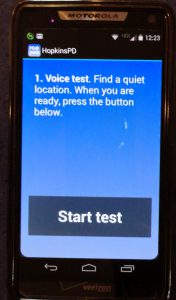
    Smartphone-PD is a study to see if it is feasible for participants to download, install, and use an Android smartphone application to track data related to Parkinson disease symptoms. (Note: only available for Android phones)  They hope to measure daily variability of movement and mobility characteristics of PD patients. The data is collected by completing voice and movement tests using my cell phone.  The results of the daily tests are encrypted and uploaded to the study team at the University of Rochester in New York.  The application will also monitor my daily activity if I keep my phone in my pocket.

    I found this trial here on Fox Trial Finder and signing up is all done online. I reviewed the study plan and the consent form which includes the disclaimer that this study is purely for research purposes, so they will not be able to provide clinical advice for individuals with PD. Therefore, no adjustments to medications or appointments with a neurologist will be made as a part of the study.  After electronically signing the consent form, I received an email with a link to the application which I downloaded to my phone and I was ready to go.

    For this study I use my phone to complete five tests twice a day for six months.  The first time is in the morning prior to taking my medication and then again about an hour later.  They realize that you might not be able to complete the tests on that schedule but they are OK with that as all collected data is valuable. So it’s OK to miss a test day due to travel or whatever, they still want the information.So most every morning I open the application on my phone and spend five minutes completing the tests which include a voice test, a balance test, a gait test, a dexterity test and a reaction test. The results are sent off and I take my medications, have breakfast and try to remember to repeat the test an hour or so later. This study is actively recruiting on FTF or the Parkinson’s Voice site.   Both PwP’s and controls are needed. You can also contact Denzil Harris, the research coordinator by email or phone him at 585-275-2791 for more information.

    See, getting involved in a clinical trial is not as difficult as one might think, even if you live in a small town or aren’t close to a research center .  Using Fox Trial Finder to identify trials you might be eligible for takes just a little bit of your time and the rewards are many including that good feeling of being involved in the quest for a cure.   As I have said before, while patients and researchers work to change the current process, there are still many trials that need participants.  If we don’t participate, we will continue to rely on a drug discovered almost 50 years ago that only treats some of our symptoms.   With 475 possible trials listed, I bet you can find one that interests you, so click on this link and join over 39,000 others on Fox Trial Finder today!

    (Updated 12/11 to add the links to Fox Trial Finder so it shows up in mobile device view with thanks to the Cure Parkinson’s Trust )

Latest Research News

Well, setting a goal of publishing a new post within two weeks of my last post didn’t quite work. Despite my best intentions and adding a reminder to my calendar, I still missed the date by, oh let’s say 2 (OK 3) weeks.  Back in the days before retirement, I used a system called the Franklin Planner to plan out everyday, so maybe I need to do something similar now – NOT!  While it was an interesting (and expensive) planning system complete with training on how to use, fancy binders and custom calendar pages, I still missed a goal or two and I was quite happy to discard the entire system upon retirement.  But enough excuses, I’ll just chalk this one up as a learning experience and remember to not promise any deliverables.😀

What I did promise last post was that this post would cover some of the latest news about PD and I will stick to that deliverable.  One of the new blogs that I now follow is The Science of Parkinson’s .  If you haven’t already discovered this site, click on the link to view the site and sign up for posts.  This site is the first I’ve found that does a superb job of taking the latest scientific publications and breaking it down to plain, understandable english.   The author is Simon Stott, and he has been working in the field of Parkinson’s disease research for over 15 years (both in academia and biotech). 

Each month, he publishes a Monthly Research Review in addition to his posts about a single research topic.  You can view the June 2018 review here.  This month there have been several great posts about the latest research and all in a readable and understandable format.  The top story this month has been the report that researchers have found that graphene dots may prevent alpha synuclein from clumping, and even better, they appear to cause the clumps already formed to break up and disappear!    I realize I threw out some new scientific words but if you go to the article here, you will get a full description of alpha synuclein and graphene dots and more.  (At least I didn’t use the actual title of the research report – Graphene Quantum Dots Appear to Prevent α-synucleinopathy in Parkinson’s disease)

So it appears these graphene dots stop the clumping of alpha synuclein and break up the existing clumps in the mouse model of PD which is a great step forward.  As always though, we have to hope the research results are the same (or better) when they conduct clinical trials on current patients.

And speaking of clinical trials, if you haven’t signed up for the Fox Insight study, please go here and join us in the largest longitudinal study of PD and the impact it has on each patient.  If you didn’t see the Micheal J Fox interview with Jane Pauly regarding the Fox Insight study a few weeks ago, you can view it here.

In the other news category, the Parkinson’s Foundation has released it’s Parkinson’s Prevalence Project results which predicts there will be over 930,000 PD patients in the US and Canada by 2020 and 1.2 million by 2030.  They also show the prevalence by state along with many other statistics.  You can view the summary study here.  Interesting findings and this study will hopefully help our efforts for more funding for PD research.

And finally, when I contacted Simon Stott about his website, he recommended some other sites that I found interesting so I have updated my blog list page with those sites, Simon’s site and a new category of sites, PD News Aggregators. 

As always,thanks for reading.

“It does not matter how slowly you go as long as you do not stop.” – Confucius


Latest Research News

Well, setting a goal of publishing a new post within two weeks of my last post didn’t quite work. Despite my best intentions and adding a reminder to my calendar, I still missed the date by, oh let’s say 2 (OK 3) weeks.  Back in the days before retirement, I used a system called the Franklin Planner to plan out everyday, so maybe I need to do something similar now – NOT!  While it was an interesting (and expensive) planning system complete with training on how to use, fancy binders and custom calendar pages, I still missed a goal or two and I was quite happy to discard the entire system upon retirement.  But enough excuses, I’ll just chalk this one up as a learning experience and remember to not promise any deliverables.😀

What I did promise last post was that this post would cover some of the latest news about PD and I will stick to that deliverable.  One of the new blogs that I now follow is The Science of Parkinson’s .  If you haven’t already discovered this site, click on the link to view the site and sign up for posts.  This site is the first I’ve found that does a superb job of taking the latest scientific publications and breaking it down to plain, understandable english.   The author is Simon Stott, and he has been working in the field of Parkinson’s disease research for over 15 years (both in academia and biotech). 

Each month, he publishes a Monthly Research Review in addition to his posts about a single research topic.  You can view the June 2018 review here.  This month there have been several great posts about the latest research and all in a readable and understandable format.  The top story this month has been the report that researchers have found that graphene dots may prevent alpha synuclein from clumping, and even better, they appear to cause the clumps already formed to break up and disappear!    I realize I threw out some new scientific words but if you go to the article here, you will get a full description of alpha synuclein and graphene dots and more.  (At least I didn’t use the actual title of the research report – Graphene Quantum Dots Appear to Prevent α-synucleinopathy in Parkinson’s disease)

So it appears these graphene dots stop the clumping of alpha synuclein and break up the existing clumps in the mouse model of PD which is a great step forward.  As always though, we have to hope the research results are the same (or better) when they conduct clinical trials on current patients.

And speaking of clinical trials, if you haven’t signed up for the Fox Insight study, please go here and join us in the largest longitudinal study of PD and the impact it has on each patient.  If you didn’t see the Micheal J Fox interview with Jane Pauly regarding the Fox Insight study a few weeks ago, you can view it here.

In the other news category, the Parkinson’s Foundation has released it’s Parkinson’s Prevalence Project results which predicts there will be over 930,000 PD patients in the US and Canada by 2020 and 1.2 million by 2030.  They also show the prevalence by state along with many other statistics.  You can view the summary study here.  Interesting findings and this study will hopefully help our efforts for more funding for PD research.

And finally, when I contacted Simon Stott about his website, he recommended some other sites that I found interesting so I have updated my blog list page with those sites, Simon’s site and a new category of sites, PD News Aggregators. 

As always,thanks for reading.

“It does not matter how slowly you go as long as you do not stop.” – Confucius


Latest Research News

Well, setting a goal of publishing a new post within two weeks of my last post didn’t quite work. Despite my best intentions and adding a reminder to my calendar, I still missed the date by, oh let’s say 2 (OK 3) weeks.  Back in the days before retirement, I used a system called the Franklin Planner to plan out everyday, so maybe I need to do something similar now – NOT!  While it was an interesting (and expensive) planning system complete with training on how to use, fancy binders and custom calendar pages, I still missed a goal or two and I was quite happy to discard the entire system upon retirement.  But enough excuses, I’ll just chalk this one up as a learning experience and remember to not promise any deliverables.😀

What I did promise last post was that this post would cover some of the latest news about PD and I will stick to that deliverable.  One of the new blogs that I now follow is The Science of Parkinson’s .  If you haven’t already discovered this site, click on the link to view the site and sign up for posts.  This site is the first I’ve found that does a superb job of taking the latest scientific publications and breaking it down to plain, understandable english.   The author is Simon Stott, and he has been working in the field of Parkinson’s disease research for over 15 years (both in academia and biotech). 

Each month, he publishes a Monthly Research Review in addition to his posts about a single research topic.  You can view the June 2018 review here.  This month there have been several great posts about the latest research and all in a readable and understandable format.  The top story this month has been the report that researchers have found that graphene dots may prevent alpha synuclein from clumping, and even better, they appear to cause the clumps already formed to break up and disappear!    I realize I threw out some new scientific words but if you go to the article here, you will get a full description of alpha synuclein and graphene dots and more.  (At least I didn’t use the actual title of the research report – Graphene Quantum Dots Appear to Prevent α-synucleinopathy in Parkinson’s disease)

So it appears these graphene dots stop the clumping of alpha synuclein and break up the existing clumps in the mouse model of PD which is a great step forward.  As always though, we have to hope the research results are the same (or better) when they conduct clinical trials on current patients.

And speaking of clinical trials, if you haven’t signed up for the Fox Insight study, please go here and join us in the largest longitudinal study of PD and the impact it has on each patient.  If you didn’t see the Micheal J Fox interview with Jane Pauly regarding the Fox Insight study a few weeks ago, you can view it here.

In the other news category, the Parkinson’s Foundation has released it’s Parkinson’s Prevalence Project results which predicts there will be over 930,000 PD patients in the US and Canada by 2020 and 1.2 million by 2030.  They also show the prevalence by state along with many other statistics.  You can view the summary study here.  Interesting findings and this study will hopefully help our efforts for more funding for PD research.

And finally, when I contacted Simon Stott about his website, he recommended some other sites that I found interesting so I have updated my blog list page with those sites, Simon’s site and a new category of sites, PD News Aggregators. 

As always,thanks for reading.

“It does not matter how slowly you go as long as you do not stop.” – Confucius