Last week was another great week at the beach. Our son, daughter-in-law and two granddaughters arrived on Saturday and we had a couple of great beach days and some pool time, when the weather cooperated, along with good food, good conversations and lots of just hanging out time. We managed a couple of trips to Capt Curt’s for clam chowder and celebrated Mara’s birthday at one of our favorite restaurants, Ophelia’s on the Bay. We were sorry to see them off for home in Seattle after a fun week.
Monday we attended a Parkinson’s event at the Asolo Theatre in Sarasota. The event was organized by Lynn Schramek, founder of the Parkinson’s Cafe. After getting to know everyone over coffee and cookies, we were treated to a backstage tour by Alex Suczewski that was fascinating. After a short history of the Asolo, we saw both stages, the rehearsal space, the green room, a dressing room, learned about costume design and saw the nifty way they move the sets back and forth on rails controlled by a computer. After the tour, we enjoyed a box lunch and a great presentation by actress Carolyn Michel who has been preforming at the Asolo for 25 years. After talking about her career and fielding our many questions, she performed a couple of monologues and it was amazing to see her drop right into the character, changing her voice and facial mannerisms to match. It was a wonderful event and we are looking forward to next month’s visit to the Sarasota Ballet.
On the Parkinson’s front, we are very pleased with the new medication routine. Our walk times to the same turn around point on the beach have dropped enough that we have moved the point further out. My rigidity is almost non existent most of the time and Mara has remarked that sometimes my walking speed is almost back to normal, we have even done a little jogging on the beach. The walking poles help with arm movement and walking erect. Studies continue to show that exercise is the best medication for PD, in fact, a Google search for scholarly studies using ‘Parkinsons and exercise’ produced 16,400 results, 617 in 2015 alone. My Doctor’s idea to add levadopa to my medication to reduce the motor symptoms so I would be able to exercise more seems to be paying off.A few weeks ago I was asked to be a guest blogger for HealthiVibe, LLC and my article was posted today and can be seen here. HealthiVibe is a firm helping design clinical trials with the premise that patients should play a more instrumental and active role in the design process and also throughout the patient journey, a topic I have blogged about in the past. I was excited to be able to add my voice to the need for changes in the clinical trial process. Which reminds me, don’t forget to sign up for the Fox Trial Finder, it’s easy and YOU are needed! See you next time.
“It does not matter how slowly you go as long as you do not stop.” – Confucius
Our first week at the beach is already over. 🙁 Last Saturday we attended the Parkinson’s Symposium sponsored by The Neuro Challenge Foundation and Sarasota Memorial Hospital. This is an annual event with 500+ attendees and included talks by recognized PD experts followed by a Q & A session afterwards. In between the talks we did two mini exercise sessions which included some voice exercises from the Loud portion of the Big and Loud program. We were joined at the meeting by Joel and Melissa whom we first met at Kripalu and then again here at the beach last year.
At the meeting we met Brad and Lynn Schramek who founded the Parkinson’s Cafe for the purpose of providing social, cultural and intellectual interaction for people with Parkinson’s disease and their families. This years events include a visit to the Asolo Repertory Theatre and a visit to the Sarasota Ballet. Both agendas look interesting so we have signed up to attend them both.
This week NPR (among others) talked about the benefits of exercise for Parkinson’s and so did all of the speakers at the Symposium. Since we arrived we have upped our exercise routine to include at least an hour walking plus Qi Gong and Tai Chi. During my recent Doctor visit, we discussed my lack of arm swing while walking and he suggested using walking poles to improve my posture and arm swing while walking. So this week I took delivery of a pair of Green Zen Nordic walking poles from York Nordic and they definitely help with the arm swing, posture and pace. I also started the Sinemet (Cardidopa/levodopa) at the beginning of the week and
I have noticed reduced rigidity and shuffle along with the improved walk times over last
year’s beach visits.
Also this week we have signed on to be Fox Trial Finder Ambassadors, which I’m sure comes as a surprise to regular readers 🙂 We are looking forward to helping spread the word about the importance of participating in clinical trials at support groups, events, informal meetings, and any other opportunities we get, like this blog.
This weekend, our granddaughters (oh and their parents) arrive from Seattle for a week of beach fun so I’m thinking it will be another fun and busy week! Thanks for reading.
“It does not matter how slowly you go as long as you do not stop.” – Confucius
For the last few months, Mara and I have been discussing changing neurologists with the idea of being seen by a Movement Disorder Specialist (MDS). I was seen by a MDS when we went to U of FL last year we felt that it was too far of a drive for regular appointments. The Vanderbilt Movement Disorder Clinic in Nashville is also an National Parkinson Foundation (NPF) Center of Excellence, they conduct a lot of Parkinson’s research and it is a two hour drive instead of ten, so we decided that was where I would go. So this week I met with Dr. Thomas Davis, a MDS and clinical researcher and Director of the Vanderbilt Movement Disorder Clinic. It was a very positive experience and we were quite impressed with Dr Davis and the Vanderbilt Movement Disorder Clinic staff.
After a simple check in process that took all of 5 minutes and only required my electronic signature on the usual forms, that’s right, I did not have to fill out any health history forms, who to contact, etc.! I had barely sat down when a nurse called me into an interview room where she took my BP, weight, and medical history once again without me having to fill out a form! She then took me to the examination room where we met Dr. Davis.
During the meeting with Dr Davis we discussed my PD history, what medication I was on and how it was working, what other symptoms I was having plus he performed the usual PD tests, finger and toe tapping, walking, etc. He also tested my cognitive skills and once again I passed! We then discussed my medication routine and he recommended I start taking levadopa/cardidopa along with a reduced dose of Mirapex four times a day instead of three. We were happy with this recommendation as it seemed the Mirapex has not been as effective in reducing my rigidity and I am taking the maximum dose. He also noted that exercise is still the best prescription for PwP and reducing the rigidity and other symptoms will allow me to up the exercise routine. The appointment lasted about 50 minutes and we came away feeling that he and the staff cared about me as a person and a patient and we had made the right decision to transfer to Dr Davis.
We also met with Kelly Arney, research outreach coordinator, whom I had been in contact with last year about a clinical trial sponsored by NPF to track the effects of treatment. I did not qualify then because the trial required participants to be seen by the Clinic, but now that I am a patient, I should be able to participate beginning with my next visit at the end of April. We also discussed upcoming clinical trials with both Dr Davis and Kelly and they will contact me if I meet the qualifications.
When I checked out, they had me sign up for access to their electronic health record system which gives me access to all of my records and a way to email Dr Davis. Again the process was simple and an employee walked me though the sign up at a terminal in the waiting area, then gave me full access to the system.
The NIH defines patient-centered care as follows: “health care that establishes a partnership among practitioners, patients, and their families (when appropriate) to ensure that decisions respect patients’ wants, needs and preferences and solicit patients’ input on the education and support they need to make decisions and participate in their own care.” The care we received at the Vanderbilt Medical Center Movement Disorder Clinic certainly fit the NIH definition.
And the positive experiences continued because Friday we checked into our ‘home away from home’ a villa on Siesta Key! Yes that’s right, we are at the BEACH! We will be attending a Parkinson’s symposium on Saturday and I also plan to sign up for the Big and Loud program while we are here so I will have plenty to blog about next time. Until then don’t forget to sign up for the Fox Trial Finder, we all have a stake in finding a cure.
“It does not matter how slowly you go as long as you do not stop.” – Confucius
After returning to Sarasota 4 weeks ago we have been ramping up the exercise routine. The day after our return I was off to the YMCA for the pedaling for Parkinson’s class while Mara did weight training. Later we met with one of the gym instructors to get instructions on the use of the equipment and his recommendations for what I should work on to improve my PD symptoms. Then we met with a wellness coach to go over all of the classes they offer at the YMCA and which ones she thought would benefit us the most.
The result is we have added 7 more hours of exercise to the 2 hours of pedaling and our hour of PD in Motion for a total of about 10 hours a week. Our classes include Tai Chi, Yoga, Fitness Fundamentals and an aerobic fitness class. Then yesterday, we added two weeks of adult beginning tennis lessons in November since we bought tennis rackets when we got here in June thinking we would take advantage of the courts here in the Village Walk complex where we are renting.
So now the question – does more exercise = more benefits for PD patients or can I overdo it? I am trying to pay attention to how well I perform each exercise class and, more importantly, will it impact how well I do with the pedaling class. There is a correlation between maintaining 80 plus RPM and pushing my heart rate into my training zone for at least 30 minutes twice a week and a reduction in my symptoms, so this is the exercise that has to be first. Of course, the way it worked out I have two other classes on the same day as the pedaling,one before and one after. So far I have noticed some impact on the pedaling but I am hopeful that, as my overall fitness improves, the impact will diminish.
In our spare time :>) we have been to concerts at the Selby Botanic Gardens, went to the Florida Studios Theater for an evening of Improv, gone to the beach and attended a concert here in the Village Walk. During that concert we discovered that a couple from our PD in Motion Class are also renting in Village Walk – it certainly is a small world!
Oh, I did find some time to do a little fishing in the lakes around Village Walk and caught a few nice size small mouth bass. A few days ago, while fishing with some light spinning gear, I caught a trophy large mouth! After about ten minutes I finally landed the fish and luckily a couple came by and took some pictures or this would have just been another fish story! I think this might be the biggest fish I have ever caught, certainly the largest bass.
While I have your attention I want to pitch SURE-PD3, a clinical trial that is recruiting right now. This is a phase three trial recruiting 270 subjects in 60 locations across the US. The primary objective is to determine whether a moderate elevation in serum urate over 2 years slows clinical decline in early PD. To learn more about the trial, click here or on the link on the right to see the presentation and get a link to the Fox Trial Finder description with a list of the trial sites.
Well, off to exercise!
“It does not matter how slowly you go as long as you do not stop.” – Confucius
After returning to Sarasota 4 weeks ago we have been ramping up the exercise routine. The day after our return I was off to the YMCA for the pedaling for Parkinson’s class while Mara did weight training. Later we met with one of the gym instructors to get instructions on the use of the equipment and his recommendations for what I should work on to improve my PD symptoms. Then we met with a wellness coach to go over all of the classes they offer at the YMCA and which ones she thought would benefit us the most.
The result is we have added 7 more hours of exercise to the 2 hours of pedaling and our hour of PD in Motion for a total of about 10 hours a week. Our classes include Tai Chi, Yoga, Fitness Fundamentals and an aerobic fitness class. Then yesterday, we added two weeks of adult beginning tennis lessons in November since we bought tennis rackets when we got here in June thinking we would take advantage of the courts here in the Village Walk complex where we are renting.
So now the question – does more exercise = more benefits for PD patients or can I overdo it? I am trying to pay attention to how well I perform each exercise class and, more importantly, will it impact how well I do with the pedaling class. There is a correlation between maintaining 80 plus RPM and pushing my heart rate into my training zone for at least 30 minutes twice a week and a reduction in my symptoms, so this is the exercise that has to be first. Of course, the way it worked out I have two other classes on the same day as the pedaling,one before and one after. So far I have noticed some impact on the pedaling but I am hopeful that, as my overall fitness improves, the impact will diminish.
In our spare time :>) we have been to concerts at the Selby Botanic Gardens, went to the Florida Studios Theater for an evening of Improv, gone to the beach and attended a concert here in the Village Walk. During that concert we discovered that a couple from our PD in Motion Class are also renting in Village Walk – it certainly is a small world!
Oh, I did find some time to do a little fishing in the lakes around Village Walk and caught a few nice size small mouth bass. A few days ago, while fishing with some light spinning gear, I caught a trophy large mouth! After about ten minutes I finally landed the fish and luckily a couple came by and took some pictures or this would have just been another fish story! I think this might be the biggest fish I have ever caught, certainly the largest bass.
While I have your attention I want to pitch SURE-PD3, a clinical trial that is recruiting right now. This is a phase three trial recruiting 270 subjects in 60 locations across the US. The primary objective is to determine whether a moderate elevation in serum urate over 2 years slows clinical decline in early PD. To learn more about the trial, click here or on the link on the right to see the presentation and get a link to the Fox Trial Finder description with a list of the trial sites.
Well, off to exercise!
“It does not matter how slowly you go as long as you do not stop.” – Confucius
After returning to Sarasota 4 weeks ago we have been ramping up the exercise routine. The day after our return I was off to the YMCA for the pedaling for Parkinson’s class while Mara did weight training. Later we met with one of the gym instructors to get instructions on the use of the equipment and his recommendations for what I should work on to improve my PD symptoms. Then we met with a wellness coach to go over all of the classes they offer at the YMCA and which ones she thought would benefit us the most.
The result is we have added 7 more hours of exercise to the 2 hours of pedaling and our hour of PD in Motion for a total of about 10 hours a week. Our classes include Tai Chi, Yoga, Fitness Fundamentals and an aerobic fitness class. Then yesterday, we added two weeks of adult beginning tennis lessons in November since we bought tennis rackets when we got here in June thinking we would take advantage of the courts here in the Village Walk complex where we are renting.
So now the question – does more exercise = more benefits for PD patients or can I overdo it? I am trying to pay attention to how well I perform each exercise class and, more importantly, will it impact how well I do with the pedaling class. There is a correlation between maintaining 80 plus RPM and pushing my heart rate into my training zone for at least 30 minutes twice a week and a reduction in my symptoms, so this is the exercise that has to be first. Of course, the way it worked out I have two other classes on the same day as the pedaling,one before and one after. So far I have noticed some impact on the pedaling but I am hopeful that, as my overall fitness improves, the impact will diminish.
In our spare time :>) we have been to concerts at the Selby Botanic Gardens, went to the Florida Studios Theater for an evening of Improv, gone to the beach and attended a concert here in the Village Walk. During that concert we discovered that a couple from our PD in Motion Class are also renting in Village Walk – it certainly is a small world!
Oh, I did find some time to do a little fishing in the lakes around Village Walk and caught a few nice size small mouth bass. A few days ago, while fishing with some light spinning gear, I caught a trophy large mouth! After about ten minutes I finally landed the fish and luckily a couple came by and took some pictures or this would have just been another fish story! I think this might be the biggest fish I have ever caught, certainly the largest bass.
While I have your attention I want to pitch SURE-PD3, a clinical trial that is recruiting right now. This is a phase three trial recruiting 270 subjects in 60 locations across the US. The primary objective is to determine whether a moderate elevation in serum urate over 2 years slows clinical decline in early PD. To learn more about the trial, click here or on the link on the right to see the presentation and get a link to the Fox Trial Finder description with a list of the trial sites.
Well, off to exercise!
“It does not matter how slowly you go as long as you do not stop.” – Confucius
We recently attended our second Grand Challenges in Parkinson’s research conference hosted by the Van Andel Research Institute in Grand Rapids, MI. Again this year The Cure Parkinson’s Trust (UK) and Parkinson’s Movement(UK) sponsored the Rallying to the Challenge meeting which is conducted in conjunction with the research conference and provides an opportunity for researchers, patients and caregivers to exchange information. The theme for this year’s Rally was “Outcomes and Measures, a new look at Measuring Parkinson’s” and, as you will see, we had a very full two day agenda.
Tom Isaacs, co-founder of the Cure Parkinson’s Trust, opened our portion of the meeting saying that together we are making a seismic shift for better research, research that includes the patient and the patient’s needs. As a result of last years Rally a ‘Clinical Trials Charter’ (click here to view the charter) was developed as a cooperative effort by patients and researchers. A UK multi-center clinical trial has adopted the charter for their research which will provide a real-world test and a stepping stone to wider adoption. We were amazed to see how our efforts from just a year ago have paid off in the cooperative development of this charter by patients and researchers. (Read the post from last year here)
Tom then discussed this year’s Challenge – How do we improve outcomes and measures in clinical trials? The emphasis again this year was on improving the patient experience and introducing patient centered change to the research process. In addition we will discuss how data gathered from new technology, (wearable sensors, smartphone apps, etc) can provide new measures and improve some of the current measures.
Jon Palfreman, PwP and author of the recently released “Brain Storms – The Race to Unlock the Mysteries of Parkinson’s Disease” pointed out that the Unified Parkinson’s Disease Rating Scale (UPDRS) is primarily subjective and provides only a snapshot of the symptoms you are having when administered, usually 1 or 2 times a year during your Dr. visit. Ideally, with the advent of wearable sensors and other technology, you should be able to provide a picture of your symptoms for the entire period between Dr. visits and get real time feedback yourself.
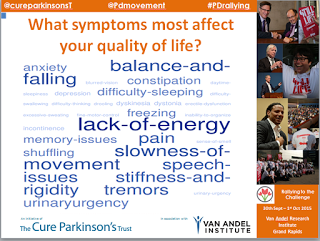
Dr. Soania Mathur and Dr. Jon Stamford reviewed the results of this year’s survey about the symptoms of PD which have the most important impact quality of life. Interestingly, out of 492 responses to the survey not one respondent listed their top five symptoms in the same order. In fact, if you look at this slide from the final presentation, I count 28 symptoms that were brought up when answering the question “What symptoms most affect your quality of life?” This slide certainly points out that PD is truly different for each of us.
The top symptoms in both categories were put into smaller groupings and we broke out into focus groups to discuss how to improve measurement of our set of symptoms. Every focus group not only developed ideas for measuring symptoms, but also came up with tips and tricks for dealing with the issue, for example walking backwards to relax dystonia of the foot.
The next morning, we had an almost overwhelming number of presentations about new technological devices that will help measure PD symptoms when on or off medication. Presenter’s included Ken Kubota from Michael J Fox Foundation (Fox Insight Wearable Trial), Anupam Pathak Ph.D. from Google (the Lyft spoon), Bruce Hellman (uMotif Smartphone app now available in the UK and coming soon to the US and Canada) and Caroline Tanner (mPower also a smartphone app developed from the SmartPhone PD clinical test I participated in)
We also had presentations from a Davis Phinney Foundation representative about a social networking program they are developing, one from Peter Schmidt of NPF about their Parkinson’s Outcome Project (another one I am participating in) and from Eli Pollard executive director of World Parkinson’s Coalition about PowerThroughParkinson’s, a program they are bringing out with the Brian Grant Foundation that encourages PwP to commit to exercise and eat right.
Day Two also included a presentation from the renowned Parkinson’s Doctor and researcher Bas Bloem from the Netherlands about Parkinson’sNet, a program he helped develop in the Netherlands 10 years ago and which has been implemented in LA area and soon in Grand Rapids. ParkinsonNet has one goal: to guarantee the best possible care for people suffering from Parkinson’s Disease.The program has been extremely successful in providing expert care while also reducing costs.
We then reconvened with the researchers and Tom Isaacs and other members of Parkinson’s Movement made a presentation of the results of our meeting and the need for patient involvement in the development of measures that would be the:
Right Measure – developed with the end user as a partner
Right Person – measure what is important to the person
Right Situation – don’t forgot off periods and how PD changes
In addition to meeting old friends and making new ones, we also enjoyed the exhibition of photos by Norwegian Photographer Andres Leines entitled “This is Parkinson’s”. Andres has early onset PD and has been taking pictures of other EOPD patients to point out that Parkinson’s is not just tremors and doesn’t just effect seniors. You can view some of the photos in this excellent YouTube video.
And finally, the Michael J Fox Foundation just announced that the Fox Clinical Trial Program has exceeded 50,000 registered volunteers! In case you’re not one of us, click on the big shiny button at the top of this page and sign up! Thanks.
“It does not matter how slowly you go as long as you do not stop.” – Confucius
No not sausage links, website links! I thought I would devote this post to what’s going on in the Parkinson’s world. As you know I follow a number of other Parkinson’s blogs and here are a few items of interest from month or so, click on the link to read the entire post (will open in a new tab).
Inosine Trial Secures Phase III Funding to Study Effect on Slowing Parkinson’s. Inosine is a precursor to the antioxidant of urate. Observational studies had shown people with higher levels of urate had lower risk of Parkinson’s disease (PD) and, if diagnosed with PD, slower disease progression. The trial will start early next year in 60 sites.
Parkinson’s Psychosis Drug One Step Closer to FDA Approval Acadia Pharmaceuticals announced that it has submitted a New Drug Application to the FDA seeking approval for its drug Nuplazid (the compound pimavanserin) for the treatment of psychosis associated with Parkinson’s disease (PD). Current drugs used to treat PD psychosis have safety concerns and serious side effects for PD patients. A Phase III study showed the drug significantly reduced psychosis compared to placebo without worsening motor function. The study also showed the drug was safe and well tolerated.
How to Find the Right Dr Some excellent suggestions from the Parkinson’s Community on linking up with the right Doctor for PD treatment. My recommendation – if possible, link up with a Movement Disorder Specialist.
10 Breakthrough Therapies for Parkinson’s Disease The NPF Medical Director, Dr. Michael Okun, has published a new book covering new therapies for PD. I purchased a copy the day it was released and it is an excellent book, as was his first book, “Parkinson’s Treatment 10 Secrets to a Happier Life with Parkinson’s Disease”. He has an excellent writing style and there are chapters covering new drugs (released and in the pipeline), effects of exercise, coffee, tea and Marijuana, new DBS advances and stem cell therapies among others. I highly recommend both of his books.
How Do I Know If I’m Doing the Right Thing When I Exercise? A post from PD Gladiators, an Atlanta based non profit devoted to combating PD with vigorous exercise. There has been a lot of emphasis on the benefits of exercise and this post discusses what exercise is optimal and how often you should exercise.
Delay the Disease, an Ohio based exercise program, is offering the Handwriting Challenge This program involves doing four simple exercises every day for 12 weeks. The exercises should take about 10 minutes to complete and are designed to test a theory they have that large muscle exercises will improve motor dexterity including micrographia (tiny handwriting). Every three weeks you write out the same sentence with the hope that your handwriting improves. Even if it doesn’t the exercises can’t hurt!
What’s It Like Having PD An excellent post by Bruce Ballard who blogs as Parking Suns. Those of us with PD will agree with these ideas to simulate PD for people who don’t have PD. I found numbers 1 and 2 an accurate description of what it feels like without medication, I’m sure you will find a few that match your symptoms too.
Coming up, Mara and I will be attending the second “Rallying to the Challenge” event organized by the Cure Parkinson’s Trust and the Van Andel Research Institute in Grand Rapids, MI at the end of September. I wrote about the first meeting here and this years meeting will center on how to introduce new technology and additional personalized patient-centric measures into clinical trials. We are looking forward to catching up with members of our Global support group, meeting new members and enjoying the ArtPrize festival in downtown Grand Rapids.
OK, if you have followed every link in this post, you have a bunch of tab’s open and your browser is getting ready to explode so I’ll stop with a quick reminder, sign up for Fox Trial Finder (click on the button above and open one more tab).
“It does not matter how slowly you go as long as you do not stop.” – Confucius

 Last week was another great week at the beach. Our son, daughter-in-law and two granddaughters arrived on Saturday and we had a couple of great beach days and some pool time, when the weather cooperated, along with good food, good conversations and lots of just hanging out time. We managed a couple of trips to Capt Curt’s for clam chowder and celebrated Mara’s birthday at one of our favorite restaurants, Ophelia’s on the Bay. We were sorry to see them off for home in Seattle after a fun week.