• Catching Up

    We have had a busy late summer and fall and, unfortunately, I have not been a faithful blog poster.  But now the holiday season is coming up, so I’m sure I can keep up with timely blog posts 🙂

    To bring you up to date, in August, my brother in law Joe in Michigan failed the eye exam for his driver’s license renewal.  It was determined that he had severe cataracts in both eyes and shouldn’t have been driving at all!  So off we went to Michigan to get him back and forth to doctors appointments and two separate surgeries.  During the break between the first eye surgery and the second, we made it out to Colorado to visit family and friends, a trip we originally had scheduled in August to coincide with grandson Charlie’s 16th birthday.  We then went to Grand Rapids for the Rallying to the Challenge meeting (see my last post for details) before heading home.

    In October, we journeyed to Asheville, NC and met up with the Marcia and Erwin whom we knew from Kripalu and her stepsister and husband, June and Phil.  We had a great time touring the Biltmore House (America’s largest single family residence) and the River Art’s District and catching up since last March when we met up in Florida. Marcia and Erwin and another couple from Kripalu held an inaugural 5K race/walk in the Poconos in June and raised $26K for the Michael J Fox Foundation!

    A week or so later we were off to San Diego to visit Ryan, Sarah and Julian.  We got to see Julian play football, attended one of Sarah’s yoga classes, enjoyed several fine wines and meals and celebrated Ryan’s 40th birthday.  The weather was perfect and we got in a lot of walking and caught some great sunsets over the ocean.

    When we returned, I had my appointment with my Movement Disorder Specialist who was pleased with how things were going and recommended no changes to my medication regimen, in fact, he was willing to schedule the next appointment for a year away, but we decided we should continue the every 6 month’s cycle for now.

    We made a short trip last weekend to Jackson, MS to watch grandson Garrett play soccer in his college league semi-final soccer tournament, held at Milsaps College.  We were rained out the first night and the next day the team lost in the last 2 minutes of a well played game. It was our first (and last) time to see him play this year. 

    In our spare time, we have continued to build up the Tennessee Parkinson’s Disease Resources website which is now operational and we have printed cards with the website address which we are sending to support groups in Tennessee.  Our hope is patients will take an extra card or two and give it to both their primary care Doctor and their neurologist so they are aware that the site exists.   If it all works as we would like, the Doctor can order additional cards to have on hand for patients.  The goal is to let newly diagnosed PwP know they are not alone and resources are available.

    So that more or less brings us up to date and I promise I will try to meet my goal of at least two posts a month, even with the holiday’s coming up.  In the meantime, don’t forget to sign up for Fox Trial Finder and Fox Insight, we have over 50,000 profiles in Trial Finder and over 3000 in Insight but we need more!!  Click on the button at the top of the page or the Fox Insight icon to sign up.  Thanks!
    “It does not matter how slowly you go as long as you do not stop.” – Confucius
  • Rallying to the Challenge – 2015

    We recently attended our second Grand Challenges in Parkinson’s research conference hosted by the Van Andel Research Institute in Grand Rapids, MI.  Again this year The Cure Parkinson’s Trust (UK) and Parkinson’s Movement(UK) sponsored the Rallying to the Challenge meeting which is conducted in conjunction with the research conference and provides an opportunity for researchers, patients and caregivers to exchange information. The theme for this year’s Rally was “Outcomes and Measures, a new look at Measuring Parkinson’s” and, as you will see, we had a very full two day agenda.

    Tom Isaacs, co-founder of the Cure Parkinson’s Trust, opened our portion of the meeting saying that together we are making a seismic shift for better research, research that includes the patient and the patient’s needs.  As a result of last years Rally a ‘Clinical Trials Charter’ (click here to view the charter) was developed as a cooperative effort by patients and researchers.  A UK multi-center clinical trial has adopted the charter for their research which will provide a real-world test and a stepping stone to wider adoption.  We were amazed to see how our efforts from just a year ago have paid off in the cooperative development of this charter by patients and researchers. (Read the post from last year here)

    Tom then discussed this year’s Challenge – How do we improve outcomes and measures in clinical trials?  The emphasis again this year was on improving the patient experience and introducing patient centered change to the research process.  In addition we will discuss how data gathered from new technology, (wearable sensors, smartphone apps, etc) can provide new measures and improve some of the current measures.

    Jon Palfreman, PwP and author of the recently released “Brain Storms – The Race to Unlock the Mysteries of Parkinson’s Disease” pointed out that the Unified Parkinson’s Disease Rating Scale (UPDRS) is primarily subjective and provides only a snapshot of the symptoms you are having when administered, usually 1 or 2 times a year during your Dr. visit.  Ideally, with the advent of wearable sensors and other technology, you should be able to provide a picture of your symptoms for the entire period between Dr. visits and get real time feedback yourself.

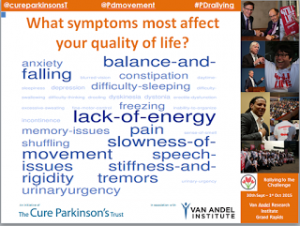
    Dr. Soania Mathur and Dr. Jon Stamford reviewed the results of this year’s survey about the symptoms of PD which have the most important impact  quality of life. Interestingly, out of 492 responses to the survey not one respondent listed their top five symptoms in the same order. In fact, if you look at this slide from the final presentation, I count 28 symptoms that were brought up when answering the question “What symptoms most affect your quality of life?” This slide certainly points out that PD is truly different for each of us.

    The top symptoms in both categories were put into smaller groupings and we broke out into focus groups to discuss how to improve measurement of our set of symptoms. Every focus group not only developed ideas for measuring symptoms, but also came up with tips and tricks for dealing with the issue, for example walking backwards to relax dystonia of the foot.

    The next morning, we had an almost overwhelming number of presentations about new technological devices that will help measure PD symptoms when on or off medication.  Presenter’s included Ken Kubota from Michael J Fox Foundation (Fox Insight Wearable Trial), Anupam Pathak Ph.D. from Google (the Lyft spoon), Bruce Hellman (uMotif Smartphone app now available in the UK and coming soon to the US and Canada) and Caroline Tanner (mPower also a smartphone app developed from the SmartPhone PD clinical test I participated in)

    We also had presentations from a Davis Phinney Foundation representative about a social networking program they are developing, one from Peter Schmidt of NPF about their Parkinson’s Outcome Project (another one I am participating in) and from Eli Pollard executive director of World Parkinson’s Coalition  about PowerThroughParkinson’s, a program they are bringing out with the Brian Grant Foundation that encourages PwP to commit to exercise and eat right.

    Day Two also included a presentation from the renowned Parkinson’s Doctor and researcher Bas Bloem from the Netherlands about Parkinson’sNet, a program he helped develop in the Netherlands 10 years ago and which has been implemented in LA area and soon in Grand Rapids.  ParkinsonNet has one goal: to guarantee the best possible care
    for people suffering from Parkinson’s Disease.The program has been extremely successful in providing expert care while also reducing costs.

    We then reconvened with the researchers and Tom Isaacs and other members of Parkinson’s Movement made a presentation of the results of our meeting and the need for patient involvement in the development of measures that would be the:

    • Right Measure – developed with the end user as a partner
    • Right Person – measure what is important to the person
    • Right Situation – don’t forgot off periods and how PD changes

    In addition to meeting old friends and making new ones, we also enjoyed the exhibition of photos by Norwegian Photographer Andres Leines entitled “This is Parkinson’s”.  Andres has early onset PD and has been taking pictures of other EOPD patients to point out that Parkinson’s is not just tremors and doesn’t just effect seniors. You can view some of the photos in this excellent YouTube video.

    And finally, the Michael J Fox Foundation just announced that the Fox Clinical Trial Program has exceeded 50,000 registered volunteers!  In case you’re not one of us, click on the big shiny button at the top of this page and sign up!  Thanks.

    “It does not matter how slowly you go as long as you do not stop.” – Confucius


  • Links and More Links

    No not sausage links, website links! I thought I would devote this post to what’s going on in the Parkinson’s world.  As you know I follow a number of other Parkinson’s blogs and here are a few items of interest from month or so, click on the link to read the entire post (will open in a new tab).

    Inosine Trial Secures Phase III Funding to Study Effect on Slowing Parkinson’s.  Inosine is a precursor to the antioxidant of urate. Observational studies had shown people with higher levels of urate had lower risk of Parkinson’s disease (PD) and, if diagnosed with PD, slower disease progression. The trial will start early next year in 60 sites.

    Parkinson’s Psychosis Drug One Step Closer to FDA Approval Acadia Pharmaceuticals announced  that it has submitted a New Drug Application to the FDA seeking approval for its drug Nuplazid (the compound pimavanserin) for the treatment of psychosis associated with Parkinson’s disease (PD).  Current drugs used to treat PD psychosis have safety concerns and serious side effects for PD patients.  A Phase III study showed the drug significantly reduced psychosis compared to placebo without worsening motor function. The study also showed the drug was safe and well tolerated.

    How to Find the Right Dr   Some excellent suggestions from the Parkinson’s Community on linking up with the right Doctor for PD treatment.  My recommendation –  if possible, link up with a Movement Disorder Specialist.

    10 Breakthrough Therapies for Parkinson’s Disease The NPF Medical Director, Dr. Michael Okun, has published a new book covering new therapies for PD.  I purchased a copy the day it was released and it is an excellent book, as was his first book,  “Parkinson’s Treatment 10 Secrets to a Happier Life with Parkinson’s Disease”.  He has an excellent writing style and there are chapters covering new drugs (released and in the pipeline), effects of exercise, coffee, tea and Marijuana, new DBS advances and stem cell therapies among others.  I highly recommend both of his books.

    How Do I Know If I’m Doing the Right Thing When I Exercise?
    A post from PD Gladiators, an Atlanta based non profit devoted to combating PD with vigorous exercise.  There has been a lot of emphasis on the benefits of exercise and this post discusses what exercise is optimal and how often you should exercise.

    Delay the Disease, an Ohio based exercise program, is offering the Handwriting Challenge This program involves doing four simple exercises every day for 12 weeks.  The exercises should take about 10 minutes to complete and are designed to test a theory they have that large muscle exercises will improve motor dexterity including micrographia (tiny handwriting).  Every three weeks you write out the same sentence with the hope that your handwriting improves. Even if it doesn’t the exercises can’t hurt!

    What’s It Like Having PD   An excellent post by Bruce Ballard who blogs as Parking Suns. Those of us with PD will agree with these ideas to simulate PD for people who don’t have PD.  I found numbers 1 and 2 an accurate description of what it feels like without medication, I’m sure you will find a few that match your symptoms too.

    Coming up, Mara and I will be attending the second “Rallying to the Challenge” event organized by the Cure Parkinson’s Trust and the Van Andel Research Institute in Grand Rapids, MI at the end of September.  I wrote about the first meeting here and this years meeting will center on how to introduce new technology and additional personalized patient-centric measures into clinical trials.  We are looking forward to catching up with members of our Global support group, meeting new members and enjoying the ArtPrize festival in downtown Grand Rapids.

    OK, if you have followed every link in this post, you have a bunch of tab’s open and your browser is getting ready to explode so I’ll stop with a quick reminder, sign up for Fox Trial Finder (click on the button above and open one more tab).

    “It does not matter how slowly you go as long as you do not stop.” – Confucius

Pedaling with Parkinson’s

As part of our stay here in Florida, we became temporary members at a local Gym that provides PwP specific classes along with all the other amenities of a large gym.  One of the classes they offer is Pedaling with Parkinson’s, a twice a week spin class specificly designed for PwP’s.  The objective of the session is to cycle for 40 minutes, keeping your heart rate between 60% – 80% of your MHR (maximum heart rate), and keeping the cadence (RPM) between 80 and 90 RPM per minute.

In order to take the class, I had an hour long evaluation that covered, among many things, medical conditions other than PD, what PD symptoms I had, and how my balance was – almost made the 30 seconds standing on one foot! Then, after taking my resting heart rate and blood pressure, I spent 20 minutes on the spin bike, upping the resistance until I couldn’t maintain 80 RPM for a minute, which provided my MHR.

I managed to pass the tests so last Friday I joined a full class of 20+ PwP’s for my first forced march on a bike!  After adjusting the bike, putting on the heart rate monitor and doing a light warm up spin (you know in the 60 – 80 RPM range) the instructor cranked up the music and off we went, upping the resistance while maintaining the cadence at 80 – 90 RPM for what seemed to be forever. OK maybe it wasn’t forever but it was a solid 40 minute workout, with brief slow downs for hydration before the next song came on.  All of our data was captured on a computer which then projected our heart rate and the percent of MHR up on a screen in front of the room.  In addition, the bike was equipped with a device showing our RPM, heart rate and % of MHR.

This program is based on research by Jay Alberts, PhD, at the Cleveland Clinic and a demonstration study by the Neuro Challenge Foundation here in Sarasota which have yielded promising preliminary scientific and anecdotal results.  The studies have indicated that doing this twice a week helps create new pathways (neuroplasticity) in the brain and participants have reported a reduction in tremors, better balance and gait, regained sense of smell, and increased energy. I have been interested in doing this for some time and I’m glad I get the opportunity to participate while here as they also offer this class at the YMCA in Knoxville if I want to continue when I get home.

The Neuro Challenge Foundation also sponsors the three dance for PD classes we are attending while here along with many other activities for PwP and Care Partners.  They provide a Parkinson Disease Resource Guide and offer a one on one Care Advisor Program to help PD Patients find the best treatment and support options available.  An excellent resource for PwP in the Sarasota area and one of the reasons we like to come to this area.  Speaking of dance classes, our Let Your Yoga Dance for PD class made the local paper, you can view the article here.  We have a good time in all three classes and it certainly helps keep me flexible.

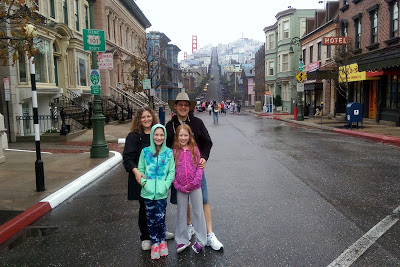
Oh, did I mention we caught up with Dale, Monica and grand daughters Angelina and Ariana in San Francisco?  OK, maybe we were at Disney World’s Hollywood Studios and took advantage of the set.  We had a great time with them in Disney World and here at the beach.

We continue to enjoy our beach time in between dance classes and time at the gym and I can’t believe our time here is half over already!

Don’t forget to sign up for MJF Trial Finder by clicking on that large orange button on the top right and then you might as well join Fox Insight by clicking on the logo to your right!  Thanks.

“It does not matter how slowly you go as long as you do not stop.” – Confucius


Pedaling with Parkinson’s

As part of our stay here in Florida, we became temporary members at a local Gym that provides PwP specific classes along with all the other amenities of a large gym.  One of the classes they offer is Pedaling with Parkinson’s, a twice a week spin class specificly designed for PwP’s.  The objective of the session is to cycle for 40 minutes, keeping your heart rate between 60% – 80% of your MHR (maximum heart rate), and keeping the cadence (RPM) between 80 and 90 RPM per minute.

In order to take the class, I had an hour long evaluation that covered, among many things, medical conditions other than PD, what PD symptoms I had, and how my balance was – almost made the 30 seconds standing on one foot! Then, after taking my resting heart rate and blood pressure, I spent 20 minutes on the spin bike, upping the resistance until I couldn’t maintain 80 RPM for a minute, which provided my MHR.

I managed to pass the tests so last Friday I joined a full class of 20+ PwP’s for my first forced march on a bike!  After adjusting the bike, putting on the heart rate monitor and doing a light warm up spin (you know in the 60 – 80 RPM range) the instructor cranked up the music and off we went, upping the resistance while maintaining the cadence at 80 – 90 RPM for what seemed to be forever. OK maybe it wasn’t forever but it was a solid 40 minute workout, with brief slow downs for hydration before the next song came on.  All of our data was captured on a computer which then projected our heart rate and the percent of MHR up on a screen in front of the room.  In addition, the bike was equipped with a device showing our RPM, heart rate and % of MHR.

This program is based on research by Jay Alberts, PhD, at the Cleveland Clinic and a demonstration study by the Neuro Challenge Foundation here in Sarasota which have yielded promising preliminary scientific and anecdotal results.  The studies have indicated that doing this twice a week helps create new pathways (neuroplasticity) in the brain and participants have reported a reduction in tremors, better balance and gait, regained sense of smell, and increased energy. I have been interested in doing this for some time and I’m glad I get the opportunity to participate while here as they also offer this class at the YMCA in Knoxville if I want to continue when I get home.

The Neuro Challenge Foundation also sponsors the three dance for PD classes we are attending while here along with many other activities for PwP and Care Partners.  They provide a Parkinson Disease Resource Guide and offer a one on one Care Advisor Program to help PD Patients find the best treatment and support options available.  An excellent resource for PwP in the Sarasota area and one of the reasons we like to come to this area.  Speaking of dance classes, our Let Your Yoga Dance for PD class made the local paper, you can view the article here.  We have a good time in all three classes and it certainly helps keep me flexible.

Oh, did I mention we caught up with Dale, Monica and grand daughters Angelina and Ariana in San Francisco?  OK, maybe we were at Disney World’s Hollywood Studios and took advantage of the set.  We had a great time with them in Disney World and here at the beach.

We continue to enjoy our beach time in between dance classes and time at the gym and I can’t believe our time here is half over already!

Don’t forget to sign up for MJF Trial Finder by clicking on that large orange button on the top right and then you might as well join Fox Insight by clicking on the logo to your right!  Thanks.

“It does not matter how slowly you go as long as you do not stop.” – Confucius


Tag: Parkinson’s Disease

  • Pedaling with Parkinson’s

    Pedaling with Parkinson’s

    As part of our stay here in Florida, we became temporary members at a local Gym that provides PwP specific classes along with all the other amenities of a large gym.  One of the classes they offer is Pedaling with Parkinson’s, a twice a week spin class specificly designed for PwP’s.  The objective of the session is to cycle for 40 minutes, keeping your heart rate between 60% – 80% of your MHR (maximum heart rate), and keeping the cadence (RPM) between 80 and 90 RPM per minute.

    In order to take the class, I had an hour long evaluation that covered, among many things, medical conditions other than PD, what PD symptoms I had, and how my balance was – almost made the 30 seconds standing on one foot! Then, after taking my resting heart rate and blood pressure, I spent 20 minutes on the spin bike, upping the resistance until I couldn’t maintain 80 RPM for a minute, which provided my MHR.

    I managed to pass the tests so last Friday I joined a full class of 20+ PwP’s for my first forced march on a bike!  After adjusting the bike, putting on the heart rate monitor and doing a light warm up spin (you know in the 60 – 80 RPM range) the instructor cranked up the music and off we went, upping the resistance while maintaining the cadence at 80 – 90 RPM for what seemed to be forever. OK maybe it wasn’t forever but it was a solid 40 minute workout, with brief slow downs for hydration before the next song came on.  All of our data was captured on a computer which then projected our heart rate and the percent of MHR up on a screen in front of the room.  In addition, the bike was equipped with a device showing our RPM, heart rate and % of MHR.

    This program is based on research by Jay Alberts, PhD, at the Cleveland Clinic and a demonstration study by the Neuro Challenge Foundation here in Sarasota which have yielded promising preliminary scientific and anecdotal results.  The studies have indicated that doing this twice a week helps create new pathways (neuroplasticity) in the brain and participants have reported a reduction in tremors, better balance and gait, regained sense of smell, and increased energy. I have been interested in doing this for some time and I’m glad I get the opportunity to participate while here as they also offer this class at the YMCA in Knoxville if I want to continue when I get home.

    The Neuro Challenge Foundation also sponsors the three dance for PD classes we are attending while here along with many other activities for PwP and Care Partners.  They provide a Parkinson Disease Resource Guide and offer a one on one Care Advisor Program to help PD Patients find the best treatment and support options available.  An excellent resource for PwP in the Sarasota area and one of the reasons we like to come to this area.  Speaking of dance classes, our Let Your Yoga Dance for PD class made the local paper, you can view the article here.  We have a good time in all three classes and it certainly helps keep me flexible.

    Oh, did I mention we caught up with Dale, Monica and grand daughters Angelina and Ariana in San Francisco?  OK, maybe we were at Disney World’s Hollywood Studios and took advantage of the set.  We had a great time with them in Disney World and here at the beach.

    We continue to enjoy our beach time in between dance classes and time at the gym and I can’t believe our time here is half over already!

    Don’t forget to sign up for MJF Trial Finder by clicking on that large orange button on the top right and then you might as well join Fox Insight by clicking on the logo to your right!  Thanks.

    “It does not matter how slowly you go as long as you do not stop.” – Confucius


  • It’s a New Year…

    and it’s way past time for a catch up blog post. I think the last post of substance was about Giving Tuesday at the end of November, 2015! So this is my attempt to condense a couple of months of activity into one post. Not long after the Giving Tuesday post, we made an unscheduled trip to Traverse City, MI to help out Mara’s sister with her used book store. We have no retail experience and it’s been over ten years since I’ve worked a 40+ hour shift but we had a great time taking care of business. If you are in the Traverse City area, be sure and stop in at her store The Bookie Joint downtown just off Front Street. (yep, a shameless plug!)

    We got home just in time to get ready for Christmas and enjoyed the holidays with our family and then it was time to start getting ready for THE BEACH! We arrived last Saturday and were awakened at 3am Sunday morning by the sounds of a tornado (I’ll be darned if it didn’t sound just like a train).  Luckily no one in our complex was injured but a lot of the units had windows and screens damaged and a lot of cars suffered broken glass and other damage.  We hadn’t planned on being part of the effort to prove the theory of global warning but we are thankful that no one was hurt and our unit and car were not damaged.

    On the Parkinson’s front, I was appointed webmaster for the East Tennessee Parkinson’s Support Group and spent a lot of free time during December learning WordPress and upgrading the site to the latest version.  When that wrapped up early in January I spent my free time updating the Tennessee Parkinson’s Disease Resource site with maps and adding new information.

    Somehow I also managed to take an exercise holiday and I began to notice my symptoms were getting worse, particularly the brady kinesia (ridgity).  Since we arrived in Florida, I have been walking at least an hour a day and we have signed up for two Parkinson’s dance classes  We are also planning to sign up for additional exercise classes at the Neuro Challenge Institute, a great resource for Parkinson’s Patients in the greater Sarasota area.  I am already noticing improvement which once again proves how important exercise is for PWP’s!  

    We also signed up for a weekly Let Your Yoga Dance class. We were introduced to Let Your Yoga Dance while at the Kripalu retreat in October 2013 and this class reunited us with instructor/founder Megha and Joel and Melissa whom we first met at the retreat and meet up with every year while in Sarasota.  Our first class was yesterday and Megha had us doing deep breathing exercises, stretching and dancing in no time. It is a great class that not only provides exercise but brings ‘healing through joy’. 

    Coming up we will attend the Neuro Challenge Insitute annual Parkinson’s Symposium on Saturday where one of the topics to be covered is the Tasigna trial conducted at Georgetown University.  Tasigna is a leukemia drug that appears to stop or reverse some of the PD symptoms during a small test involving 12 Parkinson’s patients.  I am looking forward to hearing more about the first trial and the results and will provide more information in the next post.

    So there you have it, a short version of a very busy couple of months.  Oh, did I mention I am still wearing my smartwatch and providing data for the Fox Insight Trial?  If you haven’t signed up you can do it here, and don’t forget to also sign up for Fox Trial Finder at the same time and join over 52,000 of us who have already signed up!


    “It does not matter how slowly you go as long as you do not stop.” – Confucius


  • Giving Tuesday is Almost Here!

    Tuesday, December 1st is Giving Tuesday. Black Friday is over and Cyber Monday is almost over and Tuesday will be a great opportunity to take some (or all) of the money you saved this weekend and give back by making a donation to a Parkinson’s Disease organization or another cause of your choice. As in past years, many charitable organizations have a matching plan that will double your Giving Tuesday donation for double the benefit.

    In case you need a little inspiration, I am reposting the following article “What is a Parkie? And Why are They so Expensive?“.  This article was written by Alan Zimmerman vice president of the East Tennessee Parkinson’s Support Group and posted on their website,  PK Hope is Alive . Alan is a strong and active advocate for Parkinson’s research and education. In addition to being Vice President of the group, he is the Assistant Tennessee State Director for the Parkinson’s Action Network (PAN) and a member of the Parkinson’s Disease Foundation (PDF) People with Parkinson’s Advisory Council.

    Take some time on Tuesday and support the cause of your choice,  There is a lot of exciting news on the research front and our donations can make a difference!  Happy Holidays!!


    “It does not matter how slowly you go as long as you do not stop.” – Confucius


    WHAT IS A PARKIE? AND WHY ARE THEY SO EXPENSIVE?
    by Alan Zimmerman
     
    Parkies are expensive devils.  How does $25 Billion per year in the US sound to you?  Not only that,we discover another 60,000 Parkies each year, right here in good old America.  That number that is guaranteed to rise.  And, each Parkie spends about $2500 per year trying to be less Parkie with an assortment of medications and untold more on supplements.
    So, what then is a Parkie?  It is what people with Parkinson’s disease call each other.  Yep, the term is pretty much reserved for those in the Parkie club.  They would rather be known by everyone else as people with Parkinson’s (PWP).
    I know that you know someone who is a PWP.  You may even have a relative with PD.  You have seen them taking short steps and all bent over and very stiff and slow, or maybe they are using a walker to get around or perhaps they shake uncontrollably.  Maybe you can’t hear or understand them when they talk.  Perhaps you, nor they can read their handwriting.  The list goes on and on.
    Who gets this disease?  Men are slightly more likely and most people are in their 60’s when diagnosed.  But, about one in ten are 45 or under.  By the time your symptoms are bad enough to be diagnosed, one has already lost more the 60% of their dopamine.  You see, that marvelous thing called a brain compensates until it no longer can.  Unfortunately, that is not the blessing it seems to be.  As more interventions are developed, the sooner the diagnosis, the better.
    Wait!  We have new terms: diagnosis and dopamine.
    Let’s take “diagnosis” first because most everyone has had at least one of those.  In the case of Parkinson’s there is no definitive way of diagnosing except by physical exam.  And, it really needs to be done by a neurologist who specializes in movement disorders.  There is no blood test or scan that will determine for sure that the monster called PD has attacked.
    What’s “dopamine?”  It is a chemical found in the brain.  What does it do?  Lots of things that we know about and probably some yet to be discovered.  For one, it is a communicator.  Somehow it signals the muscles to do whatever the brain tells them to do.  It also has something to do with mood, pleasure, depression and many other important functions.
    What causes this PD thing?  Nobody knows for sure but most scientists believe it is probably a combination of genetics and something in the environment, like heavy metals, toxins, or pesticides that trigger the beginning of the disease.  That is pretty much where science is.  OK, so where does it start?  Nobody is sure where exactly but some of the latest thinking is that it starts in the gut or maybe even the intestines.
    So, bottom line, what is the cure?  There isn’t one.  It just gets worse over time as more brain cells die.  OK then, what is the treatment?  Mostly, at this stage in modern medicine, only symptoms can be treated.  A few things may slow it down like exercise programs.
    We also have this thing called Deep Brain Stimulation (DBS).  Hold on, what’s that?  It may scare you if I tell you but here goes.  DBS is where a PWP has one or preferably two holes drilled in the scull.  Then you insert electrodes into certain places in the brain.  Then, you attach all that to a battery which is eventually buried into your upper chest.  Oh, I forgot to tell you.  Usually the patient is awake when those electrodes are being put in place.  Why?  So that the neurosurgeon can get feedback from the PWP.
    So, I guess we need more research.  There is a bunch going on world-wide, but we could always use more.  Researchers eat and have families and require laboratories.  What that means is that research has a price tag.  What a price tag means is that more donations are required.
    What else is needed?  More movement specialist physicians for one.  There are not enough now and certainly too few going to school while the Parkie population increases.  So, we need to encourage doctors to devote an extra two years of their life learning the intricacies of movement.  Guess what?  That too carries a pretty hefty price tag.  So, we need more scholarships which means we need more donations yet again.
    So, let’s review.  People with Parkinson’s are growing in numbers rapidly.  The disease is progressive and degenerative.  So far, we can pretty much treat the symptoms only.  But, through massive research, we believe that disease altering therapies are going to become a reality pretty soon.  What is pretty soon?  Maybe 5-10 years.  But, that only happens with support for research, i.e. donations.