• Parkinson’s Awareness Month

    As I noted in the previous post, April is Parkinson’s and Autism Awareness Month and I warned you that I will try to post more frequently this month.  Who knows, that might get me to post more frequently every month.

    For those who are wondering about my interest in Autism, I have a grandson, Charlie, who was diagnosed as being on the Autism Spectrum when he was 3.  He is 14 now and will be going to high school next year. The work done by Autism Speaks and other organizations to increase Autism awareness and research were instrumental in his early diagnoses and subsequent treatment. The information that these organizations provide to caregivers and patients is invaluable. We have found the same to be true of the Parkinson’s organizations.

    For those of you that supported the Parkinson’s Action Network (PAN) campaign to remove the Medicare therapy caps, I and PAN thank you for your support.  Unfortunately Congress ‘kicked the can’ down the road and passed an extension of the current law for another year, but we will keep trying!

    For those of you wondering what went on this week, it wasn’t all fun!  I was originally scheduled for a colonoscopy the Monday after the Superbowl. I decided to reschedule it so the preparation and fasting would not interfere with me watching the Broncos win (well it was a good idea at the time). The rescheduled event was for this Monday so I went through the fasting and other prep on Sunday but when Monday morning rolled around, things were not as clean as they should be so….I did it the fasting and prep again on Monday so they could redo things Tuesday morning.  This time it worked and no problems were found which was good news.  Also because having Parkinson’s makes you more likely to have melanoma, I had the first of my now annual visits with the Dermatologist, again all was well.

    On the positive side, we had several nice days resulting in evenings on the screen porch enjoying the lake, the sunset and music.  Now that things are warming up, I’m ready for the lake level to rise so I can do some fishing and boating.

    Tomorrow is the local Parkinson’s Unity Walk and we are hoping for nice weather.  We appreciate the support we have received, thank you.  I’ll let you know how it all goes in the next post.

  • Support

    When I was first diagnosed,  I had mixed feelings about attending a support group.  I wondered if we sat in a circle and I said “Hi, I’m Tom and I have Parkinson’s”  (Hiiii Tom).  Was there a 12 step program for dealing with Parkinson’s? 😉  And I was worried that seeing PWP’s with a wide range of  symptoms would be like seeing my future.  But as I learned more about Parkinson’s I realized that it is a progressive disease that affects everyone of us in different ways and no two seem to be alike.  And, as we learned at the Kripalu retreat and in Florida,  it is helpful to meet other PWP’s and caregivers to trade experiences, share coping strategies, and for a sense of community

    So, last week we attended two local support groups, The East Tennessee Parkinson’s Support Group and the local Kingston Support Group.   Both groups meet at a local church, both meetings included lunch and both provided us with a positive experience.

    The East Tennessee Parkinson’s Support Group, PK Hope is Alive, met on Tuesday in Oak Ridge.  There were probably 60 – 70 people in attendance pretty much evenly divided between PWP’s and caregivers.  We opened with some voice exercises led by one of the PWP which included some singing. I didn’t have a signing voice before Parkinson’s and it sure hasn’t improved, but it was fun.  After lunch they introduced Dr.Scott Wylie Ph.D from Vanderbilt University Movement Disorders Clinic, a National Parkinson’s Foundation Center of Excellence. He gave a fascinating presentation on “Cognitive Changes in the Parkinson’s Patient”.  He and his research group are doing research about the effect too little or too much dopamine can have on cognitive functions.

    Dr Wylie pointed out that James Parkinson, in his 1817 ‘Essay on the Shaking Palsy” described the disease as ” Involuntary tremulous motion, with lessened  muscular power, in parts not in action and even when supported; with a propensity to bend the trunk forward, and to pass from a walking to a running pace: the senses and intellects being uninjured.” (Underline added) He expects that last bit would be revised if James Parkinson were alive today.

    While most of us were aware that lack of dopamine is at the root of our motor symptoms, his research has shown that it may also have an impact on our cognitive symptoms too. I hope to get a copy of his presentation and will provide more information in a later post. After the presentation, he answered questions from the group which meant we didn’t get an opportunity to break out into smaller groups of PWP’s and caregivers for discussion but the meeting was fun and we plan to attend again.

    The local Kingston Support Group met on Wednesday.  We first heard about this group during a Tai Chi lesson when someone mentioned that they were aware a group met in the same space but didn’t know the day or time.  So I had planned to call the church when we returned from Florida to get the information but, as luck would have it, the Monday edition of our local paper made mention of the meeting’s day and time.  We found out later that they had been trying to get it published for quite awhile and Monday was the first time it was finally inserted in the community calendar page.

    This group was quite a bit smaller than the Oak Ridge group.  There were about sixteen attendee’s including another couple who were there for the first time after seeing the mention in the paper.  We sat around three tables and had a great opportunity to discuss symptoms, medications, exercises and care giving tips while enjoying lunch.  After lunch we had a short presentation by the founder of the group who is a speech pathologist and had just returned from a conference.  She gave us some tips on how to stand erect and a simple stretching routine that will strengthen the neck muscles and help prevent problems with swallowing.  Again an interesting and informative meeting and we will attend again.

    So I didn’t have to announce my problems to the group(s) and I didn’t see my future, but I did get a lot of good information and a chance to meet other PWP’s and caregivers and exchange information.

    We have been working at keeping up the exercise routine since we have been home and are doing pretty well, averaging about an hour a day.  We continue to walk or ride the bike and try to include either Tai Chi or Yoga routines everyday.  We purchased another Tai Chi DVD that is more advanced and not quite as easy to follow but we are getting there. Yoga continues to be difficult with my stiff muscles but I know continuing it will help me to gain flexibility and it will get easier (I hope).

    April is Parkinson’s Awareness Month and I hope to post informational items as the month progresses.  We will be walking in the East TN Parkinson’s Walk on April 5th.  This walk is the local version of the Parkinson’s Unity Walk held in NYC April 26th.  One hundred percent of the funds raised are donated to Parkinson’s research foundations.  You can find out more about the walk by clicking here or if you wish to support our team, you can click here.

    April is also Autism Awareness Month, another cause that is important to me, so next month’s posts should be chock full of information!

  • Beach Time is the Best Time!

    We are on our third week of hanging at the beach in Siesta Key, FL  We were scheduled to leave on March 1 but decided to add one more week.  We had to change units but the move was easy and we get another week away from the cold weather predicted again for Eastern Tennessee.

    While we are here we have met up with Judy and Fred Metz, old high school friends of Mara’s for a nice meal and a walk on the beach. They recently relocated to the area from Washington DC and live in a lovely home on Sarasota Bay.

    We have also joined up several times with Joel Gordon and his wife Rabbi Melissa Wenig whom we first met at the Kripalau Wellness Retreat last October. They came down from Cambridge, MA in January and are staying until May. It has been a great opportunity to discuss how Parkinson’s has impacted our lives with another PwP.  One of our outings was to the Venice Rookery, a small island on a small lake in Venice where hundreds of Egrets, Herons and other birds roost at night.  We went at sunset and watched the flocks fly in from where ever and take up residence in the bushes on the island.  This picture gives you an idea but doesn’t do justice to the whole experience.


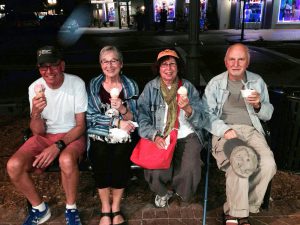
    After the Rookery, we paid a visit to Olaf’s ice cream shop in SiestaKey Village. Yum!

    The warm weather has been  great, allowing us to get out more and we have upped our exercise to at least 1.5 hours a day, primarily walking along the beach and doing Tai Chi which we both enjoy, in fact we ordered the next DVD so we can expand our practice.  We have been averaging 4 – 5 miles per day walking on the beach, plus walking to our favorite restaurant, Captain Curt’s, for a spot of their world famous clam chowder for lunch!  I have definitely noticed improvement in my walking and balance with the warm weather and increased exercise.

    We also have started doing Yoga using Introduction to Yoga and Meditation, a DVD by one of our instructors from Kripalu, Megha-Nancy Buttenheim.  The meditation instruction is great and the yoga practice is challenging for my stiff limbs 🙂

    In between all of the exercising, I’ve found time to complete more of my genetics course, enjoy many a beautiful sunset, catch up on my magazines, read a few books, and enjoy the beach.  We have rented a cabana chair for the week and we spend a few hours each day out on the beach reading, soaking up the Vitamin D and people watching. Oh and I finally found time to complete a blog post!!

    We head home Saturday and hope that spring arrives at the same time 🙂

    Until next time, I end with one of my favorite quotes by Virginia Satir- “Life is not the way it’s supposed to be.. It’s the way it is.. The way we cope with it, is what makes the difference.”

Pedaling with Parkinson’s

As part of our stay here in Florida, we became temporary members at a local Gym that provides PwP specific classes along with all the other amenities of a large gym.  One of the classes they offer is Pedaling with Parkinson’s, a twice a week spin class specificly designed for PwP’s.  The objective of the session is to cycle for 40 minutes, keeping your heart rate between 60% – 80% of your MHR (maximum heart rate), and keeping the cadence (RPM) between 80 and 90 RPM per minute.

In order to take the class, I had an hour long evaluation that covered, among many things, medical conditions other than PD, what PD symptoms I had, and how my balance was – almost made the 30 seconds standing on one foot! Then, after taking my resting heart rate and blood pressure, I spent 20 minutes on the spin bike, upping the resistance until I couldn’t maintain 80 RPM for a minute, which provided my MHR.

I managed to pass the tests so last Friday I joined a full class of 20+ PwP’s for my first forced march on a bike!  After adjusting the bike, putting on the heart rate monitor and doing a light warm up spin (you know in the 60 – 80 RPM range) the instructor cranked up the music and off we went, upping the resistance while maintaining the cadence at 80 – 90 RPM for what seemed to be forever. OK maybe it wasn’t forever but it was a solid 40 minute workout, with brief slow downs for hydration before the next song came on.  All of our data was captured on a computer which then projected our heart rate and the percent of MHR up on a screen in front of the room.  In addition, the bike was equipped with a device showing our RPM, heart rate and % of MHR.

This program is based on research by Jay Alberts, PhD, at the Cleveland Clinic and a demonstration study by the Neuro Challenge Foundation here in Sarasota which have yielded promising preliminary scientific and anecdotal results.  The studies have indicated that doing this twice a week helps create new pathways (neuroplasticity) in the brain and participants have reported a reduction in tremors, better balance and gait, regained sense of smell, and increased energy. I have been interested in doing this for some time and I’m glad I get the opportunity to participate while here as they also offer this class at the YMCA in Knoxville if I want to continue when I get home.

The Neuro Challenge Foundation also sponsors the three dance for PD classes we are attending while here along with many other activities for PwP and Care Partners.  They provide a Parkinson Disease Resource Guide and offer a one on one Care Advisor Program to help PD Patients find the best treatment and support options available.  An excellent resource for PwP in the Sarasota area and one of the reasons we like to come to this area.  Speaking of dance classes, our Let Your Yoga Dance for PD class made the local paper, you can view the article here.  We have a good time in all three classes and it certainly helps keep me flexible.

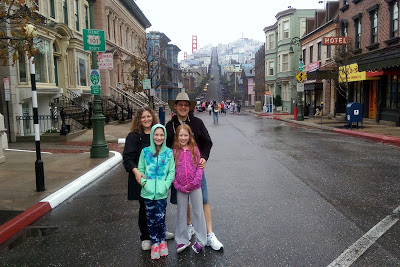
Oh, did I mention we caught up with Dale, Monica and grand daughters Angelina and Ariana in San Francisco?  OK, maybe we were at Disney World’s Hollywood Studios and took advantage of the set.  We had a great time with them in Disney World and here at the beach.

We continue to enjoy our beach time in between dance classes and time at the gym and I can’t believe our time here is half over already!

Don’t forget to sign up for MJF Trial Finder by clicking on that large orange button on the top right and then you might as well join Fox Insight by clicking on the logo to your right!  Thanks.

“It does not matter how slowly you go as long as you do not stop.” – Confucius


Pedaling with Parkinson’s

As part of our stay here in Florida, we became temporary members at a local Gym that provides PwP specific classes along with all the other amenities of a large gym.  One of the classes they offer is Pedaling with Parkinson’s, a twice a week spin class specificly designed for PwP’s.  The objective of the session is to cycle for 40 minutes, keeping your heart rate between 60% – 80% of your MHR (maximum heart rate), and keeping the cadence (RPM) between 80 and 90 RPM per minute.

In order to take the class, I had an hour long evaluation that covered, among many things, medical conditions other than PD, what PD symptoms I had, and how my balance was – almost made the 30 seconds standing on one foot! Then, after taking my resting heart rate and blood pressure, I spent 20 minutes on the spin bike, upping the resistance until I couldn’t maintain 80 RPM for a minute, which provided my MHR.

I managed to pass the tests so last Friday I joined a full class of 20+ PwP’s for my first forced march on a bike!  After adjusting the bike, putting on the heart rate monitor and doing a light warm up spin (you know in the 60 – 80 RPM range) the instructor cranked up the music and off we went, upping the resistance while maintaining the cadence at 80 – 90 RPM for what seemed to be forever. OK maybe it wasn’t forever but it was a solid 40 minute workout, with brief slow downs for hydration before the next song came on.  All of our data was captured on a computer which then projected our heart rate and the percent of MHR up on a screen in front of the room.  In addition, the bike was equipped with a device showing our RPM, heart rate and % of MHR.

This program is based on research by Jay Alberts, PhD, at the Cleveland Clinic and a demonstration study by the Neuro Challenge Foundation here in Sarasota which have yielded promising preliminary scientific and anecdotal results.  The studies have indicated that doing this twice a week helps create new pathways (neuroplasticity) in the brain and participants have reported a reduction in tremors, better balance and gait, regained sense of smell, and increased energy. I have been interested in doing this for some time and I’m glad I get the opportunity to participate while here as they also offer this class at the YMCA in Knoxville if I want to continue when I get home.

The Neuro Challenge Foundation also sponsors the three dance for PD classes we are attending while here along with many other activities for PwP and Care Partners.  They provide a Parkinson Disease Resource Guide and offer a one on one Care Advisor Program to help PD Patients find the best treatment and support options available.  An excellent resource for PwP in the Sarasota area and one of the reasons we like to come to this area.  Speaking of dance classes, our Let Your Yoga Dance for PD class made the local paper, you can view the article here.  We have a good time in all three classes and it certainly helps keep me flexible.

Oh, did I mention we caught up with Dale, Monica and grand daughters Angelina and Ariana in San Francisco?  OK, maybe we were at Disney World’s Hollywood Studios and took advantage of the set.  We had a great time with them in Disney World and here at the beach.

We continue to enjoy our beach time in between dance classes and time at the gym and I can’t believe our time here is half over already!

Don’t forget to sign up for MJF Trial Finder by clicking on that large orange button on the top right and then you might as well join Fox Insight by clicking on the logo to your right!  Thanks.

“It does not matter how slowly you go as long as you do not stop.” – Confucius


Tag: Parkinson’s Disease

  • Pedaling with Parkinson’s

    Pedaling with Parkinson’s

    As part of our stay here in Florida, we became temporary members at a local Gym that provides PwP specific classes along with all the other amenities of a large gym.  One of the classes they offer is Pedaling with Parkinson’s, a twice a week spin class specificly designed for PwP’s.  The objective of the session is to cycle for 40 minutes, keeping your heart rate between 60% – 80% of your MHR (maximum heart rate), and keeping the cadence (RPM) between 80 and 90 RPM per minute.

    In order to take the class, I had an hour long evaluation that covered, among many things, medical conditions other than PD, what PD symptoms I had, and how my balance was – almost made the 30 seconds standing on one foot! Then, after taking my resting heart rate and blood pressure, I spent 20 minutes on the spin bike, upping the resistance until I couldn’t maintain 80 RPM for a minute, which provided my MHR.

    I managed to pass the tests so last Friday I joined a full class of 20+ PwP’s for my first forced march on a bike!  After adjusting the bike, putting on the heart rate monitor and doing a light warm up spin (you know in the 60 – 80 RPM range) the instructor cranked up the music and off we went, upping the resistance while maintaining the cadence at 80 – 90 RPM for what seemed to be forever. OK maybe it wasn’t forever but it was a solid 40 minute workout, with brief slow downs for hydration before the next song came on.  All of our data was captured on a computer which then projected our heart rate and the percent of MHR up on a screen in front of the room.  In addition, the bike was equipped with a device showing our RPM, heart rate and % of MHR.

    This program is based on research by Jay Alberts, PhD, at the Cleveland Clinic and a demonstration study by the Neuro Challenge Foundation here in Sarasota which have yielded promising preliminary scientific and anecdotal results.  The studies have indicated that doing this twice a week helps create new pathways (neuroplasticity) in the brain and participants have reported a reduction in tremors, better balance and gait, regained sense of smell, and increased energy. I have been interested in doing this for some time and I’m glad I get the opportunity to participate while here as they also offer this class at the YMCA in Knoxville if I want to continue when I get home.

    The Neuro Challenge Foundation also sponsors the three dance for PD classes we are attending while here along with many other activities for PwP and Care Partners.  They provide a Parkinson Disease Resource Guide and offer a one on one Care Advisor Program to help PD Patients find the best treatment and support options available.  An excellent resource for PwP in the Sarasota area and one of the reasons we like to come to this area.  Speaking of dance classes, our Let Your Yoga Dance for PD class made the local paper, you can view the article here.  We have a good time in all three classes and it certainly helps keep me flexible.

    Oh, did I mention we caught up with Dale, Monica and grand daughters Angelina and Ariana in San Francisco?  OK, maybe we were at Disney World’s Hollywood Studios and took advantage of the set.  We had a great time with them in Disney World and here at the beach.

    We continue to enjoy our beach time in between dance classes and time at the gym and I can’t believe our time here is half over already!

    Don’t forget to sign up for MJF Trial Finder by clicking on that large orange button on the top right and then you might as well join Fox Insight by clicking on the logo to your right!  Thanks.

    “It does not matter how slowly you go as long as you do not stop.” – Confucius


  • It’s a New Year…

    and it’s way past time for a catch up blog post. I think the last post of substance was about Giving Tuesday at the end of November, 2015! So this is my attempt to condense a couple of months of activity into one post. Not long after the Giving Tuesday post, we made an unscheduled trip to Traverse City, MI to help out Mara’s sister with her used book store. We have no retail experience and it’s been over ten years since I’ve worked a 40+ hour shift but we had a great time taking care of business. If you are in the Traverse City area, be sure and stop in at her store The Bookie Joint downtown just off Front Street. (yep, a shameless plug!)

    We got home just in time to get ready for Christmas and enjoyed the holidays with our family and then it was time to start getting ready for THE BEACH! We arrived last Saturday and were awakened at 3am Sunday morning by the sounds of a tornado (I’ll be darned if it didn’t sound just like a train).  Luckily no one in our complex was injured but a lot of the units had windows and screens damaged and a lot of cars suffered broken glass and other damage.  We hadn’t planned on being part of the effort to prove the theory of global warning but we are thankful that no one was hurt and our unit and car were not damaged.

    On the Parkinson’s front, I was appointed webmaster for the East Tennessee Parkinson’s Support Group and spent a lot of free time during December learning WordPress and upgrading the site to the latest version.  When that wrapped up early in January I spent my free time updating the Tennessee Parkinson’s Disease Resource site with maps and adding new information.

    Somehow I also managed to take an exercise holiday and I began to notice my symptoms were getting worse, particularly the brady kinesia (ridgity).  Since we arrived in Florida, I have been walking at least an hour a day and we have signed up for two Parkinson’s dance classes  We are also planning to sign up for additional exercise classes at the Neuro Challenge Institute, a great resource for Parkinson’s Patients in the greater Sarasota area.  I am already noticing improvement which once again proves how important exercise is for PWP’s!  

    We also signed up for a weekly Let Your Yoga Dance class. We were introduced to Let Your Yoga Dance while at the Kripalu retreat in October 2013 and this class reunited us with instructor/founder Megha and Joel and Melissa whom we first met at the retreat and meet up with every year while in Sarasota.  Our first class was yesterday and Megha had us doing deep breathing exercises, stretching and dancing in no time. It is a great class that not only provides exercise but brings ‘healing through joy’. 

    Coming up we will attend the Neuro Challenge Insitute annual Parkinson’s Symposium on Saturday where one of the topics to be covered is the Tasigna trial conducted at Georgetown University.  Tasigna is a leukemia drug that appears to stop or reverse some of the PD symptoms during a small test involving 12 Parkinson’s patients.  I am looking forward to hearing more about the first trial and the results and will provide more information in the next post.

    So there you have it, a short version of a very busy couple of months.  Oh, did I mention I am still wearing my smartwatch and providing data for the Fox Insight Trial?  If you haven’t signed up you can do it here, and don’t forget to also sign up for Fox Trial Finder at the same time and join over 52,000 of us who have already signed up!


    “It does not matter how slowly you go as long as you do not stop.” – Confucius


  • Giving Tuesday is Almost Here!

    Tuesday, December 1st is Giving Tuesday. Black Friday is over and Cyber Monday is almost over and Tuesday will be a great opportunity to take some (or all) of the money you saved this weekend and give back by making a donation to a Parkinson’s Disease organization or another cause of your choice. As in past years, many charitable organizations have a matching plan that will double your Giving Tuesday donation for double the benefit.

    In case you need a little inspiration, I am reposting the following article “What is a Parkie? And Why are They so Expensive?“.  This article was written by Alan Zimmerman vice president of the East Tennessee Parkinson’s Support Group and posted on their website,  PK Hope is Alive . Alan is a strong and active advocate for Parkinson’s research and education. In addition to being Vice President of the group, he is the Assistant Tennessee State Director for the Parkinson’s Action Network (PAN) and a member of the Parkinson’s Disease Foundation (PDF) People with Parkinson’s Advisory Council.

    Take some time on Tuesday and support the cause of your choice,  There is a lot of exciting news on the research front and our donations can make a difference!  Happy Holidays!!


    “It does not matter how slowly you go as long as you do not stop.” – Confucius


    WHAT IS A PARKIE? AND WHY ARE THEY SO EXPENSIVE?
    by Alan Zimmerman
     
    Parkies are expensive devils.  How does $25 Billion per year in the US sound to you?  Not only that,we discover another 60,000 Parkies each year, right here in good old America.  That number that is guaranteed to rise.  And, each Parkie spends about $2500 per year trying to be less Parkie with an assortment of medications and untold more on supplements.
    So, what then is a Parkie?  It is what people with Parkinson’s disease call each other.  Yep, the term is pretty much reserved for those in the Parkie club.  They would rather be known by everyone else as people with Parkinson’s (PWP).
    I know that you know someone who is a PWP.  You may even have a relative with PD.  You have seen them taking short steps and all bent over and very stiff and slow, or maybe they are using a walker to get around or perhaps they shake uncontrollably.  Maybe you can’t hear or understand them when they talk.  Perhaps you, nor they can read their handwriting.  The list goes on and on.
    Who gets this disease?  Men are slightly more likely and most people are in their 60’s when diagnosed.  But, about one in ten are 45 or under.  By the time your symptoms are bad enough to be diagnosed, one has already lost more the 60% of their dopamine.  You see, that marvelous thing called a brain compensates until it no longer can.  Unfortunately, that is not the blessing it seems to be.  As more interventions are developed, the sooner the diagnosis, the better.
    Wait!  We have new terms: diagnosis and dopamine.
    Let’s take “diagnosis” first because most everyone has had at least one of those.  In the case of Parkinson’s there is no definitive way of diagnosing except by physical exam.  And, it really needs to be done by a neurologist who specializes in movement disorders.  There is no blood test or scan that will determine for sure that the monster called PD has attacked.
    What’s “dopamine?”  It is a chemical found in the brain.  What does it do?  Lots of things that we know about and probably some yet to be discovered.  For one, it is a communicator.  Somehow it signals the muscles to do whatever the brain tells them to do.  It also has something to do with mood, pleasure, depression and many other important functions.
    What causes this PD thing?  Nobody knows for sure but most scientists believe it is probably a combination of genetics and something in the environment, like heavy metals, toxins, or pesticides that trigger the beginning of the disease.  That is pretty much where science is.  OK, so where does it start?  Nobody is sure where exactly but some of the latest thinking is that it starts in the gut or maybe even the intestines.
    So, bottom line, what is the cure?  There isn’t one.  It just gets worse over time as more brain cells die.  OK then, what is the treatment?  Mostly, at this stage in modern medicine, only symptoms can be treated.  A few things may slow it down like exercise programs.
    We also have this thing called Deep Brain Stimulation (DBS).  Hold on, what’s that?  It may scare you if I tell you but here goes.  DBS is where a PWP has one or preferably two holes drilled in the scull.  Then you insert electrodes into certain places in the brain.  Then, you attach all that to a battery which is eventually buried into your upper chest.  Oh, I forgot to tell you.  Usually the patient is awake when those electrodes are being put in place.  Why?  So that the neurosurgeon can get feedback from the PWP.
    So, I guess we need more research.  There is a bunch going on world-wide, but we could always use more.  Researchers eat and have families and require laboratories.  What that means is that research has a price tag.  What a price tag means is that more donations are required.
    What else is needed?  More movement specialist physicians for one.  There are not enough now and certainly too few going to school while the Parkie population increases.  So, we need to encourage doctors to devote an extra two years of their life learning the intricacies of movement.  Guess what?  That too carries a pretty hefty price tag.  So, we need more scholarships which means we need more donations yet again.
    So, let’s review.  People with Parkinson’s are growing in numbers rapidly.  The disease is progressive and degenerative.  So far, we can pretty much treat the symptoms only.  But, through massive research, we believe that disease altering therapies are going to become a reality pretty soon.  What is pretty soon?  Maybe 5-10 years.  But, that only happens with support for research, i.e. donations.