• Lessons…Learned

    I know this is my second post in less than 30 days! I think I have too much free time on my hands while practicing this social distancing routine! Today I will catch up with what’s happening in PD School 2020 and talk a bit about how I have implemented what I’ve learned so far. If you aren’t aware of Dr. Mischley’s PD School 2020 you can read more about it my posts here and here. And check out the coupon offer at the end of this post!

    The last lesson I covered was lesson 3 so I will quickly catch you up on lessons 4, 5, 6 & 7 just touching on highlights and things I found interesting. Lessons 4 and 5 cover the topics of food and nutrition. Lesson 4 discusses what to eat and lesson 5 discusses when and how to eat. In lesson 4 Dr Mischley covers foods that are “Good” for PwP and also foods that are “Bad” for PwP. The data to support the designation comes from the ongoing longitudinal research trial she runs at Bastyr University.

    The good foods below are listed in order of decreasing impact, that is fresh vegetables had a greater impact than fresh fruit and so on.

    • Fresh vegetables
    • Fresh fruit
    • Nuts and seeds
    • Fish (not fried)
    • Wine (yessssssssssssssss!)
    • Olive oil
    • Coconut oil
    • Fresh herbs

    The bad foods below are listed in order of greatest negative impact.

    • Canned fruit
    • Diet soda
    • Fried foods
    • Ice cream (noooooooooooo!)
    • Canned vegetables
    • Beef
    • Pasta
    • Soda

    She also discusses how eating can impact medication absorption particularly when you eat protein just before or just after taking your meds.  Various diets are discussed and her recommendation is go as vegan as you can and follow the Mediterranean diet.

    Lesson 6 discussed the laboratory tests she requests for her patients. Several of the tests are not normally requested by your neurologist or PCP and some are not covered by insurance or Medicare. She notes at the end of the lesson that she is working on trying to set something up to provide the test to any PwP at a reduced rate (she hopes around $500 instead of $2000).

    I was interested in this lesson because she pointed out that most PwP’s are low in both vitamins D and B12. A B12 deficiency can result in neuropathy, cognitive decline and loss of sense of smell. In addition tremor, trouble walking and balance may also be effected. Vitamin D deficiency can result in constipation, falls and balance issues, depression and cognitive decline.

    I have been taking both B12 (120mg) and D (2000 iu) supplements for the last several years. My PCP tested me for both vitamins this year and I was within range as far as the lab was concerned. Dr Mischley provides her recommended reference range for the tests and I am below her recommended range in both. I was particularly surprised at the vitamin D result with all the sunshine I get here playing tennis, etc. Looks like I need to increase my supplement amounts of both vitamins.

    She covers several other lab tests she conducts and why and I think you will find this lesson very interesting.

    Lesson 7 discusses gut and intestinal health. This lesson includes a presentation by Dr Samantha Evans who practices with Dr Mischely in Seattle. Dr Mischely provides the introduction and overview pointing out that 50% of the dopamine neurons are located in your intestinal tract. She also discusses the need for gastric acid to breakdown food and medications. She points out as we get older the gastric juice becomes less acidic and recommended taking our medication with a glass of water mixed with 500 mg powered vitamin C to increase the acid level.

    Dr Evans discusses how much of what happens in the intestinal tract impacts PwP’s. She discusses SIBO (Small Intestine Bacteria Overgrowth) and Leaky Gut and how it impacts PwP, particularly medication absorption issues.

    So there are a few highlights from lessons 4,5,6, and 7. The next class is Do I need to take supplements? and will be available on the 28th of the month.

    Quick timeout for some fine print! Before I discuss how I have implemented parts of these classes I just want to remind everyone I am not a medical practitioner and you shouldn’t rely on the information below as an alternative to medical advice from your doctor or other professional healthcare providers. If you have any specific questions about any medical matter you should consult your doctor or other professional healthcare provider. You should never delay seeking medical advice, disregard medical advice, or discontinue medical treatment because of information on It Is What It Is .

    And we are back.

    I have enjoyed these classes and have started trying to put some of what I have learned in to practice. In lesson 2, Dr Mischley discusses the success she has had with treating dyskinesia with high doses of DHA fish oil for 30 days and then adding CDP Citicoline twice a day to improve absorption of Levadopa. Since we eat salmon 4-6 days a week, I decided to test taking the CDP Citicoline as she recommended (2 250 mg capsules twice a day).

    I began the test on February 2 and tracked the effects daily through April 4. As she mentioned in the lesson, my dyskinesia actually started getting worse because the supplement was improving the uptake of the medication and after 3 weeks I started to slowly reduce the amount of Sinement,Rytary and Mirapex over the next two months. My goal was to reduce my levadopa intake, reduce dyskinesia and not increase off periods.

    By April 4 I had reduced the Mirapex from 1.5 mg to .5 mg (67%) and my Sinement from 2.5 tablets 3 times a day to 2 tablets 3 times a day (20% reduction). My dyskinesia is barely noticeable and off episodes are unchanged. I believe I could stop taking the Mirapex completely except the .5 mg helps reduce my restless leg syndrome which I had before my PD diagnoses but went away with the Mirapex which is also prescribed for restless leg.

    I have also tried to do a better job of not taking meds too close to mealtime particularly high protein meals. And I have reduced my dairy intake, even ice cream! I’ve ordered some powered vitamin C which should arrive next week and I will test out taking medications with water mixed with vitamin C. Now if I could just figure out how to get Dr Mischely to remove ice cream from the bad food list!!

    Just In!! It’s Parkinson’s Awareness Month and Dr Mischley is offering a coupon for $50 off the PC School for this month (All 24 courses for $100). If you haven’t signed up or have friends or relatives that might find this program useful, please send them this link to the course and the coupon code: AWARENESS. http://pd-school.teachable.com/

  • World PD Day 2020

    First and foremost, I hope this post finds you and your families well and hunkered down as we wait out the COVID-19 pandemic.  It is an unprecedented time in our lives and I have no idea how it will all end up but I have the cleanest hands in the neighborhood!

    Today, April 11th, is World Parkinson’s Day, a part of Parkinson’s Awareness month.  In past years, we have celebrated with Parkinson’s Disease walks and last year we moved our Pedaling for PD class out into the lobby of the YMCA to bring attention to PD and the need for exercise.  But this year we can only act alone to raise awareness about PD as we stay in to prevent COVID-19.

    This month I read a new book about Parkinson’s Disease – Ending Parkinson’s Disease, A Prescription for Action.  The books co-authors show that the increasing numbers of PwP has made PD the fastest growing brain disorder in the world.  The number of PwP’s has doubled from 3 million to over 6 million in 25 years and they predict it will double again to over 12 million by 2040.  As a result they feel  PD is a world wide pandemic.

    The book is co-authored by four leading doctors and advocates for PD:

    Ray Dorsey MD who directs the Center for Health + Technology at the University of Rochester. He has used telemedicine to improve care for individuals with Parkinson’s disease and I have participated in several clinical trials where he has pioneered the use of technolgy particularly cell phones and live video to improve diagnoses and treatment of PD.

    Todd Sherer PHD is the Chief Executive Officer of The Michael J. Fox Foundation for Parkinson’s Research. Trained as a neuroscientist, he is responsible for the Foundation’s overall scientific and fundraising direction to speed treatment breakthroughs and a cure for Parkinson’s disease.

    Michael S Okun MD is Chair of Neurology at the University of Florida. He established the Movement Disorder Clinic at the University of Florida bringing together Neurologists, Speech Therapists, Occupational Therapists and Physical Therapists for a complete evaluation of the patient.  You can read my blog post about our experience when we went to the University of Florida for a second opinion here.

    Bastiaan R Bloem, MD, PHD is professor of neurology and the director of the Centre of Expertise for Parkinson & Movement Disorders at Radboud University Medical Centre in Nijmegen, the Netherlands. In 2004, with Dr. Marten Munneke, he created ParkinsonNet, the largest integrated-care program for Parkinson’s patients. 

    The authors propose a PACT to Prevent the disease, Advocate for protective policies, Care for patients, and Treat the condition with innovative therapies.

    Prevent – They point out that stopping the use of chemical pesticides and solvents and recognizing the impact of head traumas would help to prevent PD and lead to a large reduction in newly diagnosed PwP world wide.

    Advocate – They point out the need to educate the public  about the worldwide Parkinson’s pandemic. The book discusses the campaigns to end or treat Polio, HIV, and Breast Cancer as examples.

    Care – They discuss providing care for PwP’s  including in home care by healthcare workers trained in caring for PD patients.  They point out that care must be covered by health insurance including Medicare. In addition they discuss the need for each of us to take actions such as exercising to improve our own care. By the way, they have an excellent discussion about Pedaling for PD during the chapter about exercising to prevent and/or slow the progression of PD.

    Treat – The final section deals with the need to take charge of the research process and make sure new treatments are fully funded.  This would include new medications, new surgeries and improved methods of care for Parkinson’s Disease.

    The book ends with a prescription for action listing 25 steps each of us can and should take to reduce the worldwide toll of this disease. The list includes banning paraquat and other harmful pesticides, eating like the Greeks, exercising, advocating for resources and policy changes, and providing reasonable pricing for PD medications.

    The book is well written and includes many case studies and research references to support their plan for ending or at least slowing down the increasing number of Parkinson’s Disease diagnoses.  It also lays out how to care for those of us that have already been diagnosed including supporting clinical trials that slow or reverse the progression of PD.

    So, while you are home fighting off the COVID-19 pandemic, you might want to grab a copy of Ending Parkinson’s and read about the other pandemic we are fighting as PwP’s.  You can find more information about the book at www.endingPD.org.

    I am still working my way through the PD School 2020 lessons and will provide an update in my next post. In the meantime, stay safe and stay healthy!

  • PD School 2020 – Update

    This will be a short blog post regarding the PD School being conducted by Dr Laurie Mischley which I wrote about in the last post. A few days ago I received the following message from Dr Mischely:

    Hi Tom,
    Yours was one of many requests I’ve received the past few days to make class #1 free. 
    Done. It is now free.  
    Thanks for helping spread the word!  
    Laurie
     
    If you have or have not watched the first class, you now have an opportunity to not only watch it but forward that class to family members, friends, care givers and any other person you think could benefit from a good discussion about what it means to be diagnosed with PD. 
     
    As I mentioned in the last post, this lesson should be offered to all newly diagnosed Parkinson’s patients- it answers so many of the questions we have at that point but didn’t know enough to ask during that first meeting with the neurologist.  The two links below take you to the overview lesson (was already free) and the orientation lesson which is now free.


    I have completed lesson two “Dopamine Repletion” and lesson three “How Do We Know What We Know”.  Both were excellent and I highly recommend them both.  Here are a few of the highlights:
     
    Lesson two – Dopamine Repletion – is an excellent overview on the drugs available, along with when is the best time to take them and avoid the protein from meals blocking the transfer of dopamine to the brain.
     
    She utilizes the results of the ongoing CAM Study and other published research to support taking your levadopa/carbidopa with water  mixed with vitamin C to provide additional stomach acid to speed up the breakdown of the pills.
     
    In addition, she discusses the use of  Fish Oil and Citicoline (both supplements) to reduce dyskinesia by improving the uptake of dopamine so you can reduce your overall dose.
     
    At the end there is a brief discussion of Mucuna, a plant form of levadopa followed  by a ‘guest lecturer’ who discusses the pluses and minuses of using Mucuna.
     
    Lesson three – How Do We Know What We Know – discusses PD research from all directions.  She was worried this would be the lesson no one watched,  but it is another must see as she tackles traditional research, the placebo effect and more.  Rather than try to recapitulate it all here I am going to just pull a few points from her summary at the end of the lesson:
    -Physicians, patients, and researchers all describe/ define PD differently.
    -Everyone says they want medicines that slow PD progression, but they don’t have a scale to measure progression.
    -By time a patient is diagnosed, ability to significantly impact course may be compromised.
    -We don’t know who is going to get PD (screening tests), we don’t know who is at greatest risk of progression, we don’t have a tool to measure progression, and we can’t agree on a definition.
    -A shocking amount of researcher time goes to keeping one’s job. If you’re not bringing in grant money, you don’t get paid, so instead of just doing science, we spend our time courting the system. Novel ideas and  innovation must swim against a significant current. Everyone wants so
    As she wrapped up this lesson, she said she favors a ‘friendly competition’ among PD practitioners.  If she is doing something right, doesn’t your neurologist need to know and if they are doing something right, she wants to know that too. 
     
    Sounds like a good idea to me.
     
    “It does not matter how slowly you go as long as you do not stop.” – Confucius


Happy Thanksgiving!

Just a quick post wishing everyone a Happy Thanksgiving from Seattle.  I have much to be thankful for this year including:

  • making a change to a Movement Disorder Specialist who recommended a medication change that resulted in a great reduction of my symptoms;
  • and that improvement allowed me to increase my exercise time which also helped to reduce rigidity and increase my mobility; 
  • and the increased mobility gave us a chance to travel to visit family and friends across the country;
  • and I got to fish almost every day I was home without having to sit down after 15 minutes to rest!

But most of all I am thankful for the support of my wonderful wife, my family, my friends and all of you who take the time to read my wandering posts.  I hope I have provided information of value to PwP’s and others through this blog and the Tennessee Parkinson’s Resources site that we started this year.

Thank you all and Happy Thanksgiving!


Happy Thanksgiving!

Just a quick post wishing everyone a Happy Thanksgiving from Seattle.  I have much to be thankful for this year including:

  • making a change to a Movement Disorder Specialist who recommended a medication change that resulted in a great reduction of my symptoms;
  • and that improvement allowed me to increase my exercise time which also helped to reduce rigidity and increase my mobility; 
  • and the increased mobility gave us a chance to travel to visit family and friends across the country;
  • and I got to fish almost every day I was home without having to sit down after 15 minutes to rest!

But most of all I am thankful for the support of my wonderful wife, my family, my friends and all of you who take the time to read my wandering posts.  I hope I have provided information of value to PwP’s and others through this blog and the Tennessee Parkinson’s Resources site that we started this year.

Thank you all and Happy Thanksgiving!


Tag: Parkinson’s Disease

  • Happy Thanksgiving!

    Just a quick post wishing everyone a Happy Thanksgiving from Seattle.  I have much to be thankful for this year including:

    • making a change to a Movement Disorder Specialist who recommended a medication change that resulted in a great reduction of my symptoms;
    • and that improvement allowed me to increase my exercise time which also helped to reduce rigidity and increase my mobility; 
    • and the increased mobility gave us a chance to travel to visit family and friends across the country;
    • and I got to fish almost every day I was home without having to sit down after 15 minutes to rest!

    But most of all I am thankful for the support of my wonderful wife, my family, my friends and all of you who take the time to read my wandering posts.  I hope I have provided information of value to PwP’s and others through this blog and the Tennessee Parkinson’s Resources site that we started this year.

    Thank you all and Happy Thanksgiving!


  • Anniversaries abound!

    Anniversaries abound!

    When last we met, we were preparing for a visit from my daughter Holly, Paul and grandchildren Charlie and Kayla.  We had a great visit, spending most of our time on the lake where Charlie enjoys riding the tube and Kayla is an expert fisher person and the DJ for the ‘partyboat’.  Holly and Paul tried out the new paddle boards and we squeezed in a trip to Knoxville for a nice dinner.

    Now for the anniversaries. Last week, Mara and I celebrated our 25th wedding anniversary with a visit to a wonderful B & B in the Smoky Mountains and a great dinner at the Foothills Milling Co.   After a busy month we enjoyed the R & R time which included a nice but strenuous hike to Spruce Flats Falls.  The trail was steep and rocky but the beautiful falls made it all worthwhile. As we walked the trail, we remarked that I probably could not have made this trip last year and what a difference the change in medication has  made in my symptoms.

    We finished up the week by taking the boat out to watch the sunset and the ‘blue’ moon rise.  This 180 degree panoramic photo doesn’t do justice to the beautiful sunset but it was a great way to celebrate my birthday!

    July 24th was the two year anniversary of my official Parkinson’s Disease diagnosis and August 6th marked two years of writing this blog. During the year I changed to a Movement Disorder Specialist at Vanderbilt Medical Clinic and I am happy to report that his changing my medication has made a remarkable difference in my symptoms and provided me with improved gait, balance and arm movement.  As noted above, I am walking at a normal pace and was able to hike the Smokie’s, something I could not have done last year.  I realize that PD is a progressive neurological degenerative disease and I haven’t been ‘cured’ but I sure feel much better than last year and I am not going to worry about when things will change but will continue to enjoy the ride while I can!

    Also this past year we attended several conferences including Rallying to the Challenge in Grand Rapids, Partner’s in Parkinson’s in Atlanta where we were members of a panel discussion and again in  Ft Lauderdale to learn about being Fox Trial Finder Ambassadors, and the Southern Symposium in Spartanburg, SC which included the Davis Phinney Foundation Victory Summit. Again we have added many new friends to our global support group as we attended  these meetings and conferences.

    This year we have become  MJFF Trial Finder ambassadors to help promote clinical trial participation, and we are participating in trials ourselves. We are working on a new website that will provide a list of PD resources in Tennessee that we hope to promote to PD patients, care persons and the  medical community.  We continue to promote the need for patient participation in the clinical trial process and will attend the second Rallying to the Challenge meeting in Grand Rapids, MI this fall.

    I hope you will stick with me for another year as I travel this road of living with Parkinson’s Disease.  I will continue to write about PD research, how my PD is affecting me and I still plan to add a page about exercise programs for PD.  I will continue to advocate signing up for Fox Trial Finder and the Fox Insight programs on the blog and in person.   As I said last year, I am aware of what the future “might” bring but I will continue to fight to delay the disease and maintain a positive attitude because I believe we will beat Parkinson’s!  Thanks for your support, positive thoughts, and encouraging words.

    “It does not matter how slowly you go as long as you do not stop.” – Confucius
  • On the Road Again!

    On the Road Again!

    Yes,we are on the road again.  We are working our way to San Francisco to attend a wedding which will also be another 3M reunion.  I say working our way because we left home at 8:45 AM for a 10:50 flight to Houston for our connection to arrive in San Francisco around 5pm.  But the Houston flight was delayed and we would miss our connection. Sam, a very helpful United employee, was able to get us on a US Air flight to Philadelphia leaving at 3pm and connecting to a San Francisco flight arriving at 9pm.

     
    So, with plenty of time to kill, we took a walk around the airport and on the way back to our gate I see that the Philadelphia flight was delayed and we would again miss our connection! So back to Sam at the United desk where they were able to get us on a 3:55pm US Air flight to Charlotte for a connection arriving in San Francisco at 8:30.
     
    With more time to kill, we decided to get some lunch and on the way back to the gate we see the Charlotte flight is delayed 30 minutes! This meant,if we left at the new scheduled time, we will have 20 minutes to change terminals. A small challenge for me and Dr. Parkinson but all that walking we have been doing paid off and we are in the air, bouncing our way to San Francisco.
     

    Once we get there,we will have a  new challenge,finding the little house we are renting in Bolinas, north of San Francisco,in the dark!

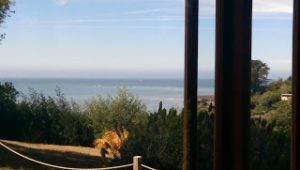
    Well it is the next day and we are sitting in the little house we rented looking out at the ocean as you can see in the picture.  We finally arrived here around midnight and this morning we took a nice walk down to town for some breakfast and a walk on the beach.  Good times, good times.

     
    After the wedding and 3M reunion we are going to Sonoma for a couple of days where we will meet up with son Ryan and his wife Sarah for some wine and beer tasting and probably some fine dining. More good times.
     

    This week I finally completed the long promised list of blogs and bloggers I follow. Click on the tab at the top of the page and check it out. Next I hope to work on the post about exercise.  Last week the results of a longitudinal study were released showing the benefits of exercise for Parkinson’s patients.  Here is a portion of the press release:

    SAN DIEGO – Regular exercise and increasing physical activity is associated with a slower decline in quality of life in Parkinson’s disease (PD) patients, according to a study released today at the 19th International Congress of Parkinson’s Disease and Movement Disorders. This study evaluated 2,940 patients from 20 sites affiliated with the National Parkinson Foundation Quality Improvement Initiative. The cohort was assessed using the Parkinson’s Disease Questionnaire (PDQ-39), and patients were measured at baseline, 1 year, and 2 year follow up appointments. Those who were classified as non-exercisers at baseline and began to exercise after their initial visit had significantly less worsening of PDQ-39 than non-exercisers. Ultimately, the study found that increasing physical activity greater than 2.5 hours of exercise per week is associated with a slower decline in total PDQ-39 scores.

    Michael Okun, Professor of Neurology at the University of Florida Center for Movement Disorders and Neurorestoration states, “This study makes clear that everyone with Parkinson’s should be exercising. This longitudinal study of patients selected without exclusions shows that patients suffer from delaying starting their exercise program. It doesn’t seem to matter what they do, they benefit from just getting up and out and from moving.” Okun adds, “This study adds to mounting evidence that exercise is good and sooner is better than later.

    I can certainly attest to the benefits of exercise and we are trying to average at least 5 hours a week so maybe I’ll get double the benefit! Hopefully that post won’t take as long as the blog list! In the meantime, check out some of the blogs on my list while you are waiting for my next post and don’t forget to sign up for Fox Trial Finder and the Fox Insight trial. Remember, they need control subjects too, not just Parkinson’s patients so sign up!

    “It does not matter how slowly you go as long as you do not stop.” – Confucius