Yep, May 4th – 8th is Clinical Trial Awareness Week, and you know how I feel about clinical trials! I have to admit, two years ago I would have said “it’s what week” but then I received the ‘Diagnosis’ and now I am an advocate for clinical trial participation and for the need to bring the patient to the table with the researcher so all of our needs are met. Amazing how life changes isn’t it?
Regular readers are aware that almost every post, no matter the topic, includes a push for you to sign up for the Fox Trial Finder. But then what? You say “OK Tom” and you sign up and you get your first list of trials that match your information and you are excited to find the perfect match that will lead to the cure! But…if you are like me, you discover that you don’t qualify for your first choice because you are already taking Sinemet or Mirapex or some other PD drug. Oh and that is the same problem with your second choice too!
Oh look, a soap box….
I have written about this problem before and it was discussed it at the Rally for the Challenge last year in Grand Rapids and we have discussed it with other PwP’s but we haven’t found an answer to this problem. I may be wrong, but I believe that this issue is a major reason PD researchers can’t recruit enough trial participants. Most of the people I have talked to were diagnosed by completing the toe-heel tapping, finger tapping, nose touching etc. tests AND then, to make sure, prescribed a dopamine replacement drug. Presto, no longer eligible for many trials, at least while in the early progression of PD.
I realize that part of the reason for not taking volunteers who are already medicated is the need to make sure it is the tested drug that produces the expected improvement, not the combination of two or more drugs. But, what if the combination produces a better result? Already many of us take two or more drugs to treat all of our symptoms and improve our quality of life. So here’s my idea..
Why not include some already medicated volunteers in the study design? For example, if you need 400 subjects for Phase III, how about 300 who aren’t taking a dopamine replacement drug (if you can find them) and 50 taking Sinement and 50 taking Mirapex? It might require some tweaking of the dosage of the drugs but you have another 100 participants in your trial. Just a thought, we need clinical trials and they need volunteers, so it’s time to stop saying ‘That’s the way we have always done it” and time to be innovative and try something new.
…..OK, off the soapbox.


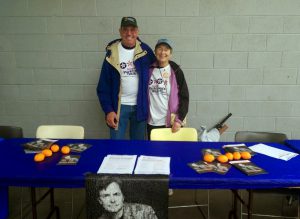
We arrived early to help with the setup for the walk and I was glad my stepson, Darrin, joined us for the heavy lifting! This was also our first ‘gig’ as Fox Trial Finder Ambassadors and we set up a table to promote Fox Trial Finder and Fox InSight. We had a lot of activity at our table, handed out a lot of information and MJFF orange brain shaped stress relievers. We met a lot of new people who were interested in both programs and hopefully our efforts result in some new sign ups.
We were asked to speak during the prerace ceremonies so, in addition to our first Trial Finder gig, I made my first presentation about current research and the need for participating in Fox Trial Finder and Fox InSight. I had prepared some notes (about 7 pages when printed in large type!) but found it hard to read the notes, maintain some eye contact, speak loudly AND hold the microphone at the same time so it was more of an ‘off the cuff’ speech it but it seemed to go OK for a first attempt.


It’s a new year and time to renew my resolution to continue exercising at least 4 -5 times per week. As 2017 came to a close a new research study was published that shows high intensity interval training (HIIT) delays Parkinson’s progression. As Daniel Corcos, one of the lead authors of the study states “If you have Parkinson’s disease and you want to delay the progression of your symptoms, you should exercise three times a week with your heart rate between 80 and 85 percent maximum. It is that simple.” If you query Google for High Intensity Exercise and Parkinson’s you will find an abundance of articles about this study, here is the link to one of them from Science Daily.
While the need to exercise for PD patients has been shown in many studies, this was one of the first to be conducted for 6 months instead of 12 weeks. The participants were divided into three groups, HIIT exercise, moderate exercise and no exercise. All scored about 20 on a PD scale of 0 – 108 before the study. When scored after the 6 months The HIIT group showed no change while the moderate group got worse by 1.5 points and the no exercise group worsened by 3 points or about a 15% change.
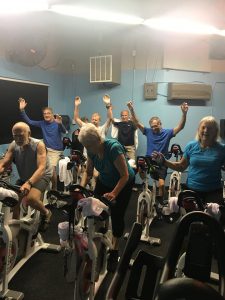
Although the primary exercise used during this study was the treadmill, Kathy, our Parkinson’s cycling instructor immediately figured that we can step up our cycling program to include high intensity intervals and start raising our aerobic fitness level. So, even though many of us thought we were doing high intensity training already (well at least I did), she started pushing us to reach the 80 – 85% heart rate after Thanksgiving. Almost every workout has incorporated HIIT and I am already starting to see a change in just 6 weeks. The first few sessions I found I had to lower the gear to finish the workout. But each time I felt I was getting stronger and this week I was able to increase instead of decrease the gear and still maintain the required 80 – 90 RPM. I am happy with that progress and I am noticing a reduction in my symptoms after exercise including not feeling ‘off’ a half hour or so before it’s time to take my medicines on the day of exercise.


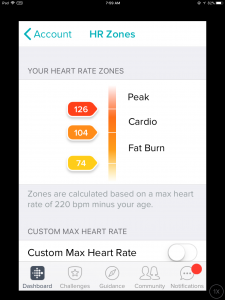
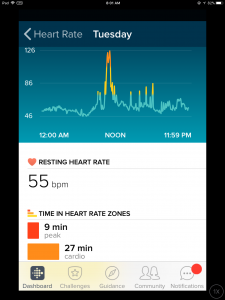
But I wondered what is happening to my aerobic fitness? Then I discovered that my Fitbit app is keeping track of my cardio fitness! The app determined my heart rate zones and then uses those zones and my resting heart rate to compute a cardio fitness score. As you can see in this screen shot on the left, Fitbit has determined that, for me, a heart rate greater than 126 is my peak zone and my cardio zone is 104 – 125. The peak range is approximately 80% of my maximum heart rate so anything above that would be considered high intensity exercise.
The app also graphs my heart rate for the entire day so I can tell from that graph how long I was in the peak zone. The screen shot on the left is for 1/2/18 which includes a cycling class.


So I was in the ‘zone’ for 9 minutes during the class which corresponds to intervals where we pushed up to 85 or 90 RPM for short periods.
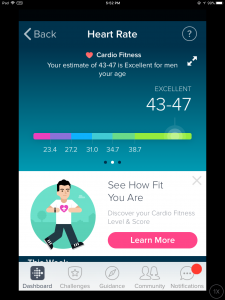
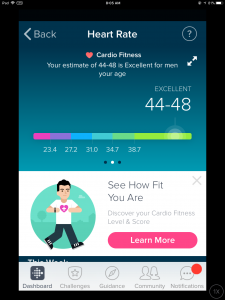
And here are screen shots showing my cardio fitness as computed by Fitbit on November 16, 2017 and January 2, 2018. So, in theory, I’ve already improved my Cardio Fitness by a point since we started the HIIT. But just as important is that fact that either score is considered excellent by Fitbit where the average score for men over 60 is 27.2 – 31.0.
Between cycling twice a week, playing tennis 2 -3 times a week and the Dance for PD class I am staying fit, slowing the progression of my Parkinson’s and having fun. We will revisit my cardiac score in a month or so to see if the trend continues or maybe I’m maxed out!
So my New Year’s resolution this year is the same as last year, keep exercising and keep fighting PD. By the way, if you are interested in Pedaling for Parkinson’s, check out this video from the Sarasota YMCA website of one of Kathy’s classes and watch us having fun doing intervals!


It’s a new year and time to renew my resolution to continue exercising at least 4 -5 times per week. As 2017 came to a close a new research study was published that shows high intensity interval training (HIIT) delays Parkinson’s progression. As Daniel Corcos, one of the lead authors of the study states “If you have Parkinson’s disease and you want to delay the progression of your symptoms, you should exercise three times a week with your heart rate between 80 and 85 percent maximum. It is that simple.” If you query Google for High Intensity Exercise and Parkinson’s you will find an abundance of articles about this study, here is the link to one of them from Science Daily.
While the need to exercise for PD patients has been shown in many studies, this was one of the first to be conducted for 6 months instead of 12 weeks. The participants were divided into three groups, HIIT exercise, moderate exercise and no exercise. All scored about 20 on a PD scale of 0 – 108 before the study. When scored after the 6 months The HIIT group showed no change while the moderate group got worse by 1.5 points and the no exercise group worsened by 3 points or about a 15% change.
Although the primary exercise used during this study was the treadmill, Kathy, our Parkinson’s cycling instructor immediately figured that we can step up our cycling program to include high intensity intervals and start raising our aerobic fitness level. So, even though many of us thought we were doing high intensity training already (well at least I did), she started pushing us to reach the 80 – 85% heart rate after Thanksgiving. Almost every workout has incorporated HIIT and I am already starting to see a change in just 6 weeks. The first few sessions I found I had to lower the gear to finish the workout. But each time I felt I was getting stronger and this week I was able to increase instead of decrease the gear and still maintain the required 80 – 90 RPM. I am happy with that progress and I am noticing a reduction in my symptoms after exercise including not feeling ‘off’ a half hour or so before it’s time to take my medicines on the day of exercise.


But I wondered what is happening to my aerobic fitness? Then I discovered that my Fitbit app is keeping track of my cardio fitness! The app determined my heart rate zones and then uses those zones and my resting heart rate to compute a cardio fitness score. As you can see in this screen shot on the left, Fitbit has determined that, for me, a heart rate greater than 126 is my peak zone and my cardio zone is 104 – 125. The peak range is approximately 80% of my maximum heart rate so anything above that would be considered high intensity exercise.
The app also graphs my heart rate for the entire day so I can tell from that graph how long I was in the peak zone. The screen shot on the left is for 1/2/18 which includes a cycling class.


So I was in the ‘zone’ for 9 minutes during the class which corresponds to intervals where we pushed up to 85 or 90 RPM for short periods.
And here are screen shots showing my cardio fitness as computed by Fitbit on November 16, 2017 and January 2, 2018. So, in theory, I’ve already improved my Cardio Fitness by a point since we started the HIIT. But just as important is that fact that either score is considered excellent by Fitbit where the average score for men over 60 is 27.2 – 31.0.
Between cycling twice a week, playing tennis 2 -3 times a week and the Dance for PD class I am staying fit, slowing the progression of my Parkinson’s and having fun. We will revisit my cardiac score in a month or so to see if the trend continues or maybe I’m maxed out!
So my New Year’s resolution this year is the same as last year, keep exercising and keep fighting PD. By the way, if you are interested in Pedaling for Parkinson’s, check out this video from the Sarasota YMCA website of one of Kathy’s classes and watch us having fun doing intervals!


It’s a new year and time to renew my resolution to continue exercising at least 4 -5 times per week. As 2017 came to a close a new research study was published that shows high intensity interval training (HIIT) delays Parkinson’s progression. As Daniel Corcos, one of the lead authors of the study states “If you have Parkinson’s disease and you want to delay the progression of your symptoms, you should exercise three times a week with your heart rate between 80 and 85 percent maximum. It is that simple.” If you query Google for High Intensity Exercise and Parkinson’s you will find an abundance of articles about this study, here is the link to one of them from Science Daily.
While the need to exercise for PD patients has been shown in many studies, this was one of the first to be conducted for 6 months instead of 12 weeks. The participants were divided into three groups, HIIT exercise, moderate exercise and no exercise. All scored about 20 on a PD scale of 0 – 108 before the study. When scored after the 6 months The HIIT group showed no change while the moderate group got worse by 1.5 points and the no exercise group worsened by 3 points or about a 15% change.
Although the primary exercise used during this study was the treadmill, Kathy, our Parkinson’s cycling instructor immediately figured that we can step up our cycling program to include high intensity intervals and start raising our aerobic fitness level. So, even though many of us thought we were doing high intensity training already (well at least I did), she started pushing us to reach the 80 – 85% heart rate after Thanksgiving. Almost every workout has incorporated HIIT and I am already starting to see a change in just 6 weeks. The first few sessions I found I had to lower the gear to finish the workout. But each time I felt I was getting stronger and this week I was able to increase instead of decrease the gear and still maintain the required 80 – 90 RPM. I am happy with that progress and I am noticing a reduction in my symptoms after exercise including not feeling ‘off’ a half hour or so before it’s time to take my medicines on the day of exercise.


But I wondered what is happening to my aerobic fitness? Then I discovered that my Fitbit app is keeping track of my cardio fitness! The app determined my heart rate zones and then uses those zones and my resting heart rate to compute a cardio fitness score. As you can see in this screen shot on the left, Fitbit has determined that, for me, a heart rate greater than 126 is my peak zone and my cardio zone is 104 – 125. The peak range is approximately 80% of my maximum heart rate so anything above that would be considered high intensity exercise.
The app also graphs my heart rate for the entire day so I can tell from that graph how long I was in the peak zone. The screen shot on the left is for 1/2/18 which includes a cycling class.


So I was in the ‘zone’ for 9 minutes during the class which corresponds to intervals where we pushed up to 85 or 90 RPM for short periods.
And here are screen shots showing my cardio fitness as computed by Fitbit on November 16, 2017 and January 2, 2018. So, in theory, I’ve already improved my Cardio Fitness by a point since we started the HIIT. But just as important is that fact that either score is considered excellent by Fitbit where the average score for men over 60 is 27.2 – 31.0.
Between cycling twice a week, playing tennis 2 -3 times a week and the Dance for PD class I am staying fit, slowing the progression of my Parkinson’s and having fun. We will revisit my cardiac score in a month or so to see if the trend continues or maybe I’m maxed out!
So my New Year’s resolution this year is the same as last year, keep exercising and keep fighting PD. By the way, if you are interested in Pedaling for Parkinson’s, check out this video from the Sarasota YMCA website of one of Kathy’s classes and watch us having fun doing intervals!
Happy Thanksgiving Holiday!
It is a busy time of year but I wanted send along good wishes for the holiday, pass along a reminder or two and note some items of interest in the Parkinson’s community.
Reminder number one: November is National Caregivers Month. Yes the month is about over but I know that you, like me, are thankful for your care partner(s) every day of the year. Remember there are lots of resources available for care partners and one of the best, available from the Parkinson’s Foundation, is the Caring and Coping guide, written for caregivers at every stage of PD. Download load a copy at this link.
Reminder number two: Tuesday the 28th is Giving Tuesday. This is a great opportunity to make a donation to your favorite charity and, in many cases, have it matched. For example the Michael J Fox Foundation is shooting to raise $1million in 1 day with every donation matched by anonymous donors. Many other charities have similar opportunities on Tuesday, so scrape the bottom of your pocket book or wallet after Black Friday and Cyber Monday and help us find a cure for PD or the charity of your choice.
Item of interest number one: This article Neurological disorders – including Parkinson’s – are leading source of disability globally points out that PD is becoming pandemic and we must take action to find a cure. This summary is worth the few minutes it will take you to read.
Item of interest number two: The Michael J. Fox Foundation for Parkinson’s Research has launched Fox Insight — an online clinical study that empowers people with PD to partner with researchers and accelerate the development of breakthrough treatments. I have talked about Fox Insight in previous posts but, if you haven’t joined yet, now is the time, your data is needed as we work to find a cure. Click on the link above to get more information and join us.
Item of interest number three: The next World Parkinson’s Congress will be June, 2019 in Kyoto, Japan. Soaring With Hope has started a project to make origami cranes for an art installation to display at the WPC. Each crane represents a person withParkinson’s or a person impacted by Parkinson’s. They are asking each person to give their message of hope, which will be written on a crane. They have a goal of 10,000 cranes to bring to the WPC, each of them with a message of hope written on it to help raise awareness and HOPE for PD globally. Please take a minute to click on this link and add your WORDS OF HOPE, and please spread the word to get others to join in and participate. Thanks to Sharon Krischer (blogging as Twitchy Woman) for providing this information on her blog.
On this Thanksgiving day I am thankful for the support of my wonderful wife, my family, my friends and all of you who take the time to read my occasional posts. Thank you all and Happy Thanksgiving!


We arrived early to help with the setup for the walk and I was glad my stepson, Darrin, joined us for the heavy lifting! This was also our first ‘gig’ as Fox Trial Finder Ambassadors and we set up a table to promote Fox Trial Finder and Fox InSight. We had a lot of activity at our table, handed out a lot of information and MJFF orange brain shaped stress relievers. We met a lot of new people who were interested in both programs and hopefully our efforts result in some new sign ups.
We were asked to speak during the prerace ceremonies so, in addition to our first Trial Finder gig, I made my first presentation about current research and the need for participating in Fox Trial Finder and Fox InSight. I had prepared some notes (about 7 pages when printed in large type!) but found it hard to read the notes, maintain some eye contact, speak loudly AND hold the microphone at the same time so it was more of an ‘off the cuff’ speech it but it seemed to go OK for a first attempt.