• Catching Up

    We have had a busy late summer and fall and, unfortunately, I have not been a faithful blog poster.  But now the holiday season is coming up, so I’m sure I can keep up with timely blog posts 🙂

    To bring you up to date, in August, my brother in law Joe in Michigan failed the eye exam for his driver’s license renewal.  It was determined that he had severe cataracts in both eyes and shouldn’t have been driving at all!  So off we went to Michigan to get him back and forth to doctors appointments and two separate surgeries.  During the break between the first eye surgery and the second, we made it out to Colorado to visit family and friends, a trip we originally had scheduled in August to coincide with grandson Charlie’s 16th birthday.  We then went to Grand Rapids for the Rallying to the Challenge meeting (see my last post for details) before heading home.

    In October, we journeyed to Asheville, NC and met up with the Marcia and Erwin whom we knew from Kripalu and her stepsister and husband, June and Phil.  We had a great time touring the Biltmore House (America’s largest single family residence) and the River Art’s District and catching up since last March when we met up in Florida. Marcia and Erwin and another couple from Kripalu held an inaugural 5K race/walk in the Poconos in June and raised $26K for the Michael J Fox Foundation!

    A week or so later we were off to San Diego to visit Ryan, Sarah and Julian.  We got to see Julian play football, attended one of Sarah’s yoga classes, enjoyed several fine wines and meals and celebrated Ryan’s 40th birthday.  The weather was perfect and we got in a lot of walking and caught some great sunsets over the ocean.

    When we returned, I had my appointment with my Movement Disorder Specialist who was pleased with how things were going and recommended no changes to my medication regimen, in fact, he was willing to schedule the next appointment for a year away, but we decided we should continue the every 6 month’s cycle for now.

    We made a short trip last weekend to Jackson, MS to watch grandson Garrett play soccer in his college league semi-final soccer tournament, held at Milsaps College.  We were rained out the first night and the next day the team lost in the last 2 minutes of a well played game. It was our first (and last) time to see him play this year. 

    In our spare time, we have continued to build up the Tennessee Parkinson’s Disease Resources website which is now operational and we have printed cards with the website address which we are sending to support groups in Tennessee.  Our hope is patients will take an extra card or two and give it to both their primary care Doctor and their neurologist so they are aware that the site exists.   If it all works as we would like, the Doctor can order additional cards to have on hand for patients.  The goal is to let newly diagnosed PwP know they are not alone and resources are available.

    So that more or less brings us up to date and I promise I will try to meet my goal of at least two posts a month, even with the holiday’s coming up.  In the meantime, don’t forget to sign up for Fox Trial Finder and Fox Insight, we have over 50,000 profiles in Trial Finder and over 3000 in Insight but we need more!!  Click on the button at the top of the page or the Fox Insight icon to sign up.  Thanks!
    “It does not matter how slowly you go as long as you do not stop.” – Confucius
  • Rallying to the Challenge – 2015

    We recently attended our second Grand Challenges in Parkinson’s research conference hosted by the Van Andel Research Institute in Grand Rapids, MI.  Again this year The Cure Parkinson’s Trust (UK) and Parkinson’s Movement(UK) sponsored the Rallying to the Challenge meeting which is conducted in conjunction with the research conference and provides an opportunity for researchers, patients and caregivers to exchange information. The theme for this year’s Rally was “Outcomes and Measures, a new look at Measuring Parkinson’s” and, as you will see, we had a very full two day agenda.

    Tom Isaacs, co-founder of the Cure Parkinson’s Trust, opened our portion of the meeting saying that together we are making a seismic shift for better research, research that includes the patient and the patient’s needs.  As a result of last years Rally a ‘Clinical Trials Charter’ (click here to view the charter) was developed as a cooperative effort by patients and researchers.  A UK multi-center clinical trial has adopted the charter for their research which will provide a real-world test and a stepping stone to wider adoption.  We were amazed to see how our efforts from just a year ago have paid off in the cooperative development of this charter by patients and researchers. (Read the post from last year here)

    Tom then discussed this year’s Challenge – How do we improve outcomes and measures in clinical trials?  The emphasis again this year was on improving the patient experience and introducing patient centered change to the research process.  In addition we will discuss how data gathered from new technology, (wearable sensors, smartphone apps, etc) can provide new measures and improve some of the current measures.

    Jon Palfreman, PwP and author of the recently released “Brain Storms – The Race to Unlock the Mysteries of Parkinson’s Disease” pointed out that the Unified Parkinson’s Disease Rating Scale (UPDRS) is primarily subjective and provides only a snapshot of the symptoms you are having when administered, usually 1 or 2 times a year during your Dr. visit.  Ideally, with the advent of wearable sensors and other technology, you should be able to provide a picture of your symptoms for the entire period between Dr. visits and get real time feedback yourself.

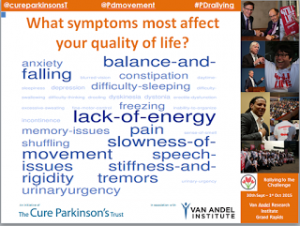
    Dr. Soania Mathur and Dr. Jon Stamford reviewed the results of this year’s survey about the symptoms of PD which have the most important impact  quality of life. Interestingly, out of 492 responses to the survey not one respondent listed their top five symptoms in the same order. In fact, if you look at this slide from the final presentation, I count 28 symptoms that were brought up when answering the question “What symptoms most affect your quality of life?” This slide certainly points out that PD is truly different for each of us.

    The top symptoms in both categories were put into smaller groupings and we broke out into focus groups to discuss how to improve measurement of our set of symptoms. Every focus group not only developed ideas for measuring symptoms, but also came up with tips and tricks for dealing with the issue, for example walking backwards to relax dystonia of the foot.

    The next morning, we had an almost overwhelming number of presentations about new technological devices that will help measure PD symptoms when on or off medication.  Presenter’s included Ken Kubota from Michael J Fox Foundation (Fox Insight Wearable Trial), Anupam Pathak Ph.D. from Google (the Lyft spoon), Bruce Hellman (uMotif Smartphone app now available in the UK and coming soon to the US and Canada) and Caroline Tanner (mPower also a smartphone app developed from the SmartPhone PD clinical test I participated in)

    We also had presentations from a Davis Phinney Foundation representative about a social networking program they are developing, one from Peter Schmidt of NPF about their Parkinson’s Outcome Project (another one I am participating in) and from Eli Pollard executive director of World Parkinson’s Coalition  about PowerThroughParkinson’s, a program they are bringing out with the Brian Grant Foundation that encourages PwP to commit to exercise and eat right.

    Day Two also included a presentation from the renowned Parkinson’s Doctor and researcher Bas Bloem from the Netherlands about Parkinson’sNet, a program he helped develop in the Netherlands 10 years ago and which has been implemented in LA area and soon in Grand Rapids.  ParkinsonNet has one goal: to guarantee the best possible care
    for people suffering from Parkinson’s Disease.The program has been extremely successful in providing expert care while also reducing costs.

    We then reconvened with the researchers and Tom Isaacs and other members of Parkinson’s Movement made a presentation of the results of our meeting and the need for patient involvement in the development of measures that would be the:

    • Right Measure – developed with the end user as a partner
    • Right Person – measure what is important to the person
    • Right Situation – don’t forgot off periods and how PD changes

    In addition to meeting old friends and making new ones, we also enjoyed the exhibition of photos by Norwegian Photographer Andres Leines entitled “This is Parkinson’s”.  Andres has early onset PD and has been taking pictures of other EOPD patients to point out that Parkinson’s is not just tremors and doesn’t just effect seniors. You can view some of the photos in this excellent YouTube video.

    And finally, the Michael J Fox Foundation just announced that the Fox Clinical Trial Program has exceeded 50,000 registered volunteers!  In case you’re not one of us, click on the big shiny button at the top of this page and sign up!  Thanks.

    “It does not matter how slowly you go as long as you do not stop.” – Confucius


  • Links and More Links

    No not sausage links, website links! I thought I would devote this post to what’s going on in the Parkinson’s world.  As you know I follow a number of other Parkinson’s blogs and here are a few items of interest from month or so, click on the link to read the entire post (will open in a new tab).

    Inosine Trial Secures Phase III Funding to Study Effect on Slowing Parkinson’s.  Inosine is a precursor to the antioxidant of urate. Observational studies had shown people with higher levels of urate had lower risk of Parkinson’s disease (PD) and, if diagnosed with PD, slower disease progression. The trial will start early next year in 60 sites.

    Parkinson’s Psychosis Drug One Step Closer to FDA Approval Acadia Pharmaceuticals announced  that it has submitted a New Drug Application to the FDA seeking approval for its drug Nuplazid (the compound pimavanserin) for the treatment of psychosis associated with Parkinson’s disease (PD).  Current drugs used to treat PD psychosis have safety concerns and serious side effects for PD patients.  A Phase III study showed the drug significantly reduced psychosis compared to placebo without worsening motor function. The study also showed the drug was safe and well tolerated.

    How to Find the Right Dr   Some excellent suggestions from the Parkinson’s Community on linking up with the right Doctor for PD treatment.  My recommendation –  if possible, link up with a Movement Disorder Specialist.

    10 Breakthrough Therapies for Parkinson’s Disease The NPF Medical Director, Dr. Michael Okun, has published a new book covering new therapies for PD.  I purchased a copy the day it was released and it is an excellent book, as was his first book,  “Parkinson’s Treatment 10 Secrets to a Happier Life with Parkinson’s Disease”.  He has an excellent writing style and there are chapters covering new drugs (released and in the pipeline), effects of exercise, coffee, tea and Marijuana, new DBS advances and stem cell therapies among others.  I highly recommend both of his books.

    How Do I Know If I’m Doing the Right Thing When I Exercise?
    A post from PD Gladiators, an Atlanta based non profit devoted to combating PD with vigorous exercise.  There has been a lot of emphasis on the benefits of exercise and this post discusses what exercise is optimal and how often you should exercise.

    Delay the Disease, an Ohio based exercise program, is offering the Handwriting Challenge This program involves doing four simple exercises every day for 12 weeks.  The exercises should take about 10 minutes to complete and are designed to test a theory they have that large muscle exercises will improve motor dexterity including micrographia (tiny handwriting).  Every three weeks you write out the same sentence with the hope that your handwriting improves. Even if it doesn’t the exercises can’t hurt!

    What’s It Like Having PD   An excellent post by Bruce Ballard who blogs as Parking Suns. Those of us with PD will agree with these ideas to simulate PD for people who don’t have PD.  I found numbers 1 and 2 an accurate description of what it feels like without medication, I’m sure you will find a few that match your symptoms too.

    Coming up, Mara and I will be attending the second “Rallying to the Challenge” event organized by the Cure Parkinson’s Trust and the Van Andel Research Institute in Grand Rapids, MI at the end of September.  I wrote about the first meeting here and this years meeting will center on how to introduce new technology and additional personalized patient-centric measures into clinical trials.  We are looking forward to catching up with members of our Global support group, meeting new members and enjoying the ArtPrize festival in downtown Grand Rapids.

    OK, if you have followed every link in this post, you have a bunch of tab’s open and your browser is getting ready to explode so I’ll stop with a quick reminder, sign up for Fox Trial Finder (click on the button above and open one more tab).

    “It does not matter how slowly you go as long as you do not stop.” – Confucius

Volunteer and Help Find a Cure for PD!


As promised in the last post, today I will discuss our experiences with clinical trials and the Fox Trial Finder (FTF) web application.  But first, are you on Fox Trial Finder? If not, click on this link and sign up today!  Currently there are 475 trials listed on FTF taking place in locations around the world. They include interventional trials (reducing tremor or dyskinesia, Tai Chi for balance, tele-medicine, etc.) and observational trials (bio markers, brain mapping, genetic research, wearable devices to measure PD, etc.). When you sign up for FTF you create a profile with information such as length of time with PD, medications, symptoms, and how far you are willing to travel to participate.  FTF then matches you to trials that fit your profile.  And don’t forget, most trials need control volunteers too so sign up your family and friends! Ready to sign up? Click on this link now! I’ll be here when you come back.

Welcome back! Mara and I recently participated in an observational study titled LRRK2 and Other Novel Exosome Proteins in Parkinson’s Disease conducted by the University of Alabama at Birmingham.  The main purpose of this study is to determine whether there are biomarkers associated with Parkinson’s disease susceptibility and/or progression in exosome-proteomes derived from PD patients that will assist with future LRRK2 inhibitor clinical trials.  You can read the full description here on FTF but it’s not exactly written in layman’s terms. (Maybe this could be a simple change to the process?)

After arriving at the UAB Medical Campus we were met by Rachel Clark who is coordinating the research study.  She went over the research protocol and we signed the consent forms; she then asked us questions about our general health and medications we take.  We both completed the Uniform Parkinson’s Disease Rating Scale (UPDRS) patient questionnaire and we were each given the Montreal Cognitive assessment. Then we took the Parkinson’s Smell Test which Mara did fine on and, surprise surprise, I didn’t.  Out of 40 samples I got 10 correct while Mara got 37. I was able to identify two odors and the rest were just lucky guesses. I was also given the general physical tests for PD (tap your fingers & toes, walk down the hall, etc.) and we both provided blood and urine samples.  That was it!  One and a half hours and we had provided them with the necessary information and samples and completed our first clinical trial! It wasn’t time consuming, I didn’t have to worry about receiving a placebo or changing my medications, and I was only poked enough to provide 1 ounce of blood.

Many of the trials listed on FTF are observational studies like this one and seven are web based like the other trial I am participating in – Smartphone-PD. All of them provide valuable information in the search for a cure and all need participants. Did you click on that link yet?

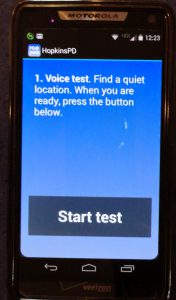
Smartphone-PD is a study to see if it is feasible for participants to download, install, and use an Android smartphone application to track data related to Parkinson disease symptoms. (Note: only available for Android phones)  They hope to measure daily variability of movement and mobility characteristics of PD patients. The data is collected by completing voice and movement tests using my cell phone.  The results of the daily tests are encrypted and uploaded to the study team at the University of Rochester in New York.  The application will also monitor my daily activity if I keep my phone in my pocket.

I found this trial here on Fox Trial Finder and signing up is all done online. I reviewed the study plan and the consent form which includes the disclaimer that this study is purely for research purposes, so they will not be able to provide clinical advice for individuals with PD. Therefore, no adjustments to medications or appointments with a neurologist will be made as a part of the study.  After electronically signing the consent form, I received an email with a link to the application which I downloaded to my phone and I was ready to go.

For this study I use my phone to complete five tests twice a day for six months.  The first time is in the morning prior to taking my medication and then again about an hour later.  They realize that you might not be able to complete the tests on that schedule but they are OK with that as all collected data is valuable. So it’s OK to miss a test day due to travel or whatever, they still want the information.So most every morning I open the application on my phone and spend five minutes completing the tests which include a voice test, a balance test, a gait test, a dexterity test and a reaction test. The results are sent off and I take my medications, have breakfast and try to remember to repeat the test an hour or so later. This study is actively recruiting on FTF or the Parkinson’s Voice site.   Both PwP’s and controls are needed. You can also contact Denzil Harris, the research coordinator by email or phone him at 585-275-2791 for more information.

See, getting involved in a clinical trial is not as difficult as one might think, even if you live in a small town or aren’t close to a research center .  Using Fox Trial Finder to identify trials you might be eligible for takes just a little bit of your time and the rewards are many including that good feeling of being involved in the quest for a cure.   As I have said before, while patients and researchers work to change the current process, there are still many trials that need participants.  If we don’t participate, we will continue to rely on a drug discovered almost 50 years ago that only treats some of our symptoms.   With 475 possible trials listed, I bet you can find one that interests you, so click on this link and join over 39,000 others on Fox Trial Finder today!

(Updated 12/11 to add the links to Fox Trial Finder so it shows up in mobile device view with thanks to the Cure Parkinson’s Trust )

Volunteer and Help Find a Cure for PD!


As promised in the last post, today I will discuss our experiences with clinical trials and the Fox Trial Finder (FTF) web application.  But first, are you on Fox Trial Finder? If not, click on this link and sign up today!  Currently there are 475 trials listed on FTF taking place in locations around the world. They include interventional trials (reducing tremor or dyskinesia, Tai Chi for balance, tele-medicine, etc.) and observational trials (bio markers, brain mapping, genetic research, wearable devices to measure PD, etc.). When you sign up for FTF you create a profile with information such as length of time with PD, medications, symptoms, and how far you are willing to travel to participate.  FTF then matches you to trials that fit your profile.  And don’t forget, most trials need control volunteers too so sign up your family and friends! Ready to sign up? Click on this link now! I’ll be here when you come back.

Welcome back! Mara and I recently participated in an observational study titled LRRK2 and Other Novel Exosome Proteins in Parkinson’s Disease conducted by the University of Alabama at Birmingham.  The main purpose of this study is to determine whether there are biomarkers associated with Parkinson’s disease susceptibility and/or progression in exosome-proteomes derived from PD patients that will assist with future LRRK2 inhibitor clinical trials.  You can read the full description here on FTF but it’s not exactly written in layman’s terms. (Maybe this could be a simple change to the process?)

After arriving at the UAB Medical Campus we were met by Rachel Clark who is coordinating the research study.  She went over the research protocol and we signed the consent forms; she then asked us questions about our general health and medications we take.  We both completed the Uniform Parkinson’s Disease Rating Scale (UPDRS) patient questionnaire and we were each given the Montreal Cognitive assessment. Then we took the Parkinson’s Smell Test which Mara did fine on and, surprise surprise, I didn’t.  Out of 40 samples I got 10 correct while Mara got 37. I was able to identify two odors and the rest were just lucky guesses. I was also given the general physical tests for PD (tap your fingers & toes, walk down the hall, etc.) and we both provided blood and urine samples.  That was it!  One and a half hours and we had provided them with the necessary information and samples and completed our first clinical trial! It wasn’t time consuming, I didn’t have to worry about receiving a placebo or changing my medications, and I was only poked enough to provide 1 ounce of blood.

Many of the trials listed on FTF are observational studies like this one and seven are web based like the other trial I am participating in – Smartphone-PD. All of them provide valuable information in the search for a cure and all need participants. Did you click on that link yet?

Smartphone-PD is a study to see if it is feasible for participants to download, install, and use an Android smartphone application to track data related to Parkinson disease symptoms. (Note: only available for Android phones)  They hope to measure daily variability of movement and mobility characteristics of PD patients. The data is collected by completing voice and movement tests using my cell phone.  The results of the daily tests are encrypted and uploaded to the study team at the University of Rochester in New York.  The application will also monitor my daily activity if I keep my phone in my pocket.

I found this trial here on Fox Trial Finder and signing up is all done online. I reviewed the study plan and the consent form which includes the disclaimer that this study is purely for research purposes, so they will not be able to provide clinical advice for individuals with PD. Therefore, no adjustments to medications or appointments with a neurologist will be made as a part of the study.  After electronically signing the consent form, I received an email with a link to the application which I downloaded to my phone and I was ready to go.

For this study I use my phone to complete five tests twice a day for six months.  The first time is in the morning prior to taking my medication and then again about an hour later.  They realize that you might not be able to complete the tests on that schedule but they are OK with that as all collected data is valuable. So it’s OK to miss a test day due to travel or whatever, they still want the information.So most every morning I open the application on my phone and spend five minutes completing the tests which include a voice test, a balance test, a gait test, a dexterity test and a reaction test. The results are sent off and I take my medications, have breakfast and try to remember to repeat the test an hour or so later. This study is actively recruiting on FTF or the Parkinson’s Voice site.   Both PwP’s and controls are needed. You can also contact Denzil Harris, the research coordinator by email or phone him at 585-275-2791 for more information.

See, getting involved in a clinical trial is not as difficult as one might think, even if you live in a small town or aren’t close to a research center .  Using Fox Trial Finder to identify trials you might be eligible for takes just a little bit of your time and the rewards are many including that good feeling of being involved in the quest for a cure.   As I have said before, while patients and researchers work to change the current process, there are still many trials that need participants.  If we don’t participate, we will continue to rely on a drug discovered almost 50 years ago that only treats some of our symptoms.   With 475 possible trials listed, I bet you can find one that interests you, so click on this link and join over 39,000 others on Fox Trial Finder today!

(Updated 12/11 to add the links to Fox Trial Finder so it shows up in mobile device view with thanks to the Cure Parkinson’s Trust )

Tag: Research

  • Volunteer and Help Find a Cure for PD!

    Volunteer and Help Find a Cure for PD!


    As promised in the last post, today I will discuss our experiences with clinical trials and the Fox Trial Finder (FTF) web application.  But first, are you on Fox Trial Finder? If not, click on this link and sign up today!  Currently there are 475 trials listed on FTF taking place in locations around the world. They include interventional trials (reducing tremor or dyskinesia, Tai Chi for balance, tele-medicine, etc.) and observational trials (bio markers, brain mapping, genetic research, wearable devices to measure PD, etc.). When you sign up for FTF you create a profile with information such as length of time with PD, medications, symptoms, and how far you are willing to travel to participate.  FTF then matches you to trials that fit your profile.  And don’t forget, most trials need control volunteers too so sign up your family and friends! Ready to sign up? Click on this link now! I’ll be here when you come back.

    Welcome back! Mara and I recently participated in an observational study titled LRRK2 and Other Novel Exosome Proteins in Parkinson’s Disease conducted by the University of Alabama at Birmingham.  The main purpose of this study is to determine whether there are biomarkers associated with Parkinson’s disease susceptibility and/or progression in exosome-proteomes derived from PD patients that will assist with future LRRK2 inhibitor clinical trials.  You can read the full description here on FTF but it’s not exactly written in layman’s terms. (Maybe this could be a simple change to the process?)

    After arriving at the UAB Medical Campus we were met by Rachel Clark who is coordinating the research study.  She went over the research protocol and we signed the consent forms; she then asked us questions about our general health and medications we take.  We both completed the Uniform Parkinson’s Disease Rating Scale (UPDRS) patient questionnaire and we were each given the Montreal Cognitive assessment. Then we took the Parkinson’s Smell Test which Mara did fine on and, surprise surprise, I didn’t.  Out of 40 samples I got 10 correct while Mara got 37. I was able to identify two odors and the rest were just lucky guesses. I was also given the general physical tests for PD (tap your fingers & toes, walk down the hall, etc.) and we both provided blood and urine samples.  That was it!  One and a half hours and we had provided them with the necessary information and samples and completed our first clinical trial! It wasn’t time consuming, I didn’t have to worry about receiving a placebo or changing my medications, and I was only poked enough to provide 1 ounce of blood.

    Many of the trials listed on FTF are observational studies like this one and seven are web based like the other trial I am participating in – Smartphone-PD. All of them provide valuable information in the search for a cure and all need participants. Did you click on that link yet?

    Smartphone-PD is a study to see if it is feasible for participants to download, install, and use an Android smartphone application to track data related to Parkinson disease symptoms. (Note: only available for Android phones)  They hope to measure daily variability of movement and mobility characteristics of PD patients. The data is collected by completing voice and movement tests using my cell phone.  The results of the daily tests are encrypted and uploaded to the study team at the University of Rochester in New York.  The application will also monitor my daily activity if I keep my phone in my pocket.

    I found this trial here on Fox Trial Finder and signing up is all done online. I reviewed the study plan and the consent form which includes the disclaimer that this study is purely for research purposes, so they will not be able to provide clinical advice for individuals with PD. Therefore, no adjustments to medications or appointments with a neurologist will be made as a part of the study.  After electronically signing the consent form, I received an email with a link to the application which I downloaded to my phone and I was ready to go.

    For this study I use my phone to complete five tests twice a day for six months.  The first time is in the morning prior to taking my medication and then again about an hour later.  They realize that you might not be able to complete the tests on that schedule but they are OK with that as all collected data is valuable. So it’s OK to miss a test day due to travel or whatever, they still want the information.So most every morning I open the application on my phone and spend five minutes completing the tests which include a voice test, a balance test, a gait test, a dexterity test and a reaction test. The results are sent off and I take my medications, have breakfast and try to remember to repeat the test an hour or so later. This study is actively recruiting on FTF or the Parkinson’s Voice site.   Both PwP’s and controls are needed. You can also contact Denzil Harris, the research coordinator by email or phone him at 585-275-2791 for more information.

    See, getting involved in a clinical trial is not as difficult as one might think, even if you live in a small town or aren’t close to a research center .  Using Fox Trial Finder to identify trials you might be eligible for takes just a little bit of your time and the rewards are many including that good feeling of being involved in the quest for a cure.   As I have said before, while patients and researchers work to change the current process, there are still many trials that need participants.  If we don’t participate, we will continue to rely on a drug discovered almost 50 years ago that only treats some of our symptoms.   With 475 possible trials listed, I bet you can find one that interests you, so click on this link and join over 39,000 others on Fox Trial Finder today!

    (Updated 12/11 to add the links to Fox Trial Finder so it shows up in mobile device view with thanks to the Cure Parkinson’s Trust )

  • Cognitive Training and ….Cinnamon?

    Cognitive Training and ….Cinnamon?

    I started ‘brain training’ with Lumosity last fall and usually play five games a day whenever possible.  If you aren’t familiar with Lumosity, they provide cognitive training exercises that teach neuroplasticity, that is training the brain to use new pathways to complete a task.  Cognitive training has blossomed in the past few years and since some of my neural pathways are deteriorating, I thought Lumosity would be an interesting test and might help me build those new paths.

    The Lumosity training works to improve five areas – memory, flexibility, problem solving, attention and speed – all improvements I can use!  After every five game session you get an overall score called  the Lumosity Performance Index or LPI which is an average of the five areas and hopefully goes up each day (I wish).  But enough of the background, if you want more info, check out their website.

    I have found that playing the brain games with PD can be a challenge, particularly the flexibility and speed games that usually require the use of the arrow keys on my laptop to select the right answer.  I have noticed that I can visualize the correct move but making my fingers press the right key is another thing altogether.  As I learned from the presentation by Kaitlyn Roland at the Kripalu session, one of the problems with a lack of dopamine is the brain sends the correct command but it gets scrambled and doesn’t follow the correct pathway which results in the wrong action being taken which can result in a fall, freezing in place or, it appears, pressing the wrong key.

    So I am hopeful that by doing the games every day I am creating those new neural pathways and my LPI score will  reflect the improvement.  But sometimes I seem to be stuck with the old paths and my LPI chart ends up looking like this one for the last four weeks, up and down.  Such is life with Parkinson’s 🙂

    The big Parkinson’s news of the last couple of weeks is the publication of a study that cinnamon might stop the progression of Parkinson’s Disease!  I figure this means I should be baking and consuming my famous (in some circles) Gram’s Pecan Rolls so named because the recipe is from my daughter in law Monica’s Gram and it is full of cinnamon.  Of course the study was conducted on mice so I don’t know how many rolls I need to eat daily but do know what the effect would be on my weight!  Guess I’ll wait for more information before getting the baking equipment out but I wonder if my LPI would go up? Sounds like a clinical study in the making!

    We had a great 4th of July visit with son Ryan and his wife Sarah and their son Julian and his half brother Trysten.  In addition, grandson Jake and granddaughter McKenna and her friend Katie also joined us for the  holiday weekend so we had a houseful.  The kids enjoyed tubing on the lake and swimming off the dock, and we all enjoyed taking the boat down to watch the fireworks go off over the lake.  We even managed to load the tube with all five kids for some fun on the lake.  Again some fishing and paddle boarding took place along with watching the World Cup games.

    Next week it will be one year since my PD diagnosis and a lot has happened in the space of the year, most of which I have managed to chronicle in this blog.   Once again I thank you all for sticking with me on this journey, your support means  a lot to me.

    BTW, if you are a tweeter, follow me on twitter by clicking on the link on the right below my profile.