In one of the greatest comebacks in sports history, Oracle Team USA won eight straight races to win the 34th America’s Cup 9 races to 8 after being down 8-1 to Emirates Team New Zealand. Watching them race over the last three weeks you realize what team work it takes to sail a 72 foot catamaran with a 150 foot ‘wing’ sail at speeds over 40 miles an hour on San Francisco Bay. In fact, at the end of the winning race today, the Team USA helmsman Jimmy Spithill tweeted a comment from his interview after the win “On your own you’re nothing but when you’ve got a team like this around you, they make you great”.
I feel the same way about dealing with Parkinson’s, you need a team to make you great. The team includes your Movement Disorder Specialist, your regular doctor and should probably include a physical therapist, an occupational therapist, a speech therapist and maybe a nutrition specialist. As you can see, it takes a village to deal with the many symptoms and issues with Parkinson’s disease, just like raising a child.
But as important as your medical team is, the support of my wife, my children and their spouses, my grandchildren, my sisters and a multitude of relatives and friends is just as needed. I am lucky to have their support, words of encouragement and positive thoughts. As Jimmy Spithill said, I would be nothing without the support of my ‘TEAM’. Thank you all for all you do to help me weather this journey.
I’ve had about a week on the new dose of medication three times a day and continue to see good improvement in walking and balance.
This weekend our friends Tom and Marilyn visited from Colorado and we had a great time on the lake cruising, swimming, and catching this shot of the harvest moon rise on the water. A grand time was had by all.
One last reminder, don’t forget the Michael J Fox show premieres this Thursday 9/26/2013.
“Time and again people with Parkinson’s have to fight against the old stereotype that the condition is just a tremor.”
“This basic misunderstanding has sentenced people with Parkinson’s to a life of hurtful comments, being refused service in shops and even being shouted at in the street, all because people have mistaken their speech or movement problems – a common symptom of the condition – for drunkenness.”
Steve Ford, chief executive at Parkinson’s UK
I heard these quotes during an interview on BBC Radio the other night and then looked it up on their website. The story is accompanied by a video interview which can be read and seen here. They recount a study conducted in the UK showing that PWP suffer discrimination because of symptoms other than tremors including the slow gait and balance issues that sometimes make me look like I’ve had one too many before 10 am. I’ve noticed people looking at me like I might be drunk as we walk into the grocery store and it appears from this study that even if I wore a shirt that said ‘I have Parkinson’s’ they still might think I was inebriated.
Thanks to the National Parkinson’s Foundation, I carry a card that helps to explain the symptoms and covers various drug interactions in case I need emergency care.
The non-tremor symptoms such as slurred speech, facial mask (unable to show expressions), freezing in place, and tipsy gait among others are the little known part of this disease for the general public. I did not realize how complex this disease can be until I starting researching after my diagnosis but I certainly have a greater understanding now. I hope that readers of this blog do too.
I had a follow up visit with the neurologist last week and he decided to double the medication dosage from .125 to .25 so I have started the increase with my midday dose and then will add the morning and night doses over the next week or two. The one thing we have already noticed is my soft voice gets stronger after the .25 dose and the balance problems decrease so I am hopeful that .25 three times a day will result in reduced motor symptoms too. I also received a prescription for physical therapy which we hope will help with the gait issues among others.
I’ve also started a spreadsheet to track symptoms after reading a blogpost by another PWP on the Michael J Fox blog. I think it is an excellent idea and should be very helpful when meeting with the doctor. And speaking of Michael J Fox don’t forget his show premiers September 26th.
I find myself uttering this remark far too often already 🙂 Unfortunately it was the first of my noticeable symptoms and the one that is still present, even with the improvements from the medication. While my normal walk in the county park next door has gone from 42 minutes down to 37 minutes since I started the medication, I still have my slow times during the day. I guess even the walk is still slow, used to be able to complete in 34 minutes a year ago.
There are many research studies that show exercise helps to slow the progression of PD symptoms so I have been exploring some options in addition to my daily walk. I have found that the local Tai Chi group has weekly Health Recovery sessions so we plan to give that a try in the next week or so. The instructor said the Health Recovery class is for students who want to address particular health issues with Tai Chi, and also for those who are not able to take the regular beginning class. The class focuses on a number of exercises rather than on learning the Tai Chi set. She also indicated that many PWP are able to take the beginning class depending on the severity of their symptoms. So we’ll start with the Health Recovery class to see how my balance issues effect the training and go from there. Will give you an update in a future post.
We also discovered that the National Parkinson Foundation sponsors a retreat every October for newly diagnosed PWP (less than 5 years) and we were able to get into this years offering at the Kripalu Retreat in Stockbridge, MA. The retreat is the third week of October and covers many topics including yoga, nutrition, medication, exercise, etc. The retreat is designed for both the PWP and their caregiver so we are excited we are able to attend.
It’s been a busy couple of weeks since my last post, Mara had her second successful cataract surgery, we celebrated grandson Jacob’s 9th birthday and enjoyed a brief trip to Pickwick Landing state park in the southwest corner of Tennessee to meet up with good friends from Colorado who were attending a family reunion. And of course we enjoyed many sunsets from the screen porch and a relaxing boat ride on the lake. I may be slower but Life is good!
PS Don’t forget the Michael J Fox show, premiering September 26th!!
As promised in the last post, today I will discuss our experiences with clinical trials and the Fox Trial Finder (FTF) web application. But first, are you on Fox Trial Finder? If not, click on this link and sign up today! Currently there are 475 trials listed on FTF taking place in locations around the world. They include interventional trials (reducing tremor or dyskinesia, Tai Chi for balance, tele-medicine, etc.) and observational trials (bio markers, brain mapping, genetic research, wearable devices to measure PD, etc.). When you sign up for FTF you create a profile with information such as length of time with PD, medications, symptoms, and how far you are willing to travel to participate. FTF then matches you to trials that fit your profile. And don’t forget, most trials need control volunteers too so sign up your family and friends! Ready to sign up? Click on this link now! I’ll be here when you come back.
Welcome back! Mara and I recently participated in an observational study titled LRRK2 and Other Novel Exosome Proteins in Parkinson’s Disease conducted by the University of Alabama at Birmingham. The main purpose of this study is to determine whether there are biomarkers associated with Parkinson’s disease susceptibility and/or progression in exosome-proteomes derived from PD patients that will assist with future LRRK2 inhibitor clinical trials. You can read the full description here on FTF but it’s not exactly written in layman’s terms. (Maybe this could be a simple change to the process?)
After arriving at the UAB Medical Campus we were met by Rachel Clark who is coordinating the research study. She went over the research protocol and we signed the consent forms; she then asked us questions about our general health and medications we take. We both completed the Uniform Parkinson’s Disease Rating Scale (UPDRS) patient questionnaire and we were each given the Montreal Cognitive assessment. Then we took the Parkinson’s Smell Test which Mara did fine on and, surprise surprise, I didn’t. Out of 40 samples I got 10 correct while Mara got 37. I was able to identify two odors and the rest were just lucky guesses. I was also given the general physical tests for PD (tap your fingers & toes, walk down the hall, etc.) and we both provided blood and urine samples. That was it! One and a half hours and we had provided them with the necessary information and samples and completed our first clinical trial! It wasn’t time consuming, I didn’t have to worry about receiving a placebo or changing my medications, and I was only poked enough to provide 1 ounce of blood.
Many of the trials listed on FTF are observational studies like this one and seven are web based like the other trial I am participating in – Smartphone-PD. All of them provide valuable information in the search for a cure and all need participants. Did you click on that link yet?
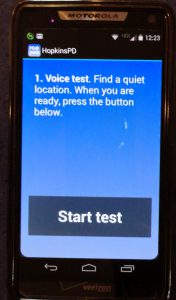
Smartphone-PD is a study to see if it is feasible for participants to download, install, and use an Android smartphone application to track data related to Parkinson disease symptoms. (Note: only available for Android phones) They hope to measure daily variability of movement and mobility characteristics of PD patients. The data is collected by completing voice and movement tests using my cell phone. The results of the daily tests are encrypted and uploaded to the study team at the University of Rochester in New York. The application will also monitor my daily activity if I keep my phone in my pocket.
I found this trial here on Fox Trial Finder and signing up is all done online. I reviewed the study plan and the consent form which includes the disclaimer that this study is purely for research purposes, so they will not be able to provide clinical advice for individuals with PD. Therefore, no adjustments to medications or appointments with a neurologist will be made as a part of the study. After electronically signing the consent form, I received an email with a link to the application which I downloaded to my phone and I was ready to go.
For this study I use my phone to complete five tests twice a day for six months. The first time is in the morning prior to taking my medication and then again about an hour later. They realize that you might not be able to complete the tests on that schedule but they are OK with that as all collected data is valuable. So it’s OK to miss a test day due to travel or whatever, they still want the information.So most every morning I open the application on my phone and spend five minutes completing the tests which include a voice test, a balance test, a gait test, a dexterity test and a reaction test. The results are sent off and I take my medications, have breakfast and try to remember to repeat the test an hour or so later. This study is actively recruiting on FTF or the Parkinson’s Voice site. Both PwP’s and controls are needed. You can also contact Denzil Harris, the research coordinator by email or phone him at 585-275-2791 for more information.
See, getting involved in a clinical trial is not as difficult as one might think, even if you live in a small town or aren’t close to a research center . Using Fox Trial Finder to identify trials you might be eligible for takes just a little bit of your time and the rewards are many including that good feeling of being involved in the quest for a cure. As I have said before, while patients and researchers work to change the current process, there are still many trials that need participants. If we don’t participate, we will continue to rely on a drug discovered almost 50 years ago that only treats some of our symptoms. With 475 possible trials listed, I bet you can find one that interests you, so click on this link and join over 39,000 others on Fox Trial Finder today!
(Updated 12/11 to add the links to Fox Trial Finder so it shows up in mobile device view with thanks to the Cure Parkinson’s Trust )
As promised in the last post, today I will discuss our experiences with clinical trials and the Fox Trial Finder (FTF) web application. But first, are you on Fox Trial Finder? If not, click on this link and sign up today! Currently there are 475 trials listed on FTF taking place in locations around the world. They include interventional trials (reducing tremor or dyskinesia, Tai Chi for balance, tele-medicine, etc.) and observational trials (bio markers, brain mapping, genetic research, wearable devices to measure PD, etc.). When you sign up for FTF you create a profile with information such as length of time with PD, medications, symptoms, and how far you are willing to travel to participate. FTF then matches you to trials that fit your profile. And don’t forget, most trials need control volunteers too so sign up your family and friends! Ready to sign up? Click on this link now! I’ll be here when you come back.
Welcome back! Mara and I recently participated in an observational study titled LRRK2 and Other Novel Exosome Proteins in Parkinson’s Disease conducted by the University of Alabama at Birmingham. The main purpose of this study is to determine whether there are biomarkers associated with Parkinson’s disease susceptibility and/or progression in exosome-proteomes derived from PD patients that will assist with future LRRK2 inhibitor clinical trials. You can read the full description here on FTF but it’s not exactly written in layman’s terms. (Maybe this could be a simple change to the process?)
After arriving at the UAB Medical Campus we were met by Rachel Clark who is coordinating the research study. She went over the research protocol and we signed the consent forms; she then asked us questions about our general health and medications we take. We both completed the Uniform Parkinson’s Disease Rating Scale (UPDRS) patient questionnaire and we were each given the Montreal Cognitive assessment. Then we took the Parkinson’s Smell Test which Mara did fine on and, surprise surprise, I didn’t. Out of 40 samples I got 10 correct while Mara got 37. I was able to identify two odors and the rest were just lucky guesses. I was also given the general physical tests for PD (tap your fingers & toes, walk down the hall, etc.) and we both provided blood and urine samples. That was it! One and a half hours and we had provided them with the necessary information and samples and completed our first clinical trial! It wasn’t time consuming, I didn’t have to worry about receiving a placebo or changing my medications, and I was only poked enough to provide 1 ounce of blood.
Many of the trials listed on FTF are observational studies like this one and seven are web based like the other trial I am participating in – Smartphone-PD. All of them provide valuable information in the search for a cure and all need participants. Did you click on that link yet?
Smartphone-PD is a study to see if it is feasible for participants to download, install, and use an Android smartphone application to track data related to Parkinson disease symptoms. (Note: only available for Android phones) They hope to measure daily variability of movement and mobility characteristics of PD patients. The data is collected by completing voice and movement tests using my cell phone. The results of the daily tests are encrypted and uploaded to the study team at the University of Rochester in New York. The application will also monitor my daily activity if I keep my phone in my pocket.
I found this trial here on Fox Trial Finder and signing up is all done online. I reviewed the study plan and the consent form which includes the disclaimer that this study is purely for research purposes, so they will not be able to provide clinical advice for individuals with PD. Therefore, no adjustments to medications or appointments with a neurologist will be made as a part of the study. After electronically signing the consent form, I received an email with a link to the application which I downloaded to my phone and I was ready to go.
For this study I use my phone to complete five tests twice a day for six months. The first time is in the morning prior to taking my medication and then again about an hour later. They realize that you might not be able to complete the tests on that schedule but they are OK with that as all collected data is valuable. So it’s OK to miss a test day due to travel or whatever, they still want the information.So most every morning I open the application on my phone and spend five minutes completing the tests which include a voice test, a balance test, a gait test, a dexterity test and a reaction test. The results are sent off and I take my medications, have breakfast and try to remember to repeat the test an hour or so later. This study is actively recruiting on FTF or the Parkinson’s Voice site. Both PwP’s and controls are needed. You can also contact Denzil Harris, the research coordinator by email or phone him at 585-275-2791 for more information.
See, getting involved in a clinical trial is not as difficult as one might think, even if you live in a small town or aren’t close to a research center . Using Fox Trial Finder to identify trials you might be eligible for takes just a little bit of your time and the rewards are many including that good feeling of being involved in the quest for a cure. As I have said before, while patients and researchers work to change the current process, there are still many trials that need participants. If we don’t participate, we will continue to rely on a drug discovered almost 50 years ago that only treats some of our symptoms. With 475 possible trials listed, I bet you can find one that interests you, so click on this link and join over 39,000 others on Fox Trial Finder today!
(Updated 12/11 to add the links to Fox Trial Finder so it shows up in mobile device view with thanks to the Cure Parkinson’s Trust )
As promised in the last post, today I will discuss our experiences with clinical trials and the Fox Trial Finder (FTF) web application. But first, are you on Fox Trial Finder? If not, click on this link and sign up today! Currently there are 475 trials listed on FTF taking place in locations around the world. They include interventional trials (reducing tremor or dyskinesia, Tai Chi for balance, tele-medicine, etc.) and observational trials (bio markers, brain mapping, genetic research, wearable devices to measure PD, etc.). When you sign up for FTF you create a profile with information such as length of time with PD, medications, symptoms, and how far you are willing to travel to participate. FTF then matches you to trials that fit your profile. And don’t forget, most trials need control volunteers too so sign up your family and friends! Ready to sign up? Click on this link now! I’ll be here when you come back.
Welcome back! Mara and I recently participated in an observational study titled LRRK2 and Other Novel Exosome Proteins in Parkinson’s Disease conducted by the University of Alabama at Birmingham. The main purpose of this study is to determine whether there are biomarkers associated with Parkinson’s disease susceptibility and/or progression in exosome-proteomes derived from PD patients that will assist with future LRRK2 inhibitor clinical trials. You can read the full description here on FTF but it’s not exactly written in layman’s terms. (Maybe this could be a simple change to the process?)
After arriving at the UAB Medical Campus we were met by Rachel Clark who is coordinating the research study. She went over the research protocol and we signed the consent forms; she then asked us questions about our general health and medications we take. We both completed the Uniform Parkinson’s Disease Rating Scale (UPDRS) patient questionnaire and we were each given the Montreal Cognitive assessment. Then we took the Parkinson’s Smell Test which Mara did fine on and, surprise surprise, I didn’t. Out of 40 samples I got 10 correct while Mara got 37. I was able to identify two odors and the rest were just lucky guesses. I was also given the general physical tests for PD (tap your fingers & toes, walk down the hall, etc.) and we both provided blood and urine samples. That was it! One and a half hours and we had provided them with the necessary information and samples and completed our first clinical trial! It wasn’t time consuming, I didn’t have to worry about receiving a placebo or changing my medications, and I was only poked enough to provide 1 ounce of blood.
Many of the trials listed on FTF are observational studies like this one and seven are web based like the other trial I am participating in – Smartphone-PD. All of them provide valuable information in the search for a cure and all need participants. Did you click on that link yet?
Smartphone-PD is a study to see if it is feasible for participants to download, install, and use an Android smartphone application to track data related to Parkinson disease symptoms. (Note: only available for Android phones) They hope to measure daily variability of movement and mobility characteristics of PD patients. The data is collected by completing voice and movement tests using my cell phone. The results of the daily tests are encrypted and uploaded to the study team at the University of Rochester in New York. The application will also monitor my daily activity if I keep my phone in my pocket.
I found this trial here on Fox Trial Finder and signing up is all done online. I reviewed the study plan and the consent form which includes the disclaimer that this study is purely for research purposes, so they will not be able to provide clinical advice for individuals with PD. Therefore, no adjustments to medications or appointments with a neurologist will be made as a part of the study. After electronically signing the consent form, I received an email with a link to the application which I downloaded to my phone and I was ready to go.
For this study I use my phone to complete five tests twice a day for six months. The first time is in the morning prior to taking my medication and then again about an hour later. They realize that you might not be able to complete the tests on that schedule but they are OK with that as all collected data is valuable. So it’s OK to miss a test day due to travel or whatever, they still want the information.So most every morning I open the application on my phone and spend five minutes completing the tests which include a voice test, a balance test, a gait test, a dexterity test and a reaction test. The results are sent off and I take my medications, have breakfast and try to remember to repeat the test an hour or so later. This study is actively recruiting on FTF or the Parkinson’s Voice site. Both PwP’s and controls are needed. You can also contact Denzil Harris, the research coordinator by email or phone him at 585-275-2791 for more information.
See, getting involved in a clinical trial is not as difficult as one might think, even if you live in a small town or aren’t close to a research center . Using Fox Trial Finder to identify trials you might be eligible for takes just a little bit of your time and the rewards are many including that good feeling of being involved in the quest for a cure. As I have said before, while patients and researchers work to change the current process, there are still many trials that need participants. If we don’t participate, we will continue to rely on a drug discovered almost 50 years ago that only treats some of our symptoms. With 475 possible trials listed, I bet you can find one that interests you, so click on this link and join over 39,000 others on Fox Trial Finder today!
(Updated 12/11 to add the links to Fox Trial Finder so it shows up in mobile device view with thanks to the Cure Parkinson’s Trust )
I started ‘brain training’ with Lumosity last fall and usually play five games a day whenever possible. If you aren’t familiar with Lumosity, they provide cognitive training exercises that teach neuroplasticity, that is training the brain to use new pathways to complete a task. Cognitive training has blossomed in the past few years and since some of my neural pathways are deteriorating, I thought Lumosity would be an interesting test and might help me build those new paths.
The Lumosity training works to improve five areas – memory, flexibility, problem solving, attention and speed – all improvements I can use! After every five game session you get an overall score called the Lumosity Performance Index or LPI which is an average of the five areas and hopefully goes up each day (I wish). But enough of the background, if you want more info, check out their website.
I have found that playing the brain games with PD can be a challenge, particularly the flexibility and speed games that usually require the use of the arrow keys on my laptop to select the right answer. I have noticed that I can visualize the correct move but making my fingers press the right key is another thing altogether. As I learned from the presentation by Kaitlyn Roland at the Kripalu session, one of the problems with a lack of dopamine is the brain sends the correct command but it gets scrambled and doesn’t follow the correct pathway which results in the wrong action being taken which can result in a fall, freezing in place or, it appears, pressing the wrong key.
So I am hopeful that by doing the games every day I am creating those new neural pathways and my LPI score will reflect the improvement. But sometimes I seem to be stuck with the old paths and my LPI chart ends up looking like this one for the last four weeks, up and down. Such is life with Parkinson’s 🙂
The big Parkinson’s news of the last couple of weeks is the publication of a study that cinnamon might stop the progression of Parkinson’s Disease! I figure this means I should be baking and consuming my famous (in some circles) Gram’s Pecan Rolls so named because the recipe is from my daughter in law Monica’s Gram and it is full of cinnamon. Of course the study was conducted on mice so I don’t know how many rolls I need to eat daily but do know what the effect would be on my weight! Guess I’ll wait for more information before getting the baking equipment out but I wonder if my LPI would go up? Sounds like a clinical study in the making!
We had a great 4th of July visit with son Ryan and his wife Sarah and their son Julian and his half brother Trysten. In addition, grandson Jake and granddaughter McKenna and her friend Katie also joined us for the holiday weekend so we had a houseful. The kids enjoyed tubing on the lake and swimming off the dock, and we all enjoyed taking the boat down to watch the fireworks go off over the lake. We even managed to load the tube with all five kids for some fun on the lake. Again some fishing and paddle boarding took place along with watching the World Cup games.
Next week it will be one year since my PD diagnosis and a lot has happened in the space of the year, most of which I have managed to chronicle in this blog. Once again I thank you all for sticking with me on this journey, your support means a lot to me.
BTW, if you are a tweeter, follow me on twitter by clicking on the link on the right below my profile.