And I’m back! I noticed that I didn’t mention anything in the last post about how my buddy Parkinson’s and I are getting along. Things are pretty much stable, still some arm stiffness and shuffling when I walk and the occasional balance problem. I don’t have the sticky feet problem nearly as often nor the internal tremors so, all in all, things are OK.
As I have noted before, I follow many other blogs, websites, and Twitter accounts related to Parkinson’s, probably close to 50 if I took the time to count them all. I have been planning to add a page with the list of who I follow to this blog and maybe that will happen one of these days soon, but remember, apathy is a non-motor symptom so don’t hold your breath. 🙂
One of the blogs I follow is Tremors in the Universe written by Robert Baittie. In a recent post, Chapter 36 Whistle while you twerk, he talks about another symptom of PD, micrographia and from there he… well here, I’ll let you read it yourself picking up where he defines micrographia:
“The symptom as it appears in association with Parkinson’s disease is called micrographia, and in handwriting or penmanship is characterized by abnormally small, cramped handwriting and/or the progression to continually smaller handwriting. It’s cause, according to the National Parkinson’s Foundation is attributed to a common feature of PD which is a slowing of movement, and feelings of muscle stiffness in the hands and fingers. Loss of automatic motion also affects the easy, flowing motion of handwriting. This can impact even simple writing taskssuch as signing your name.”
“Which started me thinking.”
“Parkinson’s disease is named after the English doctor James Parkinson, who published the first detailed description in An Essay on the Shaking Palsy in 1817.”
“In 1817”.
“Might there be any signatures of record prior to 1817 that show signs of a typical Parkinson’s style of writing?”
“Of what importance was that to me? Well my entire attitude around my diagnosis of Parkinson’s has been about succeeding with the disease and having and maintaining a positive attitude towards dealing with it. I was curious if there might be individuals who had continued to achieve and possibly even made a mark in history while in the midst of dealing with PD? At a time when they didn’t have today’s technology, support and treatments. Obviously this was all pure speculation because prior to 1817 it was not classified or known as Parkinson’s. But I was curious none the less.”
“The first thing I did was to Google micrographia thinking I might find a visual example of the malady that I could use for comparison to any earlier documents I might come across. And sure enough, in the Wikipedia Encyclopedia a writing example of a Parkinson’s patient.” “The next step was to begin searching documents prior to 1817 that might offer a similar writing style”.
“Now I was not going to go about this by pure happenstance, on the contrary, I had a hunch and I had definite place in mind to start. There was one document in particular I wanted to take a look at. And sure enough my hunch or maybe I should say my “intuition” was correct.”
Stephen Hopkins
“Here was my individual of notoriety that I felt had that characteristic signature at a time when the flourish of stylized and ornate signatures and penmanship were the art form of the day.”
“Here was a man among men. Stephen Hopkins. Born in 1707 and died in 1785 at the age of 78. He came from a prominent Rhode Island family and most definitely left his mark upon a nation. Not only did my initial examination of the document serve to heighten my belief, but further readings of his biography removed all doubt. His own admission was proof enough for me.”
“In the summer of 1776, while holding his right hand with his left, saying, “although my hand trembles, my heart does not” Stephen Hopkins, a Rhode Island delegate to the First Continental Congress, signed the Declaration of Independence.”
“It gave me tremendous pause to sit and look at that Declaration of Independence and those signatures and to think about the thoughts that must have been going through Stephen Hopkins mind. Not only could I imagine he had a sense of uncertainty and fear for what the future held for our new country at that time, but he was simultaneously dealing with the uncertainty of and concern for his own health. He held the same questions in his mind then about his health, that millions still hold to this day. What is causing this? What can be done?”
“And as I reread those simple words of Stephen Hopkins, a number of thoughts came to mind. First, I felt a tremendous amount of respect for the man because he was not afraid to share with his friends and colleagues the disease that afflicted him. Especially at a time when there was no explanation he could offer for what ailed him. He openly called attention to and acknowledged his tremor and in doing so said he was not ashamed of it. Second was that he had not allowed his tremor or the disease to limit him. He had continued on with his passion for his work. But most profoundly to me was the double meaning I took from the words as a whole. While obviously in one context he is referring to our young nation and “though his hand trembles” while signing this Declaration of Independence “his heart does not” because he believes this to be the right direction for his country, the other context it speaks to for me is the disease of Parkinson’s itself. The words make the analogy of how I have felt all along. “Although my hand trembles, my heart does not.” It’s that strange sense of the positive and knowing that although I have been diagnosed with Parkinson’s, everything I feel in my heart tells me there is nothing to fear and I will be alright. That I can and will deal with whatever it brings me.”
“Over 230 years later since the documents signing technology is most definitely moving at a rapid pace, and the research being done toward finding a cure for Parkinson’s is as well. But to continue that work and to hasten the success, additional funding is always needed. Volunteers and Foundations continue to spearhead the vast majority of the fundraising efforts but more needs to be done.”
“Given that, I find it extremely ironic that this would be the example of the signature I would find. A statesmen, a member of the First Continental Congress. Because additional support and funding from our government is what is needed to keep progress moving forward and ultimately finding a cure. And so I would like to ask everyone reading this to take the opportunity to write your Congressman with a steady hand to request that they show the heart of our founding fathers and support increased funding for Parkinson’s research. (emphasis added)
Reblog it. ReTweet it. Do it for your self. Or someone you love.
To find out what prompted Robert to research micrographia, read the complete post of Chapter 36 here. I think you will find it interesting and I highly recommend reading some or all of his other ‘Chapters’.
What a great statement “although my hand tremors, my heart does not” and as the Michael J Fox Foundation says “Our challenges don’t define us. Our actions do” We can and will deal with whatever Parkinson’s throws at us on our way to finding a cure.
I also agree that we need to continue to urge Congress to support increased funding for Parkinson’s research. In that vein,the Parkinson’s Action Network (PAN) is sponsoring a Parkinson’s Day of Action on February 26th. They ask that you contact your Representatives and ask for their support. They have provided information here on how to contact your representatives, some sample statements you can use and links to why we need more funding for research. I urge you to join me and PAN on Wednesday, February 26th and contact your Congressional Representatives.
As I write this post, we are watching it snow as we are under another winter storm warning for the next couple of days, just hoping it clears up here and in Atlanta by Friday so we can start our trip to what I hope is a warm Florida. We are looking forward to the trip and a chance to meet up with a couple that we met during the Kripalu retreat. ‘See’ you next week.
Or maybe it should be a Mish Mash? how about a Mashup? Anyway, this is a post of odds and ends I have been doing or reading about since my last post. We arrived home from Florida just in time to get caught up in the snow and ice and cold a couple of weeks ago and last week and this week so we are excited to leave soon for our regularly scheduled February beach visit. While home we have kept up the exercise on the bike, walking the few days we could, and doing Tai Chi. I purchased the DVD recommended by the National Parkinson’s Foundation and we have really enjoyed it. The fluid movements seem to be helping with flexibility and balance and the QiGong warmup exercises stretch a few muscles I haven’t been using much this winter 🙂
I was excited to see the announcement last week that The Michael J. Fox Foundation for Parkinson’s Research (MJFF), the Alzheimer’s Association (ALZ),and The W. Garfield Weston Foundation have joined together to announce a collaborative effort to stimulate analyses across the Alzheimer’s disease (AD) and Parkinson’s disease (PD) research enterprises. This will build on recent evidence suggesting substantial overlap between AD, PD, and other neurodegenerative diseases pathologically, but also potentially biologically. They will be able to utilize two large biomarker databases, the Alzheimer’s Disease Neuroimaging Initiative (ADNI) and the Parkinson’s Progression Markers Initiative (PPMI), for new research ideas. I hope this collaboration produces benefits for both PD and AZ current and potential patients.
Another collaboration recently announced was the formation of the Alliance of Independent Regional Parkinson Organizations (AIRPO). AIRPO is a consortium of regional independent nonprofit organizations, with the shared goals of finding a cure for Parkinson’s and supporting those who live with the disease. AIRPO aims to enrich programs available to the Parkinson’s disease community by encouraging collaboration, leveraging organizational strengths and maximizing efficiency among its founding member organizations, which include: Houston Area Parkinson Society,Michigan Parkinson Foundation, Northwest Parkinson’s Foundation, Parkinson Association of the Carolinas and Parkinson Association of the Rockies. The Parkinson’s Disease Foundation offers administrative support to AIRPO.
I belong to a ‘virtual’ support group site called Patients Like Me and one of the things they do is conduct research in connection with research groups. Recently they started a study with the objective of being able to monitor disease progression over the phone. I am a participant in the study and will be interested to see if it is possible. So far I was required to fill out a survey then called an 800 number and followed the instructions to record a voice segment, quite similar to the test I received in Florida last month. More information about the study has been published here.
I also started a genetics for beginners online course at Udacity.com. I have received the results of my DNA test from 23andme.com and decided I needed to increase my knowledge to fully understand the results. The course has been challenging and I just finished the quiz for lessons 1 – 4 (they didn’t say there would be a quiz!) I like the instructors and the online format has been great, they have come a long way since the last online course I took back a decade or two ago. Interesting stuff.
Well enough for this post, as the title suggests, there will be at least a Part Two which I hope to post before we leave for Florida on Friday so stay tuned.
Last week Dr Soania Mathur, whom I follow on Twitter, posted an excellent article, “10 Lessons I’ve Learned Living With a Chronic Disease” , on The Huffington Post. Dr Mathur was diagnosed with Early Onset PD 16 years ago at age 27 and in the post she discusses 10 lessons she has learned from facing the challenges of living with a chronic disease. But as she points out in the opening “Each of us is challenged in some way, be it in our health, our finances, our occupations or our interpersonal relationships, and many of the same principles that I learned on my particular journey are hopefully relevant regardless of the challenge you are facing.” I know that I found them extremely applicable for my PD journey and I think you may find one or two (or maybe 10) that will be relevant for you too. Click here to read Dr Mathur’s post.
First and foremost, I hope this post finds you and your families well and hunkered down as we wait out the COVID-19 pandemic. It is an unprecedented time in our lives and I have no idea how it will all end up but I have the cleanest hands in the neighborhood!
Today, April 11th, is World Parkinson’s Day, a part of Parkinson’s Awareness month. In past years, we have celebrated with Parkinson’s Disease walks and last year we moved our Pedaling for PD class out into the lobby of the YMCA to bring attention to PD and the need for exercise. But this year we can only act alone to raise awareness about PD as we stay in to prevent COVID-19.
This month I read a new book about Parkinson’s Disease – Ending Parkinson’s Disease, A Prescription for Action. The books co-authors show that the increasing numbers of PwP has made PD the fastest growing brain disorder in the world. The number of PwP’s has doubled from 3 million to over 6 million in 25 years and they predict it will double again to over 12 million by 2040. As a result they feel PD is a world wide pandemic.
The book is co-authored by four leading doctors and advocates for PD:
Ray Dorsey MD who directs the Center for Health + Technology at the University of Rochester. He has used telemedicine to improve care for individuals with Parkinson’s disease and I have participated in several clinical trials where he has pioneered the use of technolgy particularly cell phones and live video to improve diagnoses and treatment of PD.
Todd Sherer PHD is the Chief Executive Officer of The Michael J. Fox Foundation for Parkinson’s Research. Trained as a neuroscientist, he is responsible for the Foundation’s overall scientific and fundraising direction to speed treatment breakthroughs and a cure for Parkinson’s disease.
Michael S Okun MD is Chair of Neurology at the University of Florida. He established the Movement Disorder Clinic at the University of Florida bringing together Neurologists, Speech Therapists, Occupational Therapists and Physical Therapists for a complete evaluation of the patient. You can read my blog post about our experience when we went to the University of Florida for a second opinion here.
Bastiaan R Bloem, MD, PHD is professor of neurology and the director of the Centre of Expertise for Parkinson & Movement Disorders at Radboud University Medical Centre in Nijmegen, the Netherlands. In 2004, with Dr. Marten Munneke, he created ParkinsonNet, the largest integrated-care program for Parkinson’s patients.
The authors propose a PACT to Prevent the disease, Advocate for protective policies, Care for patients, and Treat the condition with innovative therapies.
Prevent – They point out that stopping the use of chemical pesticides and solvents and recognizing the impact of head traumas would help to prevent PD and lead to a large reduction in newly diagnosed PwP world wide.
Advocate – They point out the need to educate the public about the worldwide Parkinson’s pandemic. The book discusses the campaigns to end or treat Polio, HIV, and Breast Cancer as examples.
Care – They discuss providing care for PwP’s including in home care by healthcare workers trained in caring for PD patients. They point out that care must be covered by health insurance including Medicare. In addition they discuss the need for each of us to take actions such as exercising to improve our own care. By the way, they have an excellent discussion about Pedaling for PD during the chapter about exercising to prevent and/or slow the progression of PD.
Treat – The final section deals with the need to take charge of the research process and make sure new treatments are fully funded. This would include new medications, new surgeries and improved methods of care for Parkinson’s Disease.
The book ends with a prescription for action listing 25 steps each of us can and should take to reduce the worldwide toll of this disease. The list includes banning paraquat and other harmful pesticides, eating like the Greeks, exercising, advocating for resources and policy changes, and providing reasonable pricing for PD medications.
The book is well written and includes many case studies and research references to support their plan for ending or at least slowing down the increasing number of Parkinson’s Disease diagnoses. It also lays out how to care for those of us that have already been diagnosed including supporting clinical trials that slow or reverse the progression of PD.
So, while you are home fighting off the COVID-19 pandemic, you might want to grab a copy of Ending Parkinson’s and read about the other pandemic we are fighting as PwP’s. You can find more information about the book at www.endingPD.org.
I am still working my way through the PD School 2020 lessons and will provide an update in my next post. In the meantime, stay safe and stay healthy!
First and foremost, I hope this post finds you and your families well and hunkered down as we wait out the COVID-19 pandemic. It is an unprecedented time in our lives and I have no idea how it will all end up but I have the cleanest hands in the neighborhood!
Today, April 11th, is World Parkinson’s Day, a part of Parkinson’s Awareness month. In past years, we have celebrated with Parkinson’s Disease walks and last year we moved our Pedaling for PD class out into the lobby of the YMCA to bring attention to PD and the need for exercise. But this year we can only act alone to raise awareness about PD as we stay in to prevent COVID-19.
This month I read a new book about Parkinson’s Disease – Ending Parkinson’s Disease, A Prescription for Action. The books co-authors show that the increasing numbers of PwP has made PD the fastest growing brain disorder in the world. The number of PwP’s has doubled from 3 million to over 6 million in 25 years and they predict it will double again to over 12 million by 2040. As a result they feel PD is a world wide pandemic.
The book is co-authored by four leading doctors and advocates for PD:
Ray Dorsey MD who directs the Center for Health + Technology at the University of Rochester. He has used telemedicine to improve care for individuals with Parkinson’s disease and I have participated in several clinical trials where he has pioneered the use of technolgy particularly cell phones and live video to improve diagnoses and treatment of PD.
Todd Sherer PHD is the Chief Executive Officer of The Michael J. Fox Foundation for Parkinson’s Research. Trained as a neuroscientist, he is responsible for the Foundation’s overall scientific and fundraising direction to speed treatment breakthroughs and a cure for Parkinson’s disease.
Michael S Okun MD is Chair of Neurology at the University of Florida. He established the Movement Disorder Clinic at the University of Florida bringing together Neurologists, Speech Therapists, Occupational Therapists and Physical Therapists for a complete evaluation of the patient. You can read my blog post about our experience when we went to the University of Florida for a second opinion here.
Bastiaan R Bloem, MD, PHD is professor of neurology and the director of the Centre of Expertise for Parkinson & Movement Disorders at Radboud University Medical Centre in Nijmegen, the Netherlands. In 2004, with Dr. Marten Munneke, he created ParkinsonNet, the largest integrated-care program for Parkinson’s patients.
The authors propose a PACT to Prevent the disease, Advocate for protective policies, Care for patients, and Treat the condition with innovative therapies.
Prevent – They point out that stopping the use of chemical pesticides and solvents and recognizing the impact of head traumas would help to prevent PD and lead to a large reduction in newly diagnosed PwP world wide.
Advocate – They point out the need to educate the public about the worldwide Parkinson’s pandemic. The book discusses the campaigns to end or treat Polio, HIV, and Breast Cancer as examples.
Care – They discuss providing care for PwP’s including in home care by healthcare workers trained in caring for PD patients. They point out that care must be covered by health insurance including Medicare. In addition they discuss the need for each of us to take actions such as exercising to improve our own care. By the way, they have an excellent discussion about Pedaling for PD during the chapter about exercising to prevent and/or slow the progression of PD.
Treat – The final section deals with the need to take charge of the research process and make sure new treatments are fully funded. This would include new medications, new surgeries and improved methods of care for Parkinson’s Disease.
The book ends with a prescription for action listing 25 steps each of us can and should take to reduce the worldwide toll of this disease. The list includes banning paraquat and other harmful pesticides, eating like the Greeks, exercising, advocating for resources and policy changes, and providing reasonable pricing for PD medications.
The book is well written and includes many case studies and research references to support their plan for ending or at least slowing down the increasing number of Parkinson’s Disease diagnoses. It also lays out how to care for those of us that have already been diagnosed including supporting clinical trials that slow or reverse the progression of PD.
So, while you are home fighting off the COVID-19 pandemic, you might want to grab a copy of Ending Parkinson’s and read about the other pandemic we are fighting as PwP’s. You can find more information about the book at www.endingPD.org.
I am still working my way through the PD School 2020 lessons and will provide an update in my next post. In the meantime, stay safe and stay healthy!
First and foremost, I hope this post finds you and your families well and hunkered down as we wait out the COVID-19 pandemic. It is an unprecedented time in our lives and I have no idea how it will all end up but I have the cleanest hands in the neighborhood!
Today, April 11th, is World Parkinson’s Day, a part of Parkinson’s Awareness month. In past years, we have celebrated with Parkinson’s Disease walks and last year we moved our Pedaling for PD class out into the lobby of the YMCA to bring attention to PD and the need for exercise. But this year we can only act alone to raise awareness about PD as we stay in to prevent COVID-19.
This month I read a new book about Parkinson’s Disease – Ending Parkinson’s Disease, A Prescription for Action. The books co-authors show that the increasing numbers of PwP has made PD the fastest growing brain disorder in the world. The number of PwP’s has doubled from 3 million to over 6 million in 25 years and they predict it will double again to over 12 million by 2040. As a result they feel PD is a world wide pandemic.
The book is co-authored by four leading doctors and advocates for PD:
Ray Dorsey MD who directs the Center for Health + Technology at the University of Rochester. He has used telemedicine to improve care for individuals with Parkinson’s disease and I have participated in several clinical trials where he has pioneered the use of technolgy particularly cell phones and live video to improve diagnoses and treatment of PD.
Todd Sherer PHD is the Chief Executive Officer of The Michael J. Fox Foundation for Parkinson’s Research. Trained as a neuroscientist, he is responsible for the Foundation’s overall scientific and fundraising direction to speed treatment breakthroughs and a cure for Parkinson’s disease.
Michael S Okun MD is Chair of Neurology at the University of Florida. He established the Movement Disorder Clinic at the University of Florida bringing together Neurologists, Speech Therapists, Occupational Therapists and Physical Therapists for a complete evaluation of the patient. You can read my blog post about our experience when we went to the University of Florida for a second opinion here.
Bastiaan R Bloem, MD, PHD is professor of neurology and the director of the Centre of Expertise for Parkinson & Movement Disorders at Radboud University Medical Centre in Nijmegen, the Netherlands. In 2004, with Dr. Marten Munneke, he created ParkinsonNet, the largest integrated-care program for Parkinson’s patients.
The authors propose a PACT to Prevent the disease, Advocate for protective policies, Care for patients, and Treat the condition with innovative therapies.
Prevent – They point out that stopping the use of chemical pesticides and solvents and recognizing the impact of head traumas would help to prevent PD and lead to a large reduction in newly diagnosed PwP world wide.
Advocate – They point out the need to educate the public about the worldwide Parkinson’s pandemic. The book discusses the campaigns to end or treat Polio, HIV, and Breast Cancer as examples.
Care – They discuss providing care for PwP’s including in home care by healthcare workers trained in caring for PD patients. They point out that care must be covered by health insurance including Medicare. In addition they discuss the need for each of us to take actions such as exercising to improve our own care. By the way, they have an excellent discussion about Pedaling for PD during the chapter about exercising to prevent and/or slow the progression of PD.
Treat – The final section deals with the need to take charge of the research process and make sure new treatments are fully funded. This would include new medications, new surgeries and improved methods of care for Parkinson’s Disease.
The book ends with a prescription for action listing 25 steps each of us can and should take to reduce the worldwide toll of this disease. The list includes banning paraquat and other harmful pesticides, eating like the Greeks, exercising, advocating for resources and policy changes, and providing reasonable pricing for PD medications.
The book is well written and includes many case studies and research references to support their plan for ending or at least slowing down the increasing number of Parkinson’s Disease diagnoses. It also lays out how to care for those of us that have already been diagnosed including supporting clinical trials that slow or reverse the progression of PD.
So, while you are home fighting off the COVID-19 pandemic, you might want to grab a copy of Ending Parkinson’s and read about the other pandemic we are fighting as PwP’s. You can find more information about the book at www.endingPD.org.
I am still working my way through the PD School 2020 lessons and will provide an update in my next post. In the meantime, stay safe and stay healthy!
This will be a short blog post regarding the PD School being conducted by Dr Laurie Mischley which I wrote about in the last post. A few days ago I received the following message from Dr Mischely:
Hi Tom,
Yours was one of many requests I’ve received the past few days to make class #1 free.
Done. It is now free.
Thanks for helping spread the word!
Laurie
If you have or have not watched the first class, you now have an opportunity to not only watch it but forward that class to family members, friends, care givers and any other person you think could benefit from a good discussion about what it means to be diagnosed with PD.
As I mentioned in the last post, this lesson should be offered to all newly diagnosed Parkinson’s patients- it answers so many of the questions we have at that point but didn’t know enough to ask during that first meeting with the neurologist. The two links below take you to the overview lesson (was already free) and the orientation lesson which is now free.
I have completed lesson two “Dopamine Repletion” and lesson three “How Do We Know What We Know”. Both were excellent and I highly recommend them both. Here are a few of the highlights:
Lesson two – Dopamine Repletion – is an excellent overview on the drugs available, along with when is the best time to take them and avoid the protein from meals blocking the transfer of dopamine to the brain.
She utilizes the results of the ongoing CAM Study and other published research to support taking your levadopa/carbidopa with water mixed with vitamin C to provide additional stomach acid to speed up the breakdown of the pills.
In addition, she discusses the use of Fish Oil and Citicoline (both supplements) to reduce dyskinesia by improving the uptake of dopamine so you can reduce your overall dose.
At the end there is a brief discussion of Mucuna, a plant form of levadopa followed by a ‘guest lecturer’ who discusses the pluses and minuses of using Mucuna.
Lesson three – How Do We Know What We Know – discusses PD research from all directions. She was worried this would be the lesson no one watched, but it is another must see as she tackles traditional research, the placebo effect and more. Rather than try to recapitulate it all here I am going to just pull a few points from her summary at the end of the lesson:
-Physicians, patients, and researchers all describe/ define PD differently.
-Everyone says they want medicines that slow PD progression, but they don’t have a scale to measure progression.
-By time a patient is diagnosed, ability to significantly impact course may be compromised.
-We don’t know who is going to get PD (screening tests), we don’t know who is at greatest risk of progression, we don’t have a tool to measure progression, and we can’t agree on a definition.
-A shocking amount of researcher time goes to keeping one’s job. If you’re not bringing in grant money, you don’t get paid, so instead of just doing science, we spend our time courting the system. Novel ideas and innovation must swim against a significant current. Everyone wants so
As she wrapped up this lesson, she said she favors a ‘friendly competition’ among PD practitioners. If she is doing something right, doesn’t your neurologist need to know and if they are doing something right, she wants to know that too.
Sounds like a good idea to me.
“It does not matter how slowly you go as long as you do not stop.” – Confucius
Some of you may be familiar with Dr. Laurie K Mischley from Bastyr University in Seattle. She has a medical degree in Naturopathic Medicine and specializes in the nutritional requirements for neuro degenerative disorders. She has spent over 10 years working with PD patients and has a clinical trial going on regarding Complementary and Alternative Medicine (CAM) in PD where participants (I have been one since 8/2014) complete a series of surveys every 6 months to report the status and progression of their PD and we also compete a 24 hour food diary. She has presented programs at the World Parkinson’s Congress and other research meetings and she is considered an expert in the nutritional needs of PD patients.
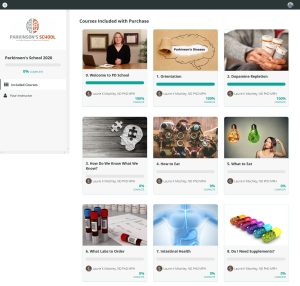
In addition to seeing patients and conducting research, Laurie also hosts a week long Parkinson’s Summer School at Baystr and she is now offering PD School 2020, an on line course. She describes the course as follows:
“Parkinson’s School was created to be a resource for patients and their family members. Clinic visits are too few and far between and patients have questions that are going unanswered. Over the past 10 years I’ve treated over 3000 patients with Parkinson’s and these courses represent the themes I find myself repeating.
Throughout 2020, a new course will be released on the 14th and 28th of every month. Comments and course discussion will be open for the two weeks after each course to allow time for questions. After comments close, you will continue to have unlimited access to the videos and may watch them as often as you’d like.
As far as I know, online education programs to teach patients to better navigate their disease do not exist. I’m hoping this program will stimulate conversation, collaboration, and a sense of empowerment throughout the community.“
You can register for the course here. The cost of the course is $10 per lesson or $150 for all 24 lessons. Use coupon code NWPF-HOPE for a 20% discount bringing the price down to $120 for all 24 lessons. Below are the topics that will be covered during the year so you can pick and choose if you don’t want to sign up for the entire course.
You can watch the welcome for no charge where she discusses her background and credentials and the outline of the course so you have a better idea of what will be offered before you commit to taking the courses. I have signed up for the full course and I have included my thoughts about the first course below.
Lesson One – Orientation
I think this is the video we wish we could have viewed when we were first diagnosed. It covers what PD is and how it is more than the motor symptoms that affect us and what we can do to delay or reverse it. If you are on the fence about taking the course I highly recommend you purchase the first lesson for $10 just for the knowledge you will gain about Parkinson’s, how it progresses and what she has been doing to reverse or slow progression.
She and her research team have created a PD scoring system that is easy to complete and correlates well with the UPDRS and other tests we often take at the Doctor’s office for both diagnosis and current status. Her goal is to reduce your score by the end of the year. The PRO PD test is available to anyone at propd.org. There is no cost and it takes about 5 minutes to complete and get a score. I took it and ended up with a score of 744. I have asked for my previous scores from my participation in the CAM trial and will be interested to see if there is a change and which way, since my exercise level now is about double what it was in 2014/15.
All of her ideas are supported by slides that contain relevant research reports along with supporting data from the CAM study. This class is interesting and provides a wealth of information for PwP’s. I will keep you posted as I progress through the remaining classes.
“It does not matter how slowly you go as long as you do not stop.” – Confucius
PS: I just received an email from National Parkinson’s Foundation, Dr. Mischley is the featured expert on their next Expert Briefing webinar on March 17, 2020 from 1pm – 2pm ET. More information is available here If you are reading this post after 3/17/2020, all of the webinars are recorded and made available on their website.