For those of you who like to keep track, July 24th – August 6th encompasses several milestones beginning with July 24th which is the 11th anniversary of my PD diagnoses. Yes, it has been 11 years and Mara and I think I am better now that I was then! Certainly I am in better physical shape due to the 5 – 7 days of exercise each week and my symptoms of bradykinesia and other motor symptoms are better because of taking Carbidopa/Levodopa. The fact that I have been able to reduce my Levodopa Equivalent Daily Dose (total LD per day from all sources) from 1688 mg to 932 mg over the past 5 years is certainly an indicator that something is working right.
This week we celebrated our 34th wedding anniversary with a superb dinner out and a fine bottle of champagne! (I need to add the champagne tradition to the PD anniversary) I wouldn’t be in the shape I am without Mara’s support. She is not only the love of my life and my best friend, she is also my caretaker extraordinaire!
Also this week I will celebrate my 78th birthday ( already have the champagne for this one!)
And on August 6th this blog will be 11 years old, and this will be the first post of 2024! Yep it’s been 16 months since my last post and I have no valid excuse except to blame it on my Parkinson’s Disease non motor symptom of apathy. I have had various ideas or information that I could use to create a post but somehow they never get written. But I am going to make the breakthrough today!
While I have successfully reduced my Levodopa Equivalent Daily Dose from 1688 mg to 932 mg per day, I haven’t stopped my PD progression particularly in non-motor symptoms. In addition to apathy, my handwriting is working it’s way to a completely illegible scrawl, my speech continues to get softer (I know, I should be using the Speak Out tools to improve this one) and constipation and drooling have become more prevalent. On the plus side, reducing my Levodopa has reduced my dyskinesia and something I am doing has improved my sleep, often getting 6 – 7 hours per night according to my FitBit:
I wish I knew what I am doing to improve my sleep, I’m pretty sure I could patent it and make a fortune! I don’t follow any of the hints you see like reduce screen time ( I usually get in bed and read on my iPad!) or limit fluid intake before bed, or take melatonin or use CBD/Marijuana. The only thing I have doing different for the past 6 or 7 months is following a version of high dose thiamine therapy or vitamin B1 (HDTT) . I have noticed some improvements from following this therapy and I will discuss the details and process in my next blog post. There, I’ve set myself a task and I will plan to write the next post no later than next week.
Speaking of tasks, I did update the Now What document with recommendations for persons who have been recently diagnosed with PD. You can click here or at the top right to read or print it.
Until then, if you are a long time subscriber and wondered where I have been, I hope this finds you in good health and thank you for sticking with me despite my 16 month hiatus. Welcome to my new subscribers that have signed up in the last 16 months , now you know why you haven’t seen any posts.
“It does not matter how slowly you go as long as you do not stop.” – Confucius
Yep, in the 10 years since I was diagnosed with PD, I have written at least one post in April about Parkinson’s Awareness Day, or Week or Month. The only year missing is 2018 when we were moving into our Sarasota home. I thought it would be fun to take a trip down memory lane and see what I wrote about in the past 10 years.
The first year was 2014 (click on the links to view) and most of the post was about Autism, my colonoscopy, my first dermatologist visit and how nice the weather was that week, Finally at the end of the post I mentioned the local Unity walk.
The next year, 2015, I quoted paragraphs from another blogger – Corey King. His views about awareness resonated with me and I hope my readers too.
In 2016 my post was long but all about PD awareness! So after 3 years I have caught on to the program and filled a post with my thoughts.
2017 was a quick one, with a link to a video about Unite for Parkinson’s.
In 2019 I had two posts (making up for missing 2018) the first one about our spinning class moving the bikes and holding our class in the lobby of the YMCA which was covered by a local TV station and resulted in my first TV gig! In the second post I covered the YMCA ride again and discussed how the class helps me fight PD. I also talked about experimenting with my medications doses and I am pleased to see that I am taking even less 4 years later!! EXERCISE WORKS!
In the COVID year of 2020, my World PD Day post was a review of the new book Ending Parkinson’s Disease, A Prescription for Action by Ray Dorsey MD et. al. The book was the basis for the Ending Parkinson’s movement that continues to lobby and push for research funding and has pushed to ban various chemicals that appear to cause PD.
In 2021 I discussed the book from the previous year and pushed for readers to join PD Avengers, a global alliance to end parkinson’s. If you haven’t joined, it’s not too late, click on the icon to the right and be a PD Avenger.
And last year, I introduced Spark! the new symbol for Parkinson’s Awareness. I also pushed again for readers to join PD Avengers and shared some infographics from the European PD organization on the myths of PD.
Now it is 2023 and we are getting closer to finding a marker that will improve the results of research trials looking for a cure or at least a disease modifying solution. We know that exercise is the best medicine to slow progression and we have many more options to deal with ‘off’ periods than there were in 2013. There have been significant improvements to DBS and Focused Ultrasound options to help deal with motor issues and tremor. Trials of stem cell implants are at stage 2 and 3 and we know a lot more about the genetics of PD. But I am sorry to report that the cure for Parkinson’s is still at least 5 years away, just like it was 10 years ago.
Parkinson’s Awareness month will continue into the foreseeable future as the hunt goes on to solve PD. So, join PD Avengers, donate to your favorite PD organization, join a clinical trial and let your elected officials know that you support the Ending Parkinson’s initiatives.
We have lived in Sarasota, Florida for 6+ years and have come to believe in the urban legend that Sarasota is protected from hurricanes because the Native Americans who first settled here blessed the lands to stay eternally safe from destructive storms and hurricanes. Fact is Sarasota Bay has not been a bull’s eye for a major hurricane in Florida since reliable records began in 1871.
But two weeks ago hurricane Ian that was forecasted to hit in Tampa to our North, started slipping south and suddenly the forecast was for it to come ashore in Sarasota. The emergency management authorities started evacuating the barrier islands, and we joined with a few neighbors to install hurricane shutters in preparation for a direct hit. Since 2002, the Florida building codes require new construction be able to withstand winds up to 150MPH. Our home was built in 2013 so it meets the new codes and it looked liked we were going to test the construction!
We opened our home to couple of friends who had to evacuate and one of them joined us as we hunkered down and got ready to ride out the storm. The Indian blessing seemed to be working as Ian continued to drop to the south and came ashore near Ft Myers’s about 50 miles (as the crow flies)south of us and then tracked northeast thru the city of Northport about 20 miles south of us on its way to the Atlantic, passing over Sarasota with windspeeds of 85 -100 mph. The wind and rain went on most of the night and you could feel the gusts when they hit the house.
We got up the next morning to find the house was undamaged except for a couple of loose roof tiles. There were lots of trees and bushes down in the area but no physical damage that we could see. Even more amazing was we never lost power! According to Florida Power and Light, of their 287,000 customers in Sarasota 280,000 were without power, so we were one of the lucky 7,000. We did lose our internet and cable for a several days, making it hard to keep up with what was happening as cell reception was spotty due to power being out to cell towers or the towers being damaged by the hurricane.
It’s been two weeks since the hurricane and most of the debris in our development has been cleaned up. Our tennis courts are back in operation after replacing the clay that blew off and putting the wind screens back up. There are still pockets of the area without power or internet particularly south of us in Northport where a large portion of the city was flooded by the Myakka river which is still above flood stage.
So, thanks to an Ancient Indian Blessing, good neighbors, and the updated Florida building codes, we survived our first and hopefully only hurricane. We are able to get groceries and fuel again and play tennis and cycle for PD. Life is returning to normal.
And I’m back! I noticed that I didn’t mention anything in the last post about how my buddy Parkinson’s and I are getting along. Things are pretty much stable, still some arm stiffness and shuffling when I walk and the occasional balance problem. I don’t have the sticky feet problem nearly as often nor the internal tremors so, all in all, things are OK.
As I have noted before, I follow many other blogs, websites, and Twitter accounts related to Parkinson’s, probably close to 50 if I took the time to count them all. I have been planning to add a page with the list of who I follow to this blog and maybe that will happen one of these days soon, but remember, apathy is a non-motor symptom so don’t hold your breath. 🙂
One of the blogs I follow is Tremors in the Universe written by Robert Baittie. In a recent post, Chapter 36 Whistle while you twerk, he talks about another symptom of PD, micrographia and from there he… well here, I’ll let you read it yourself picking up where he defines micrographia:
“The symptom as it appears in association with Parkinson’s disease is called micrographia, and in handwriting or penmanship is characterized by abnormally small, cramped handwriting and/or the progression to continually smaller handwriting. It’s cause, according to the National Parkinson’s Foundation is attributed to a common feature of PD which is a slowing of movement, and feelings of muscle stiffness in the hands and fingers. Loss of automatic motion also affects the easy, flowing motion of handwriting. This can impact even simple writing taskssuch as signing your name.”
“Which started me thinking.”
“Parkinson’s disease is named after the English doctor James Parkinson, who published the first detailed description in An Essay on the Shaking Palsy in 1817.”
“In 1817”.
“Might there be any signatures of record prior to 1817 that show signs of a typical Parkinson’s style of writing?”
“Of what importance was that to me? Well my entire attitude around my diagnosis of Parkinson’s has been about succeeding with the disease and having and maintaining a positive attitude towards dealing with it. I was curious if there might be individuals who had continued to achieve and possibly even made a mark in history while in the midst of dealing with PD? At a time when they didn’t have today’s technology, support and treatments. Obviously this was all pure speculation because prior to 1817 it was not classified or known as Parkinson’s. But I was curious none the less.”
“The first thing I did was to Google micrographia thinking I might find a visual example of the malady that I could use for comparison to any earlier documents I might come across. And sure enough, in the Wikipedia Encyclopedia a writing example of a Parkinson’s patient.” “The next step was to begin searching documents prior to 1817 that might offer a similar writing style”.
“Now I was not going to go about this by pure happenstance, on the contrary, I had a hunch and I had definite place in mind to start. There was one document in particular I wanted to take a look at. And sure enough my hunch or maybe I should say my “intuition” was correct.”
Stephen Hopkins
“Here was my individual of notoriety that I felt had that characteristic signature at a time when the flourish of stylized and ornate signatures and penmanship were the art form of the day.”
“Here was a man among men. Stephen Hopkins. Born in 1707 and died in 1785 at the age of 78. He came from a prominent Rhode Island family and most definitely left his mark upon a nation. Not only did my initial examination of the document serve to heighten my belief, but further readings of his biography removed all doubt. His own admission was proof enough for me.”
“In the summer of 1776, while holding his right hand with his left, saying, “although my hand trembles, my heart does not” Stephen Hopkins, a Rhode Island delegate to the First Continental Congress, signed the Declaration of Independence.”
“It gave me tremendous pause to sit and look at that Declaration of Independence and those signatures and to think about the thoughts that must have been going through Stephen Hopkins mind. Not only could I imagine he had a sense of uncertainty and fear for what the future held for our new country at that time, but he was simultaneously dealing with the uncertainty of and concern for his own health. He held the same questions in his mind then about his health, that millions still hold to this day. What is causing this? What can be done?”
“And as I reread those simple words of Stephen Hopkins, a number of thoughts came to mind. First, I felt a tremendous amount of respect for the man because he was not afraid to share with his friends and colleagues the disease that afflicted him. Especially at a time when there was no explanation he could offer for what ailed him. He openly called attention to and acknowledged his tremor and in doing so said he was not ashamed of it. Second was that he had not allowed his tremor or the disease to limit him. He had continued on with his passion for his work. But most profoundly to me was the double meaning I took from the words as a whole. While obviously in one context he is referring to our young nation and “though his hand trembles” while signing this Declaration of Independence “his heart does not” because he believes this to be the right direction for his country, the other context it speaks to for me is the disease of Parkinson’s itself. The words make the analogy of how I have felt all along. “Although my hand trembles, my heart does not.” It’s that strange sense of the positive and knowing that although I have been diagnosed with Parkinson’s, everything I feel in my heart tells me there is nothing to fear and I will be alright. That I can and will deal with whatever it brings me.”
“Over 230 years later since the documents signing technology is most definitely moving at a rapid pace, and the research being done toward finding a cure for Parkinson’s is as well. But to continue that work and to hasten the success, additional funding is always needed. Volunteers and Foundations continue to spearhead the vast majority of the fundraising efforts but more needs to be done.”
“Given that, I find it extremely ironic that this would be the example of the signature I would find. A statesmen, a member of the First Continental Congress. Because additional support and funding from our government is what is needed to keep progress moving forward and ultimately finding a cure. And so I would like to ask everyone reading this to take the opportunity to write your Congressman with a steady hand to request that they show the heart of our founding fathers and support increased funding for Parkinson’s research. (emphasis added)
Reblog it. ReTweet it. Do it for your self. Or someone you love.
To find out what prompted Robert to research micrographia, read the complete post of Chapter 36 here. I think you will find it interesting and I highly recommend reading some or all of his other ‘Chapters’.
What a great statement “although my hand tremors, my heart does not” and as the Michael J Fox Foundation says “Our challenges don’t define us. Our actions do” We can and will deal with whatever Parkinson’s throws at us on our way to finding a cure.
I also agree that we need to continue to urge Congress to support increased funding for Parkinson’s research. In that vein,the Parkinson’s Action Network (PAN) is sponsoring a Parkinson’s Day of Action on February 26th. They ask that you contact your Representatives and ask for their support. They have provided information here on how to contact your representatives, some sample statements you can use and links to why we need more funding for research. I urge you to join me and PAN on Wednesday, February 26th and contact your Congressional Representatives.
As I write this post, we are watching it snow as we are under another winter storm warning for the next couple of days, just hoping it clears up here and in Atlanta by Friday so we can start our trip to what I hope is a warm Florida. We are looking forward to the trip and a chance to meet up with a couple that we met during the Kripalu retreat. ‘See’ you next week.
And I’m back! I noticed that I didn’t mention anything in the last post about how my buddy Parkinson’s and I are getting along. Things are pretty much stable, still some arm stiffness and shuffling when I walk and the occasional balance problem. I don’t have the sticky feet problem nearly as often nor the internal tremors so, all in all, things are OK.
As I have noted before, I follow many other blogs, websites, and Twitter accounts related to Parkinson’s, probably close to 50 if I took the time to count them all. I have been planning to add a page with the list of who I follow to this blog and maybe that will happen one of these days soon, but remember, apathy is a non-motor symptom so don’t hold your breath. 🙂
One of the blogs I follow is Tremors in the Universe written by Robert Baittie. In a recent post, Chapter 36 Whistle while you twerk, he talks about another symptom of PD, micrographia and from there he… well here, I’ll let you read it yourself picking up where he defines micrographia:
“The symptom as it appears in association with Parkinson’s disease is called micrographia, and in handwriting or penmanship is characterized by abnormally small, cramped handwriting and/or the progression to continually smaller handwriting. It’s cause, according to the National Parkinson’s Foundation is attributed to a common feature of PD which is a slowing of movement, and feelings of muscle stiffness in the hands and fingers. Loss of automatic motion also affects the easy, flowing motion of handwriting. This can impact even simple writing taskssuch as signing your name.”
“Which started me thinking.”
“Parkinson’s disease is named after the English doctor James Parkinson, who published the first detailed description in An Essay on the Shaking Palsy in 1817.”
“In 1817”.
“Might there be any signatures of record prior to 1817 that show signs of a typical Parkinson’s style of writing?”
“Of what importance was that to me? Well my entire attitude around my diagnosis of Parkinson’s has been about succeeding with the disease and having and maintaining a positive attitude towards dealing with it. I was curious if there might be individuals who had continued to achieve and possibly even made a mark in history while in the midst of dealing with PD? At a time when they didn’t have today’s technology, support and treatments. Obviously this was all pure speculation because prior to 1817 it was not classified or known as Parkinson’s. But I was curious none the less.”
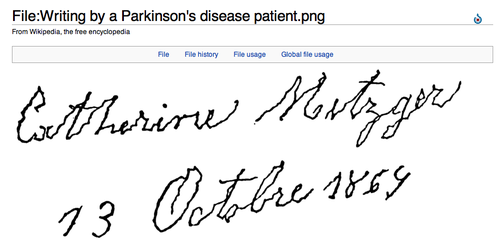
“The first thing I did was to Google micrographia thinking I might find a visual example of the malady that I could use for comparison to any earlier documents I might come across. And sure enough, in the Wikipedia Encyclopedia a writing example of a Parkinson’s patient.” “The next step was to begin searching documents prior to 1817 that might offer a similar writing style”.
“Now I was not going to go about this by pure happenstance, on the contrary, I had a hunch and I had definite place in mind to start. There was one document in particular I wanted to take a look at. And sure enough my hunch or maybe I should say my “intuition” was correct.”
Stephen Hopkins
“Here was my individual of notoriety that I felt had that characteristic signature at a time when the flourish of stylized and ornate signatures and penmanship were the art form of the day.”
“Here was a man among men. Stephen Hopkins. Born in 1707 and died in 1785 at the age of 78. He came from a prominent Rhode Island family and most definitely left his mark upon a nation. Not only did my initial examination of the document serve to heighten my belief, but further readings of his biography removed all doubt. His own admission was proof enough for me.”
“In the summer of 1776, while holding his right hand with his left, saying, “although my hand trembles, my heart does not” Stephen Hopkins, a Rhode Island delegate to the First Continental Congress, signed the Declaration of Independence.”
“It gave me tremendous pause to sit and look at that Declaration of Independence and those signatures and to think about the thoughts that must have been going through Stephen Hopkins mind. Not only could I imagine he had a sense of uncertainty and fear for what the future held for our new country at that time, but he was simultaneously dealing with the uncertainty of and concern for his own health. He held the same questions in his mind then about his health, that millions still hold to this day. What is causing this? What can be done?”
“And as I reread those simple words of Stephen Hopkins, a number of thoughts came to mind. First, I felt a tremendous amount of respect for the man because he was not afraid to share with his friends and colleagues the disease that afflicted him. Especially at a time when there was no explanation he could offer for what ailed him. He openly called attention to and acknowledged his tremor and in doing so said he was not ashamed of it. Second was that he had not allowed his tremor or the disease to limit him. He had continued on with his passion for his work. But most profoundly to me was the double meaning I took from the words as a whole. While obviously in one context he is referring to our young nation and “though his hand trembles” while signing this Declaration of Independence “his heart does not” because he believes this to be the right direction for his country, the other context it speaks to for me is the disease of Parkinson’s itself. The words make the analogy of how I have felt all along. “Although my hand trembles, my heart does not.” It’s that strange sense of the positive and knowing that although I have been diagnosed with Parkinson’s, everything I feel in my heart tells me there is nothing to fear and I will be alright. That I can and will deal with whatever it brings me.”
“Over 230 years later since the documents signing technology is most definitely moving at a rapid pace, and the research being done toward finding a cure for Parkinson’s is as well. But to continue that work and to hasten the success, additional funding is always needed. Volunteers and Foundations continue to spearhead the vast majority of the fundraising efforts but more needs to be done.”
“Given that, I find it extremely ironic that this would be the example of the signature I would find. A statesmen, a member of the First Continental Congress. Because additional support and funding from our government is what is needed to keep progress moving forward and ultimately finding a cure. And so I would like to ask everyone reading this to take the opportunity to write your Congressman with a steady hand to request that they show the heart of our founding fathers and support increased funding for Parkinson’s research. (emphasis added)
Reblog it. ReTweet it. Do it for your self. Or someone you love.
To find out what prompted Robert to research micrographia, read the complete post of Chapter 36 here. I think you will find it interesting and I highly recommend reading some or all of his other ‘Chapters’.
What a great statement “although my hand tremors, my heart does not” and as the Michael J Fox Foundation says “Our challenges don’t define us. Our actions do” We can and will deal with whatever Parkinson’s throws at us on our way to finding a cure.
I also agree that we need to continue to urge Congress to support increased funding for Parkinson’s research. In that vein,the Parkinson’s Action Network (PAN) is sponsoring a Parkinson’s Day of Action on February 26th. They ask that you contact your Representatives and ask for their support. They have provided information here on how to contact your representatives, some sample statements you can use and links to why we need more funding for research. I urge you to join me and PAN on Wednesday, February 26th and contact your Congressional Representatives.
As I write this post, we are watching it snow as we are under another winter storm warning for the next couple of days, just hoping it clears up here and in Atlanta by Friday so we can start our trip to what I hope is a warm Florida. We are looking forward to the trip and a chance to meet up with a couple that we met during the Kripalu retreat. ‘See’ you next week.
And I’m back! I noticed that I didn’t mention anything in the last post about how my buddy Parkinson’s and I are getting along. Things are pretty much stable, still some arm stiffness and shuffling when I walk and the occasional balance problem. I don’t have the sticky feet problem nearly as often nor the internal tremors so, all in all, things are OK.
As I have noted before, I follow many other blogs, websites, and Twitter accounts related to Parkinson’s, probably close to 50 if I took the time to count them all. I have been planning to add a page with the list of who I follow to this blog and maybe that will happen one of these days soon, but remember, apathy is a non-motor symptom so don’t hold your breath. 🙂
One of the blogs I follow is Tremors in the Universe written by Robert Baittie. In a recent post, Chapter 36 Whistle while you twerk, he talks about another symptom of PD, micrographia and from there he… well here, I’ll let you read it yourself picking up where he defines micrographia:
“The symptom as it appears in association with Parkinson’s disease is called micrographia, and in handwriting or penmanship is characterized by abnormally small, cramped handwriting and/or the progression to continually smaller handwriting. It’s cause, according to the National Parkinson’s Foundation is attributed to a common feature of PD which is a slowing of movement, and feelings of muscle stiffness in the hands and fingers. Loss of automatic motion also affects the easy, flowing motion of handwriting. This can impact even simple writing taskssuch as signing your name.”
“Which started me thinking.”
“Parkinson’s disease is named after the English doctor James Parkinson, who published the first detailed description in An Essay on the Shaking Palsy in 1817.”
“In 1817”.
“Might there be any signatures of record prior to 1817 that show signs of a typical Parkinson’s style of writing?”
“Of what importance was that to me? Well my entire attitude around my diagnosis of Parkinson’s has been about succeeding with the disease and having and maintaining a positive attitude towards dealing with it. I was curious if there might be individuals who had continued to achieve and possibly even made a mark in history while in the midst of dealing with PD? At a time when they didn’t have today’s technology, support and treatments. Obviously this was all pure speculation because prior to 1817 it was not classified or known as Parkinson’s. But I was curious none the less.”
“The first thing I did was to Google micrographia thinking I might find a visual example of the malady that I could use for comparison to any earlier documents I might come across. And sure enough, in the Wikipedia Encyclopedia a writing example of a Parkinson’s patient.” “The next step was to begin searching documents prior to 1817 that might offer a similar writing style”.
“Now I was not going to go about this by pure happenstance, on the contrary, I had a hunch and I had definite place in mind to start. There was one document in particular I wanted to take a look at. And sure enough my hunch or maybe I should say my “intuition” was correct.”
Stephen Hopkins
“Here was my individual of notoriety that I felt had that characteristic signature at a time when the flourish of stylized and ornate signatures and penmanship were the art form of the day.”
“Here was a man among men. Stephen Hopkins. Born in 1707 and died in 1785 at the age of 78. He came from a prominent Rhode Island family and most definitely left his mark upon a nation. Not only did my initial examination of the document serve to heighten my belief, but further readings of his biography removed all doubt. His own admission was proof enough for me.”
“In the summer of 1776, while holding his right hand with his left, saying, “although my hand trembles, my heart does not” Stephen Hopkins, a Rhode Island delegate to the First Continental Congress, signed the Declaration of Independence.”
“It gave me tremendous pause to sit and look at that Declaration of Independence and those signatures and to think about the thoughts that must have been going through Stephen Hopkins mind. Not only could I imagine he had a sense of uncertainty and fear for what the future held for our new country at that time, but he was simultaneously dealing with the uncertainty of and concern for his own health. He held the same questions in his mind then about his health, that millions still hold to this day. What is causing this? What can be done?”
“And as I reread those simple words of Stephen Hopkins, a number of thoughts came to mind. First, I felt a tremendous amount of respect for the man because he was not afraid to share with his friends and colleagues the disease that afflicted him. Especially at a time when there was no explanation he could offer for what ailed him. He openly called attention to and acknowledged his tremor and in doing so said he was not ashamed of it. Second was that he had not allowed his tremor or the disease to limit him. He had continued on with his passion for his work. But most profoundly to me was the double meaning I took from the words as a whole. While obviously in one context he is referring to our young nation and “though his hand trembles” while signing this Declaration of Independence “his heart does not” because he believes this to be the right direction for his country, the other context it speaks to for me is the disease of Parkinson’s itself. The words make the analogy of how I have felt all along. “Although my hand trembles, my heart does not.” It’s that strange sense of the positive and knowing that although I have been diagnosed with Parkinson’s, everything I feel in my heart tells me there is nothing to fear and I will be alright. That I can and will deal with whatever it brings me.”
“Over 230 years later since the documents signing technology is most definitely moving at a rapid pace, and the research being done toward finding a cure for Parkinson’s is as well. But to continue that work and to hasten the success, additional funding is always needed. Volunteers and Foundations continue to spearhead the vast majority of the fundraising efforts but more needs to be done.”
“Given that, I find it extremely ironic that this would be the example of the signature I would find. A statesmen, a member of the First Continental Congress. Because additional support and funding from our government is what is needed to keep progress moving forward and ultimately finding a cure. And so I would like to ask everyone reading this to take the opportunity to write your Congressman with a steady hand to request that they show the heart of our founding fathers and support increased funding for Parkinson’s research. (emphasis added)
Reblog it. ReTweet it. Do it for your self. Or someone you love.
To find out what prompted Robert to research micrographia, read the complete post of Chapter 36 here. I think you will find it interesting and I highly recommend reading some or all of his other ‘Chapters’.
What a great statement “although my hand tremors, my heart does not” and as the Michael J Fox Foundation says “Our challenges don’t define us. Our actions do” We can and will deal with whatever Parkinson’s throws at us on our way to finding a cure.
I also agree that we need to continue to urge Congress to support increased funding for Parkinson’s research. In that vein,the Parkinson’s Action Network (PAN) is sponsoring a Parkinson’s Day of Action on February 26th. They ask that you contact your Representatives and ask for their support. They have provided information here on how to contact your representatives, some sample statements you can use and links to why we need more funding for research. I urge you to join me and PAN on Wednesday, February 26th and contact your Congressional Representatives.
As I write this post, we are watching it snow as we are under another winter storm warning for the next couple of days, just hoping it clears up here and in Atlanta by Friday so we can start our trip to what I hope is a warm Florida. We are looking forward to the trip and a chance to meet up with a couple that we met during the Kripalu retreat. ‘See’ you next week.




Leave a Reply
You must be logged in to post a comment.