One of the big advantages to being in Sarasota has been the ability to exercise. I am able to exercise at least an hour a day, 5 – 6 days a week which has helped me keep my PD symptoms in a holding pattern. We try to play tennis everyday when possible, and I continue to do Pedaling for Parkinson’s twice a week. In addition we go spend an hour a week at PD in Motion, Let Your Yoga Dance, Easy Yoga and Fundamentals of Movement classes. When time permits, we also try to spend at least one hour a week at the gym with the weight machines pumping some iron!
While all of this exercise has helped me to slow my PD progression, I started noticing that I would be walking with my arms out front and I would become more rigid about 30 – 45 minutes before my next medication dose was due. So, after slightly over two years on the same dose, I contacted my neurologist and we agreed to increase my Sinement from 1 to 1.5 tablets 4 times a day. It’s been about a week since the change and I have already noticed reduced rigidity and the arm swing is back to almost normal, and I am hopeful that I can go another 2+ years before I have to change it again.
We have really enjoyed playing tennis. I had never played before we took lessons in December and was surprised at how much I enjoy it. We took more lessons in January and Mara attends a tennis clinic put on by Barb, our superb instructor, twice a week while I am pedaling then we practice most afternoons at the courts here in the complex for up to an hour and a half. We are also part of a group that meets once a week for doubles where we rotate in and out of the games depending on how may players show up. I’m sure we will be on the ATP tour soon!
We have enjoyed our time here in Sarasota and in being able to take part in all of the opportunities being here has provided, not only for PD, but other venues such as the Selby Botanic Gardens, the various beaches, fishing in Sarasota Bay and more. At this point we are planning to renew our lease on the townhouse so we can continue to take part in all that the area offers, particularly for PwP’s.
Speaking of opportunities, next week we will attend the Davis Phinney Victory Summit event in Punta Gorda,about an hour south of Sarasota. Many of the Pedaling for Parkinson’s participants will also be going and we are looking forward to attending this great event for the second time. You can read about our first visit here.
And finally you might have noticed the Top 50 Parkinson’s Blog badge on the right which wouldn’t have been possible without you, my loyal readers and followers. Thank you!
“It does not matter how slowly you go as long as you do not stop.” – Confucius
We have a new President who is forming a new Cabinet and we are sure to see changes that may have significant impact not only on those of us with Parkinson’s Disease but also many others with chronic diseases or preexisting conditions. Some of these changes may be positive and others may be negative and so we must be alert and pay attention to what is happening in Washington DC.
One way to do that is to follow the Michael J Fox Foundation (MJFF) FoxFeed Blog. Friday Ted Thompson JD, former head of the Parkinson’s Action Network and now the Senior VP of Public Policy for the Foundation published an excellent blog post about possible policy changes which I have reproduced below.
Sign up here to get emails from the MJFF and stay up to date about public policies that impact the Parkinson’s community.
“It does not matter how slowly you go as long as you do not stop.” – Confucius
As President Donald J. Trump is sworn in and a new Congress begins its work, headlines about policy changes big and small fill the airwaves, internet and newspapers. There is uncertainty about what will happen in Washington, but with every change comes an opportunity for advancement, and we will be looking for ways to collaborate with lawmakers on both sides of the aisle who are interested in supporting our community.
While we don’t have a crystal ball, we are closely monitoring activities on Capitol Hill and in the White House. We’ll update the community as we learn more about potential proposals that could impact people with Parkinson’s and the Foundation’s three policy priorities — furthering Parkinson’s research, supporting drug development and approvals, and safeguarding access to care.
Here, we’d like to share information about several policy issues that could see changes under the new Administration.
Tension over Medicare and Medicaid
Research indicates that 80 percent of people with Parkinson’s rely on Medicare, and of that population, up to one-third also are eligible for Medicaid. Both of these programs play an important role in providing our community with adequate health care coverage.
Republican lawmakers have differing opinions when it comes to changes to Medicare and Medicaid. Throughout his campaign, Trump assured Americans he wouldn’t touch these programs, but GOP leadership, including Speaker Paul Ryan (R-WI) and Secretary of Health and Human Services nominee Tom Price, have consistently advocated for Medicare reforms.
Speaker Ryan has crafted a plan, dubbed “A Better Way,” which would slowly raise the age of eligibility for Medicare, cap federal spending for the program, increase subsidies for low-income seniors and raise out-of-pocket costs for higher-income retirees. Ryan’s plan will likely come into play in upcoming talks about Medicare and Medicaid.
As specific legislation is introduced, we’ll keep you up to date and continue to advocate for the parts of these programs that serve people with Parkinson’s.
Talk of Repealing and Replacing the Affordable Care Act (ACA)
Among other provisions, the Affordable Care Act, or Obamacare:
prohibited insurance companies from discriminating against those with pre-existing conditions, such as Parkinson’s disease,
eliminated annual and lifetime caps on coverage of essential health benefits (e.g., emergency services, hospitalization, etc.), and
expanded states’ Medicaid eligibility criteria.
The ACA also increased the total number of people with health care coverage.
There is a clear desire among the majority in Congress to repeal the ACA. Earlier this month, lawmakers passed a budget blueprint that included repeal of key parts of the ACA. This budget bill doesn’t actually become law, but acts as a guide for upcoming budget negotiations and sends a very strong signal on the GOP plans for the ACA.
Despite ongoing conversations about repeal, no replacement plan has been decided upon and some GOP leaders are calling for a more deliberate approach in which a replacement plan would be simultaneously passed if and when the ACA is repealed. According to the Congressional Budget Office, the non-partisan agency that provides analyses on economic and budgetary issues, 32 million Americans could lose health coverage if a replacement plan isn’t enacted. (That’s not to mention the 52 million Americans with a pre-existing condition who also could be at risk of losing coverage.) ACA repeal could also have implications for those on Medicare, as provisions in the ACA looked to eliminate the Medicare Part D ‘Donut Hole’ by 2020 and remove the cost for routine wellness visits.
Trump discussed the situation recently, saying that his replacement plan will provide health care for everyone at a lower cost. He restated his campaign stance, which included that he would allow government programs like Medicare and Medicaid to negotiate directly with pharmaceutical companies, with the goal of achieving overall savings to health care.
The Foundation was in touch with the Trump transition team in late 2016 to explain the critical role that high quality and affordable health insurance plays in helping our community access essential treatments and care. We will share updates on our blog and by email as efforts around the potential ACA repeal take shape.
Support for Medical Research Funding
The federal government is the world’s largest public funder of Parkinson’s disease research. In 2016, approximately $152 million was invested in PD breakthroughs at the National Institutes of Health (NIH), and another $16 million was provided to the U.S. Department of Defense’s Parkinson’s Research Program.
There is broad, bipartisan support for federal investments in medical research, as evidenced by an increase in the NIH’s total budget over the last two years. But there is concern about President Trump’s comments on medical research, as well as his nominee for the Office of Management and Budget (which develops and executes the president’s budget), who has questioned whether the federal government should spend money on medical research. Recent reports that President Trump has asked the current NIH Director Francis Collins to remain on are a positive sign for research. Collins has been director for the past eight years, was the lead scientist for the human genome project, and has had a significant role in the BRAIN (Brain Research through Advancing Innovative Neurotechnologies) and Precision Medicine Initiatives.
Names Raised for New Food and Drug Administration (FDA) Commissioner
The FDA is responsible for approving new drugs and medical devices before they come to market. Currently, the agency will only approve a therapy or treatment once it has shown to be both safe and efficacious (meaning it actually works). Some of Trump’s potential picks for FDA commissioner (the top position at the agency) have said drugs and devices should only be proven safe, not efficacious, before they are approved. These views are based on a desire to get new treatments into patient hands more quickly, but they raise concerns that it would establish a new government approval standard that is potentially lower than the existing one. MJFF will provide more information as an official nominee for FDA commissioner is announced later in the year.
New leadership and proposals are a reality, but in our system of government very few policies change dramatically overnight. Thoughtful leaders of both parties and members of the Trump Administration will hopefully consider the full impact of new policies before they are pursued.
In this changing political climate, the Foundation will continue to advocate for the Parkinson’s community, keeping in mind our three policy priorities. We’ll work to ensure people with Parkinson’s have access to affordable health care and treatments, and to protect our country’s federal investments in medical research.
Wow, here it is almost the end another year, a time for retrospection, making resolutions and watching a lot of football. As always it has been a busy year that saw us decide to spend more time in Florida in an effort to determine if we could live here full time and take advantage of all the benefits the area offers for Parkinson’s Patients. And we spent time with friends and family in both Florida and Tennessee and during trips to Denver, San Francisco, North Carolina, and Seattle. We also attended the World Parkinson’s Congress in Portland, Oregon. (note the links throughout this post will take you to a relevant blog post or article in case you missed them the first time!)
Probably the most important thing we have been able to do is increase our exercise time while in Florida. We joined the YMCA and were attending 2 – 3 exercise classes a day there until we got hooked on tennis after taking lessons through, where else, the YMCA. We have been playing 4 or 5 times a week and we plan to sign up for more lessons next month. I find it is not only a good work out but helps alleviate the PD symptoms. Several studies were recently released showing the benefits of exercise for PD and I plan to take advantage of the opportunities we have while I still can. Now if I can stay injury free!
So we have adjusted the exercise schedule to try and limit it to about 2 hours a day. I continue the Pedaling for Parkinsons class twice a week and we go to the PD in Motion class and will start our second season of Let Your Yoga Dance for Parkinsons (this is a video link) in January. We have found also found the Tai Chi classes beneficial and think we will sign up for a class at the Sarasota branch of the Tai Chi Society also starting in January. In addition to helping with movement and balance, we find it calming and centering.
On the resolution front I decided that instead of my usual resolution to post more often (which has worked so well 🙂 I would make a few updates to the blog So you will note a new tab at the top labeled My Book List and if you click on it, you will find…wait for it…. a list of books with my short review. As the page notes there are over 2,600 PD books listed on Amazon so I’ve got a lot more reading to do! Check it out when you get a chance.
I’ve also updated My Blog List, adding a few more blogs and correcting a couple of bad links. The new links are marked with (new) to make them easier to find.
I hope everyone had a great holiday and wish everyone a Happy and Healthy New Year! Let’s hope it is the Year of the Cure!
“It does not matter how slowly you go as long as you do not stop.” – Confucius
And I’m back! I noticed that I didn’t mention anything in the last post about how my buddy Parkinson’s and I are getting along. Things are pretty much stable, still some arm stiffness and shuffling when I walk and the occasional balance problem. I don’t have the sticky feet problem nearly as often nor the internal tremors so, all in all, things are OK.
As I have noted before, I follow many other blogs, websites, and Twitter accounts related to Parkinson’s, probably close to 50 if I took the time to count them all. I have been planning to add a page with the list of who I follow to this blog and maybe that will happen one of these days soon, but remember, apathy is a non-motor symptom so don’t hold your breath. 🙂
One of the blogs I follow is Tremors in the Universe written by Robert Baittie. In a recent post, Chapter 36 Whistle while you twerk, he talks about another symptom of PD, micrographia and from there he… well here, I’ll let you read it yourself picking up where he defines micrographia:
“The symptom as it appears in association with Parkinson’s disease is called micrographia, and in handwriting or penmanship is characterized by abnormally small, cramped handwriting and/or the progression to continually smaller handwriting. It’s cause, according to the National Parkinson’s Foundation is attributed to a common feature of PD which is a slowing of movement, and feelings of muscle stiffness in the hands and fingers. Loss of automatic motion also affects the easy, flowing motion of handwriting. This can impact even simple writing taskssuch as signing your name.”
“Which started me thinking.”
“Parkinson’s disease is named after the English doctor James Parkinson, who published the first detailed description in An Essay on the Shaking Palsy in 1817.”
“In 1817”.
“Might there be any signatures of record prior to 1817 that show signs of a typical Parkinson’s style of writing?”
“Of what importance was that to me? Well my entire attitude around my diagnosis of Parkinson’s has been about succeeding with the disease and having and maintaining a positive attitude towards dealing with it. I was curious if there might be individuals who had continued to achieve and possibly even made a mark in history while in the midst of dealing with PD? At a time when they didn’t have today’s technology, support and treatments. Obviously this was all pure speculation because prior to 1817 it was not classified or known as Parkinson’s. But I was curious none the less.”
“The first thing I did was to Google micrographia thinking I might find a visual example of the malady that I could use for comparison to any earlier documents I might come across. And sure enough, in the Wikipedia Encyclopedia a writing example of a Parkinson’s patient.” “The next step was to begin searching documents prior to 1817 that might offer a similar writing style”.
“Now I was not going to go about this by pure happenstance, on the contrary, I had a hunch and I had definite place in mind to start. There was one document in particular I wanted to take a look at. And sure enough my hunch or maybe I should say my “intuition” was correct.”
Stephen Hopkins
“Here was my individual of notoriety that I felt had that characteristic signature at a time when the flourish of stylized and ornate signatures and penmanship were the art form of the day.”
“Here was a man among men. Stephen Hopkins. Born in 1707 and died in 1785 at the age of 78. He came from a prominent Rhode Island family and most definitely left his mark upon a nation. Not only did my initial examination of the document serve to heighten my belief, but further readings of his biography removed all doubt. His own admission was proof enough for me.”
“In the summer of 1776, while holding his right hand with his left, saying, “although my hand trembles, my heart does not” Stephen Hopkins, a Rhode Island delegate to the First Continental Congress, signed the Declaration of Independence.”
“It gave me tremendous pause to sit and look at that Declaration of Independence and those signatures and to think about the thoughts that must have been going through Stephen Hopkins mind. Not only could I imagine he had a sense of uncertainty and fear for what the future held for our new country at that time, but he was simultaneously dealing with the uncertainty of and concern for his own health. He held the same questions in his mind then about his health, that millions still hold to this day. What is causing this? What can be done?”
“And as I reread those simple words of Stephen Hopkins, a number of thoughts came to mind. First, I felt a tremendous amount of respect for the man because he was not afraid to share with his friends and colleagues the disease that afflicted him. Especially at a time when there was no explanation he could offer for what ailed him. He openly called attention to and acknowledged his tremor and in doing so said he was not ashamed of it. Second was that he had not allowed his tremor or the disease to limit him. He had continued on with his passion for his work. But most profoundly to me was the double meaning I took from the words as a whole. While obviously in one context he is referring to our young nation and “though his hand trembles” while signing this Declaration of Independence “his heart does not” because he believes this to be the right direction for his country, the other context it speaks to for me is the disease of Parkinson’s itself. The words make the analogy of how I have felt all along. “Although my hand trembles, my heart does not.” It’s that strange sense of the positive and knowing that although I have been diagnosed with Parkinson’s, everything I feel in my heart tells me there is nothing to fear and I will be alright. That I can and will deal with whatever it brings me.”
“Over 230 years later since the documents signing technology is most definitely moving at a rapid pace, and the research being done toward finding a cure for Parkinson’s is as well. But to continue that work and to hasten the success, additional funding is always needed. Volunteers and Foundations continue to spearhead the vast majority of the fundraising efforts but more needs to be done.”
“Given that, I find it extremely ironic that this would be the example of the signature I would find. A statesmen, a member of the First Continental Congress. Because additional support and funding from our government is what is needed to keep progress moving forward and ultimately finding a cure. And so I would like to ask everyone reading this to take the opportunity to write your Congressman with a steady hand to request that they show the heart of our founding fathers and support increased funding for Parkinson’s research. (emphasis added)
Reblog it. ReTweet it. Do it for your self. Or someone you love.
To find out what prompted Robert to research micrographia, read the complete post of Chapter 36 here. I think you will find it interesting and I highly recommend reading some or all of his other ‘Chapters’.
What a great statement “although my hand tremors, my heart does not” and as the Michael J Fox Foundation says “Our challenges don’t define us. Our actions do” We can and will deal with whatever Parkinson’s throws at us on our way to finding a cure.
I also agree that we need to continue to urge Congress to support increased funding for Parkinson’s research. In that vein,the Parkinson’s Action Network (PAN) is sponsoring a Parkinson’s Day of Action on February 26th. They ask that you contact your Representatives and ask for their support. They have provided information here on how to contact your representatives, some sample statements you can use and links to why we need more funding for research. I urge you to join me and PAN on Wednesday, February 26th and contact your Congressional Representatives.
As I write this post, we are watching it snow as we are under another winter storm warning for the next couple of days, just hoping it clears up here and in Atlanta by Friday so we can start our trip to what I hope is a warm Florida. We are looking forward to the trip and a chance to meet up with a couple that we met during the Kripalu retreat. ‘See’ you next week.
And I’m back! I noticed that I didn’t mention anything in the last post about how my buddy Parkinson’s and I are getting along. Things are pretty much stable, still some arm stiffness and shuffling when I walk and the occasional balance problem. I don’t have the sticky feet problem nearly as often nor the internal tremors so, all in all, things are OK.
As I have noted before, I follow many other blogs, websites, and Twitter accounts related to Parkinson’s, probably close to 50 if I took the time to count them all. I have been planning to add a page with the list of who I follow to this blog and maybe that will happen one of these days soon, but remember, apathy is a non-motor symptom so don’t hold your breath. 🙂
One of the blogs I follow is Tremors in the Universe written by Robert Baittie. In a recent post, Chapter 36 Whistle while you twerk, he talks about another symptom of PD, micrographia and from there he… well here, I’ll let you read it yourself picking up where he defines micrographia:
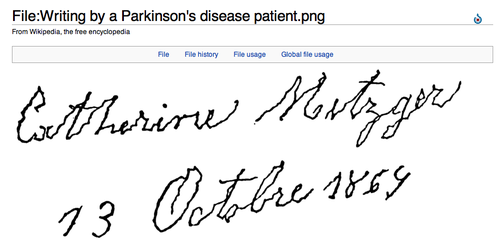
“The symptom as it appears in association with Parkinson’s disease is called micrographia, and in handwriting or penmanship is characterized by abnormally small, cramped handwriting and/or the progression to continually smaller handwriting. It’s cause, according to the National Parkinson’s Foundation is attributed to a common feature of PD which is a slowing of movement, and feelings of muscle stiffness in the hands and fingers. Loss of automatic motion also affects the easy, flowing motion of handwriting. This can impact even simple writing taskssuch as signing your name.”
“Which started me thinking.”
“Parkinson’s disease is named after the English doctor James Parkinson, who published the first detailed description in An Essay on the Shaking Palsy in 1817.”
“In 1817”.
“Might there be any signatures of record prior to 1817 that show signs of a typical Parkinson’s style of writing?”
“Of what importance was that to me? Well my entire attitude around my diagnosis of Parkinson’s has been about succeeding with the disease and having and maintaining a positive attitude towards dealing with it. I was curious if there might be individuals who had continued to achieve and possibly even made a mark in history while in the midst of dealing with PD? At a time when they didn’t have today’s technology, support and treatments. Obviously this was all pure speculation because prior to 1817 it was not classified or known as Parkinson’s. But I was curious none the less.”
“The first thing I did was to Google micrographia thinking I might find a visual example of the malady that I could use for comparison to any earlier documents I might come across. And sure enough, in the Wikipedia Encyclopedia a writing example of a Parkinson’s patient.” “The next step was to begin searching documents prior to 1817 that might offer a similar writing style”.
“Now I was not going to go about this by pure happenstance, on the contrary, I had a hunch and I had definite place in mind to start. There was one document in particular I wanted to take a look at. And sure enough my hunch or maybe I should say my “intuition” was correct.”
Stephen Hopkins
“Here was my individual of notoriety that I felt had that characteristic signature at a time when the flourish of stylized and ornate signatures and penmanship were the art form of the day.”
“Here was a man among men. Stephen Hopkins. Born in 1707 and died in 1785 at the age of 78. He came from a prominent Rhode Island family and most definitely left his mark upon a nation. Not only did my initial examination of the document serve to heighten my belief, but further readings of his biography removed all doubt. His own admission was proof enough for me.”
“In the summer of 1776, while holding his right hand with his left, saying, “although my hand trembles, my heart does not” Stephen Hopkins, a Rhode Island delegate to the First Continental Congress, signed the Declaration of Independence.”
“It gave me tremendous pause to sit and look at that Declaration of Independence and those signatures and to think about the thoughts that must have been going through Stephen Hopkins mind. Not only could I imagine he had a sense of uncertainty and fear for what the future held for our new country at that time, but he was simultaneously dealing with the uncertainty of and concern for his own health. He held the same questions in his mind then about his health, that millions still hold to this day. What is causing this? What can be done?”
“And as I reread those simple words of Stephen Hopkins, a number of thoughts came to mind. First, I felt a tremendous amount of respect for the man because he was not afraid to share with his friends and colleagues the disease that afflicted him. Especially at a time when there was no explanation he could offer for what ailed him. He openly called attention to and acknowledged his tremor and in doing so said he was not ashamed of it. Second was that he had not allowed his tremor or the disease to limit him. He had continued on with his passion for his work. But most profoundly to me was the double meaning I took from the words as a whole. While obviously in one context he is referring to our young nation and “though his hand trembles” while signing this Declaration of Independence “his heart does not” because he believes this to be the right direction for his country, the other context it speaks to for me is the disease of Parkinson’s itself. The words make the analogy of how I have felt all along. “Although my hand trembles, my heart does not.” It’s that strange sense of the positive and knowing that although I have been diagnosed with Parkinson’s, everything I feel in my heart tells me there is nothing to fear and I will be alright. That I can and will deal with whatever it brings me.”
“Over 230 years later since the documents signing technology is most definitely moving at a rapid pace, and the research being done toward finding a cure for Parkinson’s is as well. But to continue that work and to hasten the success, additional funding is always needed. Volunteers and Foundations continue to spearhead the vast majority of the fundraising efforts but more needs to be done.”
“Given that, I find it extremely ironic that this would be the example of the signature I would find. A statesmen, a member of the First Continental Congress. Because additional support and funding from our government is what is needed to keep progress moving forward and ultimately finding a cure. And so I would like to ask everyone reading this to take the opportunity to write your Congressman with a steady hand to request that they show the heart of our founding fathers and support increased funding for Parkinson’s research. (emphasis added)
Reblog it. ReTweet it. Do it for your self. Or someone you love.
To find out what prompted Robert to research micrographia, read the complete post of Chapter 36 here. I think you will find it interesting and I highly recommend reading some or all of his other ‘Chapters’.
What a great statement “although my hand tremors, my heart does not” and as the Michael J Fox Foundation says “Our challenges don’t define us. Our actions do” We can and will deal with whatever Parkinson’s throws at us on our way to finding a cure.
I also agree that we need to continue to urge Congress to support increased funding for Parkinson’s research. In that vein,the Parkinson’s Action Network (PAN) is sponsoring a Parkinson’s Day of Action on February 26th. They ask that you contact your Representatives and ask for their support. They have provided information here on how to contact your representatives, some sample statements you can use and links to why we need more funding for research. I urge you to join me and PAN on Wednesday, February 26th and contact your Congressional Representatives.
As I write this post, we are watching it snow as we are under another winter storm warning for the next couple of days, just hoping it clears up here and in Atlanta by Friday so we can start our trip to what I hope is a warm Florida. We are looking forward to the trip and a chance to meet up with a couple that we met during the Kripalu retreat. ‘See’ you next week.
And I’m back! I noticed that I didn’t mention anything in the last post about how my buddy Parkinson’s and I are getting along. Things are pretty much stable, still some arm stiffness and shuffling when I walk and the occasional balance problem. I don’t have the sticky feet problem nearly as often nor the internal tremors so, all in all, things are OK.
As I have noted before, I follow many other blogs, websites, and Twitter accounts related to Parkinson’s, probably close to 50 if I took the time to count them all. I have been planning to add a page with the list of who I follow to this blog and maybe that will happen one of these days soon, but remember, apathy is a non-motor symptom so don’t hold your breath. 🙂
One of the blogs I follow is Tremors in the Universe written by Robert Baittie. In a recent post, Chapter 36 Whistle while you twerk, he talks about another symptom of PD, micrographia and from there he… well here, I’ll let you read it yourself picking up where he defines micrographia:
“The symptom as it appears in association with Parkinson’s disease is called micrographia, and in handwriting or penmanship is characterized by abnormally small, cramped handwriting and/or the progression to continually smaller handwriting. It’s cause, according to the National Parkinson’s Foundation is attributed to a common feature of PD which is a slowing of movement, and feelings of muscle stiffness in the hands and fingers. Loss of automatic motion also affects the easy, flowing motion of handwriting. This can impact even simple writing taskssuch as signing your name.”
“Which started me thinking.”
“Parkinson’s disease is named after the English doctor James Parkinson, who published the first detailed description in An Essay on the Shaking Palsy in 1817.”
“In 1817”.
“Might there be any signatures of record prior to 1817 that show signs of a typical Parkinson’s style of writing?”
“Of what importance was that to me? Well my entire attitude around my diagnosis of Parkinson’s has been about succeeding with the disease and having and maintaining a positive attitude towards dealing with it. I was curious if there might be individuals who had continued to achieve and possibly even made a mark in history while in the midst of dealing with PD? At a time when they didn’t have today’s technology, support and treatments. Obviously this was all pure speculation because prior to 1817 it was not classified or known as Parkinson’s. But I was curious none the less.”
“The first thing I did was to Google micrographia thinking I might find a visual example of the malady that I could use for comparison to any earlier documents I might come across. And sure enough, in the Wikipedia Encyclopedia a writing example of a Parkinson’s patient.” “The next step was to begin searching documents prior to 1817 that might offer a similar writing style”.
“Now I was not going to go about this by pure happenstance, on the contrary, I had a hunch and I had definite place in mind to start. There was one document in particular I wanted to take a look at. And sure enough my hunch or maybe I should say my “intuition” was correct.”
Stephen Hopkins
“Here was my individual of notoriety that I felt had that characteristic signature at a time when the flourish of stylized and ornate signatures and penmanship were the art form of the day.”
“Here was a man among men. Stephen Hopkins. Born in 1707 and died in 1785 at the age of 78. He came from a prominent Rhode Island family and most definitely left his mark upon a nation. Not only did my initial examination of the document serve to heighten my belief, but further readings of his biography removed all doubt. His own admission was proof enough for me.”
“In the summer of 1776, while holding his right hand with his left, saying, “although my hand trembles, my heart does not” Stephen Hopkins, a Rhode Island delegate to the First Continental Congress, signed the Declaration of Independence.”
“It gave me tremendous pause to sit and look at that Declaration of Independence and those signatures and to think about the thoughts that must have been going through Stephen Hopkins mind. Not only could I imagine he had a sense of uncertainty and fear for what the future held for our new country at that time, but he was simultaneously dealing with the uncertainty of and concern for his own health. He held the same questions in his mind then about his health, that millions still hold to this day. What is causing this? What can be done?”
“And as I reread those simple words of Stephen Hopkins, a number of thoughts came to mind. First, I felt a tremendous amount of respect for the man because he was not afraid to share with his friends and colleagues the disease that afflicted him. Especially at a time when there was no explanation he could offer for what ailed him. He openly called attention to and acknowledged his tremor and in doing so said he was not ashamed of it. Second was that he had not allowed his tremor or the disease to limit him. He had continued on with his passion for his work. But most profoundly to me was the double meaning I took from the words as a whole. While obviously in one context he is referring to our young nation and “though his hand trembles” while signing this Declaration of Independence “his heart does not” because he believes this to be the right direction for his country, the other context it speaks to for me is the disease of Parkinson’s itself. The words make the analogy of how I have felt all along. “Although my hand trembles, my heart does not.” It’s that strange sense of the positive and knowing that although I have been diagnosed with Parkinson’s, everything I feel in my heart tells me there is nothing to fear and I will be alright. That I can and will deal with whatever it brings me.”
“Over 230 years later since the documents signing technology is most definitely moving at a rapid pace, and the research being done toward finding a cure for Parkinson’s is as well. But to continue that work and to hasten the success, additional funding is always needed. Volunteers and Foundations continue to spearhead the vast majority of the fundraising efforts but more needs to be done.”
“Given that, I find it extremely ironic that this would be the example of the signature I would find. A statesmen, a member of the First Continental Congress. Because additional support and funding from our government is what is needed to keep progress moving forward and ultimately finding a cure. And so I would like to ask everyone reading this to take the opportunity to write your Congressman with a steady hand to request that they show the heart of our founding fathers and support increased funding for Parkinson’s research. (emphasis added)
Reblog it. ReTweet it. Do it for your self. Or someone you love.
To find out what prompted Robert to research micrographia, read the complete post of Chapter 36 here. I think you will find it interesting and I highly recommend reading some or all of his other ‘Chapters’.
What a great statement “although my hand tremors, my heart does not” and as the Michael J Fox Foundation says “Our challenges don’t define us. Our actions do” We can and will deal with whatever Parkinson’s throws at us on our way to finding a cure.
I also agree that we need to continue to urge Congress to support increased funding for Parkinson’s research. In that vein,the Parkinson’s Action Network (PAN) is sponsoring a Parkinson’s Day of Action on February 26th. They ask that you contact your Representatives and ask for their support. They have provided information here on how to contact your representatives, some sample statements you can use and links to why we need more funding for research. I urge you to join me and PAN on Wednesday, February 26th and contact your Congressional Representatives.
As I write this post, we are watching it snow as we are under another winter storm warning for the next couple of days, just hoping it clears up here and in Atlanta by Friday so we can start our trip to what I hope is a warm Florida. We are looking forward to the trip and a chance to meet up with a couple that we met during the Kripalu retreat. ‘See’ you next week.




Leave a Reply
You must be logged in to post a comment.