We spent the last two weeks in Sarasota, Florida getting things set up and exploring the community. We are home now but will return at the end of the month for a few weeks before coming back to The Lake Cottage for most of the summer.
We brought our bicycles down to Sarasota and have enjoyed exploring the Village Walk community where our town home is located riding along the various trails that crisscross the community. We ride to the town center to pick up our mail, visit the fitness center or go to the pool. We have also found that by car we are pretty much just 15 minutes or less away from the grocery store, the YMCA, the mall, restaurants and (at least during the off season) the beach.
We have joined the Sarasota YMCA where they have a Pedaling for Parkinson’s class twice a week along with other classes for seniors. They are also working to get certified as PWR (Parkinson’s Wellness Recovery) instructors and we attended one of the classes last week as ‘guinea pigs’ as they get ready for certification in another week or so. The program was developed by Becky Farley who also developed the LSVT BIG program. The class was great and incorporated chair exercises along with standing exercises using exaggerated movements. You can read more about PWR here.
We found it easy to establish a daily exercise routine in Sarasota. Along with the pedaling classes, being able to easily bike, walk, or work out at the community fitness center provides a good variety of exercises during the week. I have become a firm believer that regular exercise is slowing the progression of my PD in addition to improving my overall health. And after reading “What’s Good for the Heart is Good for the Brain” on NPR this month, I’m hopeful that regular exercise will also improve my cardiovascular health and cognitive function along with slowing my PD progression.
You are probably beginning to notice that I write as much about the benefits of exercise as I do about signing up for the Fox Trial Finder and Fox Insight programs. And I know some of you are saying ‘I can’t exercise” because I have balance issues or I am too rigid or _______ (fill in the blank). I recently read a perfect response to “I can’t” in a post by Natasha McCarthy on her blog A broken body’s Journey where she said:
“I’m always preaching about how the studies prove that exercise is the only proven way to slow the progression of PD. If you are told there’s this miracle fix that can ensure your body works the way it does (or maybe even better) and despite your degenerative disease stays where it is for a long time to come wouldn’t you beg me for the secret? Well, it’s no secret, you just have to get up and move the more the better. If you say you “can’t” run anymore “try” walking. If you say you “can’t” do aerobics “try” water aerobics. “Can’t” handle impact on your feet “try” biking. Your balance is bad and you say you “can’t” because you’ll fall, then try a stationary bike with a good seat, or chair yoga!” (Read the entire post here)
So in addition to clicking on the logos to the right and signing up for Fox Trial Finder and/or Fox Insight, how about checking out the free exercise video available from The Davis Phinney Foundation website. The exercises are designed for PwPs, demonstrated by PwPs , can easily be modified for any level of fitness and they don’t require a gym membership or a swimming pool! Click on the Davis Phinney Foundation logo on the right to check it out.
“It does not matter how slowly you go as long as you do not stop.” – Confucius
Yep, here it is almost the end of April and the end of my third year going through Parkinson’s Awareness Month (April 1 – 30), and Parkinson’s Awareness Week (April 18 – 24th) and World Parkinson’s Day (April 11th (also Dr Parkinson’s birthday). And today I’m wondering shouldn’t every month, week, or day be Parkinson Awareness month, week or day? I don’t know about you but I’m aware of my Parkinson’s every day, and I don’t think I can get away with ignoring my PD from May to March waiting for the next Parkinson’s Awareness Month. Changing my social media icons doesn’t stop my Parkinson’s and, if we can’t keep the need for a cure in front of everyone all year, how do we expect to secure funding for necessary research, clinical trials etc. Does Congress only meet one month a year? OK maybe so, but they did proclaim April National Parkinson’s’ Disease Month this year. Do I only need to write one blog post a year (or 30 posts during the month of April, or 7 posts during Awareness Week? I don’t think setting aside a month, week or day is the answer!
OK, I’ll take my tongue out of my cheek (or is it put my tongue in?) but I have to say I feel better getting that off my chest. We can’t pretend that PD doesn’t exist the other 11 months of the year, just like we can’t pretend the same for Autism (also April) or Alzheimer’s (November) or Breast Cancer (October) just to name a few. We have made tremendous strides in the past 5 years in PD research because we work to gather the support of family, friends and strangers, not just in April but year around. So, if you didn’t get a chance to change your social icon, or participate in a fundraiser or attend a special PD event this month, you can still do something to help next month, or the month after, or…… Let’s not let up because Parkinson’s Awareness Month is over.
Our East Tennessee Support Group held it’s annual walk on April 16th, it was a beautiful day, we had a great turn out and so far we have raised over $12,500, 100% of which goes to fund research at the seven major Parkinson’s organizations through the National Parkinson’s Unity Walk held April 22, 2016. The National total so far is over $1.2 million. I want again to thank all of my supporters this year, together we will find a cure!
Speaking of the seven major organizations, if you haven’t heard, there is some welcome consolidation going on among the these groups. PAN (Parkinson’s Action Network), primarily our voice on the hill, has become the Policy unit of the Michael J Fox Foundation. In addition, NPF (National Parkinson’s Foundation) and PDF (Parkinson’s Disease Foundation) have signed an agreement to merge during this year. I feel like this is a good thing, all of the organizations have similar goals – Find A Cure- and they don’t need to be in competition.
So we are back from Florida and have been attending the Silver Sneakers Program and using the weight equipment at the local gym. We are shooting to maintain at least one hour per day/5 days per week and we have hit it most weeks so far.
We have rented a town home in Sarasota for a year to give us a chance to experience the area in all seasons, not just when it is cold in TN and warm there. So we will go down and come back up through out the summer/fall seasons plus spend most of the winter there. No plans at the moment to sell the Lake Cottage, but we keep hearing that too many people wait too long to make a decision about moving and end up somewhere they don’t enjoy. We know at some point we need a single story residence and we like the PD community in Sarasota and this opportunity popped up the last week of our stay so we jumped on it. Watch this space for more information about how it all works out.
Couple of last minute items: 1) Partners In Parkinson’s will offer a live video feed on Saturday May 14th. Click here for more information and to sign up. A great opportunity if you haven’t been able to attend a local event.
This year the Fourth Triennial World Parkinson’s Congress will be held in Portland OR, September 20 – 23. Early registration ends July 5th. Mara and I are attending and serving as volunteers. Check out the event schedule and register here.
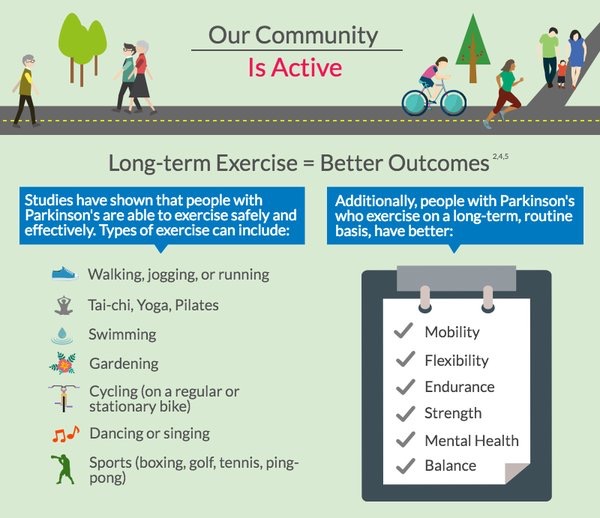
Finally, I saw this great info graphic on Parkinson’s Journey, a blog I follow by Sherri Woodbridge. This is part of a larger info grapic from the American Parkinson Disease Association. I think it hits the exercise nail right on the head!
“It does not matter how slowly you go as long as you do not stop.” – Confucius
This year while at the beach we have really stepped up the exercise routine. In addition to the Dance for PD classes and the Let Your Yoga Dance class, Mara has been attending a Yoga Fundamentals class and a Senior Fitness class while I am spinning away in my Pedaling for Parkinson’s class! After meeting with a fitness instructor at the gym, we are also doing strength training for an hour 2-3 days a week and cardio on the bike or treadmill the other days and still try to fit in a walk on the beach most days.
About now you are saying to yourselves, “Wow, Tom has gone over the edge on this exercise issue, wonder if he has seen any benefits”. And the answer is a resounding YES, I have less rigidity, better muscle tone, sleep better, walk better, and even some improvement in my posture (at least while I’m in dance class!). No I haven’t turned into Charles Atlas, no six pack flat abs or bulging muscles just better movement and improvement in my symptoms and overall health.
There are many studies that show exercise to be beneficial not only for overall health but specifically for improvement in PD symptoms. A summary of recent research found on the National Parkinson’s Foundation site ends with the statement that the research presented “…shows that for people with Parkinson’s, exercise is an essential part of managing the disease.”
On the Michael J Fox Foundation website they point out that “There is evidence that exercise may hold specific benefits for people with Parkinson’s in staying active and relatively limber, and improving balance and motor coordination.” You can find several podcasts with tips on how to get started with an exercise program, what exercises seem to be beneficial and current research results. Download one today and listen to it while you exercise!
As you can see there are a variety of possible exercises for Parkinson’s including boxing, dance, walking, running, cycling, yoga, etc. Many of them can be done while seated and they will get you moving. In fact both dance classes that we take and the senior fitness class provide a great workout while seated. So talk to your primary care physician and have a thorough checkup and start exercising and I think you will see the benefits in a short time. Exercise helps keep the PD at bay while research continues to find a cure, so exercise AND sign up for Fox Trial Finder and Fox Insight!
Here are some additional resources that might help you find an exercise program that fits your needs: Dance for PD – click on classes to find one near you. Rock Steady Boxing – click on find a class Delay the Disease – a physical therapy program with DVD’s and Books available to purchase and a growing list of trained instructors and classes. I have reviewed the DVD’s and books and found them well written and the exercises can be done sitting or standing.
Our time at the beach is about up and we return to Tennessee in a week or so, just in time for our Oak Ridge support group Parkinson’s Walk in support of the Unity Walk in NYC. Despite my fumbling attempt last year as MC, they have asked me to perform the same duty again this year. If you are in the area, please join us on April 16th. If you can’t join us, think about donating to our team PK Hope is Alive. Unity Walk is unique because all of the costs are covered by sponsors so that 100% of your donation is distributed to the 7 major Parkinson’s research organizations. Donation information is available on either of the links above.
“It does not matter how slowly you go as long as you do not stop.” – Confucius
And I’m back! I noticed that I didn’t mention anything in the last post about how my buddy Parkinson’s and I are getting along. Things are pretty much stable, still some arm stiffness and shuffling when I walk and the occasional balance problem. I don’t have the sticky feet problem nearly as often nor the internal tremors so, all in all, things are OK.
As I have noted before, I follow many other blogs, websites, and Twitter accounts related to Parkinson’s, probably close to 50 if I took the time to count them all. I have been planning to add a page with the list of who I follow to this blog and maybe that will happen one of these days soon, but remember, apathy is a non-motor symptom so don’t hold your breath. 🙂
One of the blogs I follow is Tremors in the Universe written by Robert Baittie. In a recent post, Chapter 36 Whistle while you twerk, he talks about another symptom of PD, micrographia and from there he… well here, I’ll let you read it yourself picking up where he defines micrographia:
“The symptom as it appears in association with Parkinson’s disease is called micrographia, and in handwriting or penmanship is characterized by abnormally small, cramped handwriting and/or the progression to continually smaller handwriting. It’s cause, according to the National Parkinson’s Foundation is attributed to a common feature of PD which is a slowing of movement, and feelings of muscle stiffness in the hands and fingers. Loss of automatic motion also affects the easy, flowing motion of handwriting. This can impact even simple writing taskssuch as signing your name.”
“Which started me thinking.”
“Parkinson’s disease is named after the English doctor James Parkinson, who published the first detailed description in An Essay on the Shaking Palsy in 1817.”
“In 1817”.
“Might there be any signatures of record prior to 1817 that show signs of a typical Parkinson’s style of writing?”
“Of what importance was that to me? Well my entire attitude around my diagnosis of Parkinson’s has been about succeeding with the disease and having and maintaining a positive attitude towards dealing with it. I was curious if there might be individuals who had continued to achieve and possibly even made a mark in history while in the midst of dealing with PD? At a time when they didn’t have today’s technology, support and treatments. Obviously this was all pure speculation because prior to 1817 it was not classified or known as Parkinson’s. But I was curious none the less.”
“The first thing I did was to Google micrographia thinking I might find a visual example of the malady that I could use for comparison to any earlier documents I might come across. And sure enough, in the Wikipedia Encyclopedia a writing example of a Parkinson’s patient.” “The next step was to begin searching documents prior to 1817 that might offer a similar writing style”.
“Now I was not going to go about this by pure happenstance, on the contrary, I had a hunch and I had definite place in mind to start. There was one document in particular I wanted to take a look at. And sure enough my hunch or maybe I should say my “intuition” was correct.”
Stephen Hopkins
“Here was my individual of notoriety that I felt had that characteristic signature at a time when the flourish of stylized and ornate signatures and penmanship were the art form of the day.”
“Here was a man among men. Stephen Hopkins. Born in 1707 and died in 1785 at the age of 78. He came from a prominent Rhode Island family and most definitely left his mark upon a nation. Not only did my initial examination of the document serve to heighten my belief, but further readings of his biography removed all doubt. His own admission was proof enough for me.”
“In the summer of 1776, while holding his right hand with his left, saying, “although my hand trembles, my heart does not” Stephen Hopkins, a Rhode Island delegate to the First Continental Congress, signed the Declaration of Independence.”
“It gave me tremendous pause to sit and look at that Declaration of Independence and those signatures and to think about the thoughts that must have been going through Stephen Hopkins mind. Not only could I imagine he had a sense of uncertainty and fear for what the future held for our new country at that time, but he was simultaneously dealing with the uncertainty of and concern for his own health. He held the same questions in his mind then about his health, that millions still hold to this day. What is causing this? What can be done?”
“And as I reread those simple words of Stephen Hopkins, a number of thoughts came to mind. First, I felt a tremendous amount of respect for the man because he was not afraid to share with his friends and colleagues the disease that afflicted him. Especially at a time when there was no explanation he could offer for what ailed him. He openly called attention to and acknowledged his tremor and in doing so said he was not ashamed of it. Second was that he had not allowed his tremor or the disease to limit him. He had continued on with his passion for his work. But most profoundly to me was the double meaning I took from the words as a whole. While obviously in one context he is referring to our young nation and “though his hand trembles” while signing this Declaration of Independence “his heart does not” because he believes this to be the right direction for his country, the other context it speaks to for me is the disease of Parkinson’s itself. The words make the analogy of how I have felt all along. “Although my hand trembles, my heart does not.” It’s that strange sense of the positive and knowing that although I have been diagnosed with Parkinson’s, everything I feel in my heart tells me there is nothing to fear and I will be alright. That I can and will deal with whatever it brings me.”
“Over 230 years later since the documents signing technology is most definitely moving at a rapid pace, and the research being done toward finding a cure for Parkinson’s is as well. But to continue that work and to hasten the success, additional funding is always needed. Volunteers and Foundations continue to spearhead the vast majority of the fundraising efforts but more needs to be done.”
“Given that, I find it extremely ironic that this would be the example of the signature I would find. A statesmen, a member of the First Continental Congress. Because additional support and funding from our government is what is needed to keep progress moving forward and ultimately finding a cure. And so I would like to ask everyone reading this to take the opportunity to write your Congressman with a steady hand to request that they show the heart of our founding fathers and support increased funding for Parkinson’s research. (emphasis added)
Reblog it. ReTweet it. Do it for your self. Or someone you love.
To find out what prompted Robert to research micrographia, read the complete post of Chapter 36 here. I think you will find it interesting and I highly recommend reading some or all of his other ‘Chapters’.
What a great statement “although my hand tremors, my heart does not” and as the Michael J Fox Foundation says “Our challenges don’t define us. Our actions do” We can and will deal with whatever Parkinson’s throws at us on our way to finding a cure.
I also agree that we need to continue to urge Congress to support increased funding for Parkinson’s research. In that vein,the Parkinson’s Action Network (PAN) is sponsoring a Parkinson’s Day of Action on February 26th. They ask that you contact your Representatives and ask for their support. They have provided information here on how to contact your representatives, some sample statements you can use and links to why we need more funding for research. I urge you to join me and PAN on Wednesday, February 26th and contact your Congressional Representatives.
As I write this post, we are watching it snow as we are under another winter storm warning for the next couple of days, just hoping it clears up here and in Atlanta by Friday so we can start our trip to what I hope is a warm Florida. We are looking forward to the trip and a chance to meet up with a couple that we met during the Kripalu retreat. ‘See’ you next week.
And I’m back! I noticed that I didn’t mention anything in the last post about how my buddy Parkinson’s and I are getting along. Things are pretty much stable, still some arm stiffness and shuffling when I walk and the occasional balance problem. I don’t have the sticky feet problem nearly as often nor the internal tremors so, all in all, things are OK.
As I have noted before, I follow many other blogs, websites, and Twitter accounts related to Parkinson’s, probably close to 50 if I took the time to count them all. I have been planning to add a page with the list of who I follow to this blog and maybe that will happen one of these days soon, but remember, apathy is a non-motor symptom so don’t hold your breath. 🙂
One of the blogs I follow is Tremors in the Universe written by Robert Baittie. In a recent post, Chapter 36 Whistle while you twerk, he talks about another symptom of PD, micrographia and from there he… well here, I’ll let you read it yourself picking up where he defines micrographia:
“The symptom as it appears in association with Parkinson’s disease is called micrographia, and in handwriting or penmanship is characterized by abnormally small, cramped handwriting and/or the progression to continually smaller handwriting. It’s cause, according to the National Parkinson’s Foundation is attributed to a common feature of PD which is a slowing of movement, and feelings of muscle stiffness in the hands and fingers. Loss of automatic motion also affects the easy, flowing motion of handwriting. This can impact even simple writing taskssuch as signing your name.”
“Which started me thinking.”
“Parkinson’s disease is named after the English doctor James Parkinson, who published the first detailed description in An Essay on the Shaking Palsy in 1817.”
“In 1817”.
“Might there be any signatures of record prior to 1817 that show signs of a typical Parkinson’s style of writing?”
“Of what importance was that to me? Well my entire attitude around my diagnosis of Parkinson’s has been about succeeding with the disease and having and maintaining a positive attitude towards dealing with it. I was curious if there might be individuals who had continued to achieve and possibly even made a mark in history while in the midst of dealing with PD? At a time when they didn’t have today’s technology, support and treatments. Obviously this was all pure speculation because prior to 1817 it was not classified or known as Parkinson’s. But I was curious none the less.”
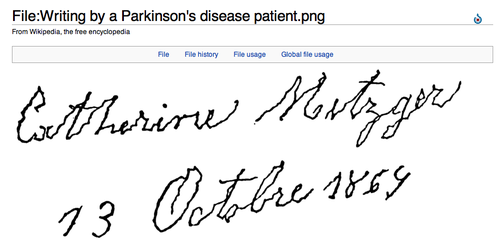
“The first thing I did was to Google micrographia thinking I might find a visual example of the malady that I could use for comparison to any earlier documents I might come across. And sure enough, in the Wikipedia Encyclopedia a writing example of a Parkinson’s patient.” “The next step was to begin searching documents prior to 1817 that might offer a similar writing style”.
“Now I was not going to go about this by pure happenstance, on the contrary, I had a hunch and I had definite place in mind to start. There was one document in particular I wanted to take a look at. And sure enough my hunch or maybe I should say my “intuition” was correct.”
Stephen Hopkins
“Here was my individual of notoriety that I felt had that characteristic signature at a time when the flourish of stylized and ornate signatures and penmanship were the art form of the day.”
“Here was a man among men. Stephen Hopkins. Born in 1707 and died in 1785 at the age of 78. He came from a prominent Rhode Island family and most definitely left his mark upon a nation. Not only did my initial examination of the document serve to heighten my belief, but further readings of his biography removed all doubt. His own admission was proof enough for me.”
“In the summer of 1776, while holding his right hand with his left, saying, “although my hand trembles, my heart does not” Stephen Hopkins, a Rhode Island delegate to the First Continental Congress, signed the Declaration of Independence.”
“It gave me tremendous pause to sit and look at that Declaration of Independence and those signatures and to think about the thoughts that must have been going through Stephen Hopkins mind. Not only could I imagine he had a sense of uncertainty and fear for what the future held for our new country at that time, but he was simultaneously dealing with the uncertainty of and concern for his own health. He held the same questions in his mind then about his health, that millions still hold to this day. What is causing this? What can be done?”
“And as I reread those simple words of Stephen Hopkins, a number of thoughts came to mind. First, I felt a tremendous amount of respect for the man because he was not afraid to share with his friends and colleagues the disease that afflicted him. Especially at a time when there was no explanation he could offer for what ailed him. He openly called attention to and acknowledged his tremor and in doing so said he was not ashamed of it. Second was that he had not allowed his tremor or the disease to limit him. He had continued on with his passion for his work. But most profoundly to me was the double meaning I took from the words as a whole. While obviously in one context he is referring to our young nation and “though his hand trembles” while signing this Declaration of Independence “his heart does not” because he believes this to be the right direction for his country, the other context it speaks to for me is the disease of Parkinson’s itself. The words make the analogy of how I have felt all along. “Although my hand trembles, my heart does not.” It’s that strange sense of the positive and knowing that although I have been diagnosed with Parkinson’s, everything I feel in my heart tells me there is nothing to fear and I will be alright. That I can and will deal with whatever it brings me.”
“Over 230 years later since the documents signing technology is most definitely moving at a rapid pace, and the research being done toward finding a cure for Parkinson’s is as well. But to continue that work and to hasten the success, additional funding is always needed. Volunteers and Foundations continue to spearhead the vast majority of the fundraising efforts but more needs to be done.”
“Given that, I find it extremely ironic that this would be the example of the signature I would find. A statesmen, a member of the First Continental Congress. Because additional support and funding from our government is what is needed to keep progress moving forward and ultimately finding a cure. And so I would like to ask everyone reading this to take the opportunity to write your Congressman with a steady hand to request that they show the heart of our founding fathers and support increased funding for Parkinson’s research. (emphasis added)
Reblog it. ReTweet it. Do it for your self. Or someone you love.
To find out what prompted Robert to research micrographia, read the complete post of Chapter 36 here. I think you will find it interesting and I highly recommend reading some or all of his other ‘Chapters’.
What a great statement “although my hand tremors, my heart does not” and as the Michael J Fox Foundation says “Our challenges don’t define us. Our actions do” We can and will deal with whatever Parkinson’s throws at us on our way to finding a cure.
I also agree that we need to continue to urge Congress to support increased funding for Parkinson’s research. In that vein,the Parkinson’s Action Network (PAN) is sponsoring a Parkinson’s Day of Action on February 26th. They ask that you contact your Representatives and ask for their support. They have provided information here on how to contact your representatives, some sample statements you can use and links to why we need more funding for research. I urge you to join me and PAN on Wednesday, February 26th and contact your Congressional Representatives.
As I write this post, we are watching it snow as we are under another winter storm warning for the next couple of days, just hoping it clears up here and in Atlanta by Friday so we can start our trip to what I hope is a warm Florida. We are looking forward to the trip and a chance to meet up with a couple that we met during the Kripalu retreat. ‘See’ you next week.
And I’m back! I noticed that I didn’t mention anything in the last post about how my buddy Parkinson’s and I are getting along. Things are pretty much stable, still some arm stiffness and shuffling when I walk and the occasional balance problem. I don’t have the sticky feet problem nearly as often nor the internal tremors so, all in all, things are OK.
As I have noted before, I follow many other blogs, websites, and Twitter accounts related to Parkinson’s, probably close to 50 if I took the time to count them all. I have been planning to add a page with the list of who I follow to this blog and maybe that will happen one of these days soon, but remember, apathy is a non-motor symptom so don’t hold your breath. 🙂
One of the blogs I follow is Tremors in the Universe written by Robert Baittie. In a recent post, Chapter 36 Whistle while you twerk, he talks about another symptom of PD, micrographia and from there he… well here, I’ll let you read it yourself picking up where he defines micrographia:
“The symptom as it appears in association with Parkinson’s disease is called micrographia, and in handwriting or penmanship is characterized by abnormally small, cramped handwriting and/or the progression to continually smaller handwriting. It’s cause, according to the National Parkinson’s Foundation is attributed to a common feature of PD which is a slowing of movement, and feelings of muscle stiffness in the hands and fingers. Loss of automatic motion also affects the easy, flowing motion of handwriting. This can impact even simple writing taskssuch as signing your name.”
“Which started me thinking.”
“Parkinson’s disease is named after the English doctor James Parkinson, who published the first detailed description in An Essay on the Shaking Palsy in 1817.”
“In 1817”.
“Might there be any signatures of record prior to 1817 that show signs of a typical Parkinson’s style of writing?”
“Of what importance was that to me? Well my entire attitude around my diagnosis of Parkinson’s has been about succeeding with the disease and having and maintaining a positive attitude towards dealing with it. I was curious if there might be individuals who had continued to achieve and possibly even made a mark in history while in the midst of dealing with PD? At a time when they didn’t have today’s technology, support and treatments. Obviously this was all pure speculation because prior to 1817 it was not classified or known as Parkinson’s. But I was curious none the less.”
“The first thing I did was to Google micrographia thinking I might find a visual example of the malady that I could use for comparison to any earlier documents I might come across. And sure enough, in the Wikipedia Encyclopedia a writing example of a Parkinson’s patient.” “The next step was to begin searching documents prior to 1817 that might offer a similar writing style”.
“Now I was not going to go about this by pure happenstance, on the contrary, I had a hunch and I had definite place in mind to start. There was one document in particular I wanted to take a look at. And sure enough my hunch or maybe I should say my “intuition” was correct.”
Stephen Hopkins
“Here was my individual of notoriety that I felt had that characteristic signature at a time when the flourish of stylized and ornate signatures and penmanship were the art form of the day.”
“Here was a man among men. Stephen Hopkins. Born in 1707 and died in 1785 at the age of 78. He came from a prominent Rhode Island family and most definitely left his mark upon a nation. Not only did my initial examination of the document serve to heighten my belief, but further readings of his biography removed all doubt. His own admission was proof enough for me.”
“In the summer of 1776, while holding his right hand with his left, saying, “although my hand trembles, my heart does not” Stephen Hopkins, a Rhode Island delegate to the First Continental Congress, signed the Declaration of Independence.”
“It gave me tremendous pause to sit and look at that Declaration of Independence and those signatures and to think about the thoughts that must have been going through Stephen Hopkins mind. Not only could I imagine he had a sense of uncertainty and fear for what the future held for our new country at that time, but he was simultaneously dealing with the uncertainty of and concern for his own health. He held the same questions in his mind then about his health, that millions still hold to this day. What is causing this? What can be done?”
“And as I reread those simple words of Stephen Hopkins, a number of thoughts came to mind. First, I felt a tremendous amount of respect for the man because he was not afraid to share with his friends and colleagues the disease that afflicted him. Especially at a time when there was no explanation he could offer for what ailed him. He openly called attention to and acknowledged his tremor and in doing so said he was not ashamed of it. Second was that he had not allowed his tremor or the disease to limit him. He had continued on with his passion for his work. But most profoundly to me was the double meaning I took from the words as a whole. While obviously in one context he is referring to our young nation and “though his hand trembles” while signing this Declaration of Independence “his heart does not” because he believes this to be the right direction for his country, the other context it speaks to for me is the disease of Parkinson’s itself. The words make the analogy of how I have felt all along. “Although my hand trembles, my heart does not.” It’s that strange sense of the positive and knowing that although I have been diagnosed with Parkinson’s, everything I feel in my heart tells me there is nothing to fear and I will be alright. That I can and will deal with whatever it brings me.”
“Over 230 years later since the documents signing technology is most definitely moving at a rapid pace, and the research being done toward finding a cure for Parkinson’s is as well. But to continue that work and to hasten the success, additional funding is always needed. Volunteers and Foundations continue to spearhead the vast majority of the fundraising efforts but more needs to be done.”
“Given that, I find it extremely ironic that this would be the example of the signature I would find. A statesmen, a member of the First Continental Congress. Because additional support and funding from our government is what is needed to keep progress moving forward and ultimately finding a cure. And so I would like to ask everyone reading this to take the opportunity to write your Congressman with a steady hand to request that they show the heart of our founding fathers and support increased funding for Parkinson’s research. (emphasis added)
Reblog it. ReTweet it. Do it for your self. Or someone you love.
To find out what prompted Robert to research micrographia, read the complete post of Chapter 36 here. I think you will find it interesting and I highly recommend reading some or all of his other ‘Chapters’.
What a great statement “although my hand tremors, my heart does not” and as the Michael J Fox Foundation says “Our challenges don’t define us. Our actions do” We can and will deal with whatever Parkinson’s throws at us on our way to finding a cure.
I also agree that we need to continue to urge Congress to support increased funding for Parkinson’s research. In that vein,the Parkinson’s Action Network (PAN) is sponsoring a Parkinson’s Day of Action on February 26th. They ask that you contact your Representatives and ask for their support. They have provided information here on how to contact your representatives, some sample statements you can use and links to why we need more funding for research. I urge you to join me and PAN on Wednesday, February 26th and contact your Congressional Representatives.
As I write this post, we are watching it snow as we are under another winter storm warning for the next couple of days, just hoping it clears up here and in Atlanta by Friday so we can start our trip to what I hope is a warm Florida. We are looking forward to the trip and a chance to meet up with a couple that we met during the Kripalu retreat. ‘See’ you next week.



Leave a Reply
You must be logged in to post a comment.