Wow, here it is December already. What happened to the month of November? It seems to have just flown by along with my good intentions to post at least every 2 -3 weeks. Ah well, you know apathy is another symptom of Parkinson’s 🙂 I started working on a post a couple of weeks ago planning to expand on my last post about the Kripalu Retreat experience but then I discovered that one of the other attendees was working on a similar project and I happily received permission to link to her post instead of reinventing the wheel as we used to say back in the day’s before retirement. So I invite you to follow Barbara’s Ramblings! Barb has done a great job of summarizing the opening session and the PD101 session with Dr. Houghton and she has laid out the other topics which she plans to also summarize as time permits. Thanks Barb! (Update 10/1/2017 – Barb’s Blog is no longer being maintained so links removed)
One thing we have been continuing since the Retreat is listening to Divine Sleep Yoga Nidra, a guided meditation CD from Jennifer Reis, one of the instructors at Kripalu. We play it almost every night and have found it to promote deep relaxation and sound sleep.
This month I purchased an indoor bike trainer so I can bike inside this winter. Bicycling has been shown to be beneficial for PWP so I plan on biking at least 3 days a week. I haven’t been on a bike in probably 5 years so I have already discovered that my rear end and the seat need to get reacquainted! We are still walking when the weather permits and we dropped our time to 35 minutes recently which is close to where it was last year.
Speaking of exercise, it’s time to sign up for the 2014 Mary-thon. I mentioned this event in a previous post. This is a great way to stay motivated to exercise. You pledge to exercise 30 minutes 5 days a week for 26 weeks. Running is not required, any form of exercise will do and this year you get a pedometer, access to Hannah’s Gym and weekly emails with your registration and $10 goes to the Project Linus organization which provides blankets to kids in traumatic situations. Go to www.mary-thon.net for more information and to sign up.
This month brings my first Physical Therapy appointment, a visit to the Neurologist and, of course, the Christmas Holidays. I plan on another post before the holidays, but just in case we wish you all a Happy and Joyous Holiday Season!
This wellness retreat for recently diagnosed PWP’s and their caregivers included sessions with a leading Movement Disorder Specialist, along with sessions about exercise, relationships, nutrition, and resilience led by experts in the field. And we had various yoga, yoga dance and meditation sessions in addition to the yoga offered daily at Kripalu. Oh and did I mention the food? We enjoyed wonderful healthy meals every day in the cafeteria all made from organic and local foods.
I will go into more detail in the next post, but first what is Kripalu? Seems like a simple question but I don’t think you can fully understand the Kripalu experience until you spend some time there. Here is part of the description from the Kripalu website:
Kripalu Center for Yoga & Health is a nonprofit educational organization dedicated to empowering people and communities to realize their full potential through the transformative wisdom and practice of yoga. For more than 30 years, Kripalu (kri-PAH-loo) has been teaching skills for optimal living through education for the whole person: body, mind, and spirit. (Emphasis added) It is the largest and most established retreat center for yoga, health, and holistic living in North America.
While it is definitely a center for the practice of yoga, the key statement is in bold above, “…teaching skills for optimal living for the whole person…” As you will see throughout this series of posts, we learned much more than the benefit of yoga during our retreat. One of the best things we learned during our retreat was we are not alone in dealing with Parkinson’s. There were about 70 attendees and we and the instructors quickly bonded as a group even though we had never met before and each of us had different symptoms and different issues to deal with. We left with a strong sense of community, a 5 page list of email addresses and phone numbers for staying in touch and lots of good information and ideas for dealing with Parkinson’s.
Without a doubt this was the best gift we could have given ourselves at this time in our lives. I can’t say enough good things about our experience but I’ll try in the next post 🙂
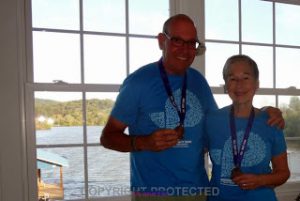
Here we are showing off our medals (and our Beat Parkinson’s TShirts) from this year’s Mary-thon. What is a Mary-thon you might ask? The Mary-thon is a 26 week exercise program developed by Mary Balagna, vice president of the National ProjectLinus organization.
The idea of the Mary-thon is you commit to exercise at least 30 minutes 5 days a week for 26 weeks. You don’t have to run or walk for 30 minutes you just need to complete 30 minutes of exercise.
We like to get out and walk for our exercise and I keep track of our time on a simple spreadsheet showing our time for the days of the week for 26 weeks. Since we usually walk the same path through the park next door, when my times started getting slower this year, it was yet another indicator that something was amiss. On the plus side the times have been going down since I started the medication which indicates it is helping reduce the rigidity and slowness.
Mara and I both volunteer for the local Project Linus Chapter. Project Linus is a volunteer organization with chapters across the US that give handmade blankets and afghans to children who are seriously ill or otherwise traumatized. When you sign up for the Mary-thon, a portion of your registration fee goes to Project Linus. In addition you get a work book with all types of exercise routines that will meet the 30 minute time frame and fit your ability level. Mary sends weekly emails with encouraging words to help keep you on track and if you complete the Mary-thon you receive a medal. .
Many studies have been completed that show that exercise is essential for People with Parkinson’s (PwP), in fact last week at the Third World Parkinson’s Congress held in Montreal, Canada one of the bloggers in attendance said that many of the sessions mention exercise as essential to optimizing daily life with Parkinson’s. But getting motivated to exercise regularly is not easy even if you don’t have Parkinson’s so consider joining next years Mary-thon.
Of course 26 weeks is only half the year so you can sign up for the Ultra Mary-thon and do another 26 weeks to finish out the year. If you are looking for an exercise program which is specifically designed for PwP, check out the new program available from the Davis Phinney Foundation. The program includes a free DVD with PwP particpants showing you how to do the exercises. A booklet is also available with the exercise information in written form. You can request a free DVD at the Davis Phinney Foundation website by clicking here. We have been trying to do the stretching exercises most mornings and both of us have noticed some improvement in flexibility especially our necks. I look forward to trying the exercises when we are unable to get out for out daily walk.
We just returned from two nice days at our favorite Smokey Mountain destination, The Dancing Bear Lodge in Townsend, TN. The plan was to visit the Great Smokey National Park, but congress apparently thought it would be better to shut down the government, including clinical trials, instead. But we had a great relaxing time and two wonderful meals at the lodge. Next weekend we head up to the retreat at Kripalu Resort in Massachusetts followed by a chance to meet with some friends from New Hampshire. Should be a great experience!
I know this is my second post in less than 30 days! I think I have too much free time on my hands while practicing this social distancing routine! Today I will catch up with what’s happening in PD School 2020 and talk a bit about how I have implemented what I’ve learned so far. If you aren’t aware of Dr. Mischley’s PD School 2020 you can read more about it my posts here and here. And check out the coupon offer at the end of this post!
The last lesson I covered was lesson 3 so I will quickly catch you up on lessons 4, 5, 6 & 7 just touching on highlights and things I found interesting. Lessons 4 and 5 cover the topics of food and nutrition. Lesson 4 discusses what to eat and lesson 5 discusses when and how to eat. In lesson 4 Dr Mischley covers foods that are “Good” for PwP and also foods that are “Bad” for PwP. The data to support the designation comes from the ongoing longitudinal research trial she runs at Bastyr University.
The good foods below are listed in order of decreasing impact, that is fresh vegetables had a greater impact than fresh fruit and so on.
Fresh vegetables
Fresh fruit
Nuts and seeds
Fish (not fried)
Wine (yessssssssssssssss!)
Olive oil
Coconut oil
Fresh herbs
The bad foods below are listed in order of greatest negative impact.
Canned fruit
Diet soda
Fried foods
Ice cream (noooooooooooo!)
Canned vegetables
Beef
Pasta
Soda
She also discusses how eating can impact medication absorption particularly when you eat protein just before or just after taking your meds. Various diets are discussed and her recommendation is go as vegan as you can and follow the Mediterranean diet.
Lesson 6 discussed the laboratory tests she requests for her patients. Several of the tests are not normally requested by your neurologist or PCP and some are not covered by insurance or Medicare. She notes at the end of the lesson that she is working on trying to set something up to provide the test to any PwP at a reduced rate (she hopes around $500 instead of $2000).
I was interested in this lesson because she pointed out that most PwP’s are low in both vitamins D and B12. A B12 deficiency can result in neuropathy, cognitive decline and loss of sense of smell. In addition tremor, trouble walking and balance may also be effected. Vitamin D deficiency can result in constipation, falls and balance issues, depression and cognitive decline.
I have been taking both B12 (120mg) and D (2000 iu) supplements for the last several years. My PCP tested me for both vitamins this year and I was within range as far as the lab was concerned. Dr Mischley provides her recommended reference range for the tests and I am below her recommended range in both. I was particularly surprised at the vitamin D result with all the sunshine I get here playing tennis, etc. Looks like I need to increase my supplement amounts of both vitamins.
She covers several other lab tests she conducts and why and I think you will find this lesson very interesting.
Lesson 7 discusses gut and intestinal health. This lesson includes a presentation by Dr Samantha Evans who practices with Dr Mischely in Seattle. Dr Mischely provides the introduction and overview pointing out that 50% of the dopamine neurons are located in your intestinal tract. She also discusses the need for gastric acid to breakdown food and medications. She points out as we get older the gastric juice becomes less acidic and recommended taking our medication with a glass of water mixed with 500 mg powered vitamin C to increase the acid level.
Dr Evans discusses how much of what happens in the intestinal tract impacts PwP’s. She discusses SIBO (Small Intestine Bacteria Overgrowth) and Leaky Gut and how it impacts PwP, particularly medication absorption issues.
So there are a few highlights from lessons 4,5,6, and 7. The next class is Do I need to take supplements? and will be available on the 28th of the month.
Quick timeout for some fine print! Before I discuss how I have implemented parts of these classes I just want to remind everyone I am not a medical practitioner and you shouldn’t rely on the information below as an alternative to medical advice from your doctor or other professional healthcare providers. If you have any specific questions about any medical matter you should consult your doctor or other professional healthcare provider. You should never delay seeking medical advice, disregard medical advice, or discontinue medical treatment because of information on It Is What It Is .
And we are back.
I have enjoyed these classes and have started trying to put some of what I have learned in to practice. In lesson 2, Dr Mischley discusses the success she has had with treating dyskinesia with high doses of DHA fish oil for 30 days and then adding CDP Citicoline twice a day to improve absorption of Levadopa. Since we eat salmon 4-6 days a week, I decided to test taking the CDP Citicoline as she recommended (2 250 mg capsules twice a day).
I began the test on February 2 and tracked the effects daily through April 4. As she mentioned in the lesson, my dyskinesia actually started getting worse because the supplement was improving the uptake of the medication and after 3 weeks I started to slowly reduce the amount of Sinement,Rytary and Mirapex over the next two months. My goal was to reduce my levadopa intake, reduce dyskinesia and not increase off periods.
By April 4 I had reduced the Mirapex from 1.5 mg to .5 mg (67%) and my Sinement from 2.5 tablets 3 times a day to 2 tablets 3 times a day (20% reduction). My dyskinesia is barely noticeable and off episodes are unchanged. I believe I could stop taking the Mirapex completely except the .5 mg helps reduce my restless leg syndrome which I had before my PD diagnoses but went away with the Mirapex which is also prescribed for restless leg.
I have also tried to do a better job of not taking meds too close to mealtime particularly high protein meals. And I have reduced my dairy intake, even ice cream! I’ve ordered some powered vitamin C which should arrive next week and I will test out taking medications with water mixed with vitamin C. Now if I could just figure out how to get Dr Mischely to remove ice cream from the bad food list!!
Just In!! It’s Parkinson’s Awareness Month and Dr Mischley is offering a coupon for $50 off the PC School for this month (All 24 courses for $100). If you haven’t signed up or have friends or relatives that might find this program useful, please send them this link to the course and the coupon code: AWARENESS. http://pd-school.teachable.com/
I know this is my second post in less than 30 days! I think I have too much free time on my hands while practicing this social distancing routine! Today I will catch up with what’s happening in PD School 2020 and talk a bit about how I have implemented what I’ve learned so far. If you aren’t aware of Dr. Mischley’s PD School 2020 you can read more about it my posts here and here. And check out the coupon offer at the end of this post!
The last lesson I covered was lesson 3 so I will quickly catch you up on lessons 4, 5, 6 & 7 just touching on highlights and things I found interesting. Lessons 4 and 5 cover the topics of food and nutrition. Lesson 4 discusses what to eat and lesson 5 discusses when and how to eat. In lesson 4 Dr Mischley covers foods that are “Good” for PwP and also foods that are “Bad” for PwP. The data to support the designation comes from the ongoing longitudinal research trial she runs at Bastyr University.
The good foods below are listed in order of decreasing impact, that is fresh vegetables had a greater impact than fresh fruit and so on.
Fresh vegetables
Fresh fruit
Nuts and seeds
Fish (not fried)
Wine (yessssssssssssssss!)
Olive oil
Coconut oil
Fresh herbs
The bad foods below are listed in order of greatest negative impact.
Canned fruit
Diet soda
Fried foods
Ice cream (noooooooooooo!)
Canned vegetables
Beef
Pasta
Soda
She also discusses how eating can impact medication absorption particularly when you eat protein just before or just after taking your meds. Various diets are discussed and her recommendation is go as vegan as you can and follow the Mediterranean diet.
Lesson 6 discussed the laboratory tests she requests for her patients. Several of the tests are not normally requested by your neurologist or PCP and some are not covered by insurance or Medicare. She notes at the end of the lesson that she is working on trying to set something up to provide the test to any PwP at a reduced rate (she hopes around $500 instead of $2000).
I was interested in this lesson because she pointed out that most PwP’s are low in both vitamins D and B12. A B12 deficiency can result in neuropathy, cognitive decline and loss of sense of smell. In addition tremor, trouble walking and balance may also be effected. Vitamin D deficiency can result in constipation, falls and balance issues, depression and cognitive decline.
I have been taking both B12 (120mg) and D (2000 iu) supplements for the last several years. My PCP tested me for both vitamins this year and I was within range as far as the lab was concerned. Dr Mischley provides her recommended reference range for the tests and I am below her recommended range in both. I was particularly surprised at the vitamin D result with all the sunshine I get here playing tennis, etc. Looks like I need to increase my supplement amounts of both vitamins.
She covers several other lab tests she conducts and why and I think you will find this lesson very interesting.
Lesson 7 discusses gut and intestinal health. This lesson includes a presentation by Dr Samantha Evans who practices with Dr Mischely in Seattle. Dr Mischely provides the introduction and overview pointing out that 50% of the dopamine neurons are located in your intestinal tract. She also discusses the need for gastric acid to breakdown food and medications. She points out as we get older the gastric juice becomes less acidic and recommended taking our medication with a glass of water mixed with 500 mg powered vitamin C to increase the acid level.
Dr Evans discusses how much of what happens in the intestinal tract impacts PwP’s. She discusses SIBO (Small Intestine Bacteria Overgrowth) and Leaky Gut and how it impacts PwP, particularly medication absorption issues.
So there are a few highlights from lessons 4,5,6, and 7. The next class is Do I need to take supplements? and will be available on the 28th of the month.
Quick timeout for some fine print! Before I discuss how I have implemented parts of these classes I just want to remind everyone I am not a medical practitioner and you shouldn’t rely on the information below as an alternative to medical advice from your doctor or other professional healthcare providers. If you have any specific questions about any medical matter you should consult your doctor or other professional healthcare provider. You should never delay seeking medical advice, disregard medical advice, or discontinue medical treatment because of information on It Is What It Is .
And we are back.
I have enjoyed these classes and have started trying to put some of what I have learned in to practice. In lesson 2, Dr Mischley discusses the success she has had with treating dyskinesia with high doses of DHA fish oil for 30 days and then adding CDP Citicoline twice a day to improve absorption of Levadopa. Since we eat salmon 4-6 days a week, I decided to test taking the CDP Citicoline as she recommended (2 250 mg capsules twice a day).
I began the test on February 2 and tracked the effects daily through April 4. As she mentioned in the lesson, my dyskinesia actually started getting worse because the supplement was improving the uptake of the medication and after 3 weeks I started to slowly reduce the amount of Sinement,Rytary and Mirapex over the next two months. My goal was to reduce my levadopa intake, reduce dyskinesia and not increase off periods.
By April 4 I had reduced the Mirapex from 1.5 mg to .5 mg (67%) and my Sinement from 2.5 tablets 3 times a day to 2 tablets 3 times a day (20% reduction). My dyskinesia is barely noticeable and off episodes are unchanged. I believe I could stop taking the Mirapex completely except the .5 mg helps reduce my restless leg syndrome which I had before my PD diagnoses but went away with the Mirapex which is also prescribed for restless leg.
I have also tried to do a better job of not taking meds too close to mealtime particularly high protein meals. And I have reduced my dairy intake, even ice cream! I’ve ordered some powered vitamin C which should arrive next week and I will test out taking medications with water mixed with vitamin C. Now if I could just figure out how to get Dr Mischely to remove ice cream from the bad food list!!
Just In!! It’s Parkinson’s Awareness Month and Dr Mischley is offering a coupon for $50 off the PC School for this month (All 24 courses for $100). If you haven’t signed up or have friends or relatives that might find this program useful, please send them this link to the course and the coupon code: AWARENESS. http://pd-school.teachable.com/
I know this is my second post in less than 30 days! I think I have too much free time on my hands while practicing this social distancing routine! Today I will catch up with what’s happening in PD School 2020 and talk a bit about how I have implemented what I’ve learned so far. If you aren’t aware of Dr. Mischley’s PD School 2020 you can read more about it my posts here and here. And check out the coupon offer at the end of this post!
The last lesson I covered was lesson 3 so I will quickly catch you up on lessons 4, 5, 6 & 7 just touching on highlights and things I found interesting. Lessons 4 and 5 cover the topics of food and nutrition. Lesson 4 discusses what to eat and lesson 5 discusses when and how to eat. In lesson 4 Dr Mischley covers foods that are “Good” for PwP and also foods that are “Bad” for PwP. The data to support the designation comes from the ongoing longitudinal research trial she runs at Bastyr University.
The good foods below are listed in order of decreasing impact, that is fresh vegetables had a greater impact than fresh fruit and so on.
Fresh vegetables
Fresh fruit
Nuts and seeds
Fish (not fried)
Wine (yessssssssssssssss!)
Olive oil
Coconut oil
Fresh herbs
The bad foods below are listed in order of greatest negative impact.
Canned fruit
Diet soda
Fried foods
Ice cream (noooooooooooo!)
Canned vegetables
Beef
Pasta
Soda
She also discusses how eating can impact medication absorption particularly when you eat protein just before or just after taking your meds. Various diets are discussed and her recommendation is go as vegan as you can and follow the Mediterranean diet.
Lesson 6 discussed the laboratory tests she requests for her patients. Several of the tests are not normally requested by your neurologist or PCP and some are not covered by insurance or Medicare. She notes at the end of the lesson that she is working on trying to set something up to provide the test to any PwP at a reduced rate (she hopes around $500 instead of $2000).
I was interested in this lesson because she pointed out that most PwP’s are low in both vitamins D and B12. A B12 deficiency can result in neuropathy, cognitive decline and loss of sense of smell. In addition tremor, trouble walking and balance may also be effected. Vitamin D deficiency can result in constipation, falls and balance issues, depression and cognitive decline.
I have been taking both B12 (120mg) and D (2000 iu) supplements for the last several years. My PCP tested me for both vitamins this year and I was within range as far as the lab was concerned. Dr Mischley provides her recommended reference range for the tests and I am below her recommended range in both. I was particularly surprised at the vitamin D result with all the sunshine I get here playing tennis, etc. Looks like I need to increase my supplement amounts of both vitamins.
She covers several other lab tests she conducts and why and I think you will find this lesson very interesting.
Lesson 7 discusses gut and intestinal health. This lesson includes a presentation by Dr Samantha Evans who practices with Dr Mischely in Seattle. Dr Mischely provides the introduction and overview pointing out that 50% of the dopamine neurons are located in your intestinal tract. She also discusses the need for gastric acid to breakdown food and medications. She points out as we get older the gastric juice becomes less acidic and recommended taking our medication with a glass of water mixed with 500 mg powered vitamin C to increase the acid level.
Dr Evans discusses how much of what happens in the intestinal tract impacts PwP’s. She discusses SIBO (Small Intestine Bacteria Overgrowth) and Leaky Gut and how it impacts PwP, particularly medication absorption issues.
So there are a few highlights from lessons 4,5,6, and 7. The next class is Do I need to take supplements? and will be available on the 28th of the month.
Quick timeout for some fine print! Before I discuss how I have implemented parts of these classes I just want to remind everyone I am not a medical practitioner and you shouldn’t rely on the information below as an alternative to medical advice from your doctor or other professional healthcare providers. If you have any specific questions about any medical matter you should consult your doctor or other professional healthcare provider. You should never delay seeking medical advice, disregard medical advice, or discontinue medical treatment because of information on It Is What It Is .
And we are back.
I have enjoyed these classes and have started trying to put some of what I have learned in to practice. In lesson 2, Dr Mischley discusses the success she has had with treating dyskinesia with high doses of DHA fish oil for 30 days and then adding CDP Citicoline twice a day to improve absorption of Levadopa. Since we eat salmon 4-6 days a week, I decided to test taking the CDP Citicoline as she recommended (2 250 mg capsules twice a day).
I began the test on February 2 and tracked the effects daily through April 4. As she mentioned in the lesson, my dyskinesia actually started getting worse because the supplement was improving the uptake of the medication and after 3 weeks I started to slowly reduce the amount of Sinement,Rytary and Mirapex over the next two months. My goal was to reduce my levadopa intake, reduce dyskinesia and not increase off periods.
By April 4 I had reduced the Mirapex from 1.5 mg to .5 mg (67%) and my Sinement from 2.5 tablets 3 times a day to 2 tablets 3 times a day (20% reduction). My dyskinesia is barely noticeable and off episodes are unchanged. I believe I could stop taking the Mirapex completely except the .5 mg helps reduce my restless leg syndrome which I had before my PD diagnoses but went away with the Mirapex which is also prescribed for restless leg.
I have also tried to do a better job of not taking meds too close to mealtime particularly high protein meals. And I have reduced my dairy intake, even ice cream! I’ve ordered some powered vitamin C which should arrive next week and I will test out taking medications with water mixed with vitamin C. Now if I could just figure out how to get Dr Mischely to remove ice cream from the bad food list!!
Just In!! It’s Parkinson’s Awareness Month and Dr Mischley is offering a coupon for $50 off the PC School for this month (All 24 courses for $100). If you haven’t signed up or have friends or relatives that might find this program useful, please send them this link to the course and the coupon code: AWARENESS. http://pd-school.teachable.com/


Leave a Reply
You must be logged in to post a comment.