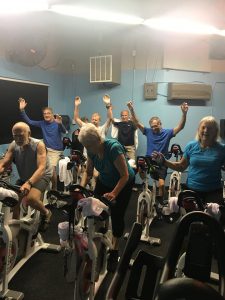
One of the big advantages to being in Sarasota has been the ability to exercise. I am able to exercise at least an hour a day, 5 – 6 days a week which has helped me keep my PD symptoms in a holding pattern. We try to play tennis everyday when possible, and I continue to do Pedaling for Parkinson’s twice a week. In addition we go spend an hour a week at PD in Motion, Let Your Yoga Dance, Easy Yoga and Fundamentals of Movement classes. When time permits, we also try to spend at least one hour a week at the gym with the weight machines pumping some iron!
While all of this exercise has helped me to slow my PD progression, I started noticing that I would be walking with my arms out front and I would become more rigid about 30 – 45 minutes before my next medication dose was due. So, after slightly over two years on the same dose, I contacted my neurologist and we agreed to increase my Sinement from 1 to 1.5 tablets 4 times a day. It’s been about a week since the change and I have already noticed reduced rigidity and the arm swing is back to almost normal, and I am hopeful that I can go another 2+ years before I have to change it again.
We have really enjoyed playing tennis. I had never played before we took lessons in December and was surprised at how much I enjoy it. We took more lessons in January and Mara attends a tennis clinic put on by Barb, our superb instructor, twice a week while I am pedaling then we practice most afternoons at the courts here in the complex for up to an hour and a half. We are also part of a group that meets once a week for doubles where we rotate in and out of the games depending on how may players show up. I’m sure we will be on the ATP tour soon!
We have enjoyed our time here in Sarasota and in being able to take part in all of the opportunities being here has provided, not only for PD, but other venues such as the Selby Botanic Gardens, the various beaches, fishing in Sarasota Bay and more. At this point we are planning to renew our lease on the townhouse so we can continue to take part in all that the area offers, particularly for PwP’s.
Speaking of opportunities, next week we will attend the Davis Phinney Victory Summit event in Punta Gorda,about an hour south of Sarasota. Many of the Pedaling for Parkinson’s participants will also be going and we are looking forward to attending this great event for the second time. You can read about our first visit here.
And finally you might have noticed the Top 50 Parkinson’s Blog badge on the right which wouldn’t have been possible without you, my loyal readers and followers. Thank you!
“It does not matter how slowly you go as long as you do not stop.” – Confucius
We have a new President who is forming a new Cabinet and we are sure to see changes that may have significant impact not only on those of us with Parkinson’s Disease but also many others with chronic diseases or preexisting conditions. Some of these changes may be positive and others may be negative and so we must be alert and pay attention to what is happening in Washington DC.
One way to do that is to follow the Michael J Fox Foundation (MJFF) FoxFeed Blog. Friday Ted Thompson JD, former head of the Parkinson’s Action Network and now the Senior VP of Public Policy for the Foundation published an excellent blog post about possible policy changes which I have reproduced below.
Sign up here to get emails from the MJFF and stay up to date about public policies that impact the Parkinson’s community.
“It does not matter how slowly you go as long as you do not stop.” – Confucius
As President Donald J. Trump is sworn in and a new Congress begins its work, headlines about policy changes big and small fill the airwaves, internet and newspapers. There is uncertainty about what will happen in Washington, but with every change comes an opportunity for advancement, and we will be looking for ways to collaborate with lawmakers on both sides of the aisle who are interested in supporting our community.
While we don’t have a crystal ball, we are closely monitoring activities on Capitol Hill and in the White House. We’ll update the community as we learn more about potential proposals that could impact people with Parkinson’s and the Foundation’s three policy priorities — furthering Parkinson’s research, supporting drug development and approvals, and safeguarding access to care.
Here, we’d like to share information about several policy issues that could see changes under the new Administration.
Tension over Medicare and Medicaid
Research indicates that 80 percent of people with Parkinson’s rely on Medicare, and of that population, up to one-third also are eligible for Medicaid. Both of these programs play an important role in providing our community with adequate health care coverage.
Republican lawmakers have differing opinions when it comes to changes to Medicare and Medicaid. Throughout his campaign, Trump assured Americans he wouldn’t touch these programs, but GOP leadership, including Speaker Paul Ryan (R-WI) and Secretary of Health and Human Services nominee Tom Price, have consistently advocated for Medicare reforms.
Speaker Ryan has crafted a plan, dubbed “A Better Way,” which would slowly raise the age of eligibility for Medicare, cap federal spending for the program, increase subsidies for low-income seniors and raise out-of-pocket costs for higher-income retirees. Ryan’s plan will likely come into play in upcoming talks about Medicare and Medicaid.
As specific legislation is introduced, we’ll keep you up to date and continue to advocate for the parts of these programs that serve people with Parkinson’s.
Talk of Repealing and Replacing the Affordable Care Act (ACA)
Among other provisions, the Affordable Care Act, or Obamacare:
prohibited insurance companies from discriminating against those with pre-existing conditions, such as Parkinson’s disease,
eliminated annual and lifetime caps on coverage of essential health benefits (e.g., emergency services, hospitalization, etc.), and
expanded states’ Medicaid eligibility criteria.
The ACA also increased the total number of people with health care coverage.
There is a clear desire among the majority in Congress to repeal the ACA. Earlier this month, lawmakers passed a budget blueprint that included repeal of key parts of the ACA. This budget bill doesn’t actually become law, but acts as a guide for upcoming budget negotiations and sends a very strong signal on the GOP plans for the ACA.
Despite ongoing conversations about repeal, no replacement plan has been decided upon and some GOP leaders are calling for a more deliberate approach in which a replacement plan would be simultaneously passed if and when the ACA is repealed. According to the Congressional Budget Office, the non-partisan agency that provides analyses on economic and budgetary issues, 32 million Americans could lose health coverage if a replacement plan isn’t enacted. (That’s not to mention the 52 million Americans with a pre-existing condition who also could be at risk of losing coverage.) ACA repeal could also have implications for those on Medicare, as provisions in the ACA looked to eliminate the Medicare Part D ‘Donut Hole’ by 2020 and remove the cost for routine wellness visits.
Trump discussed the situation recently, saying that his replacement plan will provide health care for everyone at a lower cost. He restated his campaign stance, which included that he would allow government programs like Medicare and Medicaid to negotiate directly with pharmaceutical companies, with the goal of achieving overall savings to health care.
The Foundation was in touch with the Trump transition team in late 2016 to explain the critical role that high quality and affordable health insurance plays in helping our community access essential treatments and care. We will share updates on our blog and by email as efforts around the potential ACA repeal take shape.
Support for Medical Research Funding
The federal government is the world’s largest public funder of Parkinson’s disease research. In 2016, approximately $152 million was invested in PD breakthroughs at the National Institutes of Health (NIH), and another $16 million was provided to the U.S. Department of Defense’s Parkinson’s Research Program.
There is broad, bipartisan support for federal investments in medical research, as evidenced by an increase in the NIH’s total budget over the last two years. But there is concern about President Trump’s comments on medical research, as well as his nominee for the Office of Management and Budget (which develops and executes the president’s budget), who has questioned whether the federal government should spend money on medical research. Recent reports that President Trump has asked the current NIH Director Francis Collins to remain on are a positive sign for research. Collins has been director for the past eight years, was the lead scientist for the human genome project, and has had a significant role in the BRAIN (Brain Research through Advancing Innovative Neurotechnologies) and Precision Medicine Initiatives.
Names Raised for New Food and Drug Administration (FDA) Commissioner
The FDA is responsible for approving new drugs and medical devices before they come to market. Currently, the agency will only approve a therapy or treatment once it has shown to be both safe and efficacious (meaning it actually works). Some of Trump’s potential picks for FDA commissioner (the top position at the agency) have said drugs and devices should only be proven safe, not efficacious, before they are approved. These views are based on a desire to get new treatments into patient hands more quickly, but they raise concerns that it would establish a new government approval standard that is potentially lower than the existing one. MJFF will provide more information as an official nominee for FDA commissioner is announced later in the year.
New leadership and proposals are a reality, but in our system of government very few policies change dramatically overnight. Thoughtful leaders of both parties and members of the Trump Administration will hopefully consider the full impact of new policies before they are pursued.
In this changing political climate, the Foundation will continue to advocate for the Parkinson’s community, keeping in mind our three policy priorities. We’ll work to ensure people with Parkinson’s have access to affordable health care and treatments, and to protect our country’s federal investments in medical research.
Wow, here it is almost the end another year, a time for retrospection, making resolutions and watching a lot of football. As always it has been a busy year that saw us decide to spend more time in Florida in an effort to determine if we could live here full time and take advantage of all the benefits the area offers for Parkinson’s Patients. And we spent time with friends and family in both Florida and Tennessee and during trips to Denver, San Francisco, North Carolina, and Seattle. We also attended the World Parkinson’s Congress in Portland, Oregon. (note the links throughout this post will take you to a relevant blog post or article in case you missed them the first time!)
Probably the most important thing we have been able to do is increase our exercise time while in Florida. We joined the YMCA and were attending 2 – 3 exercise classes a day there until we got hooked on tennis after taking lessons through, where else, the YMCA. We have been playing 4 or 5 times a week and we plan to sign up for more lessons next month. I find it is not only a good work out but helps alleviate the PD symptoms. Several studies were recently released showing the benefits of exercise for PD and I plan to take advantage of the opportunities we have while I still can. Now if I can stay injury free!
So we have adjusted the exercise schedule to try and limit it to about 2 hours a day. I continue the Pedaling for Parkinsons class twice a week and we go to the PD in Motion class and will start our second season of Let Your Yoga Dance for Parkinsons (this is a video link) in January. We have found also found the Tai Chi classes beneficial and think we will sign up for a class at the Sarasota branch of the Tai Chi Society also starting in January. In addition to helping with movement and balance, we find it calming and centering.
On the resolution front I decided that instead of my usual resolution to post more often (which has worked so well 🙂 I would make a few updates to the blog So you will note a new tab at the top labeled My Book List and if you click on it, you will find…wait for it…. a list of books with my short review. As the page notes there are over 2,600 PD books listed on Amazon so I’ve got a lot more reading to do! Check it out when you get a chance.
I’ve also updated My Blog List, adding a few more blogs and correcting a couple of bad links. The new links are marked with (new) to make them easier to find.
I hope everyone had a great holiday and wish everyone a Happy and Healthy New Year! Let’s hope it is the Year of the Cure!
“It does not matter how slowly you go as long as you do not stop.” – Confucius
It’s a new year and time to renew my resolution to continue exercising at least 4 -5 times per week. As 2017 came to a close a new research study was published that shows high intensity interval training (HIIT) delays Parkinson’s progression. As Daniel Corcos, one of the lead authors of the study states “If you have Parkinson’s disease and you want to delay the progression of your symptoms, you should exercise three times a week with your heart rate between 80 and 85 percent maximum. It is that simple.” If you query Google for High Intensity Exercise and Parkinson’s you will find an abundance of articles about this study, here is the link to one of them from Science Daily.
While the need to exercise for PD patients has been shown in many studies, this was one of the first to be conducted for 6 months instead of 12 weeks. The participants were divided into three groups, HIIT exercise, moderate exercise and no exercise. All scored about 20 on a PD scale of 0 – 108 before the study. When scored after the 6 months The HIIT group showed no change while the moderate group got worse by 1.5 points and the no exercise group worsened by 3 points or about a 15% change.
Although the primary exercise used during this study was the treadmill, Kathy, our Parkinson’s cycling instructor immediately figured that we can step up our cycling program to include high intensity intervals and start raising our aerobic fitness level. So, even though many of us thought we were doing high intensity training already (well at least I did), she started pushing us to reach the 80 – 85% heart rate after Thanksgiving. Almost every workout has incorporated HIIT and I am already starting to see a change in just 6 weeks. The first few sessions I found I had to lower the gear to finish the workout. But each time I felt I was getting stronger and this week I was able to increase instead of decrease the gear and still maintain the required 80 – 90 RPM. I am happy with that progress and I am noticing a reduction in my symptoms after exercise including not feeling ‘off’ a half hour or so before it’s time to take my medicines on the day of exercise.
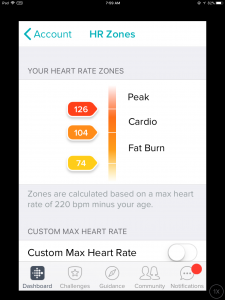
But I wondered what is happening to my aerobic fitness? Then I discovered that my Fitbit app is keeping track of my cardio fitness! The app determined my heart rate zones and then uses those zones and my resting heart rate to compute a cardio fitness score. As you can see in this screen shot on the left, Fitbit has determined that, for me, a heart rate greater than 126 is my peak zone and my cardio zone is 104 – 125. The peak range is approximately 80% of my maximum heart rate so anything above that would be considered high intensity exercise.
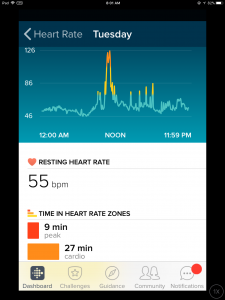
The app also graphs my heart rate for the entire day so I can tell from that graph how long I was in the peak zone. The screen shot on the left is for 1/2/18 which includes a cycling class.
November 16, 2017January 2, 2018
So I was in the ‘zone’ for 9 minutes during the class which corresponds to intervals where we pushed up to 85 or 90 RPM for short periods.
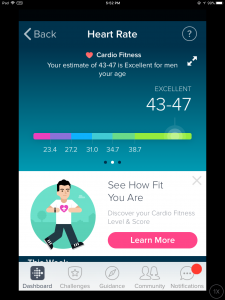
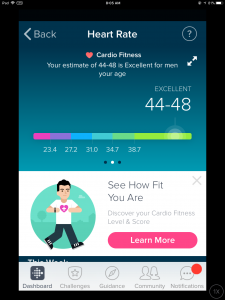
And here are screen shots showing my cardio fitness as computed by Fitbit on November 16, 2017 and January 2, 2018. So, in theory, I’ve already improved my Cardio Fitness by a point since we started the HIIT. But just as important is that fact that either score is considered excellent by Fitbit where the average score for men over 60 is 27.2 – 31.0.
Between cycling twice a week, playing tennis 2 -3 times a week and the Dance for PD class I am staying fit, slowing the progression of my Parkinson’s and having fun. We will revisit my cardiac score in a month or so to see if the trend continues or maybe I’m maxed out!
So my New Year’s resolution this year is the same as last year, keep exercising and keep fighting PD. By the way, if you are interested in Pedaling for Parkinson’s, check out this video from the Sarasota YMCA website of one of Kathy’s classes and watch us having fun doing intervals!
“It does not matter how slowly you go as long as you do not stop.” – Confucius
It’s a new year and time to renew my resolution to continue exercising at least 4 -5 times per week. As 2017 came to a close a new research study was published that shows high intensity interval training (HIIT) delays Parkinson’s progression. As Daniel Corcos, one of the lead authors of the study states “If you have Parkinson’s disease and you want to delay the progression of your symptoms, you should exercise three times a week with your heart rate between 80 and 85 percent maximum. It is that simple.” If you query Google for High Intensity Exercise and Parkinson’s you will find an abundance of articles about this study, here is the link to one of them from Science Daily.
While the need to exercise for PD patients has been shown in many studies, this was one of the first to be conducted for 6 months instead of 12 weeks. The participants were divided into three groups, HIIT exercise, moderate exercise and no exercise. All scored about 20 on a PD scale of 0 – 108 before the study. When scored after the 6 months The HIIT group showed no change while the moderate group got worse by 1.5 points and the no exercise group worsened by 3 points or about a 15% change.
Although the primary exercise used during this study was the treadmill, Kathy, our Parkinson’s cycling instructor immediately figured that we can step up our cycling program to include high intensity intervals and start raising our aerobic fitness level. So, even though many of us thought we were doing high intensity training already (well at least I did), she started pushing us to reach the 80 – 85% heart rate after Thanksgiving. Almost every workout has incorporated HIIT and I am already starting to see a change in just 6 weeks. The first few sessions I found I had to lower the gear to finish the workout. But each time I felt I was getting stronger and this week I was able to increase instead of decrease the gear and still maintain the required 80 – 90 RPM. I am happy with that progress and I am noticing a reduction in my symptoms after exercise including not feeling ‘off’ a half hour or so before it’s time to take my medicines on the day of exercise.
But I wondered what is happening to my aerobic fitness? Then I discovered that my Fitbit app is keeping track of my cardio fitness! The app determined my heart rate zones and then uses those zones and my resting heart rate to compute a cardio fitness score. As you can see in this screen shot on the left, Fitbit has determined that, for me, a heart rate greater than 126 is my peak zone and my cardio zone is 104 – 125. The peak range is approximately 80% of my maximum heart rate so anything above that would be considered high intensity exercise.
The app also graphs my heart rate for the entire day so I can tell from that graph how long I was in the peak zone. The screen shot on the left is for 1/2/18 which includes a cycling class.
November 16, 2017January 2, 2018
So I was in the ‘zone’ for 9 minutes during the class which corresponds to intervals where we pushed up to 85 or 90 RPM for short periods.
And here are screen shots showing my cardio fitness as computed by Fitbit on November 16, 2017 and January 2, 2018. So, in theory, I’ve already improved my Cardio Fitness by a point since we started the HIIT. But just as important is that fact that either score is considered excellent by Fitbit where the average score for men over 60 is 27.2 – 31.0.
Between cycling twice a week, playing tennis 2 -3 times a week and the Dance for PD class I am staying fit, slowing the progression of my Parkinson’s and having fun. We will revisit my cardiac score in a month or so to see if the trend continues or maybe I’m maxed out!
So my New Year’s resolution this year is the same as last year, keep exercising and keep fighting PD. By the way, if you are interested in Pedaling for Parkinson’s, check out this video from the Sarasota YMCA website of one of Kathy’s classes and watch us having fun doing intervals!
“It does not matter how slowly you go as long as you do not stop.” – Confucius
It’s a new year and time to renew my resolution to continue exercising at least 4 -5 times per week. As 2017 came to a close a new research study was published that shows high intensity interval training (HIIT) delays Parkinson’s progression. As Daniel Corcos, one of the lead authors of the study states “If you have Parkinson’s disease and you want to delay the progression of your symptoms, you should exercise three times a week with your heart rate between 80 and 85 percent maximum. It is that simple.” If you query Google for High Intensity Exercise and Parkinson’s you will find an abundance of articles about this study, here is the link to one of them from Science Daily.
While the need to exercise for PD patients has been shown in many studies, this was one of the first to be conducted for 6 months instead of 12 weeks. The participants were divided into three groups, HIIT exercise, moderate exercise and no exercise. All scored about 20 on a PD scale of 0 – 108 before the study. When scored after the 6 months The HIIT group showed no change while the moderate group got worse by 1.5 points and the no exercise group worsened by 3 points or about a 15% change.
Although the primary exercise used during this study was the treadmill, Kathy, our Parkinson’s cycling instructor immediately figured that we can step up our cycling program to include high intensity intervals and start raising our aerobic fitness level. So, even though many of us thought we were doing high intensity training already (well at least I did), she started pushing us to reach the 80 – 85% heart rate after Thanksgiving. Almost every workout has incorporated HIIT and I am already starting to see a change in just 6 weeks. The first few sessions I found I had to lower the gear to finish the workout. But each time I felt I was getting stronger and this week I was able to increase instead of decrease the gear and still maintain the required 80 – 90 RPM. I am happy with that progress and I am noticing a reduction in my symptoms after exercise including not feeling ‘off’ a half hour or so before it’s time to take my medicines on the day of exercise.
But I wondered what is happening to my aerobic fitness? Then I discovered that my Fitbit app is keeping track of my cardio fitness! The app determined my heart rate zones and then uses those zones and my resting heart rate to compute a cardio fitness score. As you can see in this screen shot on the left, Fitbit has determined that, for me, a heart rate greater than 126 is my peak zone and my cardio zone is 104 – 125. The peak range is approximately 80% of my maximum heart rate so anything above that would be considered high intensity exercise.
The app also graphs my heart rate for the entire day so I can tell from that graph how long I was in the peak zone. The screen shot on the left is for 1/2/18 which includes a cycling class.
November 16, 2017January 2, 2018
So I was in the ‘zone’ for 9 minutes during the class which corresponds to intervals where we pushed up to 85 or 90 RPM for short periods.
And here are screen shots showing my cardio fitness as computed by Fitbit on November 16, 2017 and January 2, 2018. So, in theory, I’ve already improved my Cardio Fitness by a point since we started the HIIT. But just as important is that fact that either score is considered excellent by Fitbit where the average score for men over 60 is 27.2 – 31.0.
Between cycling twice a week, playing tennis 2 -3 times a week and the Dance for PD class I am staying fit, slowing the progression of my Parkinson’s and having fun. We will revisit my cardiac score in a month or so to see if the trend continues or maybe I’m maxed out!
So my New Year’s resolution this year is the same as last year, keep exercising and keep fighting PD. By the way, if you are interested in Pedaling for Parkinson’s, check out this video from the Sarasota YMCA website of one of Kathy’s classes and watch us having fun doing intervals!
“It does not matter how slowly you go as long as you do not stop.” – Confucius
It is a busy time of year but I wanted send along good wishes for the holiday, pass along a reminder or two and note some items of interest in the Parkinson’s community.
Reminder number one: November is National Caregivers Month. Yes the month is about over but I know that you, like me, are thankful for your care partner(s) every day of the year. Remember there are lots of resources available for care partners and one of the best, available from the Parkinson’s Foundation, is the Caring and Coping guide, written for caregivers at every stage of PD. Download load a copy at this link.
Reminder number two: Tuesday the 28th is Giving Tuesday. This is a great opportunity to make a donation to your favorite charity and, in many cases, have it matched. For example the Michael J Fox Foundation is shooting to raise $1million in 1 day with every donation matched by anonymous donors. Many other charities have similar opportunities on Tuesday, so scrape the bottom of your pocket book or wallet after Black Friday and Cyber Monday and help us find a cure for PD or the charity of your choice.
Item of interest number two: The Michael J. Fox Foundation for Parkinson’s Research has launched Fox Insight — an online clinical study that empowers people with PD to partner with researchers and accelerate the development of breakthrough treatments. I have talked about Fox Insight in previous posts but, if you haven’t joined yet, now is the time, your data is needed as we work to find a cure. Click on the link above to get more information and join us.
Item of interest number three: The next World Parkinson’s Congress will be June, 2019 in Kyoto, Japan. Soaring With Hope has started a project to make origami cranes for an art installation to display at the WPC. Each crane represents a person withParkinson’s or a person impacted by Parkinson’s. They are asking each person to give their message of hope, which will be written on a crane. They have a goal of 10,000 cranes to bring to the WPC, each of them with a message of hope written on it to help raise awareness and HOPE for PD globally. Please take a minute to click on this link and add your WORDS OF HOPE, and please spread the word to get others to join in and participate. Thanks to Sharon Krischer (blogging as Twitchy Woman) for providing this information on her blog.
On this Thanksgiving day I am thankful for the support of my wonderful wife, my family, my friends and all of you who take the time to read my occasional posts. Thank you all and Happy Thanksgiving!
Yesterday was our local Parkinson’s Walk held in Oak Ridge,TN. The weather websites were predicting rain and thunderstorms, but it turned out to just be a cloudy day. Our local walk is in support of the Unity Walk in New York City and 100% of the funds raised go to the seven major Parkinson’s research organizations.Despite the weather forecast we had a good turnout and raised over $8100 for PD research. I want to again thank all of you who made a donation in support of Mara and me and Team PK Hope is Alive – THANKS!
We arrived early to help with the setup for the walk and I was glad my stepson, Darrin, joined us for the heavy lifting! This was also our first ‘gig’ as Fox Trial Finder Ambassadors and we set up a table to promote Fox Trial Finder and Fox InSight. We had a lot of activity at our table, handed out a lot of information and MJFF orange brain shaped stress relievers. We met a lot of new people who were interested in both programs and hopefully our efforts result in some new sign ups.
We were asked to speak during the prerace ceremonies so, in addition to our first Trial Finder gig, I made my first presentation about current research and the need for participating in Fox Trial Finder and Fox InSight. I had prepared some notes (about 7 pages when printed in large type!) but found it hard to read the notes, maintain some eye contact, speak loudly AND hold the microphone at the same time so it was more of an ‘off the cuff’ speech it but it seemed to go OK for a first attempt.
This week I moved the blog to its own internet domain www.tomspdblog.com which is easier for me (and you) to remember when people ask for the address. Google assures me there should be no noticeable change for readers as both the old and the new address will end up at the blog. So far it seems to be working OK, but those of you who have the address bookmarked may want to update your bookmark to the new address.
Next Thursday we go to Vanderbilt for my next appointment with my Movement Disorder Specialist. I continue to be so much better on the new medication and I hope Dr. Davis agrees. I am also hoping to be considered for the NPF Parkinson’s Outcomes Project which is conducted at the NPF Center’s of Excellence of which Vanderbilt is one. They have been following PwP since 2009 with a goal of establishing models of excellent PD care for best health outcomes. You can read more on the NPF website at this link .
I’m still working at reviewing some of the exercise options available for PwP, maybe it will be done by the next post (I’m pretty sure procrastination is another non motor symptom!) In the meantime, don’t forget to sign up for Fox Trial Finder and Fox Insight and be an agent for change!
“It does not matter how slowly you go as long as you do not stop.” – Confucius