One of the big advantages to being in Sarasota has been the ability to exercise. I am able to exercise at least an hour a day, 5 – 6 days a week which has helped me keep my PD symptoms in a holding pattern. We try to play tennis everyday when possible, and I continue to do Pedaling for Parkinson’s twice a week. In addition we go spend an hour a week at PD in Motion, Let Your Yoga Dance, Easy Yoga and Fundamentals of Movement classes. When time permits, we also try to spend at least one hour a week at the gym with the weight machines pumping some iron!
While all of this exercise has helped me to slow my PD progression, I started noticing that I would be walking with my arms out front and I would become more rigid about 30 – 45 minutes before my next medication dose was due. So, after slightly over two years on the same dose, I contacted my neurologist and we agreed to increase my Sinement from 1 to 1.5 tablets 4 times a day. It’s been about a week since the change and I have already noticed reduced rigidity and the arm swing is back to almost normal, and I am hopeful that I can go another 2+ years before I have to change it again.
We have really enjoyed playing tennis. I had never played before we took lessons in December and was surprised at how much I enjoy it. We took more lessons in January and Mara attends a tennis clinic put on by Barb, our superb instructor, twice a week while I am pedaling then we practice most afternoons at the courts here in the complex for up to an hour and a half. We are also part of a group that meets once a week for doubles where we rotate in and out of the games depending on how may players show up. I’m sure we will be on the ATP tour soon!
We have enjoyed our time here in Sarasota and in being able to take part in all of the opportunities being here has provided, not only for PD, but other venues such as the Selby Botanic Gardens, the various beaches, fishing in Sarasota Bay and more. At this point we are planning to renew our lease on the townhouse so we can continue to take part in all that the area offers, particularly for PwP’s.
Speaking of opportunities, next week we will attend the Davis Phinney Victory Summit event in Punta Gorda,about an hour south of Sarasota. Many of the Pedaling for Parkinson’s participants will also be going and we are looking forward to attending this great event for the second time. You can read about our first visit here.
And finally you might have noticed the Top 50 Parkinson’s Blog badge on the right which wouldn’t have been possible without you, my loyal readers and followers. Thank you!
“It does not matter how slowly you go as long as you do not stop.” – Confucius
We have a new President who is forming a new Cabinet and we are sure to see changes that may have significant impact not only on those of us with Parkinson’s Disease but also many others with chronic diseases or preexisting conditions. Some of these changes may be positive and others may be negative and so we must be alert and pay attention to what is happening in Washington DC.
One way to do that is to follow the Michael J Fox Foundation (MJFF) FoxFeed Blog. Friday Ted Thompson JD, former head of the Parkinson’s Action Network and now the Senior VP of Public Policy for the Foundation published an excellent blog post about possible policy changes which I have reproduced below.
Sign up here to get emails from the MJFF and stay up to date about public policies that impact the Parkinson’s community.
“It does not matter how slowly you go as long as you do not stop.” – Confucius
As President Donald J. Trump is sworn in and a new Congress begins its work, headlines about policy changes big and small fill the airwaves, internet and newspapers. There is uncertainty about what will happen in Washington, but with every change comes an opportunity for advancement, and we will be looking for ways to collaborate with lawmakers on both sides of the aisle who are interested in supporting our community.
While we don’t have a crystal ball, we are closely monitoring activities on Capitol Hill and in the White House. We’ll update the community as we learn more about potential proposals that could impact people with Parkinson’s and the Foundation’s three policy priorities — furthering Parkinson’s research, supporting drug development and approvals, and safeguarding access to care.
Here, we’d like to share information about several policy issues that could see changes under the new Administration.
Tension over Medicare and Medicaid
Research indicates that 80 percent of people with Parkinson’s rely on Medicare, and of that population, up to one-third also are eligible for Medicaid. Both of these programs play an important role in providing our community with adequate health care coverage.
Republican lawmakers have differing opinions when it comes to changes to Medicare and Medicaid. Throughout his campaign, Trump assured Americans he wouldn’t touch these programs, but GOP leadership, including Speaker Paul Ryan (R-WI) and Secretary of Health and Human Services nominee Tom Price, have consistently advocated for Medicare reforms.
Speaker Ryan has crafted a plan, dubbed “A Better Way,” which would slowly raise the age of eligibility for Medicare, cap federal spending for the program, increase subsidies for low-income seniors and raise out-of-pocket costs for higher-income retirees. Ryan’s plan will likely come into play in upcoming talks about Medicare and Medicaid.
As specific legislation is introduced, we’ll keep you up to date and continue to advocate for the parts of these programs that serve people with Parkinson’s.
Talk of Repealing and Replacing the Affordable Care Act (ACA)
Among other provisions, the Affordable Care Act, or Obamacare:
prohibited insurance companies from discriminating against those with pre-existing conditions, such as Parkinson’s disease,
eliminated annual and lifetime caps on coverage of essential health benefits (e.g., emergency services, hospitalization, etc.), and
expanded states’ Medicaid eligibility criteria.
The ACA also increased the total number of people with health care coverage.
There is a clear desire among the majority in Congress to repeal the ACA. Earlier this month, lawmakers passed a budget blueprint that included repeal of key parts of the ACA. This budget bill doesn’t actually become law, but acts as a guide for upcoming budget negotiations and sends a very strong signal on the GOP plans for the ACA.
Despite ongoing conversations about repeal, no replacement plan has been decided upon and some GOP leaders are calling for a more deliberate approach in which a replacement plan would be simultaneously passed if and when the ACA is repealed. According to the Congressional Budget Office, the non-partisan agency that provides analyses on economic and budgetary issues, 32 million Americans could lose health coverage if a replacement plan isn’t enacted. (That’s not to mention the 52 million Americans with a pre-existing condition who also could be at risk of losing coverage.) ACA repeal could also have implications for those on Medicare, as provisions in the ACA looked to eliminate the Medicare Part D ‘Donut Hole’ by 2020 and remove the cost for routine wellness visits.
Trump discussed the situation recently, saying that his replacement plan will provide health care for everyone at a lower cost. He restated his campaign stance, which included that he would allow government programs like Medicare and Medicaid to negotiate directly with pharmaceutical companies, with the goal of achieving overall savings to health care.
The Foundation was in touch with the Trump transition team in late 2016 to explain the critical role that high quality and affordable health insurance plays in helping our community access essential treatments and care. We will share updates on our blog and by email as efforts around the potential ACA repeal take shape.
Support for Medical Research Funding
The federal government is the world’s largest public funder of Parkinson’s disease research. In 2016, approximately $152 million was invested in PD breakthroughs at the National Institutes of Health (NIH), and another $16 million was provided to the U.S. Department of Defense’s Parkinson’s Research Program.
There is broad, bipartisan support for federal investments in medical research, as evidenced by an increase in the NIH’s total budget over the last two years. But there is concern about President Trump’s comments on medical research, as well as his nominee for the Office of Management and Budget (which develops and executes the president’s budget), who has questioned whether the federal government should spend money on medical research. Recent reports that President Trump has asked the current NIH Director Francis Collins to remain on are a positive sign for research. Collins has been director for the past eight years, was the lead scientist for the human genome project, and has had a significant role in the BRAIN (Brain Research through Advancing Innovative Neurotechnologies) and Precision Medicine Initiatives.
Names Raised for New Food and Drug Administration (FDA) Commissioner
The FDA is responsible for approving new drugs and medical devices before they come to market. Currently, the agency will only approve a therapy or treatment once it has shown to be both safe and efficacious (meaning it actually works). Some of Trump’s potential picks for FDA commissioner (the top position at the agency) have said drugs and devices should only be proven safe, not efficacious, before they are approved. These views are based on a desire to get new treatments into patient hands more quickly, but they raise concerns that it would establish a new government approval standard that is potentially lower than the existing one. MJFF will provide more information as an official nominee for FDA commissioner is announced later in the year.
New leadership and proposals are a reality, but in our system of government very few policies change dramatically overnight. Thoughtful leaders of both parties and members of the Trump Administration will hopefully consider the full impact of new policies before they are pursued.
In this changing political climate, the Foundation will continue to advocate for the Parkinson’s community, keeping in mind our three policy priorities. We’ll work to ensure people with Parkinson’s have access to affordable health care and treatments, and to protect our country’s federal investments in medical research.
Wow, here it is almost the end another year, a time for retrospection, making resolutions and watching a lot of football. As always it has been a busy year that saw us decide to spend more time in Florida in an effort to determine if we could live here full time and take advantage of all the benefits the area offers for Parkinson’s Patients. And we spent time with friends and family in both Florida and Tennessee and during trips to Denver, San Francisco, North Carolina, and Seattle. We also attended the World Parkinson’s Congress in Portland, Oregon. (note the links throughout this post will take you to a relevant blog post or article in case you missed them the first time!)
Probably the most important thing we have been able to do is increase our exercise time while in Florida. We joined the YMCA and were attending 2 – 3 exercise classes a day there until we got hooked on tennis after taking lessons through, where else, the YMCA. We have been playing 4 or 5 times a week and we plan to sign up for more lessons next month. I find it is not only a good work out but helps alleviate the PD symptoms. Several studies were recently released showing the benefits of exercise for PD and I plan to take advantage of the opportunities we have while I still can. Now if I can stay injury free!
So we have adjusted the exercise schedule to try and limit it to about 2 hours a day. I continue the Pedaling for Parkinsons class twice a week and we go to the PD in Motion class and will start our second season of Let Your Yoga Dance for Parkinsons (this is a video link) in January. We have found also found the Tai Chi classes beneficial and think we will sign up for a class at the Sarasota branch of the Tai Chi Society also starting in January. In addition to helping with movement and balance, we find it calming and centering.
On the resolution front I decided that instead of my usual resolution to post more often (which has worked so well 🙂 I would make a few updates to the blog So you will note a new tab at the top labeled My Book List and if you click on it, you will find…wait for it…. a list of books with my short review. As the page notes there are over 2,600 PD books listed on Amazon so I’ve got a lot more reading to do! Check it out when you get a chance.
I’ve also updated My Blog List, adding a few more blogs and correcting a couple of bad links. The new links are marked with (new) to make them easier to find.
I hope everyone had a great holiday and wish everyone a Happy and Healthy New Year! Let’s hope it is the Year of the Cure!
“It does not matter how slowly you go as long as you do not stop.” – Confucius
As promised in the last post, today I will discuss our experiences with clinical trials and the Fox Trial Finder (FTF) web application. But first, are you on Fox Trial Finder? If not, click on this link and sign up today! Currently there are 475 trials listed on FTF taking place in locations around the world. They include interventional trials (reducing tremor or dyskinesia, Tai Chi for balance, tele-medicine, etc.) and observational trials (bio markers, brain mapping, genetic research, wearable devices to measure PD, etc.). When you sign up for FTF you create a profile with information such as length of time with PD, medications, symptoms, and how far you are willing to travel to participate. FTF then matches you to trials that fit your profile. And don’t forget, most trials need control volunteers too so sign up your family and friends! Ready to sign up? Click on this link now! I’ll be here when you come back.
Welcome back! Mara and I recently participated in an observational study titled LRRK2 and Other Novel Exosome Proteins in Parkinson’s Disease conducted by the University of Alabama at Birmingham. The main purpose of this study is to determine whether there are biomarkers associated with Parkinson’s disease susceptibility and/or progression in exosome-proteomes derived from PD patients that will assist with future LRRK2 inhibitor clinical trials. You can read the full description here on FTF but it’s not exactly written in layman’s terms. (Maybe this could be a simple change to the process?)
After arriving at the UAB Medical Campus we were met by Rachel Clark who is coordinating the research study. She went over the research protocol and we signed the consent forms; she then asked us questions about our general health and medications we take. We both completed the Uniform Parkinson’s Disease Rating Scale (UPDRS) patient questionnaire and we were each given the Montreal Cognitive assessment. Then we took the Parkinson’s Smell Test which Mara did fine on and, surprise surprise, I didn’t. Out of 40 samples I got 10 correct while Mara got 37. I was able to identify two odors and the rest were just lucky guesses. I was also given the general physical tests for PD (tap your fingers & toes, walk down the hall, etc.) and we both provided blood and urine samples. That was it! One and a half hours and we had provided them with the necessary information and samples and completed our first clinical trial! It wasn’t time consuming, I didn’t have to worry about receiving a placebo or changing my medications, and I was only poked enough to provide 1 ounce of blood.
Many of the trials listed on FTF are observational studies like this one and seven are web based like the other trial I am participating in – Smartphone-PD. All of them provide valuable information in the search for a cure and all need participants. Did you click on that link yet?
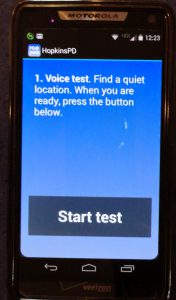
Smartphone-PD is a study to see if it is feasible for participants to download, install, and use an Android smartphone application to track data related to Parkinson disease symptoms. (Note: only available for Android phones) They hope to measure daily variability of movement and mobility characteristics of PD patients. The data is collected by completing voice and movement tests using my cell phone. The results of the daily tests are encrypted and uploaded to the study team at the University of Rochester in New York. The application will also monitor my daily activity if I keep my phone in my pocket.
I found this trial here on Fox Trial Finder and signing up is all done online. I reviewed the study plan and the consent form which includes the disclaimer that this study is purely for research purposes, so they will not be able to provide clinical advice for individuals with PD. Therefore, no adjustments to medications or appointments with a neurologist will be made as a part of the study. After electronically signing the consent form, I received an email with a link to the application which I downloaded to my phone and I was ready to go.
For this study I use my phone to complete five tests twice a day for six months. The first time is in the morning prior to taking my medication and then again about an hour later. They realize that you might not be able to complete the tests on that schedule but they are OK with that as all collected data is valuable. So it’s OK to miss a test day due to travel or whatever, they still want the information.So most every morning I open the application on my phone and spend five minutes completing the tests which include a voice test, a balance test, a gait test, a dexterity test and a reaction test. The results are sent off and I take my medications, have breakfast and try to remember to repeat the test an hour or so later. This study is actively recruiting on FTF or the Parkinson’s Voice site. Both PwP’s and controls are needed. You can also contact Denzil Harris, the research coordinator by email or phone him at 585-275-2791 for more information.
See, getting involved in a clinical trial is not as difficult as one might think, even if you live in a small town or aren’t close to a research center . Using Fox Trial Finder to identify trials you might be eligible for takes just a little bit of your time and the rewards are many including that good feeling of being involved in the quest for a cure. As I have said before, while patients and researchers work to change the current process, there are still many trials that need participants. If we don’t participate, we will continue to rely on a drug discovered almost 50 years ago that only treats some of our symptoms. With 475 possible trials listed, I bet you can find one that interests you, so click on this link and join over 39,000 others on Fox Trial Finder today!
(Updated 12/11 to add the links to Fox Trial Finder so it shows up in mobile device view with thanks to the Cure Parkinson’s Trust )
As promised in the last post, today I will discuss our experiences with clinical trials and the Fox Trial Finder (FTF) web application. But first, are you on Fox Trial Finder? If not, click on this link and sign up today! Currently there are 475 trials listed on FTF taking place in locations around the world. They include interventional trials (reducing tremor or dyskinesia, Tai Chi for balance, tele-medicine, etc.) and observational trials (bio markers, brain mapping, genetic research, wearable devices to measure PD, etc.). When you sign up for FTF you create a profile with information such as length of time with PD, medications, symptoms, and how far you are willing to travel to participate. FTF then matches you to trials that fit your profile. And don’t forget, most trials need control volunteers too so sign up your family and friends! Ready to sign up? Click on this link now! I’ll be here when you come back.
Welcome back! Mara and I recently participated in an observational study titled LRRK2 and Other Novel Exosome Proteins in Parkinson’s Disease conducted by the University of Alabama at Birmingham. The main purpose of this study is to determine whether there are biomarkers associated with Parkinson’s disease susceptibility and/or progression in exosome-proteomes derived from PD patients that will assist with future LRRK2 inhibitor clinical trials. You can read the full description here on FTF but it’s not exactly written in layman’s terms. (Maybe this could be a simple change to the process?)
After arriving at the UAB Medical Campus we were met by Rachel Clark who is coordinating the research study. She went over the research protocol and we signed the consent forms; she then asked us questions about our general health and medications we take. We both completed the Uniform Parkinson’s Disease Rating Scale (UPDRS) patient questionnaire and we were each given the Montreal Cognitive assessment. Then we took the Parkinson’s Smell Test which Mara did fine on and, surprise surprise, I didn’t. Out of 40 samples I got 10 correct while Mara got 37. I was able to identify two odors and the rest were just lucky guesses. I was also given the general physical tests for PD (tap your fingers & toes, walk down the hall, etc.) and we both provided blood and urine samples. That was it! One and a half hours and we had provided them with the necessary information and samples and completed our first clinical trial! It wasn’t time consuming, I didn’t have to worry about receiving a placebo or changing my medications, and I was only poked enough to provide 1 ounce of blood.
Many of the trials listed on FTF are observational studies like this one and seven are web based like the other trial I am participating in – Smartphone-PD. All of them provide valuable information in the search for a cure and all need participants. Did you click on that link yet?
Smartphone-PD is a study to see if it is feasible for participants to download, install, and use an Android smartphone application to track data related to Parkinson disease symptoms. (Note: only available for Android phones) They hope to measure daily variability of movement and mobility characteristics of PD patients. The data is collected by completing voice and movement tests using my cell phone. The results of the daily tests are encrypted and uploaded to the study team at the University of Rochester in New York. The application will also monitor my daily activity if I keep my phone in my pocket.
I found this trial here on Fox Trial Finder and signing up is all done online. I reviewed the study plan and the consent form which includes the disclaimer that this study is purely for research purposes, so they will not be able to provide clinical advice for individuals with PD. Therefore, no adjustments to medications or appointments with a neurologist will be made as a part of the study. After electronically signing the consent form, I received an email with a link to the application which I downloaded to my phone and I was ready to go.
For this study I use my phone to complete five tests twice a day for six months. The first time is in the morning prior to taking my medication and then again about an hour later. They realize that you might not be able to complete the tests on that schedule but they are OK with that as all collected data is valuable. So it’s OK to miss a test day due to travel or whatever, they still want the information.So most every morning I open the application on my phone and spend five minutes completing the tests which include a voice test, a balance test, a gait test, a dexterity test and a reaction test. The results are sent off and I take my medications, have breakfast and try to remember to repeat the test an hour or so later. This study is actively recruiting on FTF or the Parkinson’s Voice site. Both PwP’s and controls are needed. You can also contact Denzil Harris, the research coordinator by email or phone him at 585-275-2791 for more information.
See, getting involved in a clinical trial is not as difficult as one might think, even if you live in a small town or aren’t close to a research center . Using Fox Trial Finder to identify trials you might be eligible for takes just a little bit of your time and the rewards are many including that good feeling of being involved in the quest for a cure. As I have said before, while patients and researchers work to change the current process, there are still many trials that need participants. If we don’t participate, we will continue to rely on a drug discovered almost 50 years ago that only treats some of our symptoms. With 475 possible trials listed, I bet you can find one that interests you, so click on this link and join over 39,000 others on Fox Trial Finder today!
(Updated 12/11 to add the links to Fox Trial Finder so it shows up in mobile device view with thanks to the Cure Parkinson’s Trust )
As promised in the last post, today I will discuss our experiences with clinical trials and the Fox Trial Finder (FTF) web application. But first, are you on Fox Trial Finder? If not, click on this link and sign up today! Currently there are 475 trials listed on FTF taking place in locations around the world. They include interventional trials (reducing tremor or dyskinesia, Tai Chi for balance, tele-medicine, etc.) and observational trials (bio markers, brain mapping, genetic research, wearable devices to measure PD, etc.). When you sign up for FTF you create a profile with information such as length of time with PD, medications, symptoms, and how far you are willing to travel to participate. FTF then matches you to trials that fit your profile. And don’t forget, most trials need control volunteers too so sign up your family and friends! Ready to sign up? Click on this link now! I’ll be here when you come back.
Welcome back! Mara and I recently participated in an observational study titled LRRK2 and Other Novel Exosome Proteins in Parkinson’s Disease conducted by the University of Alabama at Birmingham. The main purpose of this study is to determine whether there are biomarkers associated with Parkinson’s disease susceptibility and/or progression in exosome-proteomes derived from PD patients that will assist with future LRRK2 inhibitor clinical trials. You can read the full description here on FTF but it’s not exactly written in layman’s terms. (Maybe this could be a simple change to the process?)
After arriving at the UAB Medical Campus we were met by Rachel Clark who is coordinating the research study. She went over the research protocol and we signed the consent forms; she then asked us questions about our general health and medications we take. We both completed the Uniform Parkinson’s Disease Rating Scale (UPDRS) patient questionnaire and we were each given the Montreal Cognitive assessment. Then we took the Parkinson’s Smell Test which Mara did fine on and, surprise surprise, I didn’t. Out of 40 samples I got 10 correct while Mara got 37. I was able to identify two odors and the rest were just lucky guesses. I was also given the general physical tests for PD (tap your fingers & toes, walk down the hall, etc.) and we both provided blood and urine samples. That was it! One and a half hours and we had provided them with the necessary information and samples and completed our first clinical trial! It wasn’t time consuming, I didn’t have to worry about receiving a placebo or changing my medications, and I was only poked enough to provide 1 ounce of blood.
Many of the trials listed on FTF are observational studies like this one and seven are web based like the other trial I am participating in – Smartphone-PD. All of them provide valuable information in the search for a cure and all need participants. Did you click on that link yet?
Smartphone-PD is a study to see if it is feasible for participants to download, install, and use an Android smartphone application to track data related to Parkinson disease symptoms. (Note: only available for Android phones) They hope to measure daily variability of movement and mobility characteristics of PD patients. The data is collected by completing voice and movement tests using my cell phone. The results of the daily tests are encrypted and uploaded to the study team at the University of Rochester in New York. The application will also monitor my daily activity if I keep my phone in my pocket.
I found this trial here on Fox Trial Finder and signing up is all done online. I reviewed the study plan and the consent form which includes the disclaimer that this study is purely for research purposes, so they will not be able to provide clinical advice for individuals with PD. Therefore, no adjustments to medications or appointments with a neurologist will be made as a part of the study. After electronically signing the consent form, I received an email with a link to the application which I downloaded to my phone and I was ready to go.
For this study I use my phone to complete five tests twice a day for six months. The first time is in the morning prior to taking my medication and then again about an hour later. They realize that you might not be able to complete the tests on that schedule but they are OK with that as all collected data is valuable. So it’s OK to miss a test day due to travel or whatever, they still want the information.So most every morning I open the application on my phone and spend five minutes completing the tests which include a voice test, a balance test, a gait test, a dexterity test and a reaction test. The results are sent off and I take my medications, have breakfast and try to remember to repeat the test an hour or so later. This study is actively recruiting on FTF or the Parkinson’s Voice site. Both PwP’s and controls are needed. You can also contact Denzil Harris, the research coordinator by email or phone him at 585-275-2791 for more information.
See, getting involved in a clinical trial is not as difficult as one might think, even if you live in a small town or aren’t close to a research center . Using Fox Trial Finder to identify trials you might be eligible for takes just a little bit of your time and the rewards are many including that good feeling of being involved in the quest for a cure. As I have said before, while patients and researchers work to change the current process, there are still many trials that need participants. If we don’t participate, we will continue to rely on a drug discovered almost 50 years ago that only treats some of our symptoms. With 475 possible trials listed, I bet you can find one that interests you, so click on this link and join over 39,000 others on Fox Trial Finder today!
(Updated 12/11 to add the links to Fox Trial Finder so it shows up in mobile device view with thanks to the Cure Parkinson’s Trust )
I started ‘brain training’ with Lumosity last fall and usually play five games a day whenever possible. If you aren’t familiar with Lumosity, they provide cognitive training exercises that teach neuroplasticity, that is training the brain to use new pathways to complete a task. Cognitive training has blossomed in the past few years and since some of my neural pathways are deteriorating, I thought Lumosity would be an interesting test and might help me build those new paths.
The Lumosity training works to improve five areas – memory, flexibility, problem solving, attention and speed – all improvements I can use! After every five game session you get an overall score called the Lumosity Performance Index or LPI which is an average of the five areas and hopefully goes up each day (I wish). But enough of the background, if you want more info, check out their website.
I have found that playing the brain games with PD can be a challenge, particularly the flexibility and speed games that usually require the use of the arrow keys on my laptop to select the right answer. I have noticed that I can visualize the correct move but making my fingers press the right key is another thing altogether. As I learned from the presentation by Kaitlyn Roland at the Kripalu session, one of the problems with a lack of dopamine is the brain sends the correct command but it gets scrambled and doesn’t follow the correct pathway which results in the wrong action being taken which can result in a fall, freezing in place or, it appears, pressing the wrong key.
So I am hopeful that by doing the games every day I am creating those new neural pathways and my LPI score will reflect the improvement. But sometimes I seem to be stuck with the old paths and my LPI chart ends up looking like this one for the last four weeks, up and down. Such is life with Parkinson’s 🙂
The big Parkinson’s news of the last couple of weeks is the publication of a study that cinnamon might stop the progression of Parkinson’s Disease! I figure this means I should be baking and consuming my famous (in some circles) Gram’s Pecan Rolls so named because the recipe is from my daughter in law Monica’s Gram and it is full of cinnamon. Of course the study was conducted on mice so I don’t know how many rolls I need to eat daily but do know what the effect would be on my weight! Guess I’ll wait for more information before getting the baking equipment out but I wonder if my LPI would go up? Sounds like a clinical study in the making!
We had a great 4th of July visit with son Ryan and his wife Sarah and their son Julian and his half brother Trysten. In addition, grandson Jake and granddaughter McKenna and her friend Katie also joined us for the holiday weekend so we had a houseful. The kids enjoyed tubing on the lake and swimming off the dock, and we all enjoyed taking the boat down to watch the fireworks go off over the lake. We even managed to load the tube with all five kids for some fun on the lake. Again some fishing and paddle boarding took place along with watching the World Cup games.
Next week it will be one year since my PD diagnosis and a lot has happened in the space of the year, most of which I have managed to chronicle in this blog. Once again I thank you all for sticking with me on this journey, your support means a lot to me.
BTW, if you are a tweeter, follow me on twitter by clicking on the link on the right below my profile.