• Tom Isaacs Tribute

    It has been over 4 months since my last post and it will take a couple of posts just to catch you up on what’s been happening this summer.  But first I wish to pay tribute to Tom Isaacs, co-founder of the Cure Parkinson’s Trust in the UK, who passed away suddenly May 31st at the age of 49.

    We first met Tom at the Rally to the Challenge held at the Van Andel Institute in Grand Rapids in 2014 and again in 2015.  In 2016 we were present at the World Parkinson’s Congress in Portland where Tom received the award for Distinguished Contributions to the Parkinson’s Community.

    Each time we came away inspired by his vision, by his energy and his sense of humor.  Tom always had a smile, always had a new idea, and was always leading the way to a cure for PD. ​​His optimism and enthusiasm were contagious and his boundless energy put the Energizer Bunny to shame. ​​It is hard to picture a world without Tom Isaacs and his determination to find a cure for PD.

    The obituary printed below is from the Journal of Parkinson’s Disease, vol. 7, no. 3, pp. 409-410, 2017  and was published August 8, 2017.


    Tom Isaacs was diagnosed with Parkinson’s at the young age of 26 and worked tirelessly to challenge the view that Parkinson’s was incurable, raising funds for research to trial new treatments and becoming one of the most well-known and popular international patient advocates.

    Having completed a successful 1,250 mile sponsored walk in 1999, Tom was determined to use his Parkinson’s to achieve more in life than he could have done without it, leaving his job as Director of a London property company to undertake his Coastin’ challenge to raise funds for Parkinson’s research. He walked 4,500 miles around the British coastline, climbed the highest mountains in England, Scotland and Wales and ran the Flora London Marathon, raising over £350,000 for Parkinson’s research. He wrote a book, Shake Well Before Use about his walk and his experiences living with Parkinson’s which he conveys with passion, optimism and humour.

    In 2004 he was awarded UK Charity Personality of the Year and a year later he helped to co-found The Cure Parkinson’s Trust (CPT), a patient-led charitable organisation of which he was President. The name alone challenged the view that Parkinson’s was incurable. “I still maintain that one day I will be able to insert the word ‘used to’ when I say I have Parkinson’s.” Tom said. Over ten years on and under Tom’s guidance, CPT is recognised as a key player in the world of research and has funded over $7.4 million of Parkinson’s research projects.

    In the early days of CPT, Tom and the charity’s Director of Research and Development Dr Richard Wyse, forged ahead with international collaborations. The first was with Patrik Brundin (of the Van Andel Institute in Grand Rapids, Michigan) who they approached about developing a research programme to re-purpose existing drugs and investigate their potential to slow, stop or reverse Parkinson’s. Dr Brundin described Tom as “a beacon of light who guided us all doing Parkinson’s research, keeping us on track.” This project became the Linked Clinical Trials (LCT) initiative, now driven by a 14-strong international Committee of neurologists and Parkinson’s researchers. LCT is in its fifth year and to date there are eight drugs within the trial programme.

    Once described as “the most expert patient” Tom was able to take part in scientific discussions at the highest level and his passion, charm and single-mindedness helped him earn the respect and support of such leading Parkinson’s researchers as Dr Patrik Brundin and Professors Andrew Lees, Anders Bjorkland, Roger Barker and Steven Gill.

    Tom worked closely and successfully with many international organisations including the Van Andel Research Institute and the Michael J Fox Foundation. He was also a Board Member of the European Parkinson’s Disease Association from 2005 until 2010.

    Tom was the first person with Parkinson’s to speak at the World Parkinson Congress in 2006. He has attended and presented at every WPC since and was also the patient representative on the Steering Committee and chaired the Patient Advocacy Committee for the World Parkinson Congress in 2010 and 2013. “He was a leader from the day of his diagnosis and he dreamed about helping others with PD to also become leaders to march alongside him in his journey to end Parkinson’s disease.” says Eli Pollard, Executive Director of the World Parkinson Coalition. At the 2016 World Parkinson Congress, Tom was awarded the inaugural prize for Distinguished Contribution to the Parkinson’s Community.

    He was also a leading contributor to the SENSE-PARK project in 2011, a European funded initiative which established more personalised, objective measuring devices for people with Parkinson’s and those who treat them. He co-founded Parkinson’s Movement, which provided a voice for people with Parkinson’s and has made progress in addressing some of the problems experienced in clinical trials – in particular, recruitment and outcome measures.

    In 2012 Tom was awarded the prestigious, Dr Rana International Parkinson’s Community Service Award and was also one of the torchbearers in the run up to the 2012 Olympic Games.

    Tom has written articles and been published in the Lancet Neurology, the Journal of Clinical Investigations and the Journal of Parkinson’s Disease for which he was on the editorial board.

    He was married to Lyndsey, an acupuncturist and former nurse who fully embraced Tom’s vision and was an advocate for Parkinson’s in her own right. Her phenomenal support for Tom enabled them to travel extensively to attend conferences and meetings at which Tom gave speeches and presentations about the urgent need for a cure, the power of advocacy in research and the impact of living with Parkinson’s. Tom and Lyndsey not only shared a vision but also a wonderful sense of humour, friendship and fun.

    Perhaps most important of all, Tom inspired people with Parkinson’s, giving hope that a cure will be found and a belief that the patient voice was being heard. He spoke openly about his condition and helped fellow patients understand they were not alone, describing hope as ‘the best medicine of all.’ As one CPT supporter said, “The PD world has lost a hero and a trailblazer.”

    Tom Isaacs, co-founder and President of The Cure Parkinson’s Trust was born on April 2 1968 and died on May 31st, 2017, aged 49.

    As you can see from his obituary, Tom was a visionary with a unique ability to pull together the people needed to make a vision become a reality. He was one of my Everyday Hero’s and, while he will be missed, his vision to find a cure will continue on through the work of the Cure Parkinson’s Trust.

    Stay tuned for my next post and we will start to catch up on what else has been happening for the last four months!
    “It does not matter how slowly you go as long as you do not stop.” – Confucius
  • World Parkinson’s Day

    TODAY, APRIL 11TH, IS WORLD PARKINSON’S DAY.  IT’S BEEN 200 YEARS SINCE PARKINSON’S DISEASE WAS FIRST IDENTIFIED AS SHAKING PALSY BY DR JAMES PARKINSON – IT’S TIME FOR A CURE!

    WATCH TOM ISSACS #UNITEFORPARKINSON’S


  • It’s Been a Busy March!

    This has been a busy month of events, travel and, of course, exercise. Here are some of the highlights.

    We started the month by attending the Davis Phinney Foundation Victory Summit in Punta Gorda, FL (about an hour away).  This was our second time to attend one of these events and it was even better than the first time.   The event included motivational talks by Davis Phinney and Tim Hague who, with his son, won the first Amazing Race in Canada.  In addition our event featured presentations by local medical personnel and support groups and a presentation by Connie Carpenter-Phinney about care partner strategies. If you get a chance to attend a Victory Summit (check the website for locations and dates), I highly recommend it.

    Next we took a road trip from Sarasota to Hilton Head Island, SC to visit friends.  On the way there and on the way back we stopped off in Amelia Island, FL where we enjoyed hiking at Fort Clinch State Park and Big and Little Talbot Islands State Parks.

    After hiking, we took the car ferry across the St John River to Mayport, FL for a great sea food lunch before heading home.

    The next event was lunch with friends at Frenchy’s Outpost Bar and Grill in Dunedin Fl where Mara saw this piano and is making plans to decorate our piano we have in Tennessee.

    After lunch we went to Honeymoon Island state park and hiked the trail to an eagles nest where one eagle was on the nest and the mate appeared in a tree close by, you can just make them out in this photo. (even with the red arrows!)

    Our next trip was going to West Virginia University Medical School in Morgantown, WV to watch our grand daughter Breanna receive her White Coat, signifying completion of two years of medical school and her transition to clinical training which will start this summer.  We enjoyed the ceremony and Morgantown, cold  weather and all! 

    So that’s a quick look at what’s been happening this month.    We continue to shoot for at least an hour of exercise per day choosing from tennis, PD in Motion Dance Class, various classes at the YMCA (yoga, tai chi, and others) and Pedaling for PD.  Yet another study by Northwestern was released in the last week or so showing the benefits of at least 150 minutes per week in slowing the progression of PD.  And the best exercise??? The one you will do!!!

    On April 1, we will attend the National Parkinson’s Foundation Moving Day Walk in Tampa. This will be our first Moving Day Walk and we are looking forward it as we kick off Parkinson’s Awareness Month. 

    “It does not matter how slowly you go as long as you do not stop.” – Confucius

Volunteer and Help Find a Cure for PD!


As promised in the last post, today I will discuss our experiences with clinical trials and the Fox Trial Finder (FTF) web application.  But first, are you on Fox Trial Finder? If not, click on this link and sign up today!  Currently there are 475 trials listed on FTF taking place in locations around the world. They include interventional trials (reducing tremor or dyskinesia, Tai Chi for balance, tele-medicine, etc.) and observational trials (bio markers, brain mapping, genetic research, wearable devices to measure PD, etc.). When you sign up for FTF you create a profile with information such as length of time with PD, medications, symptoms, and how far you are willing to travel to participate.  FTF then matches you to trials that fit your profile.  And don’t forget, most trials need control volunteers too so sign up your family and friends! Ready to sign up? Click on this link now! I’ll be here when you come back.

Welcome back! Mara and I recently participated in an observational study titled LRRK2 and Other Novel Exosome Proteins in Parkinson’s Disease conducted by the University of Alabama at Birmingham.  The main purpose of this study is to determine whether there are biomarkers associated with Parkinson’s disease susceptibility and/or progression in exosome-proteomes derived from PD patients that will assist with future LRRK2 inhibitor clinical trials.  You can read the full description here on FTF but it’s not exactly written in layman’s terms. (Maybe this could be a simple change to the process?)

After arriving at the UAB Medical Campus we were met by Rachel Clark who is coordinating the research study.  She went over the research protocol and we signed the consent forms; she then asked us questions about our general health and medications we take.  We both completed the Uniform Parkinson’s Disease Rating Scale (UPDRS) patient questionnaire and we were each given the Montreal Cognitive assessment. Then we took the Parkinson’s Smell Test which Mara did fine on and, surprise surprise, I didn’t.  Out of 40 samples I got 10 correct while Mara got 37. I was able to identify two odors and the rest were just lucky guesses. I was also given the general physical tests for PD (tap your fingers & toes, walk down the hall, etc.) and we both provided blood and urine samples.  That was it!  One and a half hours and we had provided them with the necessary information and samples and completed our first clinical trial! It wasn’t time consuming, I didn’t have to worry about receiving a placebo or changing my medications, and I was only poked enough to provide 1 ounce of blood.

Many of the trials listed on FTF are observational studies like this one and seven are web based like the other trial I am participating in – Smartphone-PD. All of them provide valuable information in the search for a cure and all need participants. Did you click on that link yet?

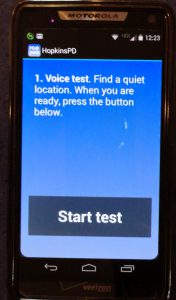
Smartphone-PD is a study to see if it is feasible for participants to download, install, and use an Android smartphone application to track data related to Parkinson disease symptoms. (Note: only available for Android phones)  They hope to measure daily variability of movement and mobility characteristics of PD patients. The data is collected by completing voice and movement tests using my cell phone.  The results of the daily tests are encrypted and uploaded to the study team at the University of Rochester in New York.  The application will also monitor my daily activity if I keep my phone in my pocket.

I found this trial here on Fox Trial Finder and signing up is all done online. I reviewed the study plan and the consent form which includes the disclaimer that this study is purely for research purposes, so they will not be able to provide clinical advice for individuals with PD. Therefore, no adjustments to medications or appointments with a neurologist will be made as a part of the study.  After electronically signing the consent form, I received an email with a link to the application which I downloaded to my phone and I was ready to go.

For this study I use my phone to complete five tests twice a day for six months.  The first time is in the morning prior to taking my medication and then again about an hour later.  They realize that you might not be able to complete the tests on that schedule but they are OK with that as all collected data is valuable. So it’s OK to miss a test day due to travel or whatever, they still want the information.So most every morning I open the application on my phone and spend five minutes completing the tests which include a voice test, a balance test, a gait test, a dexterity test and a reaction test. The results are sent off and I take my medications, have breakfast and try to remember to repeat the test an hour or so later. This study is actively recruiting on FTF or the Parkinson’s Voice site.   Both PwP’s and controls are needed. You can also contact Denzil Harris, the research coordinator by email or phone him at 585-275-2791 for more information.

See, getting involved in a clinical trial is not as difficult as one might think, even if you live in a small town or aren’t close to a research center .  Using Fox Trial Finder to identify trials you might be eligible for takes just a little bit of your time and the rewards are many including that good feeling of being involved in the quest for a cure.   As I have said before, while patients and researchers work to change the current process, there are still many trials that need participants.  If we don’t participate, we will continue to rely on a drug discovered almost 50 years ago that only treats some of our symptoms.   With 475 possible trials listed, I bet you can find one that interests you, so click on this link and join over 39,000 others on Fox Trial Finder today!

(Updated 12/11 to add the links to Fox Trial Finder so it shows up in mobile device view with thanks to the Cure Parkinson’s Trust )

Volunteer and Help Find a Cure for PD!


As promised in the last post, today I will discuss our experiences with clinical trials and the Fox Trial Finder (FTF) web application.  But first, are you on Fox Trial Finder? If not, click on this link and sign up today!  Currently there are 475 trials listed on FTF taking place in locations around the world. They include interventional trials (reducing tremor or dyskinesia, Tai Chi for balance, tele-medicine, etc.) and observational trials (bio markers, brain mapping, genetic research, wearable devices to measure PD, etc.). When you sign up for FTF you create a profile with information such as length of time with PD, medications, symptoms, and how far you are willing to travel to participate.  FTF then matches you to trials that fit your profile.  And don’t forget, most trials need control volunteers too so sign up your family and friends! Ready to sign up? Click on this link now! I’ll be here when you come back.

Welcome back! Mara and I recently participated in an observational study titled LRRK2 and Other Novel Exosome Proteins in Parkinson’s Disease conducted by the University of Alabama at Birmingham.  The main purpose of this study is to determine whether there are biomarkers associated with Parkinson’s disease susceptibility and/or progression in exosome-proteomes derived from PD patients that will assist with future LRRK2 inhibitor clinical trials.  You can read the full description here on FTF but it’s not exactly written in layman’s terms. (Maybe this could be a simple change to the process?)

After arriving at the UAB Medical Campus we were met by Rachel Clark who is coordinating the research study.  She went over the research protocol and we signed the consent forms; she then asked us questions about our general health and medications we take.  We both completed the Uniform Parkinson’s Disease Rating Scale (UPDRS) patient questionnaire and we were each given the Montreal Cognitive assessment. Then we took the Parkinson’s Smell Test which Mara did fine on and, surprise surprise, I didn’t.  Out of 40 samples I got 10 correct while Mara got 37. I was able to identify two odors and the rest were just lucky guesses. I was also given the general physical tests for PD (tap your fingers & toes, walk down the hall, etc.) and we both provided blood and urine samples.  That was it!  One and a half hours and we had provided them with the necessary information and samples and completed our first clinical trial! It wasn’t time consuming, I didn’t have to worry about receiving a placebo or changing my medications, and I was only poked enough to provide 1 ounce of blood.

Many of the trials listed on FTF are observational studies like this one and seven are web based like the other trial I am participating in – Smartphone-PD. All of them provide valuable information in the search for a cure and all need participants. Did you click on that link yet?

Smartphone-PD is a study to see if it is feasible for participants to download, install, and use an Android smartphone application to track data related to Parkinson disease symptoms. (Note: only available for Android phones)  They hope to measure daily variability of movement and mobility characteristics of PD patients. The data is collected by completing voice and movement tests using my cell phone.  The results of the daily tests are encrypted and uploaded to the study team at the University of Rochester in New York.  The application will also monitor my daily activity if I keep my phone in my pocket.

I found this trial here on Fox Trial Finder and signing up is all done online. I reviewed the study plan and the consent form which includes the disclaimer that this study is purely for research purposes, so they will not be able to provide clinical advice for individuals with PD. Therefore, no adjustments to medications or appointments with a neurologist will be made as a part of the study.  After electronically signing the consent form, I received an email with a link to the application which I downloaded to my phone and I was ready to go.

For this study I use my phone to complete five tests twice a day for six months.  The first time is in the morning prior to taking my medication and then again about an hour later.  They realize that you might not be able to complete the tests on that schedule but they are OK with that as all collected data is valuable. So it’s OK to miss a test day due to travel or whatever, they still want the information.So most every morning I open the application on my phone and spend five minutes completing the tests which include a voice test, a balance test, a gait test, a dexterity test and a reaction test. The results are sent off and I take my medications, have breakfast and try to remember to repeat the test an hour or so later. This study is actively recruiting on FTF or the Parkinson’s Voice site.   Both PwP’s and controls are needed. You can also contact Denzil Harris, the research coordinator by email or phone him at 585-275-2791 for more information.

See, getting involved in a clinical trial is not as difficult as one might think, even if you live in a small town or aren’t close to a research center .  Using Fox Trial Finder to identify trials you might be eligible for takes just a little bit of your time and the rewards are many including that good feeling of being involved in the quest for a cure.   As I have said before, while patients and researchers work to change the current process, there are still many trials that need participants.  If we don’t participate, we will continue to rely on a drug discovered almost 50 years ago that only treats some of our symptoms.   With 475 possible trials listed, I bet you can find one that interests you, so click on this link and join over 39,000 others on Fox Trial Finder today!

(Updated 12/11 to add the links to Fox Trial Finder so it shows up in mobile device view with thanks to the Cure Parkinson’s Trust )

Tag: Research

  • Volunteer and Help Find a Cure for PD!

    Volunteer and Help Find a Cure for PD!


    As promised in the last post, today I will discuss our experiences with clinical trials and the Fox Trial Finder (FTF) web application.  But first, are you on Fox Trial Finder? If not, click on this link and sign up today!  Currently there are 475 trials listed on FTF taking place in locations around the world. They include interventional trials (reducing tremor or dyskinesia, Tai Chi for balance, tele-medicine, etc.) and observational trials (bio markers, brain mapping, genetic research, wearable devices to measure PD, etc.). When you sign up for FTF you create a profile with information such as length of time with PD, medications, symptoms, and how far you are willing to travel to participate.  FTF then matches you to trials that fit your profile.  And don’t forget, most trials need control volunteers too so sign up your family and friends! Ready to sign up? Click on this link now! I’ll be here when you come back.

    Welcome back! Mara and I recently participated in an observational study titled LRRK2 and Other Novel Exosome Proteins in Parkinson’s Disease conducted by the University of Alabama at Birmingham.  The main purpose of this study is to determine whether there are biomarkers associated with Parkinson’s disease susceptibility and/or progression in exosome-proteomes derived from PD patients that will assist with future LRRK2 inhibitor clinical trials.  You can read the full description here on FTF but it’s not exactly written in layman’s terms. (Maybe this could be a simple change to the process?)

    After arriving at the UAB Medical Campus we were met by Rachel Clark who is coordinating the research study.  She went over the research protocol and we signed the consent forms; she then asked us questions about our general health and medications we take.  We both completed the Uniform Parkinson’s Disease Rating Scale (UPDRS) patient questionnaire and we were each given the Montreal Cognitive assessment. Then we took the Parkinson’s Smell Test which Mara did fine on and, surprise surprise, I didn’t.  Out of 40 samples I got 10 correct while Mara got 37. I was able to identify two odors and the rest were just lucky guesses. I was also given the general physical tests for PD (tap your fingers & toes, walk down the hall, etc.) and we both provided blood and urine samples.  That was it!  One and a half hours and we had provided them with the necessary information and samples and completed our first clinical trial! It wasn’t time consuming, I didn’t have to worry about receiving a placebo or changing my medications, and I was only poked enough to provide 1 ounce of blood.

    Many of the trials listed on FTF are observational studies like this one and seven are web based like the other trial I am participating in – Smartphone-PD. All of them provide valuable information in the search for a cure and all need participants. Did you click on that link yet?

    Smartphone-PD is a study to see if it is feasible for participants to download, install, and use an Android smartphone application to track data related to Parkinson disease symptoms. (Note: only available for Android phones)  They hope to measure daily variability of movement and mobility characteristics of PD patients. The data is collected by completing voice and movement tests using my cell phone.  The results of the daily tests are encrypted and uploaded to the study team at the University of Rochester in New York.  The application will also monitor my daily activity if I keep my phone in my pocket.

    I found this trial here on Fox Trial Finder and signing up is all done online. I reviewed the study plan and the consent form which includes the disclaimer that this study is purely for research purposes, so they will not be able to provide clinical advice for individuals with PD. Therefore, no adjustments to medications or appointments with a neurologist will be made as a part of the study.  After electronically signing the consent form, I received an email with a link to the application which I downloaded to my phone and I was ready to go.

    For this study I use my phone to complete five tests twice a day for six months.  The first time is in the morning prior to taking my medication and then again about an hour later.  They realize that you might not be able to complete the tests on that schedule but they are OK with that as all collected data is valuable. So it’s OK to miss a test day due to travel or whatever, they still want the information.So most every morning I open the application on my phone and spend five minutes completing the tests which include a voice test, a balance test, a gait test, a dexterity test and a reaction test. The results are sent off and I take my medications, have breakfast and try to remember to repeat the test an hour or so later. This study is actively recruiting on FTF or the Parkinson’s Voice site.   Both PwP’s and controls are needed. You can also contact Denzil Harris, the research coordinator by email or phone him at 585-275-2791 for more information.

    See, getting involved in a clinical trial is not as difficult as one might think, even if you live in a small town or aren’t close to a research center .  Using Fox Trial Finder to identify trials you might be eligible for takes just a little bit of your time and the rewards are many including that good feeling of being involved in the quest for a cure.   As I have said before, while patients and researchers work to change the current process, there are still many trials that need participants.  If we don’t participate, we will continue to rely on a drug discovered almost 50 years ago that only treats some of our symptoms.   With 475 possible trials listed, I bet you can find one that interests you, so click on this link and join over 39,000 others on Fox Trial Finder today!

    (Updated 12/11 to add the links to Fox Trial Finder so it shows up in mobile device view with thanks to the Cure Parkinson’s Trust )

  • Cognitive Training and ….Cinnamon?

    Cognitive Training and ….Cinnamon?

    I started ‘brain training’ with Lumosity last fall and usually play five games a day whenever possible.  If you aren’t familiar with Lumosity, they provide cognitive training exercises that teach neuroplasticity, that is training the brain to use new pathways to complete a task.  Cognitive training has blossomed in the past few years and since some of my neural pathways are deteriorating, I thought Lumosity would be an interesting test and might help me build those new paths.

    The Lumosity training works to improve five areas – memory, flexibility, problem solving, attention and speed – all improvements I can use!  After every five game session you get an overall score called  the Lumosity Performance Index or LPI which is an average of the five areas and hopefully goes up each day (I wish).  But enough of the background, if you want more info, check out their website.

    I have found that playing the brain games with PD can be a challenge, particularly the flexibility and speed games that usually require the use of the arrow keys on my laptop to select the right answer.  I have noticed that I can visualize the correct move but making my fingers press the right key is another thing altogether.  As I learned from the presentation by Kaitlyn Roland at the Kripalu session, one of the problems with a lack of dopamine is the brain sends the correct command but it gets scrambled and doesn’t follow the correct pathway which results in the wrong action being taken which can result in a fall, freezing in place or, it appears, pressing the wrong key.

    So I am hopeful that by doing the games every day I am creating those new neural pathways and my LPI score will  reflect the improvement.  But sometimes I seem to be stuck with the old paths and my LPI chart ends up looking like this one for the last four weeks, up and down.  Such is life with Parkinson’s 🙂

    The big Parkinson’s news of the last couple of weeks is the publication of a study that cinnamon might stop the progression of Parkinson’s Disease!  I figure this means I should be baking and consuming my famous (in some circles) Gram’s Pecan Rolls so named because the recipe is from my daughter in law Monica’s Gram and it is full of cinnamon.  Of course the study was conducted on mice so I don’t know how many rolls I need to eat daily but do know what the effect would be on my weight!  Guess I’ll wait for more information before getting the baking equipment out but I wonder if my LPI would go up? Sounds like a clinical study in the making!

    We had a great 4th of July visit with son Ryan and his wife Sarah and their son Julian and his half brother Trysten.  In addition, grandson Jake and granddaughter McKenna and her friend Katie also joined us for the  holiday weekend so we had a houseful.  The kids enjoyed tubing on the lake and swimming off the dock, and we all enjoyed taking the boat down to watch the fireworks go off over the lake.  We even managed to load the tube with all five kids for some fun on the lake.  Again some fishing and paddle boarding took place along with watching the World Cup games.

    Next week it will be one year since my PD diagnosis and a lot has happened in the space of the year, most of which I have managed to chronicle in this blog.   Once again I thank you all for sticking with me on this journey, your support means  a lot to me.

    BTW, if you are a tweeter, follow me on twitter by clicking on the link on the right below my profile.