• Seasons Greetings!

    Hard to believe the year is almost over!  It has been a busy couple of months but I hope to catch up soon and get back to a somewhat regular posting schedule.  In the meantime, we hope everyone has a great holiday and we are looking forward to the new year and more progress in the search for a cure.

    Happy Holidays!

    Tom and Mara

  • Giving Tuesday is Almost Here!

    Tuesday, December 1st is Giving Tuesday. Black Friday is over and Cyber Monday is almost over and Tuesday will be a great opportunity to take some (or all) of the money you saved this weekend and give back by making a donation to a Parkinson’s Disease organization or another cause of your choice. As in past years, many charitable organizations have a matching plan that will double your Giving Tuesday donation for double the benefit.

    In case you need a little inspiration, I am reposting the following article “What is a Parkie? And Why are They so Expensive?“.  This article was written by Alan Zimmerman vice president of the East Tennessee Parkinson’s Support Group and posted on their website,  PK Hope is Alive . Alan is a strong and active advocate for Parkinson’s research and education. In addition to being Vice President of the group, he is the Assistant Tennessee State Director for the Parkinson’s Action Network (PAN) and a member of the Parkinson’s Disease Foundation (PDF) People with Parkinson’s Advisory Council.

    Take some time on Tuesday and support the cause of your choice,  There is a lot of exciting news on the research front and our donations can make a difference!  Happy Holidays!!


    “It does not matter how slowly you go as long as you do not stop.” – Confucius


    WHAT IS A PARKIE? AND WHY ARE THEY SO EXPENSIVE?
    by Alan Zimmerman
     
    Parkies are expensive devils.  How does $25 Billion per year in the US sound to you?  Not only that,we discover another 60,000 Parkies each year, right here in good old America.  That number that is guaranteed to rise.  And, each Parkie spends about $2500 per year trying to be less Parkie with an assortment of medications and untold more on supplements.
    So, what then is a Parkie?  It is what people with Parkinson’s disease call each other.  Yep, the term is pretty much reserved for those in the Parkie club.  They would rather be known by everyone else as people with Parkinson’s (PWP).
    I know that you know someone who is a PWP.  You may even have a relative with PD.  You have seen them taking short steps and all bent over and very stiff and slow, or maybe they are using a walker to get around or perhaps they shake uncontrollably.  Maybe you can’t hear or understand them when they talk.  Perhaps you, nor they can read their handwriting.  The list goes on and on.
    Who gets this disease?  Men are slightly more likely and most people are in their 60’s when diagnosed.  But, about one in ten are 45 or under.  By the time your symptoms are bad enough to be diagnosed, one has already lost more the 60% of their dopamine.  You see, that marvelous thing called a brain compensates until it no longer can.  Unfortunately, that is not the blessing it seems to be.  As more interventions are developed, the sooner the diagnosis, the better.
    Wait!  We have new terms: diagnosis and dopamine.
    Let’s take “diagnosis” first because most everyone has had at least one of those.  In the case of Parkinson’s there is no definitive way of diagnosing except by physical exam.  And, it really needs to be done by a neurologist who specializes in movement disorders.  There is no blood test or scan that will determine for sure that the monster called PD has attacked.
    What’s “dopamine?”  It is a chemical found in the brain.  What does it do?  Lots of things that we know about and probably some yet to be discovered.  For one, it is a communicator.  Somehow it signals the muscles to do whatever the brain tells them to do.  It also has something to do with mood, pleasure, depression and many other important functions.
    What causes this PD thing?  Nobody knows for sure but most scientists believe it is probably a combination of genetics and something in the environment, like heavy metals, toxins, or pesticides that trigger the beginning of the disease.  That is pretty much where science is.  OK, so where does it start?  Nobody is sure where exactly but some of the latest thinking is that it starts in the gut or maybe even the intestines.
    So, bottom line, what is the cure?  There isn’t one.  It just gets worse over time as more brain cells die.  OK then, what is the treatment?  Mostly, at this stage in modern medicine, only symptoms can be treated.  A few things may slow it down like exercise programs.
    We also have this thing called Deep Brain Stimulation (DBS).  Hold on, what’s that?  It may scare you if I tell you but here goes.  DBS is where a PWP has one or preferably two holes drilled in the scull.  Then you insert electrodes into certain places in the brain.  Then, you attach all that to a battery which is eventually buried into your upper chest.  Oh, I forgot to tell you.  Usually the patient is awake when those electrodes are being put in place.  Why?  So that the neurosurgeon can get feedback from the PWP.
    So, I guess we need more research.  There is a bunch going on world-wide, but we could always use more.  Researchers eat and have families and require laboratories.  What that means is that research has a price tag.  What a price tag means is that more donations are required.
    What else is needed?  More movement specialist physicians for one.  There are not enough now and certainly too few going to school while the Parkie population increases.  So, we need to encourage doctors to devote an extra two years of their life learning the intricacies of movement.  Guess what?  That too carries a pretty hefty price tag.  So, we need more scholarships which means we need more donations yet again.
    So, let’s review.  People with Parkinson’s are growing in numbers rapidly.  The disease is progressive and degenerative.  So far, we can pretty much treat the symptoms only.  But, through massive research, we believe that disease altering therapies are going to become a reality pretty soon.  What is pretty soon?  Maybe 5-10 years.  But, that only happens with support for research, i.e. donations.
  • Happy Thanksgiving!

    Just a quick post wishing everyone a Happy Thanksgiving from Seattle.  I have much to be thankful for this year including:

    • making a change to a Movement Disorder Specialist who recommended a medication change that resulted in a great reduction of my symptoms;
    • and that improvement allowed me to increase my exercise time which also helped to reduce rigidity and increase my mobility; 
    • and the increased mobility gave us a chance to travel to visit family and friends across the country;
    • and I got to fish almost every day I was home without having to sit down after 15 minutes to rest!

    But most of all I am thankful for the support of my wonderful wife, my family, my friends and all of you who take the time to read my wandering posts.  I hope I have provided information of value to PwP’s and others through this blog and the Tennessee Parkinson’s Resources site that we started this year.

    Thank you all and Happy Thanksgiving!


Welcome 2018 – Another Year of Exercise

YMCA Pedaling Class Parakinsonscyclingcoach.com

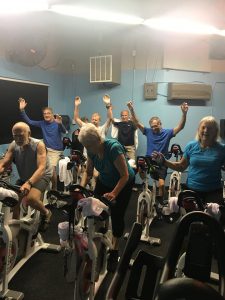
It’s a new year and time to renew my resolution to continue exercising at least 4 -5 times per week.  As 2017 came to a close a new research study was published that shows high intensity interval training (HIIT) delays Parkinson’s progression.  As Daniel Corcos, one of the lead authors of the study states “If you have Parkinson’s disease and you want to delay the progression of your symptoms, you should exercise three times a week with your heart rate between 80 and 85 percent maximum.  It is that simple.”  If you query Google for High Intensity Exercise and Parkinson’s you will find an abundance of articles about this study, here is the link to one of them from Science Daily

While the need to exercise for PD patients has been shown in many studies, this was one of the first to be conducted for 6 months instead of 12 weeks.  The participants were divided into three groups, HIIT exercise, moderate exercise and no exercise.  All scored about 20 on a PD scale of 0 – 108 before the study.  When scored after the 6 months The HIIT group showed no change while the moderate group got worse by 1.5 points and the no exercise group worsened by 3 points or about a 15% change.

Although  the primary exercise used during this study was the treadmill, Kathy, our Parkinson’s cycling instructor immediately figured that we can step up our cycling program to include high intensity intervals and start raising our aerobic fitness level.  So, even though many of us thought we were doing high intensity training already (well at least I did), she started pushing us to reach the 80 – 85% heart rate after Thanksgiving.  Almost every workout has incorporated HIIT and I am already starting to see a change in just 6 weeks.  The first few sessions I found I had to lower the gear to finish the workout.  But each time I felt I was getting stronger and this week I was able to increase instead of decrease the gear and still maintain the required 80 – 90 RPM.  I am happy with that progress and I am noticing a reduction in my symptoms after exercise including not feeling ‘off’ a half hour or so before it’s time to take my medicines on the day of exercise.

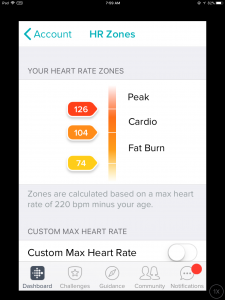
But I wondered what is happening to my aerobic fitness?  Then I discovered that my Fitbit app is keeping track of my cardio fitness! The app determined my heart rate zones and then uses those zones and my resting heart rate to compute a cardio fitness score.  As you can see in this screen shot on the left, Fitbit has determined that, for me,  a heart rate greater than 126 is my peak zone and my cardio zone is 104 – 125.  The peak range is approximately 80% of my maximum heart rate so anything above that would be considered high intensity exercise.

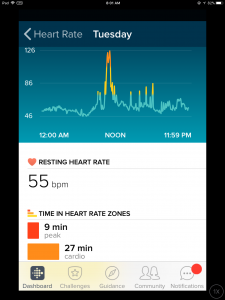
The app also graphs my heart rate for the entire day so I can tell from that graph how long I was in the peak zone.  The screen shot on the left is for 1/2/18 which includes a cycling class. 

November 16, 2017
January 2, 2018

So I was in the ‘zone’ for 9 minutes during the class which corresponds to intervals where we pushed up to 85 or 90 RPM for short periods.

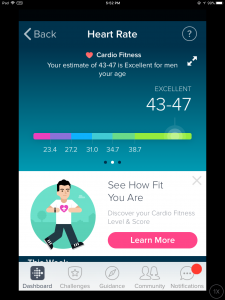
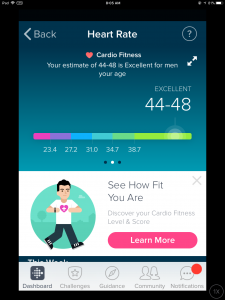
And here are screen shots showing my cardio fitness as computed by Fitbit on November 16, 2017 and January 2, 2018. So, in theory, I’ve already improved my Cardio Fitness by a point since we started the HIIT.  But just as important is that fact that either score is considered excellent by Fitbit where the average score for men over 60 is 27.2 – 31.0. 


Between cycling twice a week, playing tennis 2 -3 times a week and the Dance for PD class I am staying fit, slowing the progression of my Parkinson’s and having fun.  We will revisit my cardiac score in a month or so to see if the trend continues or maybe I’m maxed out!

So my New Year’s resolution this year is the same as last year, keep exercising and keep fighting PD. By the way, if you are interested in Pedaling for Parkinson’s, check out this video from the Sarasota YMCA website of one of Kathy’s classes and watch us having fun doing intervals!

“It does not matter how slowly you go as long as you do not stop.” – Confucius
 

Welcome 2018 – Another Year of Exercise

YMCA Pedaling Class Parakinsonscyclingcoach.com

It’s a new year and time to renew my resolution to continue exercising at least 4 -5 times per week.  As 2017 came to a close a new research study was published that shows high intensity interval training (HIIT) delays Parkinson’s progression.  As Daniel Corcos, one of the lead authors of the study states “If you have Parkinson’s disease and you want to delay the progression of your symptoms, you should exercise three times a week with your heart rate between 80 and 85 percent maximum.  It is that simple.”  If you query Google for High Intensity Exercise and Parkinson’s you will find an abundance of articles about this study, here is the link to one of them from Science Daily

While the need to exercise for PD patients has been shown in many studies, this was one of the first to be conducted for 6 months instead of 12 weeks.  The participants were divided into three groups, HIIT exercise, moderate exercise and no exercise.  All scored about 20 on a PD scale of 0 – 108 before the study.  When scored after the 6 months The HIIT group showed no change while the moderate group got worse by 1.5 points and the no exercise group worsened by 3 points or about a 15% change.

Although  the primary exercise used during this study was the treadmill, Kathy, our Parkinson’s cycling instructor immediately figured that we can step up our cycling program to include high intensity intervals and start raising our aerobic fitness level.  So, even though many of us thought we were doing high intensity training already (well at least I did), she started pushing us to reach the 80 – 85% heart rate after Thanksgiving.  Almost every workout has incorporated HIIT and I am already starting to see a change in just 6 weeks.  The first few sessions I found I had to lower the gear to finish the workout.  But each time I felt I was getting stronger and this week I was able to increase instead of decrease the gear and still maintain the required 80 – 90 RPM.  I am happy with that progress and I am noticing a reduction in my symptoms after exercise including not feeling ‘off’ a half hour or so before it’s time to take my medicines on the day of exercise.

But I wondered what is happening to my aerobic fitness?  Then I discovered that my Fitbit app is keeping track of my cardio fitness! The app determined my heart rate zones and then uses those zones and my resting heart rate to compute a cardio fitness score.  As you can see in this screen shot on the left, Fitbit has determined that, for me,  a heart rate greater than 126 is my peak zone and my cardio zone is 104 – 125.  The peak range is approximately 80% of my maximum heart rate so anything above that would be considered high intensity exercise.

The app also graphs my heart rate for the entire day so I can tell from that graph how long I was in the peak zone.  The screen shot on the left is for 1/2/18 which includes a cycling class. 

November 16, 2017
January 2, 2018

So I was in the ‘zone’ for 9 minutes during the class which corresponds to intervals where we pushed up to 85 or 90 RPM for short periods.

And here are screen shots showing my cardio fitness as computed by Fitbit on November 16, 2017 and January 2, 2018. So, in theory, I’ve already improved my Cardio Fitness by a point since we started the HIIT.  But just as important is that fact that either score is considered excellent by Fitbit where the average score for men over 60 is 27.2 – 31.0. 


Between cycling twice a week, playing tennis 2 -3 times a week and the Dance for PD class I am staying fit, slowing the progression of my Parkinson’s and having fun.  We will revisit my cardiac score in a month or so to see if the trend continues or maybe I’m maxed out!

So my New Year’s resolution this year is the same as last year, keep exercising and keep fighting PD. By the way, if you are interested in Pedaling for Parkinson’s, check out this video from the Sarasota YMCA website of one of Kathy’s classes and watch us having fun doing intervals!

“It does not matter how slowly you go as long as you do not stop.” – Confucius
 

Tag: Research

  • Welcome 2018 – Another Year of Exercise

    Welcome 2018 – Another Year of Exercise

    YMCA Pedaling Class Parakinsonscyclingcoach.com

    It’s a new year and time to renew my resolution to continue exercising at least 4 -5 times per week.  As 2017 came to a close a new research study was published that shows high intensity interval training (HIIT) delays Parkinson’s progression.  As Daniel Corcos, one of the lead authors of the study states “If you have Parkinson’s disease and you want to delay the progression of your symptoms, you should exercise three times a week with your heart rate between 80 and 85 percent maximum.  It is that simple.”  If you query Google for High Intensity Exercise and Parkinson’s you will find an abundance of articles about this study, here is the link to one of them from Science Daily

    While the need to exercise for PD patients has been shown in many studies, this was one of the first to be conducted for 6 months instead of 12 weeks.  The participants were divided into three groups, HIIT exercise, moderate exercise and no exercise.  All scored about 20 on a PD scale of 0 – 108 before the study.  When scored after the 6 months The HIIT group showed no change while the moderate group got worse by 1.5 points and the no exercise group worsened by 3 points or about a 15% change.

    Although  the primary exercise used during this study was the treadmill, Kathy, our Parkinson’s cycling instructor immediately figured that we can step up our cycling program to include high intensity intervals and start raising our aerobic fitness level.  So, even though many of us thought we were doing high intensity training already (well at least I did), she started pushing us to reach the 80 – 85% heart rate after Thanksgiving.  Almost every workout has incorporated HIIT and I am already starting to see a change in just 6 weeks.  The first few sessions I found I had to lower the gear to finish the workout.  But each time I felt I was getting stronger and this week I was able to increase instead of decrease the gear and still maintain the required 80 – 90 RPM.  I am happy with that progress and I am noticing a reduction in my symptoms after exercise including not feeling ‘off’ a half hour or so before it’s time to take my medicines on the day of exercise.

    But I wondered what is happening to my aerobic fitness?  Then I discovered that my Fitbit app is keeping track of my cardio fitness! The app determined my heart rate zones and then uses those zones and my resting heart rate to compute a cardio fitness score.  As you can see in this screen shot on the left, Fitbit has determined that, for me,  a heart rate greater than 126 is my peak zone and my cardio zone is 104 – 125.  The peak range is approximately 80% of my maximum heart rate so anything above that would be considered high intensity exercise.

    The app also graphs my heart rate for the entire day so I can tell from that graph how long I was in the peak zone.  The screen shot on the left is for 1/2/18 which includes a cycling class. 

    November 16, 2017
    January 2, 2018

    So I was in the ‘zone’ for 9 minutes during the class which corresponds to intervals where we pushed up to 85 or 90 RPM for short periods.

    And here are screen shots showing my cardio fitness as computed by Fitbit on November 16, 2017 and January 2, 2018. So, in theory, I’ve already improved my Cardio Fitness by a point since we started the HIIT.  But just as important is that fact that either score is considered excellent by Fitbit where the average score for men over 60 is 27.2 – 31.0. 


    Between cycling twice a week, playing tennis 2 -3 times a week and the Dance for PD class I am staying fit, slowing the progression of my Parkinson’s and having fun.  We will revisit my cardiac score in a month or so to see if the trend continues or maybe I’m maxed out!

    So my New Year’s resolution this year is the same as last year, keep exercising and keep fighting PD. By the way, if you are interested in Pedaling for Parkinson’s, check out this video from the Sarasota YMCA website of one of Kathy’s classes and watch us having fun doing intervals!

    “It does not matter how slowly you go as long as you do not stop.” – Confucius
     
  • Thanksgiving

    Happy Thanksgiving Holiday! 

    It is a busy time of year but I wanted send along good wishes for the holiday, pass along a reminder or two and note some items of interest in the Parkinson’s community.

    Reminder number one:  November is National Caregivers  Month.  Yes the month is about over but I know that you, like me, are  thankful for your care partner(s) every day of the year.  Remember there are lots of resources available for care partners and one of the best, available from the Parkinson’s Foundation, is the Caring and Coping guide, written for caregivers at every stage of PD.  Download load a copy at this link.

    Reminder number two:  Tuesday the 28th is Giving Tuesday.  This is a great opportunity to make a donation to your favorite charity and, in many cases, have it matched.  For example the Michael J Fox Foundation is shooting to raise $1million in 1 day with every donation matched by anonymous donors.  Many other charities have similar opportunities on Tuesday, so scrape the bottom of your pocket book or wallet after Black Friday and Cyber Monday and help us find a cure for PD or the charity of your choice.

    Item of interest number one:  This article  Neurological disorders – including Parkinson’s – are leading source of disability globally  points out that PD is becoming pandemic and we must take action to find a cure.  This summary is worth the few minutes it will take you to read.

    Item of interest number two:  The Michael J. Fox Foundation for Parkinson’s Research has launched Fox Insight — an online clinical study that empowers people with PD to partner with researchers and accelerate the development of breakthrough treatments. I have talked about Fox Insight in previous posts but, if you haven’t joined yet, now is the time, your data is needed as we work to find a cure.  Click on the link above to get more information and join us.

    Item of interest number three:  The next World Parkinson’s Congress will be June, 2019 in Kyoto, Japan.  Soaring With Hope has started a project to make origami cranes for an art installation to display at the WPC.   Each crane represents a person withParkinson’s or a person impacted by Parkinson’s. They are asking each person to give their message of hope, which will be written on a crane.  They have a goal of 10,000 cranes to bring to the WPC, each of them with a message of hope written on it to help raise awareness and HOPE for PD globally.  Please take a minute to click on this link and add your WORDS OF HOPE, and please spread the word to get others to join in and participate.  Thanks to Sharon Krischer (blogging as Twitchy Woman) for providing this information on her blog.

    On this Thanksgiving day I am thankful for the support of my wonderful wife, my family, my friends and all of you who take the time to read my occasional posts. Thank you all and Happy Thanksgiving!

  • Walking for Parkinson’s Research

    Walking for Parkinson’s Research

    Yesterday was our local Parkinson’s Walk held in Oak Ridge,TN.  The weather websites were predicting rain and thunderstorms, but it turned out to just be a cloudy day. Our local walk is in support of the Unity Walk in New York City and 100% of the funds raised go to the seven major Parkinson’s research organizations.Despite the weather forecast we had a good turnout and raised over $8100 for PD research. I want to again thank all of you who made a donation in support of Mara and me and Team PK Hope is Alive – THANKS!

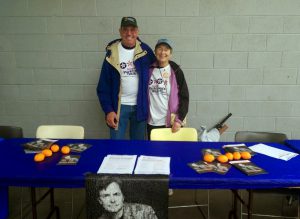
    We arrived early to help with the setup for the walk and I was glad my stepson, Darrin, joined us for the heavy lifting! This was also our first ‘gig’ as Fox Trial Finder Ambassadors and we set up a table to promote Fox Trial Finder and Fox InSight. We had a lot of activity at our table, handed out a lot of information and MJFF orange brain shaped stress relievers. We met a lot of new people who were interested in both programs and hopefully our efforts result in some new sign ups.

    We were asked to speak during the prerace ceremonies so, in addition to our first Trial Finder gig, I made my first presentation about current research and the need for participating in Fox Trial Finder and Fox InSight. I had prepared some notes (about 7 pages when printed in large type!) but found it hard to read the notes, maintain some eye contact, speak loudly AND hold the microphone at the same time so it was more of an ‘off the cuff’ speech it but it seemed to go OK for a first attempt.

     
    This week I moved the blog to its own internet domain www.tomspdblog.com which is easier for me (and you) to remember when people ask for the address. Google assures me there should be no noticeable change for readers as both the old and the new address will end up at the blog. So far it seems to be working OK, but those of you who have the address bookmarked may want to update your bookmark to the new address.
     
    Next Thursday we go to Vanderbilt for my next appointment with my Movement Disorder Specialist.  I continue to be so much better on the new medication and I hope Dr. Davis agrees. I am also hoping to be considered for the NPF Parkinson’s Outcomes Project which is conducted at the NPF Center’s of Excellence of which Vanderbilt is one. They have been following PwP since 2009 with a goal of establishing models of excellent PD care for best health outcomes. You can read more on the NPF website at this link .
     
    I’m still working at reviewing some of the exercise options available for PwP, maybe it will be done by the next post (I’m pretty sure procrastination is another non motor symptom!) In the meantime, don’t forget to sign up for Fox Trial Finder and Fox Insight and be an agent for change!
     
    “It does not matter how slowly you go as long as you do not stop.” – Confucius