• Stay Injury Free While Combating Parkinson’s Disease

    I just posted this on our East Tennessee Support Group website and thought I would also post it here. This excellent article is from the PD Gladiators™ website and is posted here with their permission. PD Gladiators™ is a nonprofit organization devoted to combating Parkinson’s disease with vigorous exercise. They are based in Atlanta and provide over 40 weekly exercise classes for PD patients in the Atlanta area. For more information, please visit their website by clicking here.

    Stay Injury Free While Combating Parkinson’s Disease

    Maggie-Coslett

    Posting for Dr. Hackney this month is Maggie Coslett a doctoral candidate at Emory University School of Medicine’s DPT program. She is also working on a Dance Medicine Directed Study Internship, evaluating and providing appropriate therapeutic interventions for a variety of dance-specific injuries and conditions . Maggie has assisted with treatment sessions for Atlanta Ballet dancers and other pre-professional dancers.

    Madeleine E. Hackney, PhD The Exercise Files blog

    We all are now well aware of the research that highlights the benefits of exercise for Parkinson’s disease (PD). Many neurologists now are saying that exercise could even be considered as a type of medication for PD, and it should be taken regularly.1 Exercise has been shown to help slow the progression of Parkinson’s, prevent falls, improve balance and strength, result in better posture, and even assist your brain’s cognitive function.1 With all of these positive gains, who wouldn’t want to exercise? With so many great options out there now for PD individuals including boxing, tai chi, yoga, dance, Zumba, and movement classes that specifically target PD-specific concerns, there is no question that many of you will begin exercising for the first time in years. However when beginning a new exercise program, there is always the risk of becoming injured.

    Having been a dancer for ten years, one of the most important lessons I learned was knowing how to listen to my own body. I knew when a particular movement did not feel right, and I knew when to not ignore the pain and get my body checked out. Now that I am fortunate enough to be working with the physical therapists who treat the Atlanta Ballet dancers through a directed study internship, I have noticed that the same mentality holds true with these dancers. We consistently see dancers that come in due to something not ‘feeling right’ during class or rehearsal, and they want to get it checked out sooner rather than later to prevent injury. They are dedicated and motivated to continue dancing, and they understand that sometimes this means that they have to take a break to allow their body to rest. This trend is true for all of the dancers we treat, from the professional dancers all the way down to the 10 year olds. They have this devotion and perseverance instilled in them to follow the necessary recovery steps in order to pursue their passion of dancing.

    In order for all of you to continue to exercise long-term, I have compiled a few tips that I have learned along the way to help ensure that you can combat Parkinson’s while staying injury free!

    Listen to your body!

    No Pain No Gain

    One of the biggest causes of overuse injuries is not realizing when to listen to your body and stop exercising. Forget the old saying “no pain, no gain” and begin noticing if you are experiencing any type of pain that lasts more than a few days. You are expected to feel some soreness and pain after a hard workout or if you engage in a new type of exercise, as the muscles are beginning their break-down and repair process in order to grow stronger. However, if this pain lasts more than 72 hours, it is likely that you may have suffered an injury. If you attempt to “work through” the pain hoping it will ease off, it will most likely continue to get worse. Our muscles require some amount of time to be able to adjust and adapt to a new program, and if they do not receive enough of the necessary rest, they can fatigue and your body begins to compensate, leading to injury.

    If you are taking one of the classes offered through PD Gladiators, you can always notify your instructor who will help guide you in the right direction. But if you are beginning a new workout session independently, I would highly recommend getting a trainer for the first month in order to have someone there to help you recognize what is “good” pain and what is “bad” pain. Sometimes you just need a little bit more rest in between exercise sessions to allow your body to recover, so listen to YOUR body and take some time off so that next time you can push it even harder at that exercise class!

    Warm-up and Cool-down

    Group exercise guys

    Most exercise programs incorporate warm-ups and cool-downs into their sessions, but if you start to realize that there is not enough for your specific needs, you can begin coming to class a little early in order to get your body primed for exercise! It has been proven that warm-up prior to physical activity significantly reduces the likelihood of an injury occurring.3 A proper warm-up allows your body temperature to increase, facilitates the blood flow to the muscles, steadily increases your heart rate, and this gives oxygen the opportunity to be sent out to the body more efficiently.3 A proper warm-up should also include dynamic stretching rather than static stretching. Dynamic stretching is a type of stretching that involves movement and is a very quick stretch to the muscle. This can include walking back and forth while drawing your knee to your chest, swinging your leg out in front and back, performing lunges, or arm circles.

    Static stretching is the type of prolonged stretch that most of us think of with the word ‘stretch’. However this type of stretch is more beneficial to be performed after exercise during the cool-down. Static stretching allows the muscles to relax and helps re-align the muscle fibers to assist in preventing injury. This is any type of stretch where you hold the position for 10 seconds or longer. Skipping the cool-down will also result in waste products such as lactic acid to build up in the muscle and can cause additional muscle soreness later on.3

    Exercise at YOUR Level

    Every person is different and unique, and everyone who partakes in fitness classes is on a particular level. I know it is difficult to try and not compare yourself to other individuals in the class, but just know that everyone began from square one at some point, and you need to start off slow in the beginning. By individualizing your exercise session and listening to your body, you will help prevent injuries from occurring and you can exercise for a long time in the future!

    Get Plenty of Rest

    Enough sleep is necessary in order to help your body to repair itself. Every individual needs between 7 and 9 hours each night in order for your body to release its natural hormones and keep you energized and ready for that next exercise session.

    Eat Healthy and Hydrate

    Make sure you drink enough water during exercise to help prevent unnecessary fatigue and muscle cramps. Proper nutrition can also help keep your mind alert and your body feeling great so you can take it to the next level.

    Cross-Training

    Repeating the same motions and movement patterns over and over again can lead to overuse injuries. By choosing other various activities and exercise classes, you can give your muscles a break and allow them to recover. Try combining dance or zumba classes with boxing classes to get a combination of upper and lower body strengthening!

    Get Regular Physicals

    Going to see your primary care provider regularly can help make sure you do not have any other health issues or overuse injuries occurring. Your doctor can make sure that everything looks great, and in the chance that there might be an injury or there are risk factors present, your doctor can then possibly make the decision to refer you to another healthcare profession such as physical therapy.

    References:
    1. Cianci, H. (2012). Parkinson’s disease: fitness counts. National Parkinson Foundation.
    2. Exercise: Injury Prevention and Self-Care. (2014, March). Retrieved February 24, 2016. http://www.uhs.berkeley.edu/home/healthtopics/exerciseselfcare.shtml
    3. Woods, K., Bishop, P., & Jones, E. (2007). Warm-up and stretching in the prevention of muscular injury. Sports Medicine, 37(12), 1089-1099.

    Dr. Madeleine E. Hackney, Ph.D, is a Research Health Scientist at the Atlanta VA Center for Visual and Neurocognitive Rehabilitation and an Assistant professor of Medicine in the division of General Medicine and Geriatrics at the Emory School of Medicine. She holds a Ph.D. in Movement Science from Washington University and a BFA in Dance from NYU, Tisch School of the Arts and has also been an American Council on Exercise certified personal trainer since 2000. Dr. Hackney’s extensive research interests include inquiry into challenging exercise programs–traditional exercise, Tai Chi and partnered tango classes–designed to improve physical function and quality of life in people with PD, older adults and those with serious mental illness. In 2014, she co-founded MDT Education Solutions, which has trained dozens of fitness and allied health professionals how to develop and lead safe, evidence-based exercise programs for people with PD at all stages of the disease, including almost all instructors in the PD Gladiators Metro Atlanta Fitness Network (including the YMCA of Metro Atlanta).
  • Pedaling with Parkinson’s

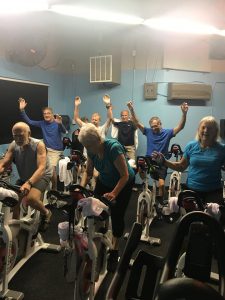
    As part of our stay here in Florida, we became temporary members at a local Gym that provides PwP specific classes along with all the other amenities of a large gym.  One of the classes they offer is Pedaling with Parkinson’s, a twice a week spin class specificly designed for PwP’s.  The objective of the session is to cycle for 40 minutes, keeping your heart rate between 60% – 80% of your MHR (maximum heart rate), and keeping the cadence (RPM) between 80 and 90 RPM per minute.

    In order to take the class, I had an hour long evaluation that covered, among many things, medical conditions other than PD, what PD symptoms I had, and how my balance was – almost made the 30 seconds standing on one foot! Then, after taking my resting heart rate and blood pressure, I spent 20 minutes on the spin bike, upping the resistance until I couldn’t maintain 80 RPM for a minute, which provided my MHR.

    I managed to pass the tests so last Friday I joined a full class of 20+ PwP’s for my first forced march on a bike!  After adjusting the bike, putting on the heart rate monitor and doing a light warm up spin (you know in the 60 – 80 RPM range) the instructor cranked up the music and off we went, upping the resistance while maintaining the cadence at 80 – 90 RPM for what seemed to be forever. OK maybe it wasn’t forever but it was a solid 40 minute workout, with brief slow downs for hydration before the next song came on.  All of our data was captured on a computer which then projected our heart rate and the percent of MHR up on a screen in front of the room.  In addition, the bike was equipped with a device showing our RPM, heart rate and % of MHR.

    This program is based on research by Jay Alberts, PhD, at the Cleveland Clinic and a demonstration study by the Neuro Challenge Foundation here in Sarasota which have yielded promising preliminary scientific and anecdotal results.  The studies have indicated that doing this twice a week helps create new pathways (neuroplasticity) in the brain and participants have reported a reduction in tremors, better balance and gait, regained sense of smell, and increased energy. I have been interested in doing this for some time and I’m glad I get the opportunity to participate while here as they also offer this class at the YMCA in Knoxville if I want to continue when I get home.

    The Neuro Challenge Foundation also sponsors the three dance for PD classes we are attending while here along with many other activities for PwP and Care Partners.  They provide a Parkinson Disease Resource Guide and offer a one on one Care Advisor Program to help PD Patients find the best treatment and support options available.  An excellent resource for PwP in the Sarasota area and one of the reasons we like to come to this area.  Speaking of dance classes, our Let Your Yoga Dance for PD class made the local paper, you can view the article here.  We have a good time in all three classes and it certainly helps keep me flexible.

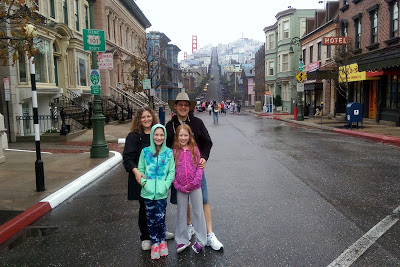
    Oh, did I mention we caught up with Dale, Monica and grand daughters Angelina and Ariana in San Francisco?  OK, maybe we were at Disney World’s Hollywood Studios and took advantage of the set.  We had a great time with them in Disney World and here at the beach.

    We continue to enjoy our beach time in between dance classes and time at the gym and I can’t believe our time here is half over already!

    Don’t forget to sign up for MJF Trial Finder by clicking on that large orange button on the top right and then you might as well join Fox Insight by clicking on the logo to your right!  Thanks.

    “It does not matter how slowly you go as long as you do not stop.” – Confucius


  • It’s a New Year…

    and it’s way past time for a catch up blog post. I think the last post of substance was about Giving Tuesday at the end of November, 2015! So this is my attempt to condense a couple of months of activity into one post. Not long after the Giving Tuesday post, we made an unscheduled trip to Traverse City, MI to help out Mara’s sister with her used book store. We have no retail experience and it’s been over ten years since I’ve worked a 40+ hour shift but we had a great time taking care of business. If you are in the Traverse City area, be sure and stop in at her store The Bookie Joint downtown just off Front Street. (yep, a shameless plug!)

    We got home just in time to get ready for Christmas and enjoyed the holidays with our family and then it was time to start getting ready for THE BEACH! We arrived last Saturday and were awakened at 3am Sunday morning by the sounds of a tornado (I’ll be darned if it didn’t sound just like a train).  Luckily no one in our complex was injured but a lot of the units had windows and screens damaged and a lot of cars suffered broken glass and other damage.  We hadn’t planned on being part of the effort to prove the theory of global warning but we are thankful that no one was hurt and our unit and car were not damaged.

    On the Parkinson’s front, I was appointed webmaster for the East Tennessee Parkinson’s Support Group and spent a lot of free time during December learning WordPress and upgrading the site to the latest version.  When that wrapped up early in January I spent my free time updating the Tennessee Parkinson’s Disease Resource site with maps and adding new information.

    Somehow I also managed to take an exercise holiday and I began to notice my symptoms were getting worse, particularly the brady kinesia (ridgity).  Since we arrived in Florida, I have been walking at least an hour a day and we have signed up for two Parkinson’s dance classes  We are also planning to sign up for additional exercise classes at the Neuro Challenge Institute, a great resource for Parkinson’s Patients in the greater Sarasota area.  I am already noticing improvement which once again proves how important exercise is for PWP’s!  

    We also signed up for a weekly Let Your Yoga Dance class. We were introduced to Let Your Yoga Dance while at the Kripalu retreat in October 2013 and this class reunited us with instructor/founder Megha and Joel and Melissa whom we first met at the retreat and meet up with every year while in Sarasota.  Our first class was yesterday and Megha had us doing deep breathing exercises, stretching and dancing in no time. It is a great class that not only provides exercise but brings ‘healing through joy’. 

    Coming up we will attend the Neuro Challenge Insitute annual Parkinson’s Symposium on Saturday where one of the topics to be covered is the Tasigna trial conducted at Georgetown University.  Tasigna is a leukemia drug that appears to stop or reverse some of the PD symptoms during a small test involving 12 Parkinson’s patients.  I am looking forward to hearing more about the first trial and the results and will provide more information in the next post.

    So there you have it, a short version of a very busy couple of months.  Oh, did I mention I am still wearing my smartwatch and providing data for the Fox Insight Trial?  If you haven’t signed up you can do it here, and don’t forget to also sign up for Fox Trial Finder at the same time and join over 52,000 of us who have already signed up!


    “It does not matter how slowly you go as long as you do not stop.” – Confucius


Welcome 2018 – Another Year of Exercise

YMCA Pedaling Class Parakinsonscyclingcoach.com

It’s a new year and time to renew my resolution to continue exercising at least 4 -5 times per week.  As 2017 came to a close a new research study was published that shows high intensity interval training (HIIT) delays Parkinson’s progression.  As Daniel Corcos, one of the lead authors of the study states “If you have Parkinson’s disease and you want to delay the progression of your symptoms, you should exercise three times a week with your heart rate between 80 and 85 percent maximum.  It is that simple.”  If you query Google for High Intensity Exercise and Parkinson’s you will find an abundance of articles about this study, here is the link to one of them from Science Daily

While the need to exercise for PD patients has been shown in many studies, this was one of the first to be conducted for 6 months instead of 12 weeks.  The participants were divided into three groups, HIIT exercise, moderate exercise and no exercise.  All scored about 20 on a PD scale of 0 – 108 before the study.  When scored after the 6 months The HIIT group showed no change while the moderate group got worse by 1.5 points and the no exercise group worsened by 3 points or about a 15% change.

Although  the primary exercise used during this study was the treadmill, Kathy, our Parkinson’s cycling instructor immediately figured that we can step up our cycling program to include high intensity intervals and start raising our aerobic fitness level.  So, even though many of us thought we were doing high intensity training already (well at least I did), she started pushing us to reach the 80 – 85% heart rate after Thanksgiving.  Almost every workout has incorporated HIIT and I am already starting to see a change in just 6 weeks.  The first few sessions I found I had to lower the gear to finish the workout.  But each time I felt I was getting stronger and this week I was able to increase instead of decrease the gear and still maintain the required 80 – 90 RPM.  I am happy with that progress and I am noticing a reduction in my symptoms after exercise including not feeling ‘off’ a half hour or so before it’s time to take my medicines on the day of exercise.

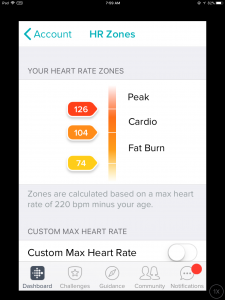
But I wondered what is happening to my aerobic fitness?  Then I discovered that my Fitbit app is keeping track of my cardio fitness! The app determined my heart rate zones and then uses those zones and my resting heart rate to compute a cardio fitness score.  As you can see in this screen shot on the left, Fitbit has determined that, for me,  a heart rate greater than 126 is my peak zone and my cardio zone is 104 – 125.  The peak range is approximately 80% of my maximum heart rate so anything above that would be considered high intensity exercise.

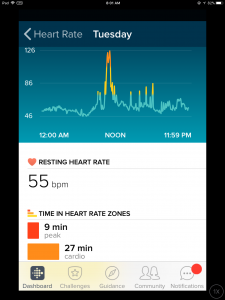
The app also graphs my heart rate for the entire day so I can tell from that graph how long I was in the peak zone.  The screen shot on the left is for 1/2/18 which includes a cycling class. 

November 16, 2017
January 2, 2018

So I was in the ‘zone’ for 9 minutes during the class which corresponds to intervals where we pushed up to 85 or 90 RPM for short periods.

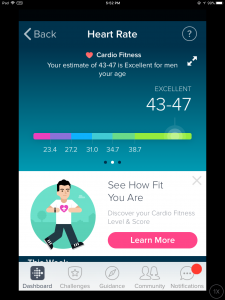
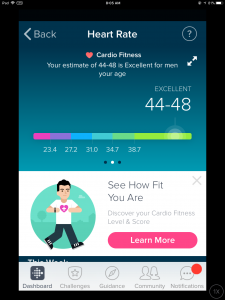
And here are screen shots showing my cardio fitness as computed by Fitbit on November 16, 2017 and January 2, 2018. So, in theory, I’ve already improved my Cardio Fitness by a point since we started the HIIT.  But just as important is that fact that either score is considered excellent by Fitbit where the average score for men over 60 is 27.2 – 31.0. 


Between cycling twice a week, playing tennis 2 -3 times a week and the Dance for PD class I am staying fit, slowing the progression of my Parkinson’s and having fun.  We will revisit my cardiac score in a month or so to see if the trend continues or maybe I’m maxed out!

So my New Year’s resolution this year is the same as last year, keep exercising and keep fighting PD. By the way, if you are interested in Pedaling for Parkinson’s, check out this video from the Sarasota YMCA website of one of Kathy’s classes and watch us having fun doing intervals!

“It does not matter how slowly you go as long as you do not stop.” – Confucius
 

Welcome 2018 – Another Year of Exercise

YMCA Pedaling Class Parakinsonscyclingcoach.com

It’s a new year and time to renew my resolution to continue exercising at least 4 -5 times per week.  As 2017 came to a close a new research study was published that shows high intensity interval training (HIIT) delays Parkinson’s progression.  As Daniel Corcos, one of the lead authors of the study states “If you have Parkinson’s disease and you want to delay the progression of your symptoms, you should exercise three times a week with your heart rate between 80 and 85 percent maximum.  It is that simple.”  If you query Google for High Intensity Exercise and Parkinson’s you will find an abundance of articles about this study, here is the link to one of them from Science Daily

While the need to exercise for PD patients has been shown in many studies, this was one of the first to be conducted for 6 months instead of 12 weeks.  The participants were divided into three groups, HIIT exercise, moderate exercise and no exercise.  All scored about 20 on a PD scale of 0 – 108 before the study.  When scored after the 6 months The HIIT group showed no change while the moderate group got worse by 1.5 points and the no exercise group worsened by 3 points or about a 15% change.

Although  the primary exercise used during this study was the treadmill, Kathy, our Parkinson’s cycling instructor immediately figured that we can step up our cycling program to include high intensity intervals and start raising our aerobic fitness level.  So, even though many of us thought we were doing high intensity training already (well at least I did), she started pushing us to reach the 80 – 85% heart rate after Thanksgiving.  Almost every workout has incorporated HIIT and I am already starting to see a change in just 6 weeks.  The first few sessions I found I had to lower the gear to finish the workout.  But each time I felt I was getting stronger and this week I was able to increase instead of decrease the gear and still maintain the required 80 – 90 RPM.  I am happy with that progress and I am noticing a reduction in my symptoms after exercise including not feeling ‘off’ a half hour or so before it’s time to take my medicines on the day of exercise.

But I wondered what is happening to my aerobic fitness?  Then I discovered that my Fitbit app is keeping track of my cardio fitness! The app determined my heart rate zones and then uses those zones and my resting heart rate to compute a cardio fitness score.  As you can see in this screen shot on the left, Fitbit has determined that, for me,  a heart rate greater than 126 is my peak zone and my cardio zone is 104 – 125.  The peak range is approximately 80% of my maximum heart rate so anything above that would be considered high intensity exercise.

The app also graphs my heart rate for the entire day so I can tell from that graph how long I was in the peak zone.  The screen shot on the left is for 1/2/18 which includes a cycling class. 

November 16, 2017
January 2, 2018

So I was in the ‘zone’ for 9 minutes during the class which corresponds to intervals where we pushed up to 85 or 90 RPM for short periods.

And here are screen shots showing my cardio fitness as computed by Fitbit on November 16, 2017 and January 2, 2018. So, in theory, I’ve already improved my Cardio Fitness by a point since we started the HIIT.  But just as important is that fact that either score is considered excellent by Fitbit where the average score for men over 60 is 27.2 – 31.0. 


Between cycling twice a week, playing tennis 2 -3 times a week and the Dance for PD class I am staying fit, slowing the progression of my Parkinson’s and having fun.  We will revisit my cardiac score in a month or so to see if the trend continues or maybe I’m maxed out!

So my New Year’s resolution this year is the same as last year, keep exercising and keep fighting PD. By the way, if you are interested in Pedaling for Parkinson’s, check out this video from the Sarasota YMCA website of one of Kathy’s classes and watch us having fun doing intervals!

“It does not matter how slowly you go as long as you do not stop.” – Confucius
 

Tag: Research

  • Welcome 2018 – Another Year of Exercise

    Welcome 2018 – Another Year of Exercise

    YMCA Pedaling Class Parakinsonscyclingcoach.com

    It’s a new year and time to renew my resolution to continue exercising at least 4 -5 times per week.  As 2017 came to a close a new research study was published that shows high intensity interval training (HIIT) delays Parkinson’s progression.  As Daniel Corcos, one of the lead authors of the study states “If you have Parkinson’s disease and you want to delay the progression of your symptoms, you should exercise three times a week with your heart rate between 80 and 85 percent maximum.  It is that simple.”  If you query Google for High Intensity Exercise and Parkinson’s you will find an abundance of articles about this study, here is the link to one of them from Science Daily

    While the need to exercise for PD patients has been shown in many studies, this was one of the first to be conducted for 6 months instead of 12 weeks.  The participants were divided into three groups, HIIT exercise, moderate exercise and no exercise.  All scored about 20 on a PD scale of 0 – 108 before the study.  When scored after the 6 months The HIIT group showed no change while the moderate group got worse by 1.5 points and the no exercise group worsened by 3 points or about a 15% change.

    Although  the primary exercise used during this study was the treadmill, Kathy, our Parkinson’s cycling instructor immediately figured that we can step up our cycling program to include high intensity intervals and start raising our aerobic fitness level.  So, even though many of us thought we were doing high intensity training already (well at least I did), she started pushing us to reach the 80 – 85% heart rate after Thanksgiving.  Almost every workout has incorporated HIIT and I am already starting to see a change in just 6 weeks.  The first few sessions I found I had to lower the gear to finish the workout.  But each time I felt I was getting stronger and this week I was able to increase instead of decrease the gear and still maintain the required 80 – 90 RPM.  I am happy with that progress and I am noticing a reduction in my symptoms after exercise including not feeling ‘off’ a half hour or so before it’s time to take my medicines on the day of exercise.

    But I wondered what is happening to my aerobic fitness?  Then I discovered that my Fitbit app is keeping track of my cardio fitness! The app determined my heart rate zones and then uses those zones and my resting heart rate to compute a cardio fitness score.  As you can see in this screen shot on the left, Fitbit has determined that, for me,  a heart rate greater than 126 is my peak zone and my cardio zone is 104 – 125.  The peak range is approximately 80% of my maximum heart rate so anything above that would be considered high intensity exercise.

    The app also graphs my heart rate for the entire day so I can tell from that graph how long I was in the peak zone.  The screen shot on the left is for 1/2/18 which includes a cycling class. 

    November 16, 2017
    January 2, 2018

    So I was in the ‘zone’ for 9 minutes during the class which corresponds to intervals where we pushed up to 85 or 90 RPM for short periods.

    And here are screen shots showing my cardio fitness as computed by Fitbit on November 16, 2017 and January 2, 2018. So, in theory, I’ve already improved my Cardio Fitness by a point since we started the HIIT.  But just as important is that fact that either score is considered excellent by Fitbit where the average score for men over 60 is 27.2 – 31.0. 


    Between cycling twice a week, playing tennis 2 -3 times a week and the Dance for PD class I am staying fit, slowing the progression of my Parkinson’s and having fun.  We will revisit my cardiac score in a month or so to see if the trend continues or maybe I’m maxed out!

    So my New Year’s resolution this year is the same as last year, keep exercising and keep fighting PD. By the way, if you are interested in Pedaling for Parkinson’s, check out this video from the Sarasota YMCA website of one of Kathy’s classes and watch us having fun doing intervals!

    “It does not matter how slowly you go as long as you do not stop.” – Confucius
     
  • Thanksgiving

    Happy Thanksgiving Holiday! 

    It is a busy time of year but I wanted send along good wishes for the holiday, pass along a reminder or two and note some items of interest in the Parkinson’s community.

    Reminder number one:  November is National Caregivers  Month.  Yes the month is about over but I know that you, like me, are  thankful for your care partner(s) every day of the year.  Remember there are lots of resources available for care partners and one of the best, available from the Parkinson’s Foundation, is the Caring and Coping guide, written for caregivers at every stage of PD.  Download load a copy at this link.

    Reminder number two:  Tuesday the 28th is Giving Tuesday.  This is a great opportunity to make a donation to your favorite charity and, in many cases, have it matched.  For example the Michael J Fox Foundation is shooting to raise $1million in 1 day with every donation matched by anonymous donors.  Many other charities have similar opportunities on Tuesday, so scrape the bottom of your pocket book or wallet after Black Friday and Cyber Monday and help us find a cure for PD or the charity of your choice.

    Item of interest number one:  This article  Neurological disorders – including Parkinson’s – are leading source of disability globally  points out that PD is becoming pandemic and we must take action to find a cure.  This summary is worth the few minutes it will take you to read.

    Item of interest number two:  The Michael J. Fox Foundation for Parkinson’s Research has launched Fox Insight — an online clinical study that empowers people with PD to partner with researchers and accelerate the development of breakthrough treatments. I have talked about Fox Insight in previous posts but, if you haven’t joined yet, now is the time, your data is needed as we work to find a cure.  Click on the link above to get more information and join us.

    Item of interest number three:  The next World Parkinson’s Congress will be June, 2019 in Kyoto, Japan.  Soaring With Hope has started a project to make origami cranes for an art installation to display at the WPC.   Each crane represents a person withParkinson’s or a person impacted by Parkinson’s. They are asking each person to give their message of hope, which will be written on a crane.  They have a goal of 10,000 cranes to bring to the WPC, each of them with a message of hope written on it to help raise awareness and HOPE for PD globally.  Please take a minute to click on this link and add your WORDS OF HOPE, and please spread the word to get others to join in and participate.  Thanks to Sharon Krischer (blogging as Twitchy Woman) for providing this information on her blog.

    On this Thanksgiving day I am thankful for the support of my wonderful wife, my family, my friends and all of you who take the time to read my occasional posts. Thank you all and Happy Thanksgiving!

  • Walking for Parkinson’s Research

    Walking for Parkinson’s Research

    Yesterday was our local Parkinson’s Walk held in Oak Ridge,TN.  The weather websites were predicting rain and thunderstorms, but it turned out to just be a cloudy day. Our local walk is in support of the Unity Walk in New York City and 100% of the funds raised go to the seven major Parkinson’s research organizations.Despite the weather forecast we had a good turnout and raised over $8100 for PD research. I want to again thank all of you who made a donation in support of Mara and me and Team PK Hope is Alive – THANKS!

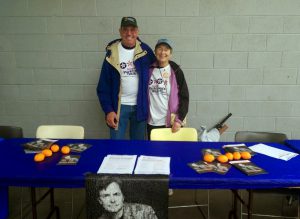
    We arrived early to help with the setup for the walk and I was glad my stepson, Darrin, joined us for the heavy lifting! This was also our first ‘gig’ as Fox Trial Finder Ambassadors and we set up a table to promote Fox Trial Finder and Fox InSight. We had a lot of activity at our table, handed out a lot of information and MJFF orange brain shaped stress relievers. We met a lot of new people who were interested in both programs and hopefully our efforts result in some new sign ups.

    We were asked to speak during the prerace ceremonies so, in addition to our first Trial Finder gig, I made my first presentation about current research and the need for participating in Fox Trial Finder and Fox InSight. I had prepared some notes (about 7 pages when printed in large type!) but found it hard to read the notes, maintain some eye contact, speak loudly AND hold the microphone at the same time so it was more of an ‘off the cuff’ speech it but it seemed to go OK for a first attempt.

     
    This week I moved the blog to its own internet domain www.tomspdblog.com which is easier for me (and you) to remember when people ask for the address. Google assures me there should be no noticeable change for readers as both the old and the new address will end up at the blog. So far it seems to be working OK, but those of you who have the address bookmarked may want to update your bookmark to the new address.
     
    Next Thursday we go to Vanderbilt for my next appointment with my Movement Disorder Specialist.  I continue to be so much better on the new medication and I hope Dr. Davis agrees. I am also hoping to be considered for the NPF Parkinson’s Outcomes Project which is conducted at the NPF Center’s of Excellence of which Vanderbilt is one. They have been following PwP since 2009 with a goal of establishing models of excellent PD care for best health outcomes. You can read more on the NPF website at this link .
     
    I’m still working at reviewing some of the exercise options available for PwP, maybe it will be done by the next post (I’m pretty sure procrastination is another non motor symptom!) In the meantime, don’t forget to sign up for Fox Trial Finder and Fox Insight and be an agent for change!
     
    “It does not matter how slowly you go as long as you do not stop.” – Confucius