• Stay Injury Free While Combating Parkinson’s Disease

    I just posted this on our East Tennessee Support Group website and thought I would also post it here. This excellent article is from the PD Gladiators™ website and is posted here with their permission. PD Gladiators™ is a nonprofit organization devoted to combating Parkinson’s disease with vigorous exercise. They are based in Atlanta and provide over 40 weekly exercise classes for PD patients in the Atlanta area. For more information, please visit their website by clicking here.

    Stay Injury Free While Combating Parkinson’s Disease

    Maggie-Coslett

    Posting for Dr. Hackney this month is Maggie Coslett a doctoral candidate at Emory University School of Medicine’s DPT program. She is also working on a Dance Medicine Directed Study Internship, evaluating and providing appropriate therapeutic interventions for a variety of dance-specific injuries and conditions . Maggie has assisted with treatment sessions for Atlanta Ballet dancers and other pre-professional dancers.

    Madeleine E. Hackney, PhD The Exercise Files blog

    We all are now well aware of the research that highlights the benefits of exercise for Parkinson’s disease (PD). Many neurologists now are saying that exercise could even be considered as a type of medication for PD, and it should be taken regularly.1 Exercise has been shown to help slow the progression of Parkinson’s, prevent falls, improve balance and strength, result in better posture, and even assist your brain’s cognitive function.1 With all of these positive gains, who wouldn’t want to exercise? With so many great options out there now for PD individuals including boxing, tai chi, yoga, dance, Zumba, and movement classes that specifically target PD-specific concerns, there is no question that many of you will begin exercising for the first time in years. However when beginning a new exercise program, there is always the risk of becoming injured.

    Having been a dancer for ten years, one of the most important lessons I learned was knowing how to listen to my own body. I knew when a particular movement did not feel right, and I knew when to not ignore the pain and get my body checked out. Now that I am fortunate enough to be working with the physical therapists who treat the Atlanta Ballet dancers through a directed study internship, I have noticed that the same mentality holds true with these dancers. We consistently see dancers that come in due to something not ‘feeling right’ during class or rehearsal, and they want to get it checked out sooner rather than later to prevent injury. They are dedicated and motivated to continue dancing, and they understand that sometimes this means that they have to take a break to allow their body to rest. This trend is true for all of the dancers we treat, from the professional dancers all the way down to the 10 year olds. They have this devotion and perseverance instilled in them to follow the necessary recovery steps in order to pursue their passion of dancing.

    In order for all of you to continue to exercise long-term, I have compiled a few tips that I have learned along the way to help ensure that you can combat Parkinson’s while staying injury free!

    Listen to your body!

    No Pain No Gain

    One of the biggest causes of overuse injuries is not realizing when to listen to your body and stop exercising. Forget the old saying “no pain, no gain” and begin noticing if you are experiencing any type of pain that lasts more than a few days. You are expected to feel some soreness and pain after a hard workout or if you engage in a new type of exercise, as the muscles are beginning their break-down and repair process in order to grow stronger. However, if this pain lasts more than 72 hours, it is likely that you may have suffered an injury. If you attempt to “work through” the pain hoping it will ease off, it will most likely continue to get worse. Our muscles require some amount of time to be able to adjust and adapt to a new program, and if they do not receive enough of the necessary rest, they can fatigue and your body begins to compensate, leading to injury.

    If you are taking one of the classes offered through PD Gladiators, you can always notify your instructor who will help guide you in the right direction. But if you are beginning a new workout session independently, I would highly recommend getting a trainer for the first month in order to have someone there to help you recognize what is “good” pain and what is “bad” pain. Sometimes you just need a little bit more rest in between exercise sessions to allow your body to recover, so listen to YOUR body and take some time off so that next time you can push it even harder at that exercise class!

    Warm-up and Cool-down

    Group exercise guys

    Most exercise programs incorporate warm-ups and cool-downs into their sessions, but if you start to realize that there is not enough for your specific needs, you can begin coming to class a little early in order to get your body primed for exercise! It has been proven that warm-up prior to physical activity significantly reduces the likelihood of an injury occurring.3 A proper warm-up allows your body temperature to increase, facilitates the blood flow to the muscles, steadily increases your heart rate, and this gives oxygen the opportunity to be sent out to the body more efficiently.3 A proper warm-up should also include dynamic stretching rather than static stretching. Dynamic stretching is a type of stretching that involves movement and is a very quick stretch to the muscle. This can include walking back and forth while drawing your knee to your chest, swinging your leg out in front and back, performing lunges, or arm circles.

    Static stretching is the type of prolonged stretch that most of us think of with the word ‘stretch’. However this type of stretch is more beneficial to be performed after exercise during the cool-down. Static stretching allows the muscles to relax and helps re-align the muscle fibers to assist in preventing injury. This is any type of stretch where you hold the position for 10 seconds or longer. Skipping the cool-down will also result in waste products such as lactic acid to build up in the muscle and can cause additional muscle soreness later on.3

    Exercise at YOUR Level

    Every person is different and unique, and everyone who partakes in fitness classes is on a particular level. I know it is difficult to try and not compare yourself to other individuals in the class, but just know that everyone began from square one at some point, and you need to start off slow in the beginning. By individualizing your exercise session and listening to your body, you will help prevent injuries from occurring and you can exercise for a long time in the future!

    Get Plenty of Rest

    Enough sleep is necessary in order to help your body to repair itself. Every individual needs between 7 and 9 hours each night in order for your body to release its natural hormones and keep you energized and ready for that next exercise session.

    Eat Healthy and Hydrate

    Make sure you drink enough water during exercise to help prevent unnecessary fatigue and muscle cramps. Proper nutrition can also help keep your mind alert and your body feeling great so you can take it to the next level.

    Cross-Training

    Repeating the same motions and movement patterns over and over again can lead to overuse injuries. By choosing other various activities and exercise classes, you can give your muscles a break and allow them to recover. Try combining dance or zumba classes with boxing classes to get a combination of upper and lower body strengthening!

    Get Regular Physicals

    Going to see your primary care provider regularly can help make sure you do not have any other health issues or overuse injuries occurring. Your doctor can make sure that everything looks great, and in the chance that there might be an injury or there are risk factors present, your doctor can then possibly make the decision to refer you to another healthcare profession such as physical therapy.

    References:
    1. Cianci, H. (2012). Parkinson’s disease: fitness counts. National Parkinson Foundation.
    2. Exercise: Injury Prevention and Self-Care. (2014, March). Retrieved February 24, 2016. http://www.uhs.berkeley.edu/home/healthtopics/exerciseselfcare.shtml
    3. Woods, K., Bishop, P., & Jones, E. (2007). Warm-up and stretching in the prevention of muscular injury. Sports Medicine, 37(12), 1089-1099.

    Dr. Madeleine E. Hackney, Ph.D, is a Research Health Scientist at the Atlanta VA Center for Visual and Neurocognitive Rehabilitation and an Assistant professor of Medicine in the division of General Medicine and Geriatrics at the Emory School of Medicine. She holds a Ph.D. in Movement Science from Washington University and a BFA in Dance from NYU, Tisch School of the Arts and has also been an American Council on Exercise certified personal trainer since 2000. Dr. Hackney’s extensive research interests include inquiry into challenging exercise programs–traditional exercise, Tai Chi and partnered tango classes–designed to improve physical function and quality of life in people with PD, older adults and those with serious mental illness. In 2014, she co-founded MDT Education Solutions, which has trained dozens of fitness and allied health professionals how to develop and lead safe, evidence-based exercise programs for people with PD at all stages of the disease, including almost all instructors in the PD Gladiators Metro Atlanta Fitness Network (including the YMCA of Metro Atlanta).

  • Pedaling with Parkinson’s

    As part of our stay here in Florida, we became temporary members at a local Gym that provides PwP specific classes along with all the other amenities of a large gym.  One of the classes they offer is Pedaling with Parkinson’s, a twice a week spin class specificly designed for PwP’s.  The objective of the session is to cycle for 40 minutes, keeping your heart rate between 60% – 80% of your MHR (maximum heart rate), and keeping the cadence (RPM) between 80 and 90 RPM per minute.

    In order to take the class, I had an hour long evaluation that covered, among many things, medical conditions other than PD, what PD symptoms I had, and how my balance was – almost made the 30 seconds standing on one foot! Then, after taking my resting heart rate and blood pressure, I spent 20 minutes on the spin bike, upping the resistance until I couldn’t maintain 80 RPM for a minute, which provided my MHR.

    I managed to pass the tests so last Friday I joined a full class of 20+ PwP’s for my first forced march on a bike!  After adjusting the bike, putting on the heart rate monitor and doing a light warm up spin (you know in the 60 – 80 RPM range) the instructor cranked up the music and off we went, upping the resistance while maintaining the cadence at 80 – 90 RPM for what seemed to be forever. OK maybe it wasn’t forever but it was a solid 40 minute workout, with brief slow downs for hydration before the next song came on.  All of our data was captured on a computer which then projected our heart rate and the percent of MHR up on a screen in front of the room.  In addition, the bike was equipped with a device showing our RPM, heart rate and % of MHR.

    This program is based on research by Jay Alberts, PhD, at the Cleveland Clinic and a demonstration study by the Neuro Challenge Foundation here in Sarasota which have yielded promising preliminary scientific and anecdotal results.  The studies have indicated that doing this twice a week helps create new pathways (neuroplasticity) in the brain and participants have reported a reduction in tremors, better balance and gait, regained sense of smell, and increased energy. I have been interested in doing this for some time and I’m glad I get the opportunity to participate while here as they also offer this class at the YMCA in Knoxville if I want to continue when I get home.

    The Neuro Challenge Foundation also sponsors the three dance for PD classes we are attending while here along with many other activities for PwP and Care Partners.  They provide a Parkinson Disease Resource Guide and offer a one on one Care Advisor Program to help PD Patients find the best treatment and support options available.  An excellent resource for PwP in the Sarasota area and one of the reasons we like to come to this area.  Speaking of dance classes, our Let Your Yoga Dance for PD class made the local paper, you can view the article here.  We have a good time in all three classes and it certainly helps keep me flexible.

    Oh, did I mention we caught up with Dale, Monica and grand daughters Angelina and Ariana in San Francisco?  OK, maybe we were at Disney World’s Hollywood Studios and took advantage of the set.  We had a great time with them in Disney World and here at the beach.

    We continue to enjoy our beach time in between dance classes and time at the gym and I can’t believe our time here is half over already!

    Don’t forget to sign up for MJF Trial Finder by clicking on that large orange button on the top right and then you might as well join Fox Insight by clicking on the logo to your right!  Thanks.

    “It does not matter how slowly you go as long as you do not stop.” – Confucius


  • It’s a New Year…

    and it’s way past time for a catch up blog post. I think the last post of substance was about Giving Tuesday at the end of November, 2015! So this is my attempt to condense a couple of months of activity into one post. Not long after the Giving Tuesday post, we made an unscheduled trip to Traverse City, MI to help out Mara’s sister with her used book store. We have no retail experience and it’s been over ten years since I’ve worked a 40+ hour shift but we had a great time taking care of business. If you are in the Traverse City area, be sure and stop in at her store The Bookie Joint downtown just off Front Street. (yep, a shameless plug!)

    We got home just in time to get ready for Christmas and enjoyed the holidays with our family and then it was time to start getting ready for THE BEACH! We arrived last Saturday and were awakened at 3am Sunday morning by the sounds of a tornado (I’ll be darned if it didn’t sound just like a train).  Luckily no one in our complex was injured but a lot of the units had windows and screens damaged and a lot of cars suffered broken glass and other damage.  We hadn’t planned on being part of the effort to prove the theory of global warning but we are thankful that no one was hurt and our unit and car were not damaged.

    On the Parkinson’s front, I was appointed webmaster for the East Tennessee Parkinson’s Support Group and spent a lot of free time during December learning WordPress and upgrading the site to the latest version.  When that wrapped up early in January I spent my free time updating the Tennessee Parkinson’s Disease Resource site with maps and adding new information.

    Somehow I also managed to take an exercise holiday and I began to notice my symptoms were getting worse, particularly the brady kinesia (ridgity).  Since we arrived in Florida, I have been walking at least an hour a day and we have signed up for two Parkinson’s dance classes  We are also planning to sign up for additional exercise classes at the Neuro Challenge Institute, a great resource for Parkinson’s Patients in the greater Sarasota area.  I am already noticing improvement which once again proves how important exercise is for PWP’s!  

    We also signed up for a weekly Let Your Yoga Dance class. We were introduced to Let Your Yoga Dance while at the Kripalu retreat in October 2013 and this class reunited us with instructor/founder Megha and Joel and Melissa whom we first met at the retreat and meet up with every year while in Sarasota.  Our first class was yesterday and Megha had us doing deep breathing exercises, stretching and dancing in no time. It is a great class that not only provides exercise but brings ‘healing through joy’. 

    Coming up we will attend the Neuro Challenge Insitute annual Parkinson’s Symposium on Saturday where one of the topics to be covered is the Tasigna trial conducted at Georgetown University.  Tasigna is a leukemia drug that appears to stop or reverse some of the PD symptoms during a small test involving 12 Parkinson’s patients.  I am looking forward to hearing more about the first trial and the results and will provide more information in the next post.

    So there you have it, a short version of a very busy couple of months.  Oh, did I mention I am still wearing my smartwatch and providing data for the Fox Insight Trial?  If you haven’t signed up you can do it here, and don’t forget to also sign up for Fox Trial Finder at the same time and join over 52,000 of us who have already signed up!


    “It does not matter how slowly you go as long as you do not stop.” – Confucius


Volunteer and Help Find a Cure for PD!


As promised in the last post, today I will discuss our experiences with clinical trials and the Fox Trial Finder (FTF) web application.  But first, are you on Fox Trial Finder? If not, click on this link and sign up today!  Currently there are 475 trials listed on FTF taking place in locations around the world. They include interventional trials (reducing tremor or dyskinesia, Tai Chi for balance, tele-medicine, etc.) and observational trials (bio markers, brain mapping, genetic research, wearable devices to measure PD, etc.). When you sign up for FTF you create a profile with information such as length of time with PD, medications, symptoms, and how far you are willing to travel to participate.  FTF then matches you to trials that fit your profile.  And don’t forget, most trials need control volunteers too so sign up your family and friends! Ready to sign up? Click on this link now! I’ll be here when you come back.

Welcome back! Mara and I recently participated in an observational study titled LRRK2 and Other Novel Exosome Proteins in Parkinson’s Disease conducted by the University of Alabama at Birmingham.  The main purpose of this study is to determine whether there are biomarkers associated with Parkinson’s disease susceptibility and/or progression in exosome-proteomes derived from PD patients that will assist with future LRRK2 inhibitor clinical trials.  You can read the full description here on FTF but it’s not exactly written in layman’s terms. (Maybe this could be a simple change to the process?)

After arriving at the UAB Medical Campus we were met by Rachel Clark who is coordinating the research study.  She went over the research protocol and we signed the consent forms; she then asked us questions about our general health and medications we take.  We both completed the Uniform Parkinson’s Disease Rating Scale (UPDRS) patient questionnaire and we were each given the Montreal Cognitive assessment. Then we took the Parkinson’s Smell Test which Mara did fine on and, surprise surprise, I didn’t.  Out of 40 samples I got 10 correct while Mara got 37. I was able to identify two odors and the rest were just lucky guesses. I was also given the general physical tests for PD (tap your fingers & toes, walk down the hall, etc.) and we both provided blood and urine samples.  That was it!  One and a half hours and we had provided them with the necessary information and samples and completed our first clinical trial! It wasn’t time consuming, I didn’t have to worry about receiving a placebo or changing my medications, and I was only poked enough to provide 1 ounce of blood.

Many of the trials listed on FTF are observational studies like this one and seven are web based like the other trial I am participating in – Smartphone-PD. All of them provide valuable information in the search for a cure and all need participants. Did you click on that link yet?

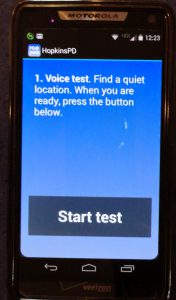
Smartphone-PD is a study to see if it is feasible for participants to download, install, and use an Android smartphone application to track data related to Parkinson disease symptoms. (Note: only available for Android phones)  They hope to measure daily variability of movement and mobility characteristics of PD patients. The data is collected by completing voice and movement tests using my cell phone.  The results of the daily tests are encrypted and uploaded to the study team at the University of Rochester in New York.  The application will also monitor my daily activity if I keep my phone in my pocket.

I found this trial here on Fox Trial Finder and signing up is all done online. I reviewed the study plan and the consent form which includes the disclaimer that this study is purely for research purposes, so they will not be able to provide clinical advice for individuals with PD. Therefore, no adjustments to medications or appointments with a neurologist will be made as a part of the study.  After electronically signing the consent form, I received an email with a link to the application which I downloaded to my phone and I was ready to go.

For this study I use my phone to complete five tests twice a day for six months.  The first time is in the morning prior to taking my medication and then again about an hour later.  They realize that you might not be able to complete the tests on that schedule but they are OK with that as all collected data is valuable. So it’s OK to miss a test day due to travel or whatever, they still want the information.So most every morning I open the application on my phone and spend five minutes completing the tests which include a voice test, a balance test, a gait test, a dexterity test and a reaction test. The results are sent off and I take my medications, have breakfast and try to remember to repeat the test an hour or so later. This study is actively recruiting on FTF or the Parkinson’s Voice site.   Both PwP’s and controls are needed. You can also contact Denzil Harris, the research coordinator by email or phone him at 585-275-2791 for more information.

See, getting involved in a clinical trial is not as difficult as one might think, even if you live in a small town or aren’t close to a research center .  Using Fox Trial Finder to identify trials you might be eligible for takes just a little bit of your time and the rewards are many including that good feeling of being involved in the quest for a cure.   As I have said before, while patients and researchers work to change the current process, there are still many trials that need participants.  If we don’t participate, we will continue to rely on a drug discovered almost 50 years ago that only treats some of our symptoms.   With 475 possible trials listed, I bet you can find one that interests you, so click on this link and join over 39,000 others on Fox Trial Finder today!

(Updated 12/11 to add the links to Fox Trial Finder so it shows up in mobile device view with thanks to the Cure Parkinson’s Trust )

Volunteer and Help Find a Cure for PD!


As promised in the last post, today I will discuss our experiences with clinical trials and the Fox Trial Finder (FTF) web application.  But first, are you on Fox Trial Finder? If not, click on this link and sign up today!  Currently there are 475 trials listed on FTF taking place in locations around the world. They include interventional trials (reducing tremor or dyskinesia, Tai Chi for balance, tele-medicine, etc.) and observational trials (bio markers, brain mapping, genetic research, wearable devices to measure PD, etc.). When you sign up for FTF you create a profile with information such as length of time with PD, medications, symptoms, and how far you are willing to travel to participate.  FTF then matches you to trials that fit your profile.  And don’t forget, most trials need control volunteers too so sign up your family and friends! Ready to sign up? Click on this link now! I’ll be here when you come back.

Welcome back! Mara and I recently participated in an observational study titled LRRK2 and Other Novel Exosome Proteins in Parkinson’s Disease conducted by the University of Alabama at Birmingham.  The main purpose of this study is to determine whether there are biomarkers associated with Parkinson’s disease susceptibility and/or progression in exosome-proteomes derived from PD patients that will assist with future LRRK2 inhibitor clinical trials.  You can read the full description here on FTF but it’s not exactly written in layman’s terms. (Maybe this could be a simple change to the process?)

After arriving at the UAB Medical Campus we were met by Rachel Clark who is coordinating the research study.  She went over the research protocol and we signed the consent forms; she then asked us questions about our general health and medications we take.  We both completed the Uniform Parkinson’s Disease Rating Scale (UPDRS) patient questionnaire and we were each given the Montreal Cognitive assessment. Then we took the Parkinson’s Smell Test which Mara did fine on and, surprise surprise, I didn’t.  Out of 40 samples I got 10 correct while Mara got 37. I was able to identify two odors and the rest were just lucky guesses. I was also given the general physical tests for PD (tap your fingers & toes, walk down the hall, etc.) and we both provided blood and urine samples.  That was it!  One and a half hours and we had provided them with the necessary information and samples and completed our first clinical trial! It wasn’t time consuming, I didn’t have to worry about receiving a placebo or changing my medications, and I was only poked enough to provide 1 ounce of blood.

Many of the trials listed on FTF are observational studies like this one and seven are web based like the other trial I am participating in – Smartphone-PD. All of them provide valuable information in the search for a cure and all need participants. Did you click on that link yet?

Smartphone-PD is a study to see if it is feasible for participants to download, install, and use an Android smartphone application to track data related to Parkinson disease symptoms. (Note: only available for Android phones)  They hope to measure daily variability of movement and mobility characteristics of PD patients. The data is collected by completing voice and movement tests using my cell phone.  The results of the daily tests are encrypted and uploaded to the study team at the University of Rochester in New York.  The application will also monitor my daily activity if I keep my phone in my pocket.

I found this trial here on Fox Trial Finder and signing up is all done online. I reviewed the study plan and the consent form which includes the disclaimer that this study is purely for research purposes, so they will not be able to provide clinical advice for individuals with PD. Therefore, no adjustments to medications or appointments with a neurologist will be made as a part of the study.  After electronically signing the consent form, I received an email with a link to the application which I downloaded to my phone and I was ready to go.

For this study I use my phone to complete five tests twice a day for six months.  The first time is in the morning prior to taking my medication and then again about an hour later.  They realize that you might not be able to complete the tests on that schedule but they are OK with that as all collected data is valuable. So it’s OK to miss a test day due to travel or whatever, they still want the information.So most every morning I open the application on my phone and spend five minutes completing the tests which include a voice test, a balance test, a gait test, a dexterity test and a reaction test. The results are sent off and I take my medications, have breakfast and try to remember to repeat the test an hour or so later. This study is actively recruiting on FTF or the Parkinson’s Voice site.   Both PwP’s and controls are needed. You can also contact Denzil Harris, the research coordinator by email or phone him at 585-275-2791 for more information.

See, getting involved in a clinical trial is not as difficult as one might think, even if you live in a small town or aren’t close to a research center .  Using Fox Trial Finder to identify trials you might be eligible for takes just a little bit of your time and the rewards are many including that good feeling of being involved in the quest for a cure.   As I have said before, while patients and researchers work to change the current process, there are still many trials that need participants.  If we don’t participate, we will continue to rely on a drug discovered almost 50 years ago that only treats some of our symptoms.   With 475 possible trials listed, I bet you can find one that interests you, so click on this link and join over 39,000 others on Fox Trial Finder today!

(Updated 12/11 to add the links to Fox Trial Finder so it shows up in mobile device view with thanks to the Cure Parkinson’s Trust )

Tag: Research

  • Volunteer and Help Find a Cure for PD!

    Volunteer and Help Find a Cure for PD!


    As promised in the last post, today I will discuss our experiences with clinical trials and the Fox Trial Finder (FTF) web application.  But first, are you on Fox Trial Finder? If not, click on this link and sign up today!  Currently there are 475 trials listed on FTF taking place in locations around the world. They include interventional trials (reducing tremor or dyskinesia, Tai Chi for balance, tele-medicine, etc.) and observational trials (bio markers, brain mapping, genetic research, wearable devices to measure PD, etc.). When you sign up for FTF you create a profile with information such as length of time with PD, medications, symptoms, and how far you are willing to travel to participate.  FTF then matches you to trials that fit your profile.  And don’t forget, most trials need control volunteers too so sign up your family and friends! Ready to sign up? Click on this link now! I’ll be here when you come back.

    Welcome back! Mara and I recently participated in an observational study titled LRRK2 and Other Novel Exosome Proteins in Parkinson’s Disease conducted by the University of Alabama at Birmingham.  The main purpose of this study is to determine whether there are biomarkers associated with Parkinson’s disease susceptibility and/or progression in exosome-proteomes derived from PD patients that will assist with future LRRK2 inhibitor clinical trials.  You can read the full description here on FTF but it’s not exactly written in layman’s terms. (Maybe this could be a simple change to the process?)

    After arriving at the UAB Medical Campus we were met by Rachel Clark who is coordinating the research study.  She went over the research protocol and we signed the consent forms; she then asked us questions about our general health and medications we take.  We both completed the Uniform Parkinson’s Disease Rating Scale (UPDRS) patient questionnaire and we were each given the Montreal Cognitive assessment. Then we took the Parkinson’s Smell Test which Mara did fine on and, surprise surprise, I didn’t.  Out of 40 samples I got 10 correct while Mara got 37. I was able to identify two odors and the rest were just lucky guesses. I was also given the general physical tests for PD (tap your fingers & toes, walk down the hall, etc.) and we both provided blood and urine samples.  That was it!  One and a half hours and we had provided them with the necessary information and samples and completed our first clinical trial! It wasn’t time consuming, I didn’t have to worry about receiving a placebo or changing my medications, and I was only poked enough to provide 1 ounce of blood.

    Many of the trials listed on FTF are observational studies like this one and seven are web based like the other trial I am participating in – Smartphone-PD. All of them provide valuable information in the search for a cure and all need participants. Did you click on that link yet?

    Smartphone-PD is a study to see if it is feasible for participants to download, install, and use an Android smartphone application to track data related to Parkinson disease symptoms. (Note: only available for Android phones)  They hope to measure daily variability of movement and mobility characteristics of PD patients. The data is collected by completing voice and movement tests using my cell phone.  The results of the daily tests are encrypted and uploaded to the study team at the University of Rochester in New York.  The application will also monitor my daily activity if I keep my phone in my pocket.

    I found this trial here on Fox Trial Finder and signing up is all done online. I reviewed the study plan and the consent form which includes the disclaimer that this study is purely for research purposes, so they will not be able to provide clinical advice for individuals with PD. Therefore, no adjustments to medications or appointments with a neurologist will be made as a part of the study.  After electronically signing the consent form, I received an email with a link to the application which I downloaded to my phone and I was ready to go.

    For this study I use my phone to complete five tests twice a day for six months.  The first time is in the morning prior to taking my medication and then again about an hour later.  They realize that you might not be able to complete the tests on that schedule but they are OK with that as all collected data is valuable. So it’s OK to miss a test day due to travel or whatever, they still want the information.So most every morning I open the application on my phone and spend five minutes completing the tests which include a voice test, a balance test, a gait test, a dexterity test and a reaction test. The results are sent off and I take my medications, have breakfast and try to remember to repeat the test an hour or so later. This study is actively recruiting on FTF or the Parkinson’s Voice site.   Both PwP’s and controls are needed. You can also contact Denzil Harris, the research coordinator by email or phone him at 585-275-2791 for more information.

    See, getting involved in a clinical trial is not as difficult as one might think, even if you live in a small town or aren’t close to a research center .  Using Fox Trial Finder to identify trials you might be eligible for takes just a little bit of your time and the rewards are many including that good feeling of being involved in the quest for a cure.   As I have said before, while patients and researchers work to change the current process, there are still many trials that need participants.  If we don’t participate, we will continue to rely on a drug discovered almost 50 years ago that only treats some of our symptoms.   With 475 possible trials listed, I bet you can find one that interests you, so click on this link and join over 39,000 others on Fox Trial Finder today!

    (Updated 12/11 to add the links to Fox Trial Finder so it shows up in mobile device view with thanks to the Cure Parkinson’s Trust )

  • Cognitive Training and ….Cinnamon?

    Cognitive Training and ….Cinnamon?

    I started ‘brain training’ with Lumosity last fall and usually play five games a day whenever possible.  If you aren’t familiar with Lumosity, they provide cognitive training exercises that teach neuroplasticity, that is training the brain to use new pathways to complete a task.  Cognitive training has blossomed in the past few years and since some of my neural pathways are deteriorating, I thought Lumosity would be an interesting test and might help me build those new paths.

    The Lumosity training works to improve five areas – memory, flexibility, problem solving, attention and speed – all improvements I can use!  After every five game session you get an overall score called  the Lumosity Performance Index or LPI which is an average of the five areas and hopefully goes up each day (I wish).  But enough of the background, if you want more info, check out their website.

    I have found that playing the brain games with PD can be a challenge, particularly the flexibility and speed games that usually require the use of the arrow keys on my laptop to select the right answer.  I have noticed that I can visualize the correct move but making my fingers press the right key is another thing altogether.  As I learned from the presentation by Kaitlyn Roland at the Kripalu session, one of the problems with a lack of dopamine is the brain sends the correct command but it gets scrambled and doesn’t follow the correct pathway which results in the wrong action being taken which can result in a fall, freezing in place or, it appears, pressing the wrong key.

    So I am hopeful that by doing the games every day I am creating those new neural pathways and my LPI score will  reflect the improvement.  But sometimes I seem to be stuck with the old paths and my LPI chart ends up looking like this one for the last four weeks, up and down.  Such is life with Parkinson’s 🙂

    The big Parkinson’s news of the last couple of weeks is the publication of a study that cinnamon might stop the progression of Parkinson’s Disease!  I figure this means I should be baking and consuming my famous (in some circles) Gram’s Pecan Rolls so named because the recipe is from my daughter in law Monica’s Gram and it is full of cinnamon.  Of course the study was conducted on mice so I don’t know how many rolls I need to eat daily but do know what the effect would be on my weight!  Guess I’ll wait for more information before getting the baking equipment out but I wonder if my LPI would go up? Sounds like a clinical study in the making!

    We had a great 4th of July visit with son Ryan and his wife Sarah and their son Julian and his half brother Trysten.  In addition, grandson Jake and granddaughter McKenna and her friend Katie also joined us for the  holiday weekend so we had a houseful.  The kids enjoyed tubing on the lake and swimming off the dock, and we all enjoyed taking the boat down to watch the fireworks go off over the lake.  We even managed to load the tube with all five kids for some fun on the lake.  Again some fishing and paddle boarding took place along with watching the World Cup games.

    Next week it will be one year since my PD diagnosis and a lot has happened in the space of the year, most of which I have managed to chronicle in this blog.   Once again I thank you all for sticking with me on this journey, your support means  a lot to me.

    BTW, if you are a tweeter, follow me on twitter by clicking on the link on the right below my profile.