And I’m back! I noticed that I didn’t mention anything in the last post about how my buddy Parkinson’s and I are getting along. Things are pretty much stable, still some arm stiffness and shuffling when I walk and the occasional balance problem. I don’t have the sticky feet problem nearly as often nor the internal tremors so, all in all, things are OK.
As I have noted before, I follow many other blogs, websites, and Twitter accounts related to Parkinson’s, probably close to 50 if I took the time to count them all. I have been planning to add a page with the list of who I follow to this blog and maybe that will happen one of these days soon, but remember, apathy is a non-motor symptom so don’t hold your breath. 🙂
One of the blogs I follow is Tremors in the Universe written by Robert Baittie. In a recent post, Chapter 36 Whistle while you twerk, he talks about another symptom of PD, micrographia and from there he… well here, I’ll let you read it yourself picking up where he defines micrographia:
“The symptom as it appears in association with Parkinson’s disease is called micrographia, and in handwriting or penmanship is characterized by abnormally small, cramped handwriting and/or the progression to continually smaller handwriting. It’s cause, according to the National Parkinson’s Foundation is attributed to a common feature of PD which is a slowing of movement, and feelings of muscle stiffness in the hands and fingers. Loss of automatic motion also affects the easy, flowing motion of handwriting. This can impact even simple writing taskssuch as signing your name.”
“Which started me thinking.”
“Parkinson’s disease is named after the English doctor James Parkinson, who published the first detailed description in An Essay on the Shaking Palsy in 1817.”
“In 1817”.
“Might there be any signatures of record prior to 1817 that show signs of a typical Parkinson’s style of writing?”
“Of what importance was that to me? Well my entire attitude around my diagnosis of Parkinson’s has been about succeeding with the disease and having and maintaining a positive attitude towards dealing with it. I was curious if there might be individuals who had continued to achieve and possibly even made a mark in history while in the midst of dealing with PD? At a time when they didn’t have today’s technology, support and treatments. Obviously this was all pure speculation because prior to 1817 it was not classified or known as Parkinson’s. But I was curious none the less.”
“The first thing I did was to Google micrographia thinking I might find a visual example of the malady that I could use for comparison to any earlier documents I might come across. And sure enough, in the Wikipedia Encyclopedia a writing example of a Parkinson’s patient.” “The next step was to begin searching documents prior to 1817 that might offer a similar writing style”.
“Now I was not going to go about this by pure happenstance, on the contrary, I had a hunch and I had definite place in mind to start. There was one document in particular I wanted to take a look at. And sure enough my hunch or maybe I should say my “intuition” was correct.”
Stephen Hopkins
“Here was my individual of notoriety that I felt had that characteristic signature at a time when the flourish of stylized and ornate signatures and penmanship were the art form of the day.”
“Here was a man among men. Stephen Hopkins. Born in 1707 and died in 1785 at the age of 78. He came from a prominent Rhode Island family and most definitely left his mark upon a nation. Not only did my initial examination of the document serve to heighten my belief, but further readings of his biography removed all doubt. His own admission was proof enough for me.”
“In the summer of 1776, while holding his right hand with his left, saying, “although my hand trembles, my heart does not” Stephen Hopkins, a Rhode Island delegate to the First Continental Congress, signed the Declaration of Independence.”
“It gave me tremendous pause to sit and look at that Declaration of Independence and those signatures and to think about the thoughts that must have been going through Stephen Hopkins mind. Not only could I imagine he had a sense of uncertainty and fear for what the future held for our new country at that time, but he was simultaneously dealing with the uncertainty of and concern for his own health. He held the same questions in his mind then about his health, that millions still hold to this day. What is causing this? What can be done?”
“And as I reread those simple words of Stephen Hopkins, a number of thoughts came to mind. First, I felt a tremendous amount of respect for the man because he was not afraid to share with his friends and colleagues the disease that afflicted him. Especially at a time when there was no explanation he could offer for what ailed him. He openly called attention to and acknowledged his tremor and in doing so said he was not ashamed of it. Second was that he had not allowed his tremor or the disease to limit him. He had continued on with his passion for his work. But most profoundly to me was the double meaning I took from the words as a whole. While obviously in one context he is referring to our young nation and “though his hand trembles” while signing this Declaration of Independence “his heart does not” because he believes this to be the right direction for his country, the other context it speaks to for me is the disease of Parkinson’s itself. The words make the analogy of how I have felt all along. “Although my hand trembles, my heart does not.” It’s that strange sense of the positive and knowing that although I have been diagnosed with Parkinson’s, everything I feel in my heart tells me there is nothing to fear and I will be alright. That I can and will deal with whatever it brings me.”
“Over 230 years later since the documents signing technology is most definitely moving at a rapid pace, and the research being done toward finding a cure for Parkinson’s is as well. But to continue that work and to hasten the success, additional funding is always needed. Volunteers and Foundations continue to spearhead the vast majority of the fundraising efforts but more needs to be done.”
“Given that, I find it extremely ironic that this would be the example of the signature I would find. A statesmen, a member of the First Continental Congress. Because additional support and funding from our government is what is needed to keep progress moving forward and ultimately finding a cure. And so I would like to ask everyone reading this to take the opportunity to write your Congressman with a steady hand to request that they show the heart of our founding fathers and support increased funding for Parkinson’s research. (emphasis added)
Reblog it. ReTweet it. Do it for your self. Or someone you love.
To find out what prompted Robert to research micrographia, read the complete post of Chapter 36 here. I think you will find it interesting and I highly recommend reading some or all of his other ‘Chapters’.
What a great statement “although my hand tremors, my heart does not” and as the Michael J Fox Foundation says “Our challenges don’t define us. Our actions do” We can and will deal with whatever Parkinson’s throws at us on our way to finding a cure.
I also agree that we need to continue to urge Congress to support increased funding for Parkinson’s research. In that vein,the Parkinson’s Action Network (PAN) is sponsoring a Parkinson’s Day of Action on February 26th. They ask that you contact your Representatives and ask for their support. They have provided information here on how to contact your representatives, some sample statements you can use and links to why we need more funding for research. I urge you to join me and PAN on Wednesday, February 26th and contact your Congressional Representatives.
As I write this post, we are watching it snow as we are under another winter storm warning for the next couple of days, just hoping it clears up here and in Atlanta by Friday so we can start our trip to what I hope is a warm Florida. We are looking forward to the trip and a chance to meet up with a couple that we met during the Kripalu retreat. ‘See’ you next week.
Or maybe it should be a Mish Mash? how about a Mashup? Anyway, this is a post of odds and ends I have been doing or reading about since my last post. We arrived home from Florida just in time to get caught up in the snow and ice and cold a couple of weeks ago and last week and this week so we are excited to leave soon for our regularly scheduled February beach visit. While home we have kept up the exercise on the bike, walking the few days we could, and doing Tai Chi. I purchased the DVD recommended by the National Parkinson’s Foundation and we have really enjoyed it. The fluid movements seem to be helping with flexibility and balance and the QiGong warmup exercises stretch a few muscles I haven’t been using much this winter 🙂
I was excited to see the announcement last week that The Michael J. Fox Foundation for Parkinson’s Research (MJFF), the Alzheimer’s Association (ALZ),and The W. Garfield Weston Foundation have joined together to announce a collaborative effort to stimulate analyses across the Alzheimer’s disease (AD) and Parkinson’s disease (PD) research enterprises. This will build on recent evidence suggesting substantial overlap between AD, PD, and other neurodegenerative diseases pathologically, but also potentially biologically. They will be able to utilize two large biomarker databases, the Alzheimer’s Disease Neuroimaging Initiative (ADNI) and the Parkinson’s Progression Markers Initiative (PPMI), for new research ideas. I hope this collaboration produces benefits for both PD and AZ current and potential patients.
Another collaboration recently announced was the formation of the Alliance of Independent Regional Parkinson Organizations (AIRPO). AIRPO is a consortium of regional independent nonprofit organizations, with the shared goals of finding a cure for Parkinson’s and supporting those who live with the disease. AIRPO aims to enrich programs available to the Parkinson’s disease community by encouraging collaboration, leveraging organizational strengths and maximizing efficiency among its founding member organizations, which include: Houston Area Parkinson Society,Michigan Parkinson Foundation, Northwest Parkinson’s Foundation, Parkinson Association of the Carolinas and Parkinson Association of the Rockies. The Parkinson’s Disease Foundation offers administrative support to AIRPO.
I belong to a ‘virtual’ support group site called Patients Like Me and one of the things they do is conduct research in connection with research groups. Recently they started a study with the objective of being able to monitor disease progression over the phone. I am a participant in the study and will be interested to see if it is possible. So far I was required to fill out a survey then called an 800 number and followed the instructions to record a voice segment, quite similar to the test I received in Florida last month. More information about the study has been published here.
I also started a genetics for beginners online course at Udacity.com. I have received the results of my DNA test from 23andme.com and decided I needed to increase my knowledge to fully understand the results. The course has been challenging and I just finished the quiz for lessons 1 – 4 (they didn’t say there would be a quiz!) I like the instructors and the online format has been great, they have come a long way since the last online course I took back a decade or two ago. Interesting stuff.
Well enough for this post, as the title suggests, there will be at least a Part Two which I hope to post before we leave for Florida on Friday so stay tuned.
Last week Dr Soania Mathur, whom I follow on Twitter, posted an excellent article, “10 Lessons I’ve Learned Living With a Chronic Disease” , on The Huffington Post. Dr Mathur was diagnosed with Early Onset PD 16 years ago at age 27 and in the post she discusses 10 lessons she has learned from facing the challenges of living with a chronic disease. But as she points out in the opening “Each of us is challenged in some way, be it in our health, our finances, our occupations or our interpersonal relationships, and many of the same principles that I learned on my particular journey are hopefully relevant regardless of the challenge you are facing.” I know that I found them extremely applicable for my PD journey and I think you may find one or two (or maybe 10) that will be relevant for you too. Click here to read Dr Mathur’s post.
It’s a new year and time to renew my resolution to continue exercising at least 4 -5 times per week. As 2017 came to a close a new research study was published that shows high intensity interval training (HIIT) delays Parkinson’s progression. As Daniel Corcos, one of the lead authors of the study states “If you have Parkinson’s disease and you want to delay the progression of your symptoms, you should exercise three times a week with your heart rate between 80 and 85 percent maximum. It is that simple.” If you query Google for High Intensity Exercise and Parkinson’s you will find an abundance of articles about this study, here is the link to one of them from Science Daily.
While the need to exercise for PD patients has been shown in many studies, this was one of the first to be conducted for 6 months instead of 12 weeks. The participants were divided into three groups, HIIT exercise, moderate exercise and no exercise. All scored about 20 on a PD scale of 0 – 108 before the study. When scored after the 6 months The HIIT group showed no change while the moderate group got worse by 1.5 points and the no exercise group worsened by 3 points or about a 15% change.
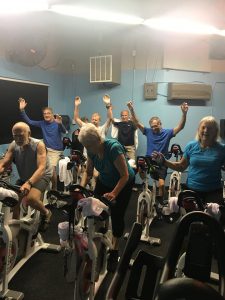
Although the primary exercise used during this study was the treadmill, Kathy, our Parkinson’s cycling instructor immediately figured that we can step up our cycling program to include high intensity intervals and start raising our aerobic fitness level. So, even though many of us thought we were doing high intensity training already (well at least I did), she started pushing us to reach the 80 – 85% heart rate after Thanksgiving. Almost every workout has incorporated HIIT and I am already starting to see a change in just 6 weeks. The first few sessions I found I had to lower the gear to finish the workout. But each time I felt I was getting stronger and this week I was able to increase instead of decrease the gear and still maintain the required 80 – 90 RPM. I am happy with that progress and I am noticing a reduction in my symptoms after exercise including not feeling ‘off’ a half hour or so before it’s time to take my medicines on the day of exercise.
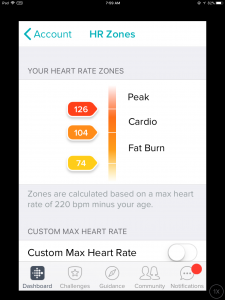
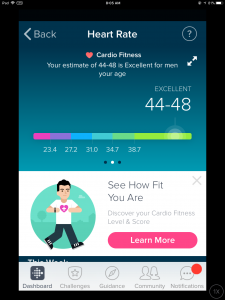
But I wondered what is happening to my aerobic fitness? Then I discovered that my Fitbit app is keeping track of my cardio fitness! The app determined my heart rate zones and then uses those zones and my resting heart rate to compute a cardio fitness score. As you can see in this screen shot on the left, Fitbit has determined that, for me, a heart rate greater than 126 is my peak zone and my cardio zone is 104 – 125. The peak range is approximately 80% of my maximum heart rate so anything above that would be considered high intensity exercise.
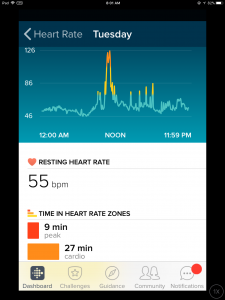
The app also graphs my heart rate for the entire day so I can tell from that graph how long I was in the peak zone. The screen shot on the left is for 1/2/18 which includes a cycling class.
November 16, 2017January 2, 2018
So I was in the ‘zone’ for 9 minutes during the class which corresponds to intervals where we pushed up to 85 or 90 RPM for short periods.
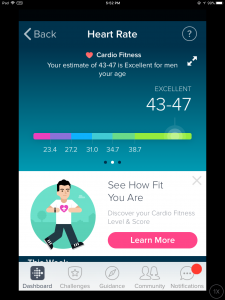
And here are screen shots showing my cardio fitness as computed by Fitbit on November 16, 2017 and January 2, 2018. So, in theory, I’ve already improved my Cardio Fitness by a point since we started the HIIT. But just as important is that fact that either score is considered excellent by Fitbit where the average score for men over 60 is 27.2 – 31.0.
Between cycling twice a week, playing tennis 2 -3 times a week and the Dance for PD class I am staying fit, slowing the progression of my Parkinson’s and having fun. We will revisit my cardiac score in a month or so to see if the trend continues or maybe I’m maxed out!
So my New Year’s resolution this year is the same as last year, keep exercising and keep fighting PD. By the way, if you are interested in Pedaling for Parkinson’s, check out this video from the Sarasota YMCA website of one of Kathy’s classes and watch us having fun doing intervals!
“It does not matter how slowly you go as long as you do not stop.” – Confucius
It’s a new year and time to renew my resolution to continue exercising at least 4 -5 times per week. As 2017 came to a close a new research study was published that shows high intensity interval training (HIIT) delays Parkinson’s progression. As Daniel Corcos, one of the lead authors of the study states “If you have Parkinson’s disease and you want to delay the progression of your symptoms, you should exercise three times a week with your heart rate between 80 and 85 percent maximum. It is that simple.” If you query Google for High Intensity Exercise and Parkinson’s you will find an abundance of articles about this study, here is the link to one of them from Science Daily.
While the need to exercise for PD patients has been shown in many studies, this was one of the first to be conducted for 6 months instead of 12 weeks. The participants were divided into three groups, HIIT exercise, moderate exercise and no exercise. All scored about 20 on a PD scale of 0 – 108 before the study. When scored after the 6 months The HIIT group showed no change while the moderate group got worse by 1.5 points and the no exercise group worsened by 3 points or about a 15% change.
Although the primary exercise used during this study was the treadmill, Kathy, our Parkinson’s cycling instructor immediately figured that we can step up our cycling program to include high intensity intervals and start raising our aerobic fitness level. So, even though many of us thought we were doing high intensity training already (well at least I did), she started pushing us to reach the 80 – 85% heart rate after Thanksgiving. Almost every workout has incorporated HIIT and I am already starting to see a change in just 6 weeks. The first few sessions I found I had to lower the gear to finish the workout. But each time I felt I was getting stronger and this week I was able to increase instead of decrease the gear and still maintain the required 80 – 90 RPM. I am happy with that progress and I am noticing a reduction in my symptoms after exercise including not feeling ‘off’ a half hour or so before it’s time to take my medicines on the day of exercise.
But I wondered what is happening to my aerobic fitness? Then I discovered that my Fitbit app is keeping track of my cardio fitness! The app determined my heart rate zones and then uses those zones and my resting heart rate to compute a cardio fitness score. As you can see in this screen shot on the left, Fitbit has determined that, for me, a heart rate greater than 126 is my peak zone and my cardio zone is 104 – 125. The peak range is approximately 80% of my maximum heart rate so anything above that would be considered high intensity exercise.
The app also graphs my heart rate for the entire day so I can tell from that graph how long I was in the peak zone. The screen shot on the left is for 1/2/18 which includes a cycling class.
November 16, 2017January 2, 2018
So I was in the ‘zone’ for 9 minutes during the class which corresponds to intervals where we pushed up to 85 or 90 RPM for short periods.
And here are screen shots showing my cardio fitness as computed by Fitbit on November 16, 2017 and January 2, 2018. So, in theory, I’ve already improved my Cardio Fitness by a point since we started the HIIT. But just as important is that fact that either score is considered excellent by Fitbit where the average score for men over 60 is 27.2 – 31.0.
Between cycling twice a week, playing tennis 2 -3 times a week and the Dance for PD class I am staying fit, slowing the progression of my Parkinson’s and having fun. We will revisit my cardiac score in a month or so to see if the trend continues or maybe I’m maxed out!
So my New Year’s resolution this year is the same as last year, keep exercising and keep fighting PD. By the way, if you are interested in Pedaling for Parkinson’s, check out this video from the Sarasota YMCA website of one of Kathy’s classes and watch us having fun doing intervals!
“It does not matter how slowly you go as long as you do not stop.” – Confucius
It’s a new year and time to renew my resolution to continue exercising at least 4 -5 times per week. As 2017 came to a close a new research study was published that shows high intensity interval training (HIIT) delays Parkinson’s progression. As Daniel Corcos, one of the lead authors of the study states “If you have Parkinson’s disease and you want to delay the progression of your symptoms, you should exercise three times a week with your heart rate between 80 and 85 percent maximum. It is that simple.” If you query Google for High Intensity Exercise and Parkinson’s you will find an abundance of articles about this study, here is the link to one of them from Science Daily.
While the need to exercise for PD patients has been shown in many studies, this was one of the first to be conducted for 6 months instead of 12 weeks. The participants were divided into three groups, HIIT exercise, moderate exercise and no exercise. All scored about 20 on a PD scale of 0 – 108 before the study. When scored after the 6 months The HIIT group showed no change while the moderate group got worse by 1.5 points and the no exercise group worsened by 3 points or about a 15% change.
Although the primary exercise used during this study was the treadmill, Kathy, our Parkinson’s cycling instructor immediately figured that we can step up our cycling program to include high intensity intervals and start raising our aerobic fitness level. So, even though many of us thought we were doing high intensity training already (well at least I did), she started pushing us to reach the 80 – 85% heart rate after Thanksgiving. Almost every workout has incorporated HIIT and I am already starting to see a change in just 6 weeks. The first few sessions I found I had to lower the gear to finish the workout. But each time I felt I was getting stronger and this week I was able to increase instead of decrease the gear and still maintain the required 80 – 90 RPM. I am happy with that progress and I am noticing a reduction in my symptoms after exercise including not feeling ‘off’ a half hour or so before it’s time to take my medicines on the day of exercise.
But I wondered what is happening to my aerobic fitness? Then I discovered that my Fitbit app is keeping track of my cardio fitness! The app determined my heart rate zones and then uses those zones and my resting heart rate to compute a cardio fitness score. As you can see in this screen shot on the left, Fitbit has determined that, for me, a heart rate greater than 126 is my peak zone and my cardio zone is 104 – 125. The peak range is approximately 80% of my maximum heart rate so anything above that would be considered high intensity exercise.
The app also graphs my heart rate for the entire day so I can tell from that graph how long I was in the peak zone. The screen shot on the left is for 1/2/18 which includes a cycling class.
November 16, 2017January 2, 2018
So I was in the ‘zone’ for 9 minutes during the class which corresponds to intervals where we pushed up to 85 or 90 RPM for short periods.
And here are screen shots showing my cardio fitness as computed by Fitbit on November 16, 2017 and January 2, 2018. So, in theory, I’ve already improved my Cardio Fitness by a point since we started the HIIT. But just as important is that fact that either score is considered excellent by Fitbit where the average score for men over 60 is 27.2 – 31.0.
Between cycling twice a week, playing tennis 2 -3 times a week and the Dance for PD class I am staying fit, slowing the progression of my Parkinson’s and having fun. We will revisit my cardiac score in a month or so to see if the trend continues or maybe I’m maxed out!
So my New Year’s resolution this year is the same as last year, keep exercising and keep fighting PD. By the way, if you are interested in Pedaling for Parkinson’s, check out this video from the Sarasota YMCA website of one of Kathy’s classes and watch us having fun doing intervals!
“It does not matter how slowly you go as long as you do not stop.” – Confucius
It is a busy time of year but I wanted send along good wishes for the holiday, pass along a reminder or two and note some items of interest in the Parkinson’s community.
Reminder number one: November is National Caregivers Month. Yes the month is about over but I know that you, like me, are thankful for your care partner(s) every day of the year. Remember there are lots of resources available for care partners and one of the best, available from the Parkinson’s Foundation, is the Caring and Coping guide, written for caregivers at every stage of PD. Download load a copy at this link.
Reminder number two: Tuesday the 28th is Giving Tuesday. This is a great opportunity to make a donation to your favorite charity and, in many cases, have it matched. For example the Michael J Fox Foundation is shooting to raise $1million in 1 day with every donation matched by anonymous donors. Many other charities have similar opportunities on Tuesday, so scrape the bottom of your pocket book or wallet after Black Friday and Cyber Monday and help us find a cure for PD or the charity of your choice.
Item of interest number two: The Michael J. Fox Foundation for Parkinson’s Research has launched Fox Insight — an online clinical study that empowers people with PD to partner with researchers and accelerate the development of breakthrough treatments. I have talked about Fox Insight in previous posts but, if you haven’t joined yet, now is the time, your data is needed as we work to find a cure. Click on the link above to get more information and join us.
Item of interest number three: The next World Parkinson’s Congress will be June, 2019 in Kyoto, Japan. Soaring With Hope has started a project to make origami cranes for an art installation to display at the WPC. Each crane represents a person withParkinson’s or a person impacted by Parkinson’s. They are asking each person to give their message of hope, which will be written on a crane. They have a goal of 10,000 cranes to bring to the WPC, each of them with a message of hope written on it to help raise awareness and HOPE for PD globally. Please take a minute to click on this link and add your WORDS OF HOPE, and please spread the word to get others to join in and participate. Thanks to Sharon Krischer (blogging as Twitchy Woman) for providing this information on her blog.
On this Thanksgiving day I am thankful for the support of my wonderful wife, my family, my friends and all of you who take the time to read my occasional posts. Thank you all and Happy Thanksgiving!
Yesterday was our local Parkinson’s Walk held in Oak Ridge,TN. The weather websites were predicting rain and thunderstorms, but it turned out to just be a cloudy day. Our local walk is in support of the Unity Walk in New York City and 100% of the funds raised go to the seven major Parkinson’s research organizations.Despite the weather forecast we had a good turnout and raised over $8100 for PD research. I want to again thank all of you who made a donation in support of Mara and me and Team PK Hope is Alive – THANKS!
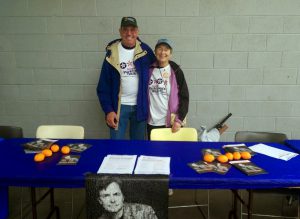
We arrived early to help with the setup for the walk and I was glad my stepson, Darrin, joined us for the heavy lifting! This was also our first ‘gig’ as Fox Trial Finder Ambassadors and we set up a table to promote Fox Trial Finder and Fox InSight. We had a lot of activity at our table, handed out a lot of information and MJFF orange brain shaped stress relievers. We met a lot of new people who were interested in both programs and hopefully our efforts result in some new sign ups.
We were asked to speak during the prerace ceremonies so, in addition to our first Trial Finder gig, I made my first presentation about current research and the need for participating in Fox Trial Finder and Fox InSight. I had prepared some notes (about 7 pages when printed in large type!) but found it hard to read the notes, maintain some eye contact, speak loudly AND hold the microphone at the same time so it was more of an ‘off the cuff’ speech it but it seemed to go OK for a first attempt.
This week I moved the blog to its own internet domain www.tomspdblog.com which is easier for me (and you) to remember when people ask for the address. Google assures me there should be no noticeable change for readers as both the old and the new address will end up at the blog. So far it seems to be working OK, but those of you who have the address bookmarked may want to update your bookmark to the new address.
Next Thursday we go to Vanderbilt for my next appointment with my Movement Disorder Specialist. I continue to be so much better on the new medication and I hope Dr. Davis agrees. I am also hoping to be considered for the NPF Parkinson’s Outcomes Project which is conducted at the NPF Center’s of Excellence of which Vanderbilt is one. They have been following PwP since 2009 with a goal of establishing models of excellent PD care for best health outcomes. You can read more on the NPF website at this link .
I’m still working at reviewing some of the exercise options available for PwP, maybe it will be done by the next post (I’m pretty sure procrastination is another non motor symptom!) In the meantime, don’t forget to sign up for Fox Trial Finder and Fox Insight and be an agent for change!
“It does not matter how slowly you go as long as you do not stop.” – Confucius