• My Everyday Heroes

    After my last post, I started thinking about the support network we have built because of the people we have met while attending the Kripalu Wellness Retreat, the Partner’s in Parkinson’s event and the Grand Challenge meeting. The more I thought about them, the more I realized how every one of us has been impacted differently by the  many symptoms of PD and how we hunger for information from each other. As Bill Wilkins said in Atlanta, I can meet a person with PD and immediately strike up a conversation and that conversation often gravitates to questions like:

    •     When were you diagnosed?
    •     What symptoms do you have?
    •     What medications are you using?
    •      How are you dealing with….?
    •      Do you belong to a support group?
    •     What kind of exercise regimen do you follow?

    In the past year we have met many other PwP’s, care partners, researchers, representatives of organizations supporting Parkinson’s patients and others involved in Parkinson’s care or research. And I have realized how many everyday heroes we have met, for example the couple whose son was diagnosed with early onset PD and can no longer work, or the school teacher who had to retire because she lost her voice, or Soania who was diagnosed at 27 as she was just starting her medical career and now writes a blog for about.com health including one about another hero we met, Steve, who has come up with an innovative way to transport PwP to clinical trials, or Saul from Atlanta whose daughter / care partner was diagnosed with MS and Sandra who started our local support group because she saw a need and many, many more. All heroes in my book.

    Then there are the many people we have met that work or volunteer for the Michael J Fox Foundation (MJFF) or the Cure Parkinson’s Trust (CPT) or the National Parkinson’s Foundation (NPF) or Parkinson’s Disease Foundation (PDF) or Brian Grant Foundation (BGF) or Parkinson’s Action Network (PAN) and others. These individuals are dedicated to the cause of finding a cure for PD and they are passionate about it. Some have PD and some have relatives or friends with PD but they all want to be involved in research or fund raising or developing educational materials or advocating on behalf of PD patients at the state and national and world levels. They include Tom Isaacs whom I mentioned in the last post and Jon Stamford of CPT, Claire and Claudia from MJFF, Joyce from NPF, Steve and Linda from PDF, Bill of the Wilkins Foundation, Brian Grant from BGF (duh), and Israel from PAN.

    And while we didn’t meet Michael J Fox, I know I am not alone in viewing him as a hero, in fact, he was just selected as the first WebMD Health Hero Hall of Fame winner for his significant accomplishments, both personally and through his foundation, to raise awareness, expand funding, develop treatment options, and advocate for patients in his tireless quest to find a cure for Parkinson’s disease.

    And there is the online community which includes some of the same people I’ve already mentioned that I follow on Twitter along with Robert who writes the blog Tremors in the Universe and has just published a book of the same name with part of the proceeds going to MJFF and NPF, and Grove who represents PAN for the State of Idaho and Kaitlyn whom we first met at Kripalu and many, many more. Again even more heroes.

    These are just a few examples of the many dedicated PD advocates I have met in the past year. I could easily fill several more pages with examples of the people we have met and the actions they have taken to live with Parkinson’s or help someone else live with PD or the research they have done to find a cure, or the actions they have taken to raise funds for research and education and they are all everyday heros.

    Finding a cure or even a way to slow the progression won’t happen without this patient involvement and advocacy. As Tom Isaacs said in Grand Rapids, “We must make patient involvement the rule, not the exception.” He found that PwP’s who are involved in any constructive way benefit from an improved sense of wellbeing and fulfillment. Being able to go to Kripalu and Atlanta and Grand Rapids has resulted in having expanded my network of supporters and increased my understanding of PD. My online community helps me stay current on PD news, new medications and therapies, how others are dealing with the many symptoms of PD and provide me with another support network.

    We plan to keep on traveling to Parkinson’s events while I still can and we will continue to be advocates for PD. This includes advocating for increased patient involvement in all aspects of PD from clinical trials to pushing for increased funding for PT & OT visits and for changes that will allow PwP to take or get your medication on time while hospitalized.

    I am honored to report that my last blog post – Increasing Patient Involvement – was featured on the Parkinson’s Movement website!  Thanks for reading, and if you tuned in to find out about brewing beer at home, maybe I’ll get to that one next !
  • Increasing Patient Involvement

    What a busy couple of weeks! We traveled to Bellaire and Traverse City Michigan to visit relatives, spent two days at the Grand Challenges in Parkinson’s Disease Symposium held in Grand Rapids Michigan (more details below) and finished up with a trip to Bay City to visit with more relatives and friends.

    In the Bellaire area we celebrated Mara’s brother’s 70th birthday and in Traverse City we helped out her sister at her used book store, The Bookie Joint, in downtown Traverse City (shameless plug). In Grand Rapids we had dinner with Rob and Carol Jones whom we first met at the Kripalu Wellness Retreat last October. We had a great time and caught up on changes to medications, symptoms, etc. since Kripalu.

    In Bay City we visited with Mara’s cousins and met up with our friends Karen and Jerry whom we visited in Tucson, AZ in April. As I mentioned in the post about that visit, Jerry was diagnosed about the same time as I was last year. They were great hosts and a highlight was Friday night’s fried perch dinner.

    The Grand Challenges in Parkinson’s Disease Symposium was held at the Van Andel Institute and provided a forum for people with Parkinson’s Disease to interact with some of the top medical professionals and scientists involved in Parkinson’s Disease research. The event featured information sessions and presentations aimed at those in the research/medical field, caregivers and people living with the disease. The symposium also included Rallying to the Challenge, a one-of-a-kind patient-centered meeting designed to highlight the many ways people with Parkinson’s disease can impact the clinical trial process and accelerate access to new Parkinson’s disease treatments.

    The Rallying to the Challenge was kicked off by Tom Isaacs, PwP and co-founder of the Cure Parkinson’s Trust, a UK based Parkinson’s research organization. Tom was diagnosed with early onset PD 20 years ago at the age of 27 and has been an active advocate for Parkinson’s research since then. His presentation to the 250+ neuroscientists and medical professionals and the 100+ PwP and care partners titled “The Urgent Unmet Needs of People with Parkinson’s” was inspiring and he received a standing ovation from the entire audience.

    Tom noted that the one constant he has seen in PwP’s is if they are involved in any constructive way they benefit from an improved sense of well being and fulfillment. Saying “We must make patient involvement the rule, not the exception”, he went on to set out the different unmet needs at the different stages of the disease. You can watch a prerecorded video of the speech here it is about 16 minutes long but it will be worth your time.

    Patients and caregivers then joined Tom Isaacs and a panel consisting of PwP’s, representatives from major organizations including National Parkinson’s Foundation, Michael J Fox Foundation, Parkinson’s Disease Foundation, Parkinson’s Action Network, The Davis Phinney Foundation, The Brian Grant Foundation, Parkinson’s Movement, and The Cure Parkinson’s Trust along with patient advocates from around the world. We went over the results of a survey of PwP’s and researchers about what is needed for successful clinical trials. It was pretty exciting to be involved in this group all focused on one goal, increasing patient involvement.

    The issue we brainstormed was how to overcome the fact that only about 5 – 10% of PwP’s participate in trials and up to 30% of clinical trials fail to recruit any participants. The goal was to find ways around the barriers that prevent participation. One of our team members was Brian Grant, a former NBA star who was diagnosed at the age of 36. He made an excellent presentation to the group on the benefits of teamwork.

    The next day we rejoined the scientific presentation group and Tom Isaacs and the moderators from the breakout groups made a presentation on what is needed to increase patient engagement and clinical trial participation. Some of the points included getting PwP’s involved at the beginning of the trial so that our concerns are addressed up front, providing additional funding to pay for participants travel costs, and making use of current technology such as Skype so the participant doesn’t have to travel as often. The end goal is to make the process patient driven because with patient involvement more will participate in the trial, they will address patient needs, and they can be completed in a shorter time frame.

    The conference was very educational and we added new “family” as we met many more PwP’s and care partner’s from the US, UK, and Canada. We were happy to see Bill Wilkins our fellow panel member from Atlanta on the Rallying to the Challenge team. Meeting Tom Isaacs and many of his panel members was an added bonus as it included many authors of blogs I follow and it was nice to meet them or hear them speak.

    I have included a link to an easy to use glossary of the language of PD from National Parkinson’s Foundation under the PD Resources heading in the right hand column. If you do much research into PD you will come across a lot of new words and this link (or Google) will help you decode them.

    We are home for a while and one of our goals is to switch my Parkinson’s care to a Movement Disorder Specialist (MDS) at the Vanderbilt Parkinson’s Disease Center in Nashville. They are one of NPF’s Centers of Excellence and only about two hours away from home. Stay tuned for our progress in that endeavor and my foray into brewing my own

  • On The Road…Again!

    Mara and I attended the Partners in Parkinson’s event in Atlanta recently, along with an estimated 650+ other patients with Parkinson’s and their loved ones.  We were also honored to serve as panelists during one of the breakout sessions.
     
    Our day started with meeting a couple from Knoxville as we walked to the convention center. We introduced ourselves and agreed to stay in contact since they had not yet found a support group.  After getting registered, we enjoyed the complimentary breakfast with a couple from Atlanta and soon selected a table to sit at for the morning presentation, joining a father and daughter from the area.  We had already added six people to our support group and the day was young!
     
    Three main topics were covered in the morning moderated by longtime journalist Dave Iverson, a Parkinson’s patient himself, who serves as contributing editor for the The Michael J. Fox Foundation.  Each topic was followed by Q & A from the audience. The first topic was The Many Faces of Parkinson’s Disease.  Dave questioned three Parkinson’s patients about their diagnoses and the path their lives have taken since, reinforcing the fact that this disease impacts everyone differently. As Dave said “If you have seen one person with Parkinson’s, you have seen one person with Parkinson’s.”
     
    Next up was Seeing a Movement Disorder Specialist: What to Know, Ask and Expect.  A Movement Disorder Specialist MDS is a neurologist who has received additional training in PD and other disorders. One of the cool things you can find on the Partners in Parkinson’s website is a searchable database to help you find a movement disorder specialist near you.

    Dr. Stewart Factor, Director of the Emory University Movement Disorder Clinic, conducted an “appointment”  with a PD patient and his wife.  It was an interesting, informative session prompting many of us to realize that our initial consultation may not have been filled with as much information about PD that he was covering.

    The final topic was Parkinson’s Research: The Road Ahead where Dave questioned three experts involved in clinical trials and PD research.  This was an informative session that engendered many questions from the audience including when to start levodopa, diet, new drugs in the pipeline, clinical trials and others.
     
    After lunch, the breakout sessions were offered twice so you  could attend two different sessions.  The sessions were Living Well with Parkinson’s, presented by The Davis Phinney Foundation; I’m Still Wondering About…, an opportunity to ask additional questions; and Building Connections with Family, Friends and Community, the one we participated in.You could also browse the Resource Fair where over 20 local organizations and care providers offered information for PD patients.Since we were involved in both of our sessions, we couldn’t attend any of the others but I did hear a lot of positive response about The Davis Phinney presentation.
     
    Our panel included Bill Wilkins, diagnosed 8 years ago and very active in the Parkinson’s community through his organization, The Wilkins Parkinson’s Foundation,  and India Pender Martin, whose grandfather was diagnosed when she was three and who is also active in the Parkinson’s community.  Our panel was expertly moderated by Claire Meunier, vice president of  research engagement for the Fox Foundation.
     
    Mara and I discussed the path we have been following since my diagnosis, how we communicate with family and friends, our trip to Kripalu and why I started the blog.  Bill discussed his diagnosis and how he became active in the Atlanta community and across the US.  India talked about dealing with her grandfather’s Parkinson’s symptoms at an early age and her desire to find a cure.  Then we took questions from the audience.  We received positive comments from attendee’s after each session, and I handed out quite a few cards with the blog address — so might pick up a few more readers!
     
    We are glad we accepted the invitation to participate on this panel even though neither of us are fans of public speaking. It became easier for me when Bill said, “I can meet a person with PD and immediately strike up a conversation.” Which is true for us too. We added many new friends to our support group. Partners in Parkinson’s allowed us  the opportunity to “strike up a conversation” with fellow people living with Parkinson’s.
     
    At the closing session Dave interviewed Mahlon R. DeLong MD, who just received the Lasker Award for research that led to Deep Brain Stimulation (DBS).  They talked about what’s next and the possibility of using DBS to help with balance and gait issues that aren’t solved with the current procedure.  I am excited about that since those are my worst motor symptoms.
     
    So that’s what happens at a Partners in Parkinson’s event and if one is being held near you we both recommend attending, you can find the schedule for the remaining events here.
     
    Next…we are in Northern Michigan to celebrate Mara’s  brother’s 70th birthday.   Our timing is right and we will attend the Grand Challenges in Parkinson’s Disease conference held in Grand Rapids where we will meet up with a couple we met at Kripalu.
     
    Whew this was a long post, thanks for sticking it out to the end and stay tuned for the next post.

A Hodgepodge – Part Two

And I’m back!  I noticed that I didn’t mention anything in the last post about how my buddy Parkinson’s and I are getting along. Things are pretty much stable, still some arm stiffness and shuffling when I walk and the occasional balance problem.  I don’t have the sticky feet problem nearly as often nor the internal tremors so, all in all, things are OK.

As I have noted before, I follow many other blogs, websites, and Twitter accounts related to Parkinson’s, probably close to 50 if I took the time to count them all.  I have been planning to add a page with the list of who I follow to this blog and maybe that will happen one of these days soon, but remember, apathy is a non-motor symptom so don’t hold your breath. 🙂

One of the blogs I follow is Tremors in the Universe written by Robert Baittie.  In a recent post, Chapter 36 Whistle while you twerk,  he talks about another symptom of PD, micrographia and from there he… well here, I’ll let you read it yourself picking up where he defines micrographia:

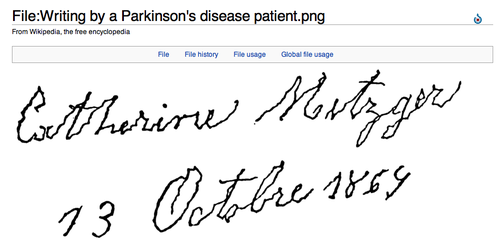
“The symptom as it appears in association with Parkinson’s disease is called micrographia, and in handwriting or penmanship is characterized by abnormally small, cramped handwriting and/or the progression to continually smaller handwriting. It’s cause, according to the National Parkinson’s Foundation is attributed to a common feature of PD which is a slowing of movement, and feelings of muscle stiffness in the hands and fingers. Loss of automatic motion also affects the easy, flowing motion of handwriting. This can impact even simple writing taskssuch as signing your name.”

“Which started me thinking.”

“Parkinson’s disease is named after the English doctor James Parkinson, who published the first detailed description in An Essay on the Shaking Palsy in 1817.”

“In 1817”.

“Might there be any signatures of record prior to 1817 that show signs of a typical Parkinson’s style of writing?”

“Of what importance was that to me? Well my entire attitude around my diagnosis of Parkinson’s has been about succeeding with the disease and having and maintaining a positive attitude towards dealing with it. I was curious if there might be individuals who had continued to achieve and possibly even made a mark in history while in the midst of dealing with PD? At a time when they didn’t have today’s technology, support and treatments. Obviously this was all pure speculation because prior to 1817 it was not classified or known as Parkinson’s. But I was curious none the less.”

“The first thing I did was to Google micrographia thinking I might find a visual example of the malady that I could use for comparison to any earlier documents I might come across. And sure enough, in the Wikipedia Encyclopedia a writing example of a Parkinson’s patient.”
image
“The next step was to begin searching documents prior to 1817 that might offer a similar writing style”.

“Now I was not going to go about this by pure happenstance, on the contrary, I had a hunch and I had definite place in mind to start. There was one document in particular I wanted to take a look at. And sure
enough my hunch or maybe I should say my “intuition” was correct.”

image
Stephen Hopkins

“Here was my individual of notoriety that I felt had that characteristic signature at a time when the flourish of stylized and ornate signatures and penmanship were the art form of the day.”

“Here was a man among men. Stephen Hopkins. Born in 1707 and died in 1785 at the age of 78. He came from a prominent Rhode Island family and most definitely left his mark upon a nation. Not only did my initial
examination of the document serve to heighten my belief, but further readings of his biography removed all doubt. His own admission was proof enough for me.”

“In the summer of 1776, while holding his right hand with his left, saying, “although my hand trembles, my heart does not” Stephen Hopkins, a Rhode Island delegate to the First Continental Congress,
signed the Declaration of Independence.”

image

“It gave me tremendous pause to sit and look at that Declaration of Independence and those signatures and to think about the thoughts that must have been going through Stephen Hopkins mind. Not only could I
imagine he had a sense of uncertainty and fear for what the future held for our new country at that time, but he was simultaneously dealing with the uncertainty of and concern for his own health. He held the same
questions in his mind then about his health, that millions still hold to this day. What is causing this? What can be done?”

“And as I reread those simple words of Stephen Hopkins, a number of thoughts came to mind. First, I felt a tremendous amount of respect for the man because he was not afraid to share with his friends and
colleagues the disease that afflicted him. Especially at a time when there was no explanation he could offer for what ailed him. He openly called attention to and acknowledged his tremor and in doing so said he
was not ashamed of it. Second was that he had not allowed his tremor or the disease to limit him.  He had continued on with his passion for his work. But most profoundly to me was the double meaning I took from the words as a whole. While obviously in one context he is referring to our young nation and “though his hand trembles” while signing this Declaration of Independence “his heart does not” because he believes
this to be the right direction for his country, the other context it speaks to for me is the disease of Parkinson’s itself. The words make the analogy of how I have felt all along. “Although my hand trembles, my heart does not.” It’s that strange sense of the positive and knowing that although I have been diagnosed with Parkinson’s, everything I feel in my heart tells me there is nothing to fear and I will be alright. That I can and will deal with whatever it brings me.”

“Over 230 years later since the documents signing technology is most definitely moving at a rapid pace, and the research being done toward finding a cure for Parkinson’s is as well. But to continue that work and
to hasten the success, additional funding is always needed. Volunteers and Foundations continue to spearhead the vast majority of the fundraising efforts but more needs to be done.”

“Given that, I find it extremely ironic that this would be the example of the signature I would find. A statesmen, a member of the First Continental Congress. Because additional support and funding from our government is what is needed to keep progress moving forward and ultimately finding a cure. And so I would like to ask everyone reading this to take the opportunity to write your Congressman with a steady hand to request that they show the heart of our founding fathers and support increased funding for Parkinson’s research. (emphasis added)

Reblog it. ReTweet it. Do it for your self. Or someone you love.

More to come.
Tremors in the Universe Copyright © 2014 by Robert Baittie”

To find out what prompted Robert to research micrographia, read the complete post of Chapter 36 here.  I think you will find it interesting and I highly recommend reading some or all of his other ‘Chapters’.

What a great statement “although my hand tremors, my heart does not” and as the Michael J Fox Foundation says “Our challenges don’t define us. Our actions do”  We can and will deal with whatever Parkinson’s throws at us on our way to finding a cure.

I also agree that we need to continue to urge Congress to support increased funding for Parkinson’s research.  In that vein,the Parkinson’s Action Network (PAN) is sponsoring a Parkinson’s Day of Action on February 26th. They ask that you contact your Representatives and ask for their support.  They have provided information here on how to contact your representatives, some sample statements you can use and links to why we need more funding for research.  I urge you to join me and PAN on Wednesday, February 26th and contact your Congressional Representatives.

As I write this post, we are watching it snow as we are under another winter storm warning for the next couple of days, just hoping it clears up here and in Atlanta by Friday so we can start our trip to what I hope is a warm Florida.  We are looking forward to the trip and a chance to meet up with  a couple that we met during the Kripalu retreat.  ‘See’ you next week.

A Hodgepodge – Part Two

And I’m back!  I noticed that I didn’t mention anything in the last post about how my buddy Parkinson’s and I are getting along. Things are pretty much stable, still some arm stiffness and shuffling when I walk and the occasional balance problem.  I don’t have the sticky feet problem nearly as often nor the internal tremors so, all in all, things are OK.

As I have noted before, I follow many other blogs, websites, and Twitter accounts related to Parkinson’s, probably close to 50 if I took the time to count them all.  I have been planning to add a page with the list of who I follow to this blog and maybe that will happen one of these days soon, but remember, apathy is a non-motor symptom so don’t hold your breath. 🙂

One of the blogs I follow is Tremors in the Universe written by Robert Baittie.  In a recent post, Chapter 36 Whistle while you twerk,  he talks about another symptom of PD, micrographia and from there he… well here, I’ll let you read it yourself picking up where he defines micrographia:

“The symptom as it appears in association with Parkinson’s disease is called micrographia, and in handwriting or penmanship is characterized by abnormally small, cramped handwriting and/or the progression to continually smaller handwriting. It’s cause, according to the National Parkinson’s Foundation is attributed to a common feature of PD which is a slowing of movement, and feelings of muscle stiffness in the hands and fingers. Loss of automatic motion also affects the easy, flowing motion of handwriting. This can impact even simple writing taskssuch as signing your name.”

“Which started me thinking.”

“Parkinson’s disease is named after the English doctor James Parkinson, who published the first detailed description in An Essay on the Shaking Palsy in 1817.”

“In 1817”.

“Might there be any signatures of record prior to 1817 that show signs of a typical Parkinson’s style of writing?”

“Of what importance was that to me? Well my entire attitude around my diagnosis of Parkinson’s has been about succeeding with the disease and having and maintaining a positive attitude towards dealing with it. I was curious if there might be individuals who had continued to achieve and possibly even made a mark in history while in the midst of dealing with PD? At a time when they didn’t have today’s technology, support and treatments. Obviously this was all pure speculation because prior to 1817 it was not classified or known as Parkinson’s. But I was curious none the less.”

“The first thing I did was to Google micrographia thinking I might find a visual example of the malady that I could use for comparison to any earlier documents I might come across. And sure enough, in the Wikipedia Encyclopedia a writing example of a Parkinson’s patient.”
image
“The next step was to begin searching documents prior to 1817 that might offer a similar writing style”.

“Now I was not going to go about this by pure happenstance, on the contrary, I had a hunch and I had definite place in mind to start. There was one document in particular I wanted to take a look at. And sure
enough my hunch or maybe I should say my “intuition” was correct.”

image
Stephen Hopkins

“Here was my individual of notoriety that I felt had that characteristic signature at a time when the flourish of stylized and ornate signatures and penmanship were the art form of the day.”

“Here was a man among men. Stephen Hopkins. Born in 1707 and died in 1785 at the age of 78. He came from a prominent Rhode Island family and most definitely left his mark upon a nation. Not only did my initial
examination of the document serve to heighten my belief, but further readings of his biography removed all doubt. His own admission was proof enough for me.”

“In the summer of 1776, while holding his right hand with his left, saying, “although my hand trembles, my heart does not” Stephen Hopkins, a Rhode Island delegate to the First Continental Congress,
signed the Declaration of Independence.”

image

“It gave me tremendous pause to sit and look at that Declaration of Independence and those signatures and to think about the thoughts that must have been going through Stephen Hopkins mind. Not only could I
imagine he had a sense of uncertainty and fear for what the future held for our new country at that time, but he was simultaneously dealing with the uncertainty of and concern for his own health. He held the same
questions in his mind then about his health, that millions still hold to this day. What is causing this? What can be done?”

“And as I reread those simple words of Stephen Hopkins, a number of thoughts came to mind. First, I felt a tremendous amount of respect for the man because he was not afraid to share with his friends and
colleagues the disease that afflicted him. Especially at a time when there was no explanation he could offer for what ailed him. He openly called attention to and acknowledged his tremor and in doing so said he
was not ashamed of it. Second was that he had not allowed his tremor or the disease to limit him.  He had continued on with his passion for his work. But most profoundly to me was the double meaning I took from the words as a whole. While obviously in one context he is referring to our young nation and “though his hand trembles” while signing this Declaration of Independence “his heart does not” because he believes
this to be the right direction for his country, the other context it speaks to for me is the disease of Parkinson’s itself. The words make the analogy of how I have felt all along. “Although my hand trembles, my heart does not.” It’s that strange sense of the positive and knowing that although I have been diagnosed with Parkinson’s, everything I feel in my heart tells me there is nothing to fear and I will be alright. That I can and will deal with whatever it brings me.”

“Over 230 years later since the documents signing technology is most definitely moving at a rapid pace, and the research being done toward finding a cure for Parkinson’s is as well. But to continue that work and
to hasten the success, additional funding is always needed. Volunteers and Foundations continue to spearhead the vast majority of the fundraising efforts but more needs to be done.”

“Given that, I find it extremely ironic that this would be the example of the signature I would find. A statesmen, a member of the First Continental Congress. Because additional support and funding from our government is what is needed to keep progress moving forward and ultimately finding a cure. And so I would like to ask everyone reading this to take the opportunity to write your Congressman with a steady hand to request that they show the heart of our founding fathers and support increased funding for Parkinson’s research. (emphasis added)

Reblog it. ReTweet it. Do it for your self. Or someone you love.

More to come.
Tremors in the Universe Copyright © 2014 by Robert Baittie”

To find out what prompted Robert to research micrographia, read the complete post of Chapter 36 here.  I think you will find it interesting and I highly recommend reading some or all of his other ‘Chapters’.

What a great statement “although my hand tremors, my heart does not” and as the Michael J Fox Foundation says “Our challenges don’t define us. Our actions do”  We can and will deal with whatever Parkinson’s throws at us on our way to finding a cure.

I also agree that we need to continue to urge Congress to support increased funding for Parkinson’s research.  In that vein,the Parkinson’s Action Network (PAN) is sponsoring a Parkinson’s Day of Action on February 26th. They ask that you contact your Representatives and ask for their support.  They have provided information here on how to contact your representatives, some sample statements you can use and links to why we need more funding for research.  I urge you to join me and PAN on Wednesday, February 26th and contact your Congressional Representatives.

As I write this post, we are watching it snow as we are under another winter storm warning for the next couple of days, just hoping it clears up here and in Atlanta by Friday so we can start our trip to what I hope is a warm Florida.  We are looking forward to the trip and a chance to meet up with  a couple that we met during the Kripalu retreat.  ‘See’ you next week.

A Hodgepodge – Part Two

And I’m back!  I noticed that I didn’t mention anything in the last post about how my buddy Parkinson’s and I are getting along. Things are pretty much stable, still some arm stiffness and shuffling when I walk and the occasional balance problem.  I don’t have the sticky feet problem nearly as often nor the internal tremors so, all in all, things are OK.

As I have noted before, I follow many other blogs, websites, and Twitter accounts related to Parkinson’s, probably close to 50 if I took the time to count them all.  I have been planning to add a page with the list of who I follow to this blog and maybe that will happen one of these days soon, but remember, apathy is a non-motor symptom so don’t hold your breath. 🙂

One of the blogs I follow is Tremors in the Universe written by Robert Baittie.  In a recent post, Chapter 36 Whistle while you twerk,  he talks about another symptom of PD, micrographia and from there he… well here, I’ll let you read it yourself picking up where he defines micrographia:

“The symptom as it appears in association with Parkinson’s disease is called micrographia, and in handwriting or penmanship is characterized by abnormally small, cramped handwriting and/or the progression to continually smaller handwriting. It’s cause, according to the National Parkinson’s Foundation is attributed to a common feature of PD which is a slowing of movement, and feelings of muscle stiffness in the hands and fingers. Loss of automatic motion also affects the easy, flowing motion of handwriting. This can impact even simple writing taskssuch as signing your name.”

“Which started me thinking.”

“Parkinson’s disease is named after the English doctor James Parkinson, who published the first detailed description in An Essay on the Shaking Palsy in 1817.”

“In 1817”.

“Might there be any signatures of record prior to 1817 that show signs of a typical Parkinson’s style of writing?”

“Of what importance was that to me? Well my entire attitude around my diagnosis of Parkinson’s has been about succeeding with the disease and having and maintaining a positive attitude towards dealing with it. I was curious if there might be individuals who had continued to achieve and possibly even made a mark in history while in the midst of dealing with PD? At a time when they didn’t have today’s technology, support and treatments. Obviously this was all pure speculation because prior to 1817 it was not classified or known as Parkinson’s. But I was curious none the less.”

“The first thing I did was to Google micrographia thinking I might find a visual example of the malady that I could use for comparison to any earlier documents I might come across. And sure enough, in the Wikipedia Encyclopedia a writing example of a Parkinson’s patient.”
image
“The next step was to begin searching documents prior to 1817 that might offer a similar writing style”.

“Now I was not going to go about this by pure happenstance, on the contrary, I had a hunch and I had definite place in mind to start. There was one document in particular I wanted to take a look at. And sure
enough my hunch or maybe I should say my “intuition” was correct.”

image
Stephen Hopkins

“Here was my individual of notoriety that I felt had that characteristic signature at a time when the flourish of stylized and ornate signatures and penmanship were the art form of the day.”

“Here was a man among men. Stephen Hopkins. Born in 1707 and died in 1785 at the age of 78. He came from a prominent Rhode Island family and most definitely left his mark upon a nation. Not only did my initial
examination of the document serve to heighten my belief, but further readings of his biography removed all doubt. His own admission was proof enough for me.”

“In the summer of 1776, while holding his right hand with his left, saying, “although my hand trembles, my heart does not” Stephen Hopkins, a Rhode Island delegate to the First Continental Congress,
signed the Declaration of Independence.”

image

“It gave me tremendous pause to sit and look at that Declaration of Independence and those signatures and to think about the thoughts that must have been going through Stephen Hopkins mind. Not only could I
imagine he had a sense of uncertainty and fear for what the future held for our new country at that time, but he was simultaneously dealing with the uncertainty of and concern for his own health. He held the same
questions in his mind then about his health, that millions still hold to this day. What is causing this? What can be done?”

“And as I reread those simple words of Stephen Hopkins, a number of thoughts came to mind. First, I felt a tremendous amount of respect for the man because he was not afraid to share with his friends and
colleagues the disease that afflicted him. Especially at a time when there was no explanation he could offer for what ailed him. He openly called attention to and acknowledged his tremor and in doing so said he
was not ashamed of it. Second was that he had not allowed his tremor or the disease to limit him.  He had continued on with his passion for his work. But most profoundly to me was the double meaning I took from the words as a whole. While obviously in one context he is referring to our young nation and “though his hand trembles” while signing this Declaration of Independence “his heart does not” because he believes
this to be the right direction for his country, the other context it speaks to for me is the disease of Parkinson’s itself. The words make the analogy of how I have felt all along. “Although my hand trembles, my heart does not.” It’s that strange sense of the positive and knowing that although I have been diagnosed with Parkinson’s, everything I feel in my heart tells me there is nothing to fear and I will be alright. That I can and will deal with whatever it brings me.”

“Over 230 years later since the documents signing technology is most definitely moving at a rapid pace, and the research being done toward finding a cure for Parkinson’s is as well. But to continue that work and
to hasten the success, additional funding is always needed. Volunteers and Foundations continue to spearhead the vast majority of the fundraising efforts but more needs to be done.”

“Given that, I find it extremely ironic that this would be the example of the signature I would find. A statesmen, a member of the First Continental Congress. Because additional support and funding from our government is what is needed to keep progress moving forward and ultimately finding a cure. And so I would like to ask everyone reading this to take the opportunity to write your Congressman with a steady hand to request that they show the heart of our founding fathers and support increased funding for Parkinson’s research. (emphasis added)

Reblog it. ReTweet it. Do it for your self. Or someone you love.

More to come.
Tremors in the Universe Copyright © 2014 by Robert Baittie”

To find out what prompted Robert to research micrographia, read the complete post of Chapter 36 here.  I think you will find it interesting and I highly recommend reading some or all of his other ‘Chapters’.

What a great statement “although my hand tremors, my heart does not” and as the Michael J Fox Foundation says “Our challenges don’t define us. Our actions do”  We can and will deal with whatever Parkinson’s throws at us on our way to finding a cure.

I also agree that we need to continue to urge Congress to support increased funding for Parkinson’s research.  In that vein,the Parkinson’s Action Network (PAN) is sponsoring a Parkinson’s Day of Action on February 26th. They ask that you contact your Representatives and ask for their support.  They have provided information here on how to contact your representatives, some sample statements you can use and links to why we need more funding for research.  I urge you to join me and PAN on Wednesday, February 26th and contact your Congressional Representatives.

As I write this post, we are watching it snow as we are under another winter storm warning for the next couple of days, just hoping it clears up here and in Atlanta by Friday so we can start our trip to what I hope is a warm Florida.  We are looking forward to the trip and a chance to meet up with  a couple that we met during the Kripalu retreat.  ‘See’ you next week.

Comments

Leave a Reply