First a word about the new “Resources for PD” tab above this (or any) post. I have added a page with links to the major organizations that provide PD support. Every one of them can provide a wealth of information for patients and caregivers and most provide both web based information or you can call their 800 number for assistance. By no means is this a complete list and I plan to update the list as I find new sources but I hope it will be beneficial, whether you are newly diagnosed and looking for as much information as you can find or you just have a question about a new symptom. Check it out when you get a chance. And yes the list of blogs I follow is still coming, soon I hope 🙂
We have returned from a great trip to Colorado, Oregon and Washington to see family and friends. During our short Colorado visit we saw daughter Holly and the grandkids, celebrated grandson Charlies 15th birthday and had lunch with my sisters and my nephew Michael and his wife, Kelsie, whom we hadn’t seen in several visits. Michael is a wonderful nature photographer and you can check out his work at Timberline Images. We also met other friends for breakfast, lunch, or dinner so it was a packed few days before we flew on to the Pacific Northwest.
Upon arriving at the Seattle airport, we drove to Prineville, Oregon to meet up with our close friend Ed who has wanted us to visit for years. He lives on a hillside with a beautiful view of the surrounding area from a large deck. We were treated like royalty as our visit included a steak and elk dinner on the deck with some of Ed’s friends, a fun dinner at The Red Martini and a massage! The massage was wonderful and loosened up my back and neck plus I had a good conversation with the therapist about Parkinson’s and rigidity, you know me, always spreading the word 🙂
We then returned to Seattle for a fun week with our two youngest grand children Angelina and Ariana, oh, and their parents, Dale and Monica. We had a wonderful time with the kids during the last week of summer before school started. We again were treated like royalty, enjoying many fine meals, taking the girls shopping for school clothes, and Dale and I might have hit a brew pub or two 🙂 Best of all, we had time to visit and enjoy each others company. It was a good time and even the Seattle weather was great.
This was my second trip across multiple time zones since my diagnosis. Strangely, I found that gaining the two hours on the outbound trip to Colorado affected my fatigue level on the next day more than I would have expected. I tried to take my medication every six hours on the travel day, without regard to the actual time of day but the next day I was wiped out by early evening. Just before we left I visited the neurologist and he doubled my Mirapex dose to 1.5 mg three times a day, so that may also have been a factor. The one hour time change to the Northwest didn’t have any noticeable affect and I again tried to keep taking the medication 6 hours apart. Flying home where I lost 3 hours did not seem to have the fatigue effect either but we didn’t have visits and dinners etc. to attend the next day so that may be the difference. I did make sure I had my Aware in Care kit (available here from NPF) and extra medication in my carry on, just in case.
Next week, Mara and I will attend the Michael J Fox Foundation/AbbVie Partners in Parkinson’s event in Atlanta where we will be on the panel for a breakout session entitled ‘Building Connections with Family, Friends and Community’. Topics will include how we dealt with the diagnosis, how we communicated with family and friends and what we have done to connect with the Parkinson’s community. We are excited to participate but at the same time we are a bit nervous as we understand that they are expecting over 600 attendees! By the way, there is still time to register for this event if you are near the Atlanta area, or for one of the six remaining events held around the country, check the website link above for details. I will write a blog post devoted to the event and our participation on the panel so stay tuned!
Well it has been one year since the inception of this blog and an interesting year it was, as outlined in my last post. And as promised this post will contain some nerdy, but kind of fun, information collected by Blogger during the year. Blogger is the Google platform I use to maintain the blog. They kindly keep track of how many times a page is viewed, the approximate location of the viewer and the ten most viewed posts among other things.
Page views:
The number of page views was about 2200 for the period 8/6/13 – 8/4/14 or about 180 views a month but suddenly the last post went viral! The National Parkinson’s Foundation (NPF) mentioned my last blog post on Twitter and Facebook on Tuesday and suddenly the blog received almost 700 pageviews on 8/5/14 alone! So now the number of views as of this writing is 3055! Thank you NPF and welcome new readers, I hope you enjoy reading It Is What It Is.
Reader location:
The top ten reader locations are shown in this graphic.
Not much to say about this list, as one would expect, most viewers are in the United States. The top five States are Colorado, Tennessee, Maine, Florida and California. A number of readers from other countries are also following the blog which is pretty cool!
Ten most viewed posts for the year:
Of course the winner for this year is the post which was mentioned by NPF, What a Year!. The next most popular was the post about visiting the University of Florida Movement Disorder Clinic which is carefully disguised as a post about Hanging at the Beach! Others making the cut include Cognitive Training about playing Lumosity with PD, Team about Partners in Parkison’s, the Kripalu Wellness Retreat post, the post about Staying Motivated to Exercise and Support about our visits to the local support groups.
You can view these posts and others from the Popular Posts listed just below my profile or from the Blog Archive,located near the bottom of the right hand column.
So there you go, some nerdy but interesting (well to me anyway) information about the blog over the past year. Again I want to thank all of you for your support and hope you will stick with me for another year as I travel this road of living with Parkinson’s Disease. I plan to continue staying on top of current Parkinson’s Disease research and I will continue to look for a clinical trial that I can join. I am quite aware of what “might” happen in the future but that doesn’t mean I have to give in, I will continue to fight and maintain a positive attitude because I believe we will beat Parkinson’s!
It’s is a time for anniversaries, first and foremost, Mara and I celebrated our 24th wedding anniversary with a trip to a cabin in the Smokies for some R and R and a wonderful dinner at a new restaurant we found nearby. We had a great time and came home rested and relaxed in time for a nice pontoon ride on the lake for my birthday.
Last week was also my one year anniversary as an official Person with Parkinson’s. A lot has happened in the last 365 days which somehow included a lot of beach time! I have researched Parkinson’s, met other PwP, both in person and on the web, took up Yoga and Tai Chi, and started this blog. I have alarms set on my watch and my phone to remind me to open the little pill container I carry with me at all times and take my medication timely. I have been to the University of Florida Movement Disorder Clinic to experience a multidisciplinary and patient centered approach to dealing with PD (highly recommended) and will return next winter for a follow up visit. I chronicled that visit in this blog post.
We attended a week long retreat with about 70 other PwP and caregivers sponsored by National Parkinson Foundation at Kripalu where we had a great opportunity to share symptoms and how we were dealing with our diagnoses. We heard from professionals who provided us with information and ideas, plus it was my first experience with yoga. We stay in touch with many of the other attendees via email and Facebook and I highly recommend attending this retreat if you are within 5 years of being diagnosed, check out the NPF website for more information and dates for this year’s retreat. Again you can read more about it in this blog post from last year.
The most important thing that has happened is being on the receiving end of endless support from my family, my friends, other PwP I have met, support group members, readers of this blog, and other bloggers and Twitter followers. I can’t say thank you enough for all of the support that has flowed my way since my diagnosis. It is amazing and I am humbled beyond words.
If you read other blogs by PwP you will notice that we often talk of the downsides to having Parkinson’s but we also talk about how the diagnosis also opens new doors and you meet new friends and your outlook becomes what positive actions can I take to beat this disease. As Michael J Fox notes in this graphic, “..something is what it is and.there’s got to be a way through it”. Again thanks to all of you for supporting me in trying to find that way and maintain a positive attitude.
Speaking of new doors opening, in a previous post, I discussed the new Partner’s in Parkinson’s, a joint effort with the Michael J Fox Foundation and AbbVie, a drug company. They are holding events around the country and we signed up to attend the event in Atlanta in September. Since that post we have been contacted by the Foundation and asked to participate in a break out session called ‘Building Connections with Family, Friends and Community’ which is focused on how the entrance/existence of PD has influenced the way we navigate and build relationships with others and how it has driven us to take action to get involved in making a difference for PD. It will be a moderated discussion with Q & A and we will be on the panel with three others with a connection to Parkinson’s. We are looking forward to it, hopefully it will not be a soft voice day for me. 🙂
Next week this blog will be one year old and I plan to have a short post to celebrate that anniversary on or around August 6th that will include some nerdy statistics about number of visitors and stuff like that, see you then.
And I’m back! I noticed that I didn’t mention anything in the last post about how my buddy Parkinson’s and I are getting along. Things are pretty much stable, still some arm stiffness and shuffling when I walk and the occasional balance problem. I don’t have the sticky feet problem nearly as often nor the internal tremors so, all in all, things are OK.
As I have noted before, I follow many other blogs, websites, and Twitter accounts related to Parkinson’s, probably close to 50 if I took the time to count them all. I have been planning to add a page with the list of who I follow to this blog and maybe that will happen one of these days soon, but remember, apathy is a non-motor symptom so don’t hold your breath. 🙂
One of the blogs I follow is Tremors in the Universe written by Robert Baittie. In a recent post, Chapter 36 Whistle while you twerk, he talks about another symptom of PD, micrographia and from there he… well here, I’ll let you read it yourself picking up where he defines micrographia:
“The symptom as it appears in association with Parkinson’s disease is called micrographia, and in handwriting or penmanship is characterized by abnormally small, cramped handwriting and/or the progression to continually smaller handwriting. It’s cause, according to the National Parkinson’s Foundation is attributed to a common feature of PD which is a slowing of movement, and feelings of muscle stiffness in the hands and fingers. Loss of automatic motion also affects the easy, flowing motion of handwriting. This can impact even simple writing taskssuch as signing your name.”
“Which started me thinking.”
“Parkinson’s disease is named after the English doctor James Parkinson, who published the first detailed description in An Essay on the Shaking Palsy in 1817.”
“In 1817”.
“Might there be any signatures of record prior to 1817 that show signs of a typical Parkinson’s style of writing?”
“Of what importance was that to me? Well my entire attitude around my diagnosis of Parkinson’s has been about succeeding with the disease and having and maintaining a positive attitude towards dealing with it. I was curious if there might be individuals who had continued to achieve and possibly even made a mark in history while in the midst of dealing with PD? At a time when they didn’t have today’s technology, support and treatments. Obviously this was all pure speculation because prior to 1817 it was not classified or known as Parkinson’s. But I was curious none the less.”
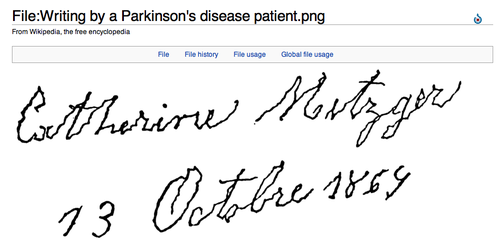
“The first thing I did was to Google micrographia thinking I might find a visual example of the malady that I could use for comparison to any earlier documents I might come across. And sure enough, in the Wikipedia Encyclopedia a writing example of a Parkinson’s patient.” “The next step was to begin searching documents prior to 1817 that might offer a similar writing style”.
“Now I was not going to go about this by pure happenstance, on the contrary, I had a hunch and I had definite place in mind to start. There was one document in particular I wanted to take a look at. And sure enough my hunch or maybe I should say my “intuition” was correct.”
Stephen Hopkins
“Here was my individual of notoriety that I felt had that characteristic signature at a time when the flourish of stylized and ornate signatures and penmanship were the art form of the day.”
“Here was a man among men. Stephen Hopkins. Born in 1707 and died in 1785 at the age of 78. He came from a prominent Rhode Island family and most definitely left his mark upon a nation. Not only did my initial examination of the document serve to heighten my belief, but further readings of his biography removed all doubt. His own admission was proof enough for me.”
“In the summer of 1776, while holding his right hand with his left, saying, “although my hand trembles, my heart does not” Stephen Hopkins, a Rhode Island delegate to the First Continental Congress, signed the Declaration of Independence.”
“It gave me tremendous pause to sit and look at that Declaration of Independence and those signatures and to think about the thoughts that must have been going through Stephen Hopkins mind. Not only could I imagine he had a sense of uncertainty and fear for what the future held for our new country at that time, but he was simultaneously dealing with the uncertainty of and concern for his own health. He held the same questions in his mind then about his health, that millions still hold to this day. What is causing this? What can be done?”
“And as I reread those simple words of Stephen Hopkins, a number of thoughts came to mind. First, I felt a tremendous amount of respect for the man because he was not afraid to share with his friends and colleagues the disease that afflicted him. Especially at a time when there was no explanation he could offer for what ailed him. He openly called attention to and acknowledged his tremor and in doing so said he was not ashamed of it. Second was that he had not allowed his tremor or the disease to limit him. He had continued on with his passion for his work. But most profoundly to me was the double meaning I took from the words as a whole. While obviously in one context he is referring to our young nation and “though his hand trembles” while signing this Declaration of Independence “his heart does not” because he believes this to be the right direction for his country, the other context it speaks to for me is the disease of Parkinson’s itself. The words make the analogy of how I have felt all along. “Although my hand trembles, my heart does not.” It’s that strange sense of the positive and knowing that although I have been diagnosed with Parkinson’s, everything I feel in my heart tells me there is nothing to fear and I will be alright. That I can and will deal with whatever it brings me.”
“Over 230 years later since the documents signing technology is most definitely moving at a rapid pace, and the research being done toward finding a cure for Parkinson’s is as well. But to continue that work and to hasten the success, additional funding is always needed. Volunteers and Foundations continue to spearhead the vast majority of the fundraising efforts but more needs to be done.”
“Given that, I find it extremely ironic that this would be the example of the signature I would find. A statesmen, a member of the First Continental Congress. Because additional support and funding from our government is what is needed to keep progress moving forward and ultimately finding a cure. And so I would like to ask everyone reading this to take the opportunity to write your Congressman with a steady hand to request that they show the heart of our founding fathers and support increased funding for Parkinson’s research. (emphasis added)
Reblog it. ReTweet it. Do it for your self. Or someone you love.
To find out what prompted Robert to research micrographia, read the complete post of Chapter 36 here. I think you will find it interesting and I highly recommend reading some or all of his other ‘Chapters’.
What a great statement “although my hand tremors, my heart does not” and as the Michael J Fox Foundation says “Our challenges don’t define us. Our actions do” We can and will deal with whatever Parkinson’s throws at us on our way to finding a cure.
I also agree that we need to continue to urge Congress to support increased funding for Parkinson’s research. In that vein,the Parkinson’s Action Network (PAN) is sponsoring a Parkinson’s Day of Action on February 26th. They ask that you contact your Representatives and ask for their support. They have provided information here on how to contact your representatives, some sample statements you can use and links to why we need more funding for research. I urge you to join me and PAN on Wednesday, February 26th and contact your Congressional Representatives.
As I write this post, we are watching it snow as we are under another winter storm warning for the next couple of days, just hoping it clears up here and in Atlanta by Friday so we can start our trip to what I hope is a warm Florida. We are looking forward to the trip and a chance to meet up with a couple that we met during the Kripalu retreat. ‘See’ you next week.
And I’m back! I noticed that I didn’t mention anything in the last post about how my buddy Parkinson’s and I are getting along. Things are pretty much stable, still some arm stiffness and shuffling when I walk and the occasional balance problem. I don’t have the sticky feet problem nearly as often nor the internal tremors so, all in all, things are OK.
As I have noted before, I follow many other blogs, websites, and Twitter accounts related to Parkinson’s, probably close to 50 if I took the time to count them all. I have been planning to add a page with the list of who I follow to this blog and maybe that will happen one of these days soon, but remember, apathy is a non-motor symptom so don’t hold your breath. 🙂
One of the blogs I follow is Tremors in the Universe written by Robert Baittie. In a recent post, Chapter 36 Whistle while you twerk, he talks about another symptom of PD, micrographia and from there he… well here, I’ll let you read it yourself picking up where he defines micrographia:
“The symptom as it appears in association with Parkinson’s disease is called micrographia, and in handwriting or penmanship is characterized by abnormally small, cramped handwriting and/or the progression to continually smaller handwriting. It’s cause, according to the National Parkinson’s Foundation is attributed to a common feature of PD which is a slowing of movement, and feelings of muscle stiffness in the hands and fingers. Loss of automatic motion also affects the easy, flowing motion of handwriting. This can impact even simple writing taskssuch as signing your name.”
“Which started me thinking.”
“Parkinson’s disease is named after the English doctor James Parkinson, who published the first detailed description in An Essay on the Shaking Palsy in 1817.”
“In 1817”.
“Might there be any signatures of record prior to 1817 that show signs of a typical Parkinson’s style of writing?”
“Of what importance was that to me? Well my entire attitude around my diagnosis of Parkinson’s has been about succeeding with the disease and having and maintaining a positive attitude towards dealing with it. I was curious if there might be individuals who had continued to achieve and possibly even made a mark in history while in the midst of dealing with PD? At a time when they didn’t have today’s technology, support and treatments. Obviously this was all pure speculation because prior to 1817 it was not classified or known as Parkinson’s. But I was curious none the less.”
“The first thing I did was to Google micrographia thinking I might find a visual example of the malady that I could use for comparison to any earlier documents I might come across. And sure enough, in the Wikipedia Encyclopedia a writing example of a Parkinson’s patient.” “The next step was to begin searching documents prior to 1817 that might offer a similar writing style”.
“Now I was not going to go about this by pure happenstance, on the contrary, I had a hunch and I had definite place in mind to start. There was one document in particular I wanted to take a look at. And sure enough my hunch or maybe I should say my “intuition” was correct.”
Stephen Hopkins
“Here was my individual of notoriety that I felt had that characteristic signature at a time when the flourish of stylized and ornate signatures and penmanship were the art form of the day.”
“Here was a man among men. Stephen Hopkins. Born in 1707 and died in 1785 at the age of 78. He came from a prominent Rhode Island family and most definitely left his mark upon a nation. Not only did my initial examination of the document serve to heighten my belief, but further readings of his biography removed all doubt. His own admission was proof enough for me.”
“In the summer of 1776, while holding his right hand with his left, saying, “although my hand trembles, my heart does not” Stephen Hopkins, a Rhode Island delegate to the First Continental Congress, signed the Declaration of Independence.”
“It gave me tremendous pause to sit and look at that Declaration of Independence and those signatures and to think about the thoughts that must have been going through Stephen Hopkins mind. Not only could I imagine he had a sense of uncertainty and fear for what the future held for our new country at that time, but he was simultaneously dealing with the uncertainty of and concern for his own health. He held the same questions in his mind then about his health, that millions still hold to this day. What is causing this? What can be done?”
“And as I reread those simple words of Stephen Hopkins, a number of thoughts came to mind. First, I felt a tremendous amount of respect for the man because he was not afraid to share with his friends and colleagues the disease that afflicted him. Especially at a time when there was no explanation he could offer for what ailed him. He openly called attention to and acknowledged his tremor and in doing so said he was not ashamed of it. Second was that he had not allowed his tremor or the disease to limit him. He had continued on with his passion for his work. But most profoundly to me was the double meaning I took from the words as a whole. While obviously in one context he is referring to our young nation and “though his hand trembles” while signing this Declaration of Independence “his heart does not” because he believes this to be the right direction for his country, the other context it speaks to for me is the disease of Parkinson’s itself. The words make the analogy of how I have felt all along. “Although my hand trembles, my heart does not.” It’s that strange sense of the positive and knowing that although I have been diagnosed with Parkinson’s, everything I feel in my heart tells me there is nothing to fear and I will be alright. That I can and will deal with whatever it brings me.”
“Over 230 years later since the documents signing technology is most definitely moving at a rapid pace, and the research being done toward finding a cure for Parkinson’s is as well. But to continue that work and to hasten the success, additional funding is always needed. Volunteers and Foundations continue to spearhead the vast majority of the fundraising efforts but more needs to be done.”
“Given that, I find it extremely ironic that this would be the example of the signature I would find. A statesmen, a member of the First Continental Congress. Because additional support and funding from our government is what is needed to keep progress moving forward and ultimately finding a cure. And so I would like to ask everyone reading this to take the opportunity to write your Congressman with a steady hand to request that they show the heart of our founding fathers and support increased funding for Parkinson’s research. (emphasis added)
Reblog it. ReTweet it. Do it for your self. Or someone you love.
To find out what prompted Robert to research micrographia, read the complete post of Chapter 36 here. I think you will find it interesting and I highly recommend reading some or all of his other ‘Chapters’.
What a great statement “although my hand tremors, my heart does not” and as the Michael J Fox Foundation says “Our challenges don’t define us. Our actions do” We can and will deal with whatever Parkinson’s throws at us on our way to finding a cure.
I also agree that we need to continue to urge Congress to support increased funding for Parkinson’s research. In that vein,the Parkinson’s Action Network (PAN) is sponsoring a Parkinson’s Day of Action on February 26th. They ask that you contact your Representatives and ask for their support. They have provided information here on how to contact your representatives, some sample statements you can use and links to why we need more funding for research. I urge you to join me and PAN on Wednesday, February 26th and contact your Congressional Representatives.
As I write this post, we are watching it snow as we are under another winter storm warning for the next couple of days, just hoping it clears up here and in Atlanta by Friday so we can start our trip to what I hope is a warm Florida. We are looking forward to the trip and a chance to meet up with a couple that we met during the Kripalu retreat. ‘See’ you next week.
And I’m back! I noticed that I didn’t mention anything in the last post about how my buddy Parkinson’s and I are getting along. Things are pretty much stable, still some arm stiffness and shuffling when I walk and the occasional balance problem. I don’t have the sticky feet problem nearly as often nor the internal tremors so, all in all, things are OK.
As I have noted before, I follow many other blogs, websites, and Twitter accounts related to Parkinson’s, probably close to 50 if I took the time to count them all. I have been planning to add a page with the list of who I follow to this blog and maybe that will happen one of these days soon, but remember, apathy is a non-motor symptom so don’t hold your breath. 🙂
One of the blogs I follow is Tremors in the Universe written by Robert Baittie. In a recent post, Chapter 36 Whistle while you twerk, he talks about another symptom of PD, micrographia and from there he… well here, I’ll let you read it yourself picking up where he defines micrographia:
“The symptom as it appears in association with Parkinson’s disease is called micrographia, and in handwriting or penmanship is characterized by abnormally small, cramped handwriting and/or the progression to continually smaller handwriting. It’s cause, according to the National Parkinson’s Foundation is attributed to a common feature of PD which is a slowing of movement, and feelings of muscle stiffness in the hands and fingers. Loss of automatic motion also affects the easy, flowing motion of handwriting. This can impact even simple writing taskssuch as signing your name.”
“Which started me thinking.”
“Parkinson’s disease is named after the English doctor James Parkinson, who published the first detailed description in An Essay on the Shaking Palsy in 1817.”
“In 1817”.
“Might there be any signatures of record prior to 1817 that show signs of a typical Parkinson’s style of writing?”
“Of what importance was that to me? Well my entire attitude around my diagnosis of Parkinson’s has been about succeeding with the disease and having and maintaining a positive attitude towards dealing with it. I was curious if there might be individuals who had continued to achieve and possibly even made a mark in history while in the midst of dealing with PD? At a time when they didn’t have today’s technology, support and treatments. Obviously this was all pure speculation because prior to 1817 it was not classified or known as Parkinson’s. But I was curious none the less.”
“The first thing I did was to Google micrographia thinking I might find a visual example of the malady that I could use for comparison to any earlier documents I might come across. And sure enough, in the Wikipedia Encyclopedia a writing example of a Parkinson’s patient.” “The next step was to begin searching documents prior to 1817 that might offer a similar writing style”.
“Now I was not going to go about this by pure happenstance, on the contrary, I had a hunch and I had definite place in mind to start. There was one document in particular I wanted to take a look at. And sure enough my hunch or maybe I should say my “intuition” was correct.”
Stephen Hopkins
“Here was my individual of notoriety that I felt had that characteristic signature at a time when the flourish of stylized and ornate signatures and penmanship were the art form of the day.”
“Here was a man among men. Stephen Hopkins. Born in 1707 and died in 1785 at the age of 78. He came from a prominent Rhode Island family and most definitely left his mark upon a nation. Not only did my initial examination of the document serve to heighten my belief, but further readings of his biography removed all doubt. His own admission was proof enough for me.”
“In the summer of 1776, while holding his right hand with his left, saying, “although my hand trembles, my heart does not” Stephen Hopkins, a Rhode Island delegate to the First Continental Congress, signed the Declaration of Independence.”
“It gave me tremendous pause to sit and look at that Declaration of Independence and those signatures and to think about the thoughts that must have been going through Stephen Hopkins mind. Not only could I imagine he had a sense of uncertainty and fear for what the future held for our new country at that time, but he was simultaneously dealing with the uncertainty of and concern for his own health. He held the same questions in his mind then about his health, that millions still hold to this day. What is causing this? What can be done?”
“And as I reread those simple words of Stephen Hopkins, a number of thoughts came to mind. First, I felt a tremendous amount of respect for the man because he was not afraid to share with his friends and colleagues the disease that afflicted him. Especially at a time when there was no explanation he could offer for what ailed him. He openly called attention to and acknowledged his tremor and in doing so said he was not ashamed of it. Second was that he had not allowed his tremor or the disease to limit him. He had continued on with his passion for his work. But most profoundly to me was the double meaning I took from the words as a whole. While obviously in one context he is referring to our young nation and “though his hand trembles” while signing this Declaration of Independence “his heart does not” because he believes this to be the right direction for his country, the other context it speaks to for me is the disease of Parkinson’s itself. The words make the analogy of how I have felt all along. “Although my hand trembles, my heart does not.” It’s that strange sense of the positive and knowing that although I have been diagnosed with Parkinson’s, everything I feel in my heart tells me there is nothing to fear and I will be alright. That I can and will deal with whatever it brings me.”
“Over 230 years later since the documents signing technology is most definitely moving at a rapid pace, and the research being done toward finding a cure for Parkinson’s is as well. But to continue that work and to hasten the success, additional funding is always needed. Volunteers and Foundations continue to spearhead the vast majority of the fundraising efforts but more needs to be done.”
“Given that, I find it extremely ironic that this would be the example of the signature I would find. A statesmen, a member of the First Continental Congress. Because additional support and funding from our government is what is needed to keep progress moving forward and ultimately finding a cure. And so I would like to ask everyone reading this to take the opportunity to write your Congressman with a steady hand to request that they show the heart of our founding fathers and support increased funding for Parkinson’s research. (emphasis added)
Reblog it. ReTweet it. Do it for your self. Or someone you love.
To find out what prompted Robert to research micrographia, read the complete post of Chapter 36 here. I think you will find it interesting and I highly recommend reading some or all of his other ‘Chapters’.
What a great statement “although my hand tremors, my heart does not” and as the Michael J Fox Foundation says “Our challenges don’t define us. Our actions do” We can and will deal with whatever Parkinson’s throws at us on our way to finding a cure.
I also agree that we need to continue to urge Congress to support increased funding for Parkinson’s research. In that vein,the Parkinson’s Action Network (PAN) is sponsoring a Parkinson’s Day of Action on February 26th. They ask that you contact your Representatives and ask for their support. They have provided information here on how to contact your representatives, some sample statements you can use and links to why we need more funding for research. I urge you to join me and PAN on Wednesday, February 26th and contact your Congressional Representatives.
As I write this post, we are watching it snow as we are under another winter storm warning for the next couple of days, just hoping it clears up here and in Atlanta by Friday so we can start our trip to what I hope is a warm Florida. We are looking forward to the trip and a chance to meet up with a couple that we met during the Kripalu retreat. ‘See’ you next week.




Leave a Reply
You must be logged in to post a comment.